I wasn’t intending to do another post on macrocarpa so soon, but while visiting Whanganui I came across a cluster of 16 gold-foliaged macrocarpa. I knew a little about the garden history of Whanganui from compiling New Zealand Tree Register entries on the Phoenix palms at Virginia Lake and at Queen’s Park, and from writing a blog for the Garden History Research Foundation on the palms of Pakaitore. From this I knew that from the 1920s Whanganui had a strong movement for city beautification through planned planting in parks, gardens, and street verges. But I hadn’t come across this noticeable cluster of macrocarpas planted in an historic cemetery maintained by the local city council. A first photo helps explain why it is worth closer description:
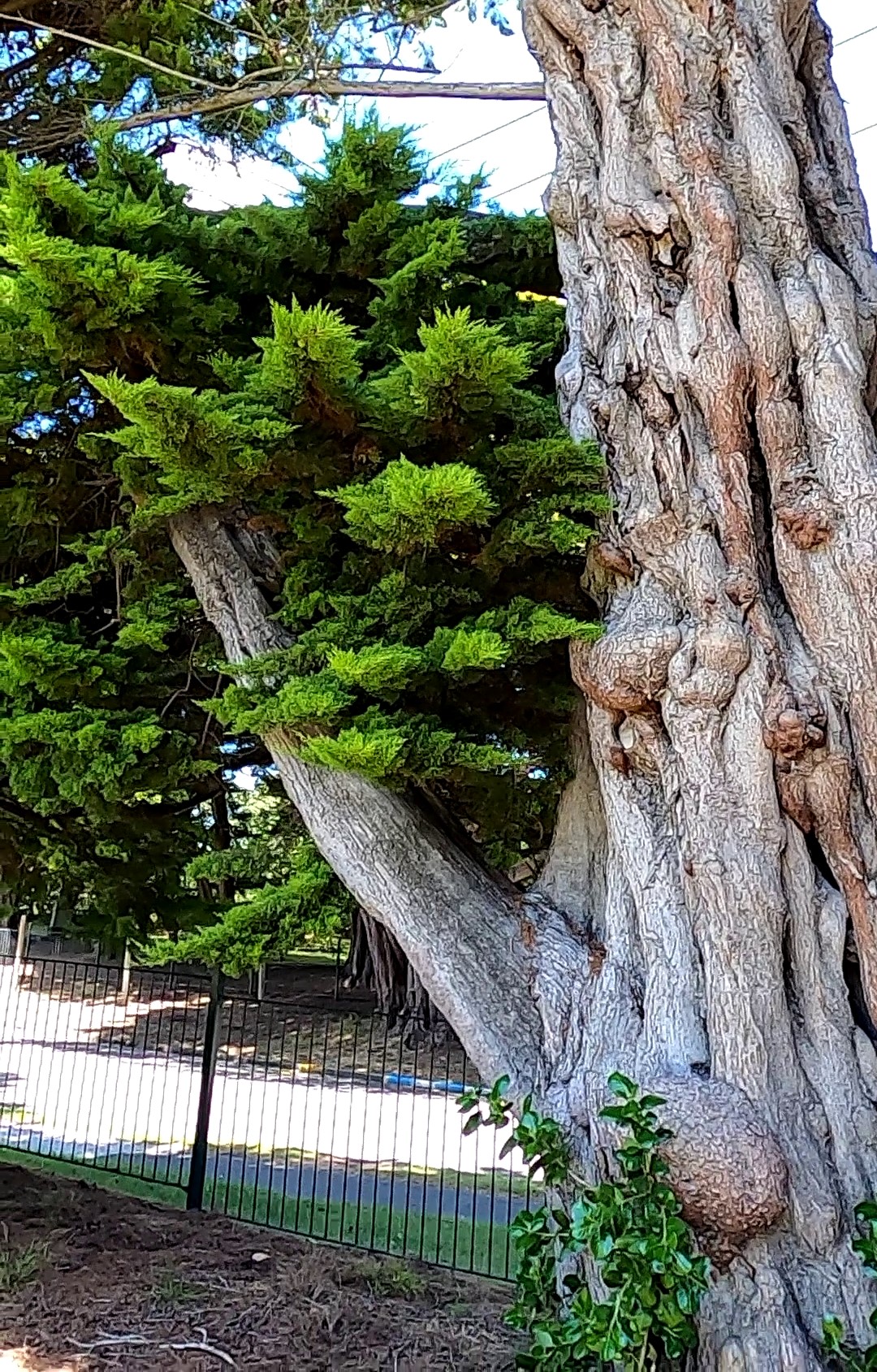
This shows a yellow foliage cultivar of the standard dark-green foliaged macrocarpa. Such different coloured ‘sports’ of well-known trees have often become ‘cultivars’ available in nurseries. Two common examples are the golden elm, and the golden totara. In the example photographed, the macrocarpa is probably ‘fine gold’. The photo shows the typical macrocarpa foliage, which in this case is a much brighter yellow, but it also shows a particularly interesting knobbly and sinewy trunk. The yellow foliage is certainly noticeable, but it was the trunk in particular that drew my attention.
We saw some interesting features on macrocarpa trunks in the previous two blogs, but in this case the vast majority of the cluster of 16 showed these features. This might lead to a reasonable speculation that there is something about the yellow cultivar that also results in frequent variation in trunk features. However, not long after taking this photo I moved across Whanganui to Virginia Lake and in an area devoted to conifers came across the following sight:

The light isn’t good for the photo, but you can see the difference in colour between the green and gold macrocarpa growing next to each other. Also, even from a distance, you can see that the green macrocarpa has a trunk that is more sinewy than the gold cultivar. A close-up view of the trunk confirms that in this case the gold cultivar has a standard-looking macrocarpa trunk:
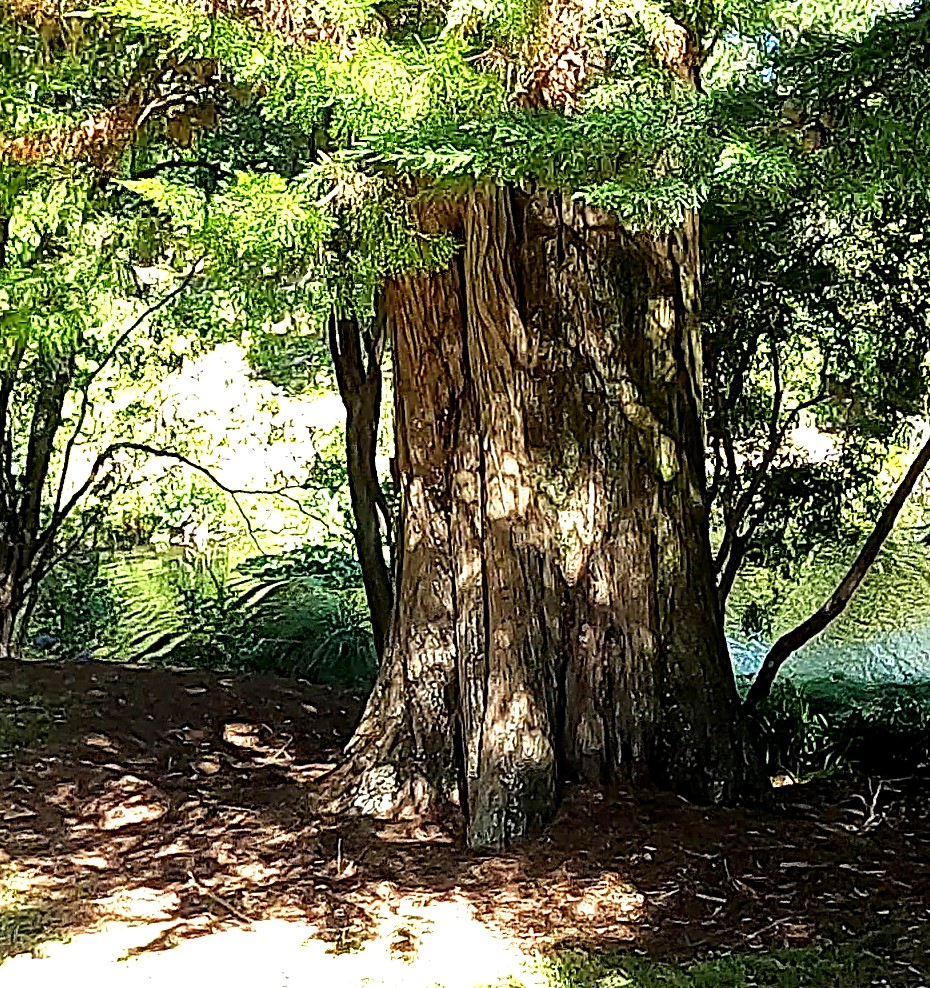
I’m not testing hypotheses here, but maybe the key factor related to this difference is age, not whether the tree is a standard genus/species macrocarpa or a gold-foliage cultivar. The following photo of a very large circumference macrocarpa in Belmont, with a friend standing next to it, clearly shows the sinewy effect on the trunk that can occur with very large macrocarpa.

The Heads Road Cemetery Gold Macrocarpas
Heads Road Cemetery was used for burials in Whanganui from 1843, and consequently has considerable historic interest as a remaining example of a Victorian/Edwardian cemetery. No further burials occurred after 1915, and the gold macrocarpas here appear to have been planted about 1954 (see the Whites Aviation aerial photo from 1958). From this time the cemetery was probably better known to locals for being in the centre of the Cemetery Circuit motorcycle race, which began in 1951. This annual race draws New Zealand’s top motorcyclists using a route through and around the cemetery. If you visit the Cemetery Circuit 2020 website there is a YouTube showing motorcyclists screaming past a group of gold macrocarpa once every lap, On the day I visited though, there was very little traffic:
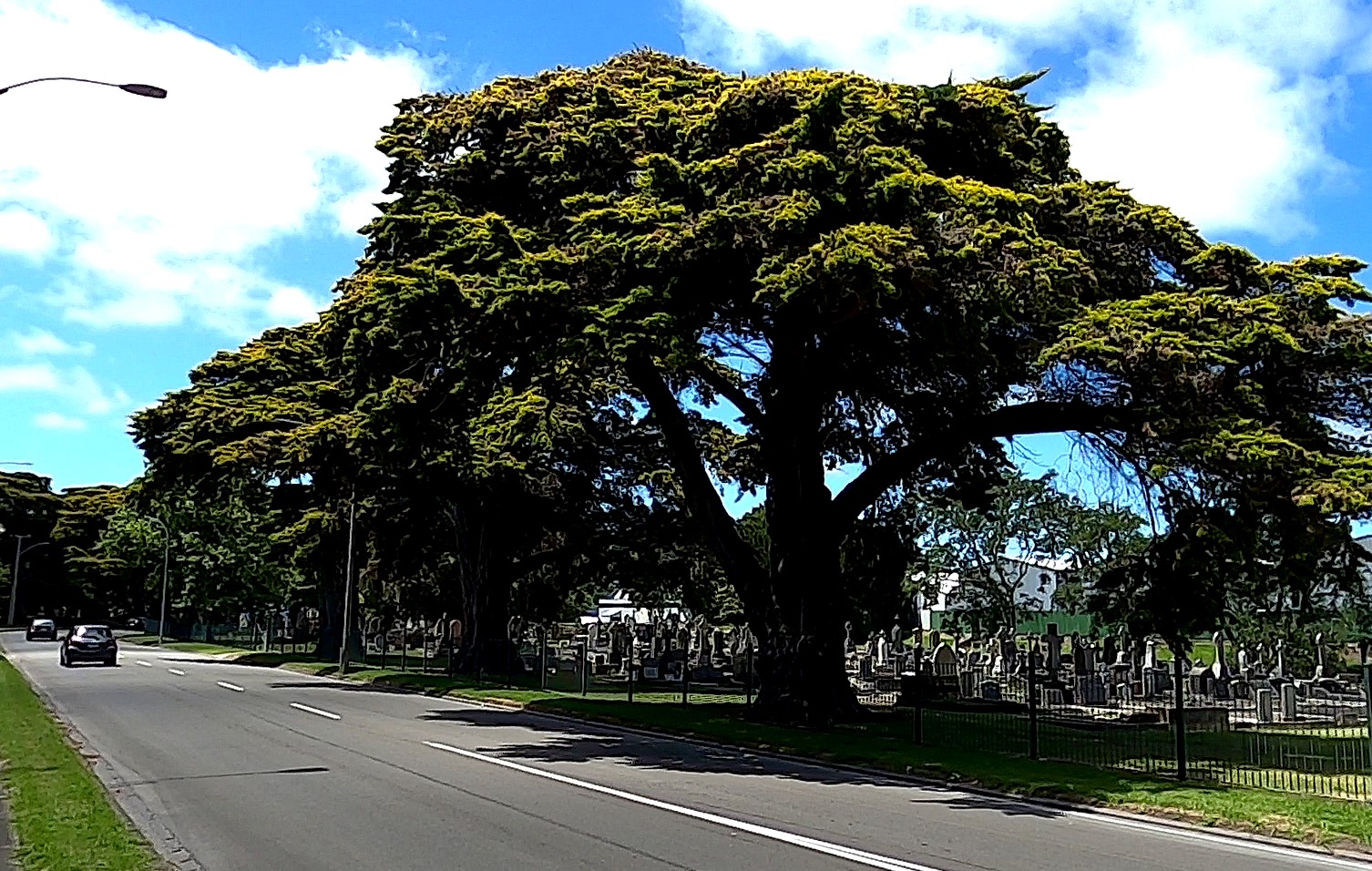
From this distance the trees are noticeable for the obvious gold colour, and for a quite tight symmetrical canopy (see the previous blog on the coastal macrocarpas). But as we draw nearer another interesting feature emerges:
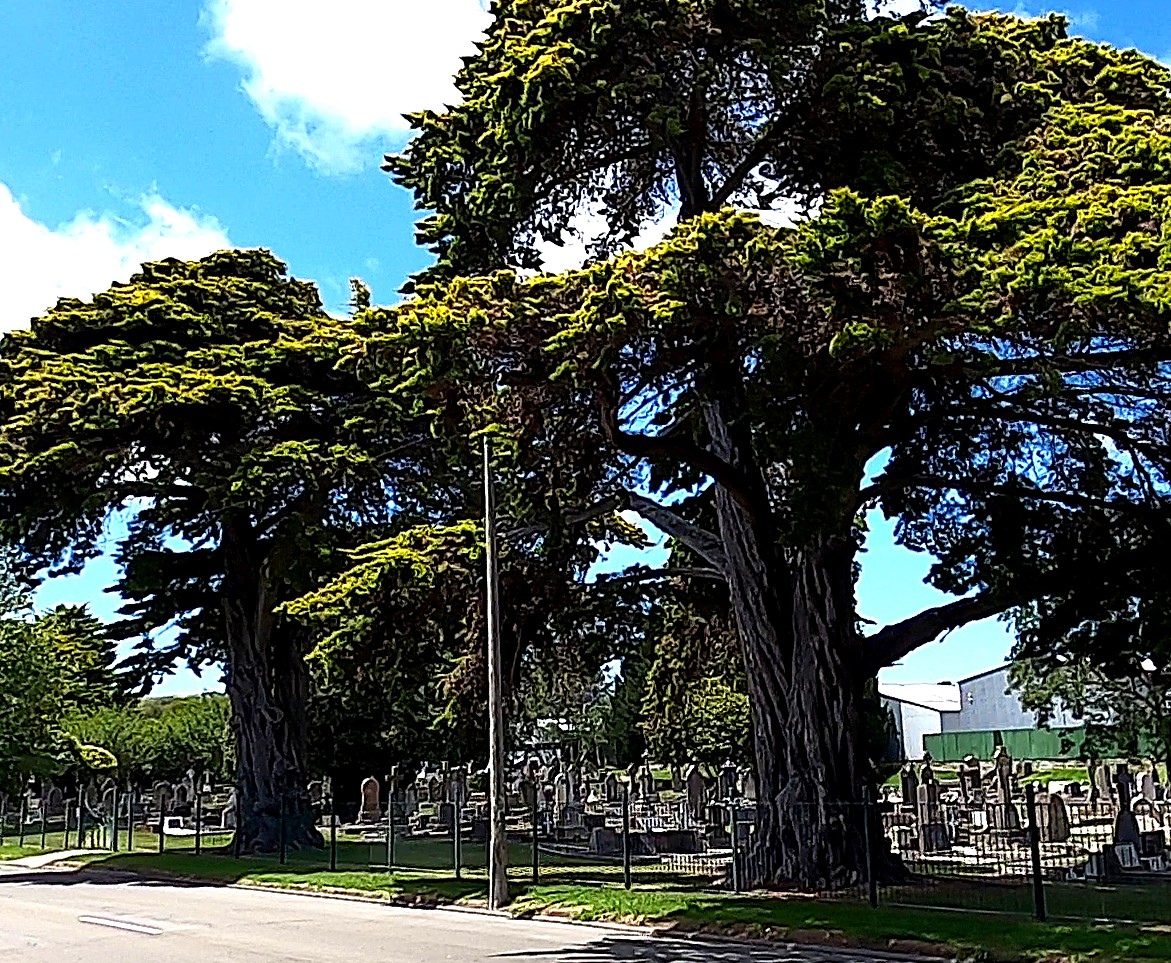
The gold colour shifts from attention as we get closer, with our focus drawn to the remarkably knotty, furrowed and sinewy trunk. It is worth photos from both sides of one tree:
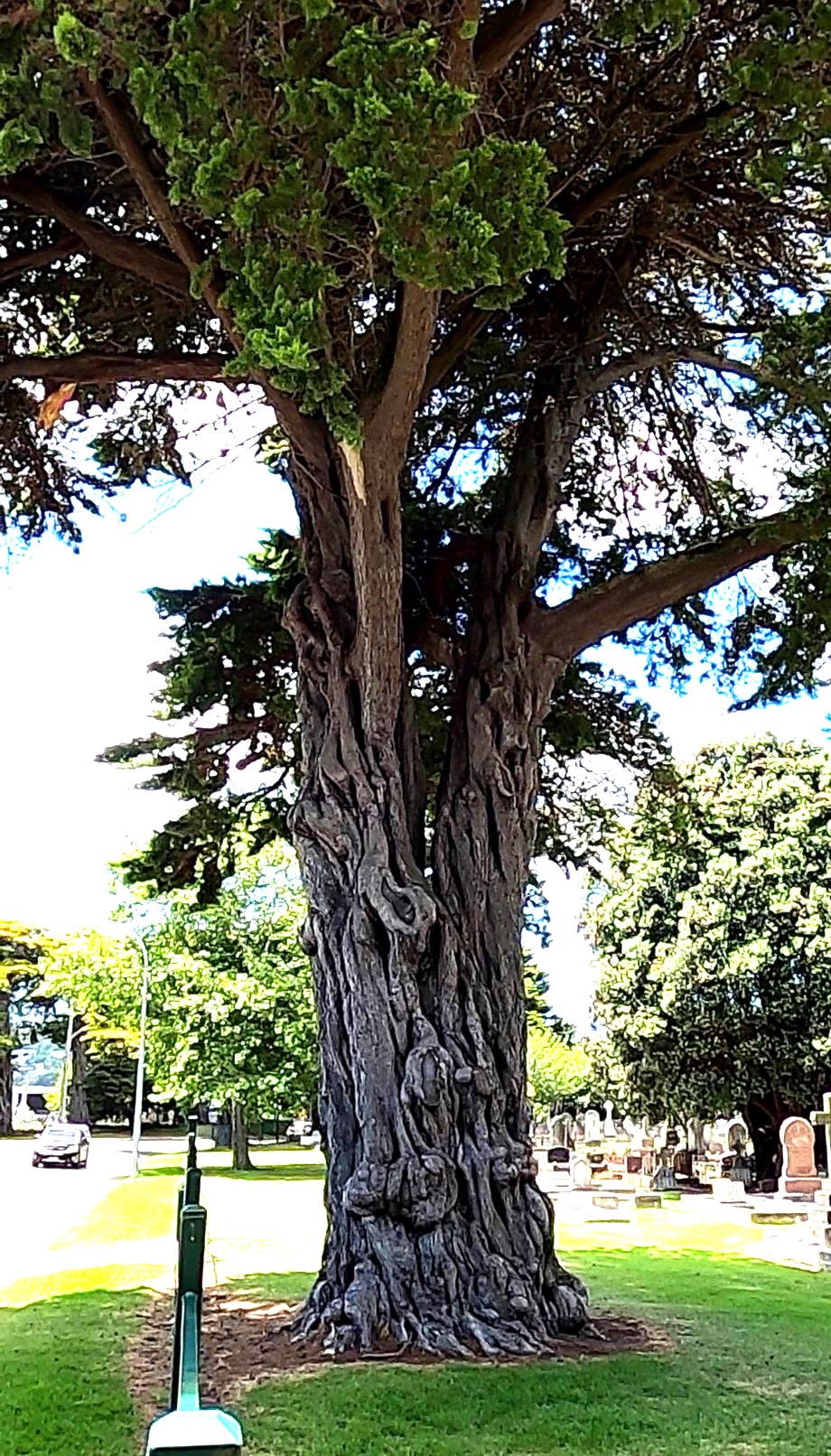
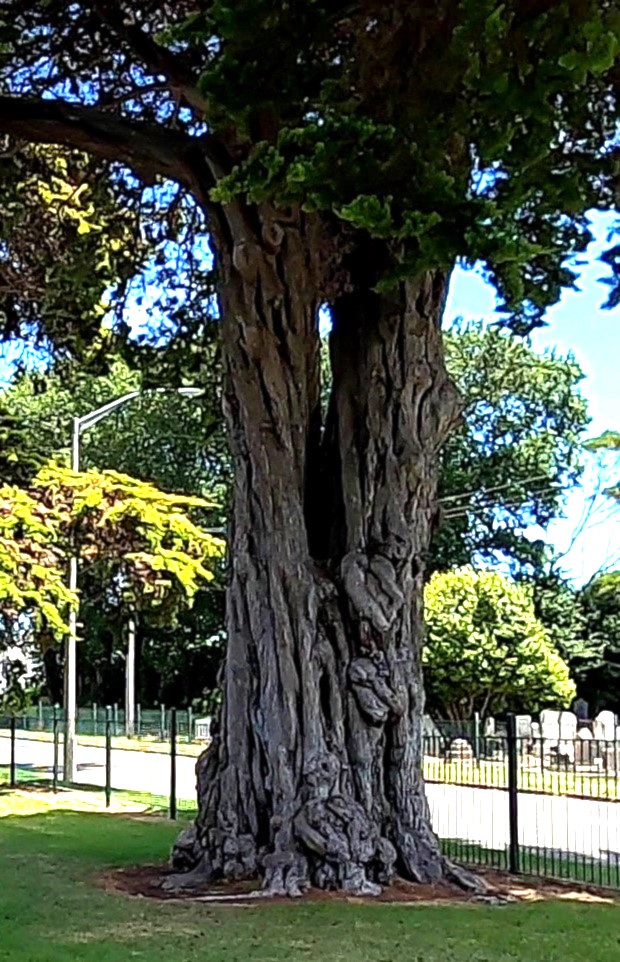
To show the scale, here is a photo with me standing beside the tree:

There is probably a technical name for this kind of trunk feature, but walking around the cluster of trees, this wasn’t top of mind as I was simply impressed by the sight itself. It became clear that most of the trees had developed this feature, though where there is a curve in the road (attractive for motorbike riders) there were some less knotty trunks. A few more shots are worth considering:
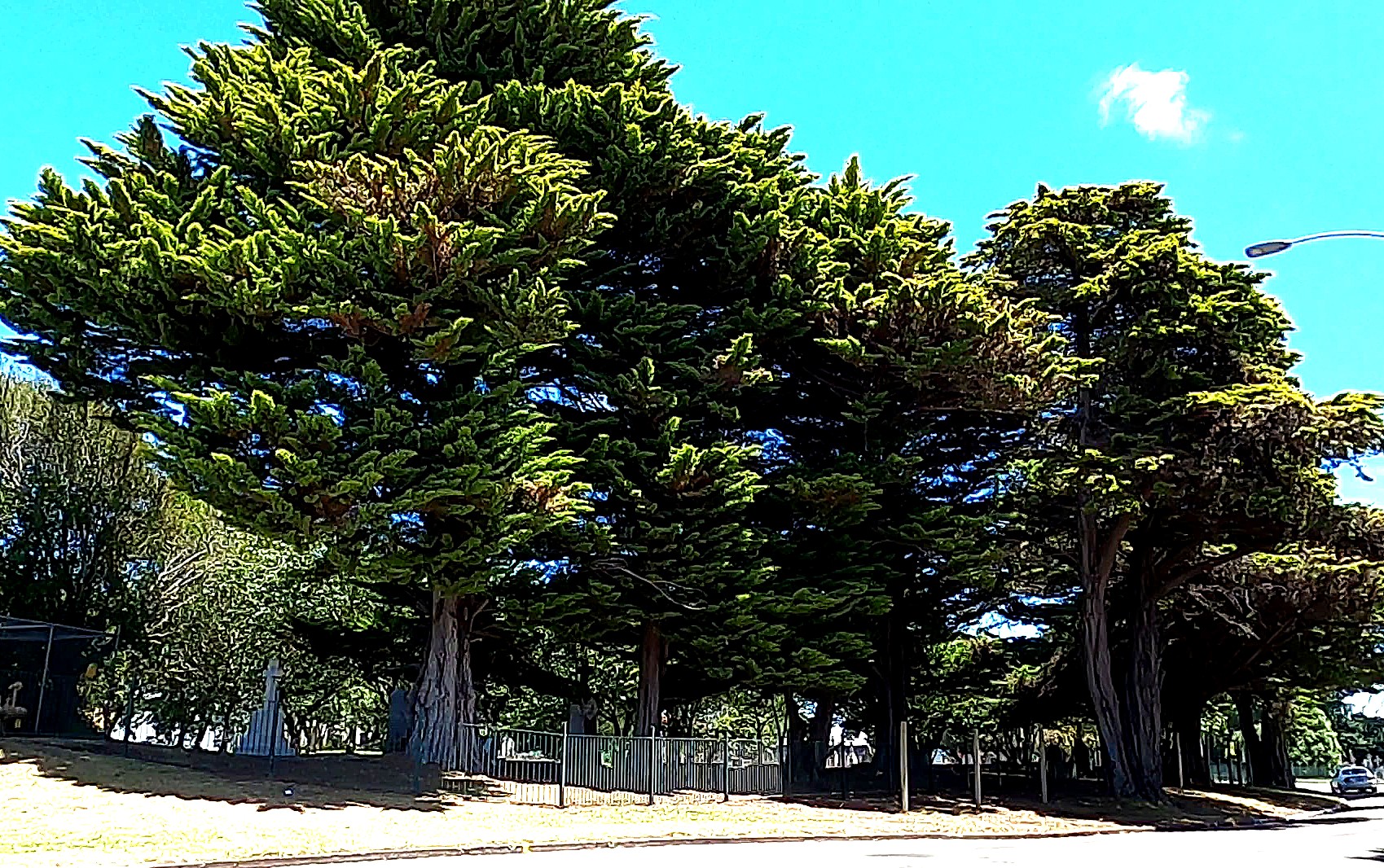
The macrocarpa on the left has both a standard upright form and a standard trunk. As a group they are also relatively closely planted giving less chance for a distinct canopy form to develop. Immediately across the road however, we again find the interesting features of the trunk appearing:
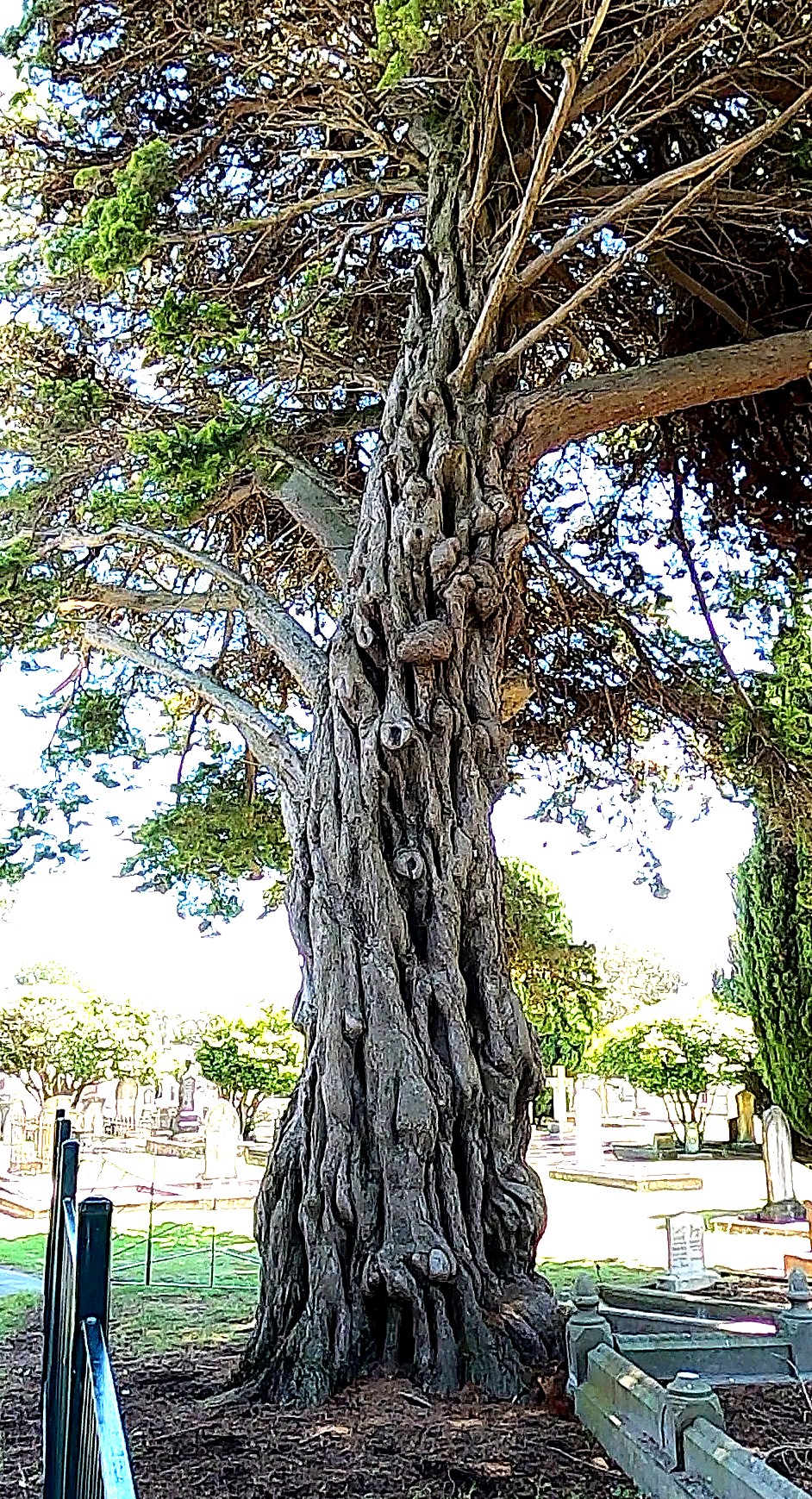

The features we see here clearly require a little attention to be noticed. Whether such noticing occurs is likely connected to what a person moving through the cemetery is doing. For a motorcyclist competing in the annual Cemetery Circuit race, travelling at sometimes over 130 kilometres an hour, the trees will mostly be a gold blur, or a solid object they do not wish to crash into. Alternatively, for someone with an interest in late 1800s burials, the interest will be in the graves and headstones themselves as historical records. But even these people may glance up while walking about, noticing the clear contrast of the gold macrocarpa foliage framed by other traditionally green trees (below, an Irish yew and a Norfolk Island Pine):
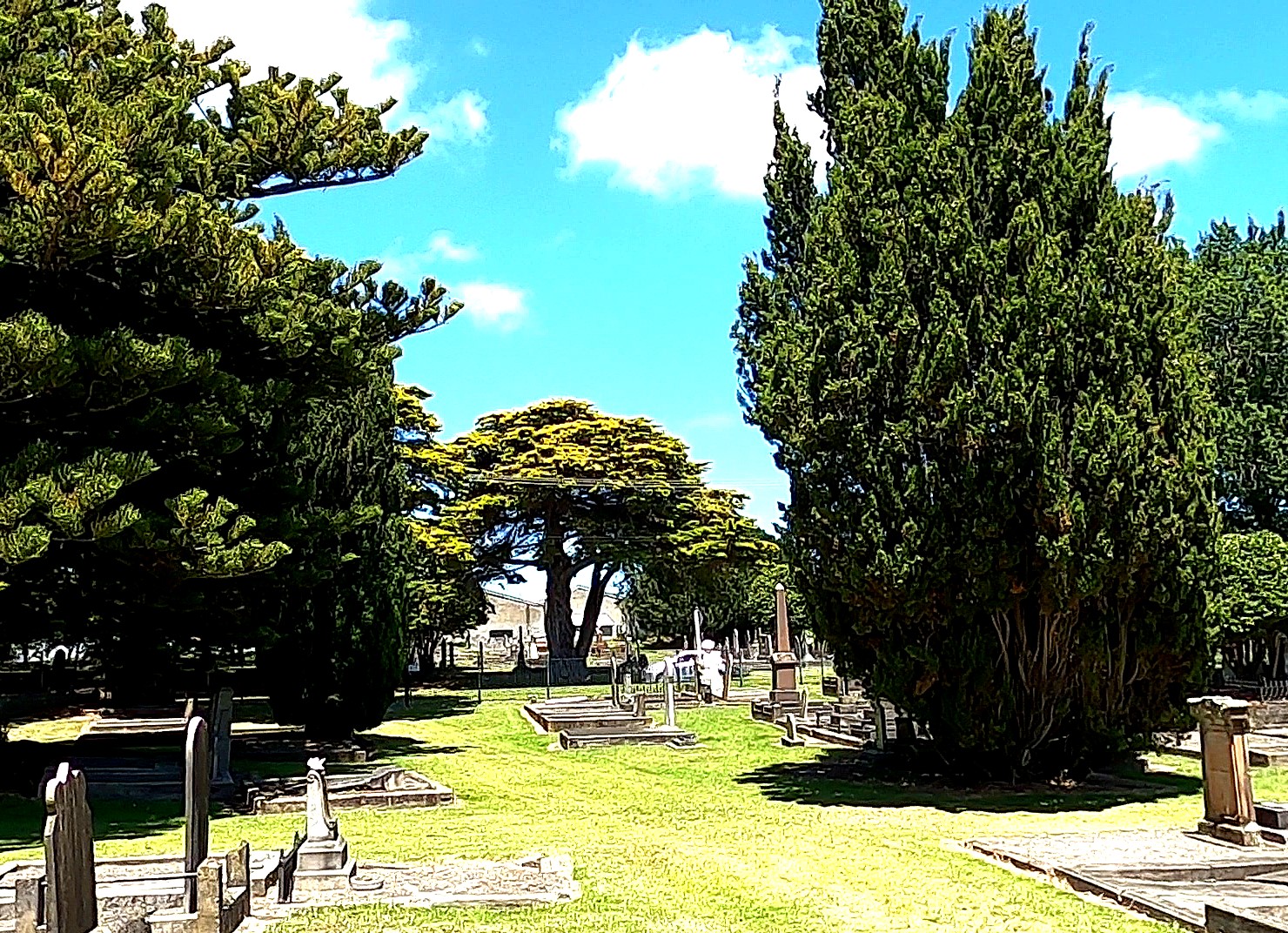
Such a contrast may lead cemetery visitors to discover the richness of ‘knobbliness’ the trunks display. Then the common human tendency to anthropomorphise may come into play: seeing human-like forms, such as faces and body parts, in the trees. It doesn’t take much viewing of the gold macrocarpas in the cemetery to find this. Even if gold macrocarpas are relatively common plantings, examples like this show that arboreal memories can develop with a little noticing. As far as I know though, chance is what may best explain this particular cluster’s development, meaning that it would be difficult intentionally to replicate their quirky appeal.


 The Local Arboretum: Noticeable trees and their stories