Recently I travelled to the small rural town of Cheviot in North Canterbury because I’d learnt there were many significant trees there. Some were planted in the 1870s when it was a large rural estate owned by ‘Ready Money’ Robinson. The old estate was broken up before the 1900s, and the land is now called the Cheviot Hills Reserve. It is still extensive, having enough space to house the local cricket ground. Whereas it is not an arboretum or botanical garden, I quickly discovered that the practice of affixing identification labels had been followed.

I appreciated such labelling very much. For example, I’d never come across Calocedrus decurrens before – they were more of a forestry tree or a tree for a large estate, so you don’t tend to find them in garden centres. On the assumption that the identification was correct, I went ahead and took some photos and measured the girth of the tree, as I thought it could be entered in the New Zealand Tree Register.
All well and good, but you do need to be careful when following such a commonsense route to plant identification. Not far away from the Calocedrus were a group of what I knew as Chinese fan palms. In this case the label on one palm’s trunk was quite high up, hence the blurriness in the photo.
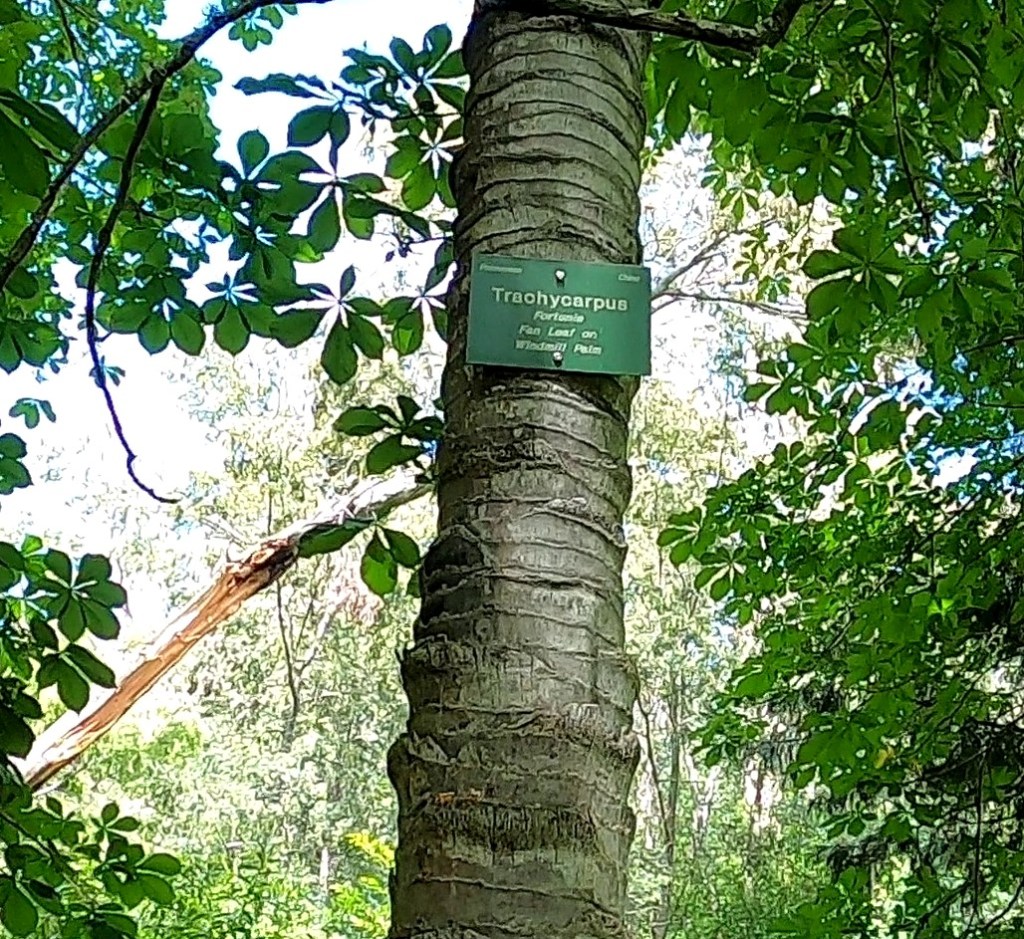
What the label says is ‘Trachycarpus fortunie’. The i and the e are around the wrong way – It’s an easily made error. The species part of the palm’s name comes from Robert Fortune who was the European who first saw cultivated specimens in China. The i comes after his surname due to the conventions of botanical latin.
This is all a long-winded way of saying it’s great to find a tree with an identification label, but we always need to do a bit of checking. These days such checking is greatly aided by smartphone apps or websites like iNaturalist. I haven’t used either yet, but friends tell me they are great. An example might show why I haven’t succumbed to this temptation. I hope that it shows, without blowing my own trumpet, that if you hold fire on defaulting to app or website use, having a go at plant identification can be rewarding. The example concerns the tree shown here which is planted on a route I commonly take while dog-walking.
Aro Street, Wellington, December 2024


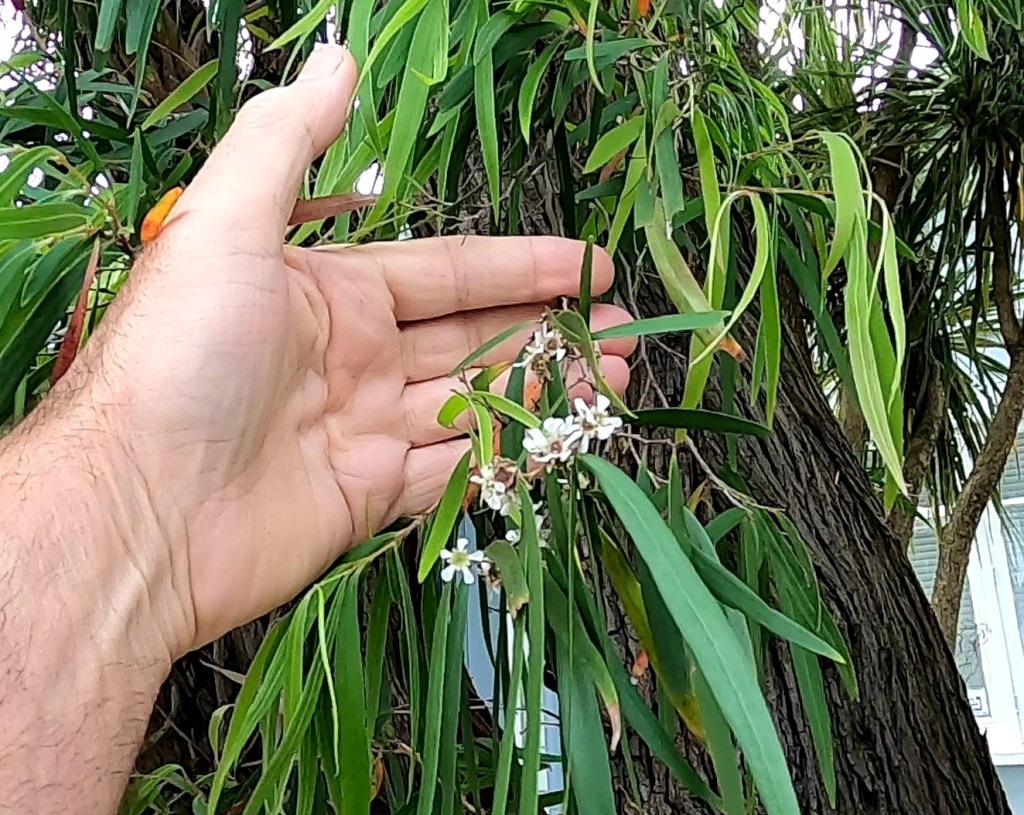
They are not large trees, but as can be seen they fit well within quite a constrained street environment, including the need to accommodate overhead lines. I’d always admired them, partly because Wellington’s famed (and real) windiness makes life hard for trees, but also because to me they look great. There is the gnarly trunk, with what look like sinews winding up, or sometimes knobs that look like knees, and the trunk almost corkscrews up to the pleasing weeping canopy. The flowers when they come in early spring are relatively small, nonetheless they are attractive (there is no scent). Despite my appreciation of the tree, I had never attempted to identify their botanical name. But then I came across a second planting of them, again as street trees. This time it was about 15 kilometres away in Lower Hutt, where a collection of 23 were spread out for almost a kilometre.
Cuba St, Petone, December 2024

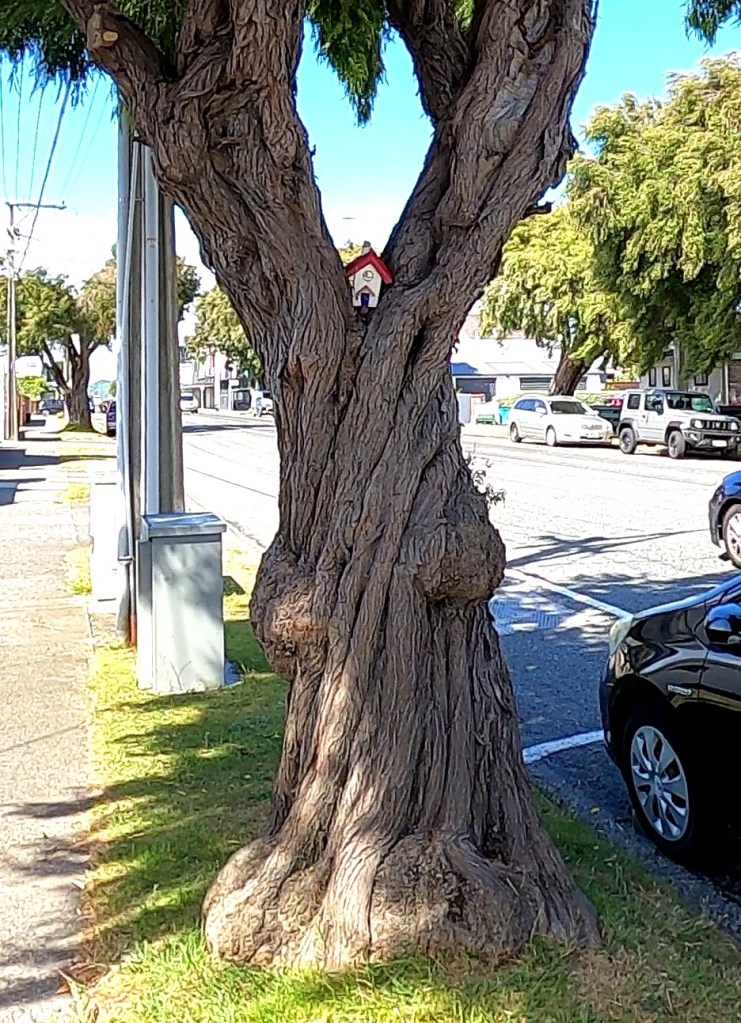
I cannot establish a planting date for this group, but their larger size would indicate they are probably a bit older than the Aro Street trees. The tiny house seen in the bottom photo suggests one of the residents appreciates the trees as well. I really wanted to be able to identify the tree, but of course none of them had a convenient identification label like the trees in Cheviot (even if there was a small typo in one). I didn’t want to borrow a friend’s smartphone and use an identification app, nor did I want to post up some photos on iNaturalist. Some basic commonsense logic came to my aid, along with my prior experience in horticulture.
First, I grabbed some leaves, crushed and smelled them. There was a very strong peppermint smell. I took a small branch with leaves and flowers home, and started Google searching, first using the term ‘peppermint gums’. This was simply because to me the foliage looked very similar to typical Eucalyptus foliage. Also, I had in my memory the phrase peppermint gum. The Google search quickly turned up a good number of candidates, but after going through them comparing the photos and descriptions with the foliage and flowers, I had no strong lead.
So I moved focus to the flowers, and while I couldn’t say what the technical specifics of them were I kept thinking ‘they look like myrtle flowers’. These are plants that are often known in Australia and New Zealand as ‘tea trees’. Back on Google, I then searched ‘peppermint myrtle’. Eureka: a description and photos for Agonis flexuosa quickly turned up. I carefully compared the photos with the foliage and flowers I was still holding and there seemed little doubt that Agonis flexuosa was the correct identification.
Obviously,I couldn’t have reached this conclusion without using internet resources. Nevertheless, I did have to think about what I was doing, using what I had to hand – the sample of foliage and flowers, and my past knowledge. There was a decent amount of satisfaction in having worked this out without resorting to an app. My training in horticulture was useful, but it should be emphasised that in terms of formal botanical identification my training was never as rigorous or technical as that of a trained botanist. Trying to work it out myself has also added just a little to my knowledge of genus/species differences; something that could be built on. An obvious spectre lurking at the back of this blog is AI: I have actually just left quite a lengthy stint as an academic, in part because I could no longer face marking essays written by AI. Somewhere in both domains of plant identification processes, and working up knowledge in an essay, the human element has to remain of central importance. In terms of the former, whereas computing technology is very useful it is still humans that appreciate what they find in the local arboretum
Coda
The first nursery/garden centre I worked in had plants labels made up by a local printery (it was some time ago). There were typos in a few of them, which is to be expected given botanical latin, but one typo in particular has remained with me. In spring I still find myself looking for the appearance of the notable flowers of the manglia tree. Given how well-known magnolias are, I doubt whether there is anyone in Christchurch calling them that because of the typo on the plant label, but it gives me a little mental smile to silently say ‘ah, the manglias are out’.

 The Local Arboretum: Noticeable trees and their stories