As windbreaks, macrocarpa trees are part of our landscape, the gnarled border to many paddocks. Their outstretched limbs offer shelter to sheep. … Like most New Zealanders, I have always pronounced macrocarpa with an extra ‘a’ in place of the ‘o’. Elsewhere, it’s known as Monterey cypress. For whatever reason we’ve decided here to call it by one half of its botanical name, Cupressus macrocarpa, the half that means ‘large fruit’, a reference to its tidy seed pods.
John Summers, 2021, ‘Notes on macrocarpa’ in The Commercial Hotel, Victoria University of Wellington Press, pp 88-90.
Summers has got so much right in his note, it’s a pity to point out that since 2009 the genus of what New Zealanders do indeed call ‘macracarpa’ was reclassified as Hesperocyparis. After more than one hundred and fifty years of using macrocarpa as windbreaks on farms, use of the new genus name is unlikely to be insisted upon.
The ubiquity of macrocarpa in New Zealand is easily shown through a little Google Map searching. Here’s a view of a relatively isolated road through farming country, clearly showing a large macrocarpa and a few more in the background.
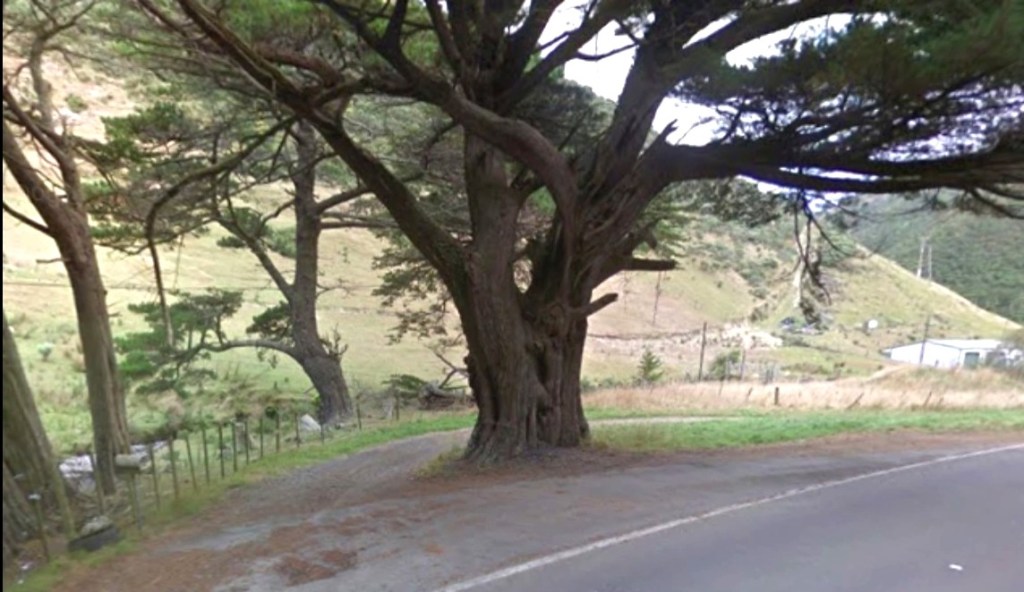
Source: Google Street View, 2015, 1006 Paekakariki Hill Road
The larger one certainly has some size, and is reasonably symmetrically shaped, but it wouldn’t really gain a second glance as you drove by. This might explain what happened to it, as shown in a 2021 photo.

Source: Google Street View, 2021
I know nothing about why this big macrocarpa was so precisely cut down. The fact that the group on the other side of the fence did not face the same fate, might suggest there are two different landowners here, with different views on the value of the tree. Whatever, the larger tree has clearly gone. In truth, even though I think too many trees get cut down too easily, in this case there doesn’t seem to be much point in gnashing your teeth. It is easy to imagine the landowner saying ‘it’s just a macrocarpa – it’ll make bloody good firewood’.
That said, I think there are cases where I would be alarmed if certain macrocarpas were to face the chop, simply because they can grow to be remarkably interesting, and indeed beautiful trees. I could refer to other sources here, including the claim that the tree that inspired Dr Seuss’ The Lorax was a macrocarpa, but the argument is best made by considering some specific trees. Below, we’ll consider a collection of macrocarpa that grow in coastal sites in the Wellington region, but clearly a two-part blog is needed to cover all this.
- The sandhill bonsai
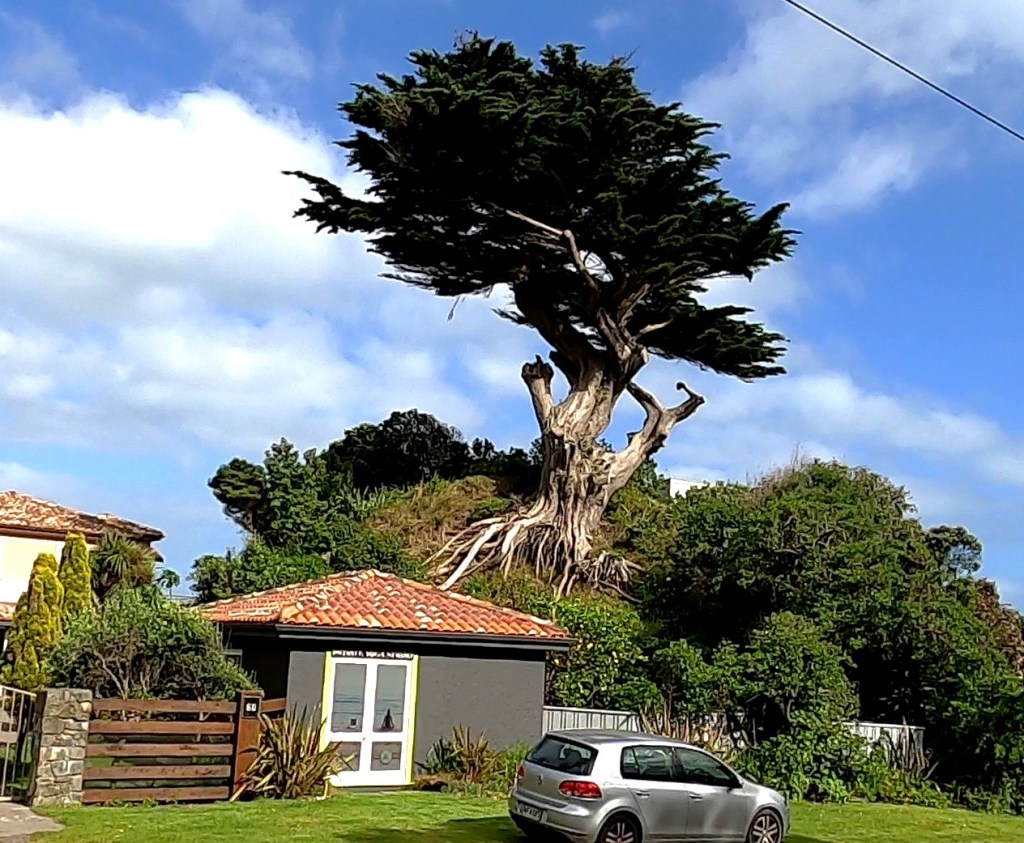
The property where this tree grows is 25 metres from the sea in Raumati South. The tree grows on a remnant sandhill, and the tree is pretty much all that is stopping the sandhill from gradually disappearing. The exposed roots, and the lopped off but retained large branches, are the kind of things that bonsai enthusiasts try so hard to reproduce in their so carefully-crafted miniature trees. Macrocarpa are in fact a good choice for a bonzai specimen, and it would be hard to surpass this solidly holding-on specimen for an exemplar for the careful craft of bonzai.
2. Jack’s weeping beach tree
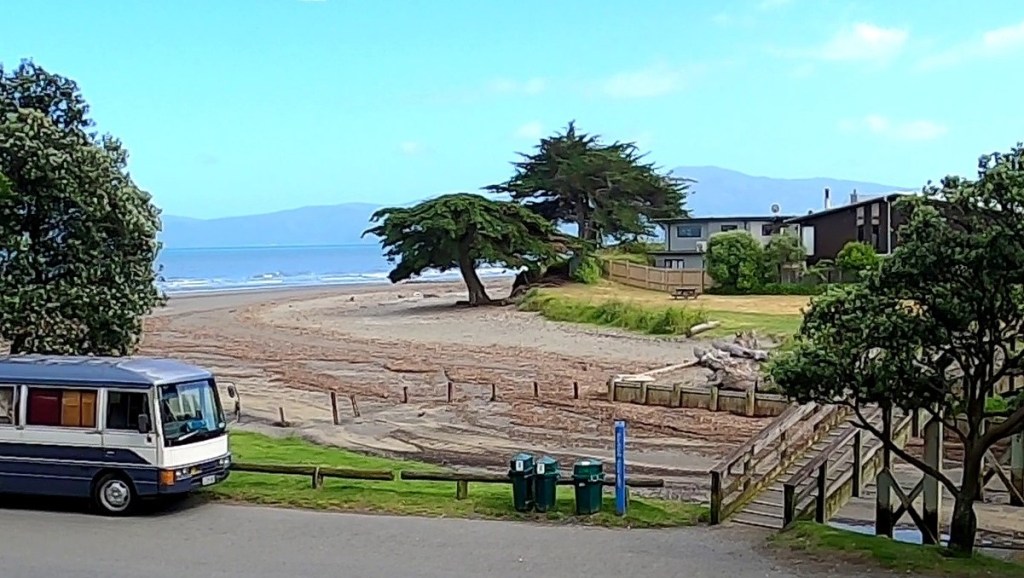
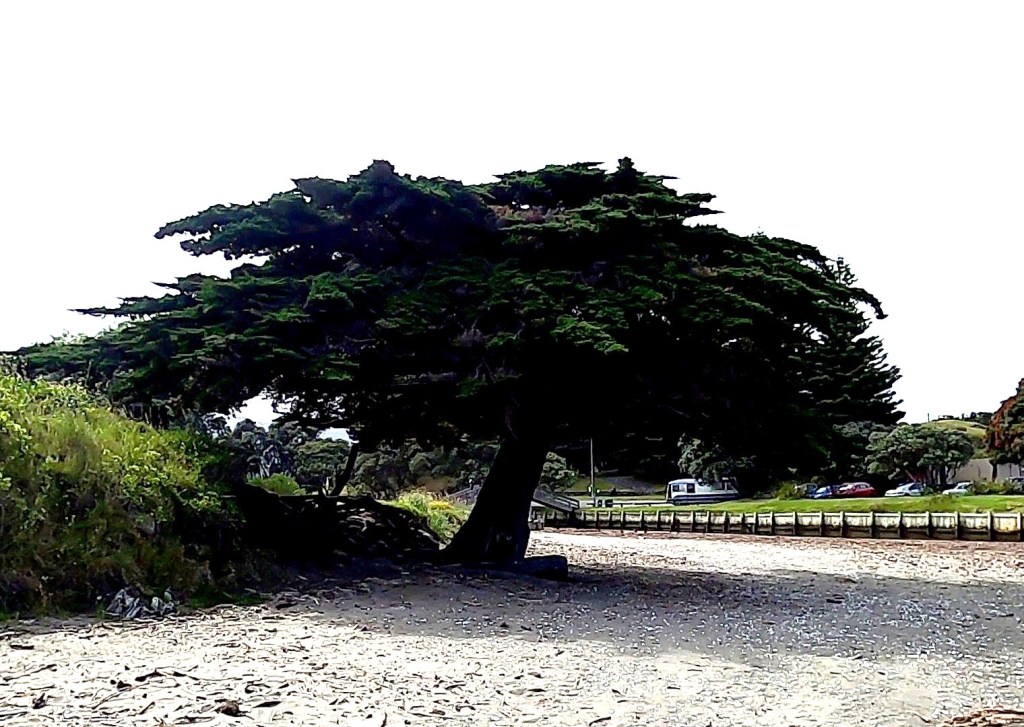
This is not a particularly tall, thick, or old macrocarpa, but it has an especially graceful pendulous form. It is literally on Raumati Beach, bordering a small stream that winds past the Marine Gardens and a parking area with boat ramp. Before rapid growth from the 1950s on, the broader Raumati area had small farms and vacant land with many macrocarpa hedges or shelter belts. The macrocarpas also edged up close to the sea, something common in New Zealand coastal towns. The weeping tree may be a seedling of the larger one that can be seen close by. It is probably in the vicinity of 60 years old. There are four small lower branches that have been pruned, but apart from that its weeping form is naturally occurring: a combination of variation from the standard macrocarpa form (see the second larger tree), helped by the shaping effect of salt-laden winds, with a possible dwarfing effect from the nutrient poor sand it is growing in The beauty of the tree’s form is further enhanced by the backdrop of the sea and the well-known shape of Kapiti Island. Being on the beach no one can claim ownership of the tree, but a vernacular version of such has occurred:

The basis of Jack’s claim to the tree is unknown, but perhaps it is not so much a claim to ownership but simply an indication of fondness for the tree. In contrast to the sandhill bonzai macrocarpa, this is not a candidate for bonzai-modelling, as it is almost too perfect in its symmetry and weeping form.
3. Shelter-belt remnants
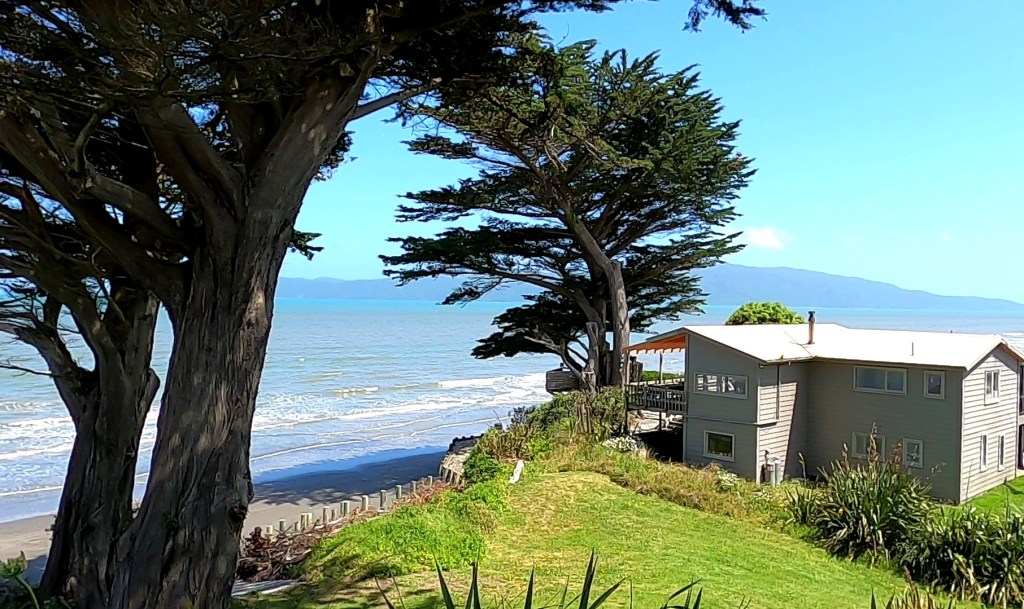
In this site just a bit further north, there are five big macrocarpas: two by the house and then three in a line going up from the beach. It looks very much like they are a remnant of a shelter belt, possibly planted about 100 years ago (the tree height would suggest this).
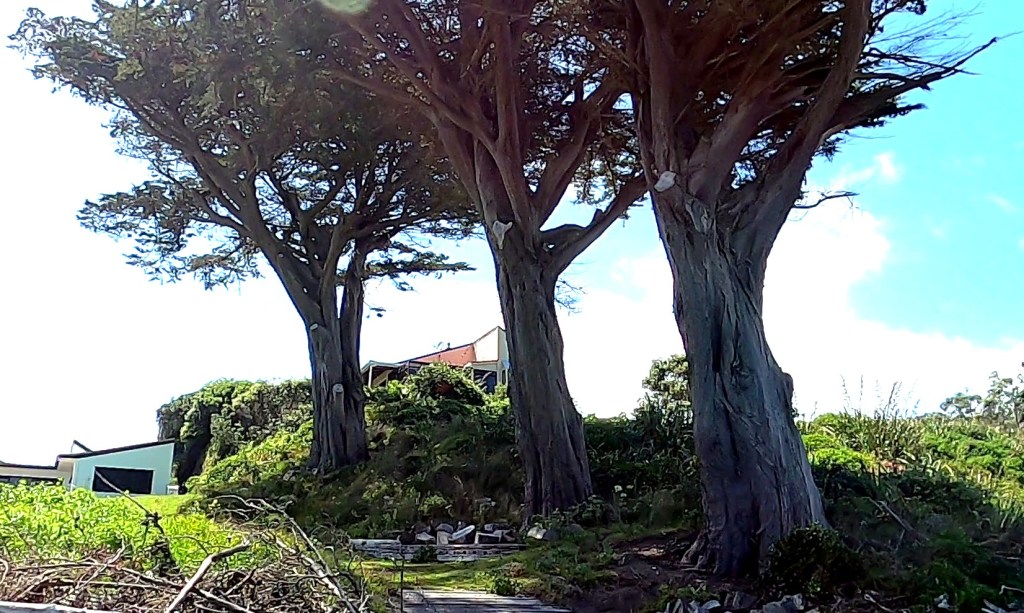
Like Jack’s weeping tree all are very close to the beach, but in this case they have grown in the more typical upright form of the macrocarpa. Some upper branches have been trimmed and this would help maintain the upright form. They are perhaps not so picturesque as the weeping form, nonetheless they have their own charm. They certainly give off a feeling of strength and hardiness. The contrast between the large trunk, with its tough weathered look, and the upwards reaching canopy is a common from macrocarpas seem to take.
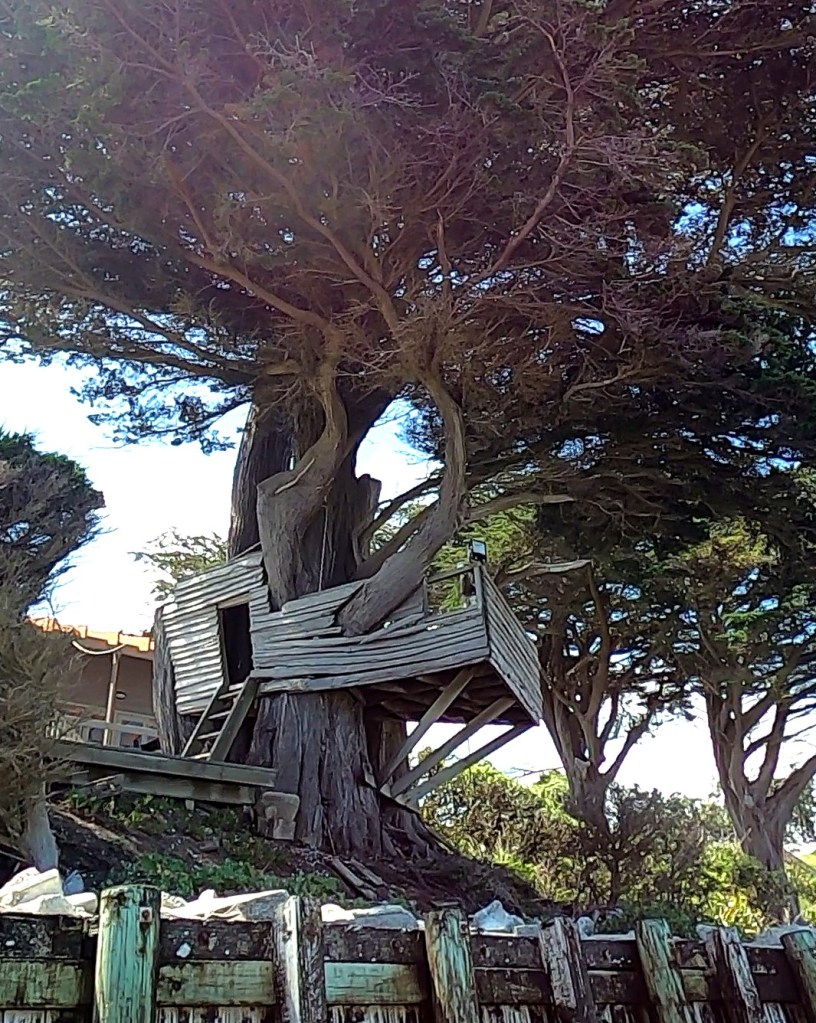
When the large lower branches are retained, or even if pruned leaving a protruding stump, macrocarpas are very easily used as a base for multiple forms of the classic tree hut. The final photo here shows a well-built hut, obviously grounded in the strength that the macrocarpa branches provide. It probably didn’t get a building consent, but it doesn’t look to be going anywhere anytime soon. The substantial hut clearly affords an excellent view over the beach and to Kapiti Island beyond.
Many more examples could be shown from the Kapiti coastline, but this is enough to get the feel for the variety of forms of coastal macrocarpa. In Part 2 of this blog we’ll move nearer to Wellington to consider further examples. These will also include historical photos and an overall reflection on what this specific part of the local arboretum opens up.

 The Local Arboretum: Noticeable trees and their stories