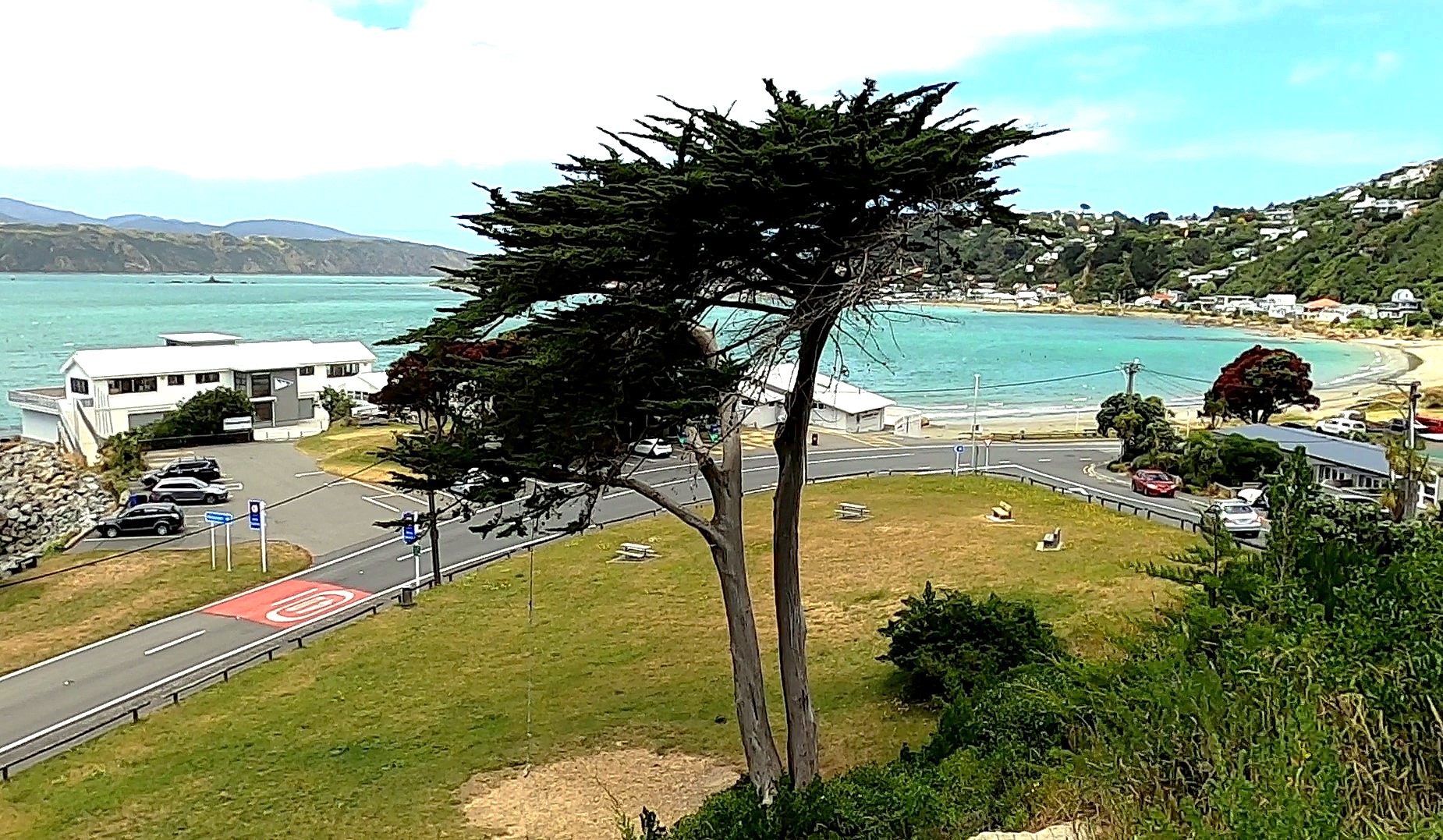
Part 2 of this blog starts with a departure from the previous style by using a colour photo. This is useful as it shows the contrast between the dark macrocarpa canopy and the sea beyond. This tree is found in Worser Bay, Seatoun. Straight out to sea – in the photo about the mid-left of the tree’s canopy – is where the Wahine interislander ferry struck a reef and sank on April 10 1968. This was New Zealand’s worst modern maritime disaster, with 51 lives lost. On the day this photo was taken Wellington’s wind was relatively benign, allowing me to climb the hill above the tree to take this photo of the ‘Seatoun macrocarpa swing’.
A photo available from the DigitalNZ resource, dated circa 1965, shows that this tree was present when the Wahine sank. This means it survived the 100-knot wind that drove the Wahine onto Barrett Reef, where it took on water and sank. The photo shows that in 1965 (or thereabouts) there was a whole group of macrocarpa in this location. The photo has an added rectangle for the tree focused on, and smaller squares for the other macrocarpa that were then present on the hillside close by.
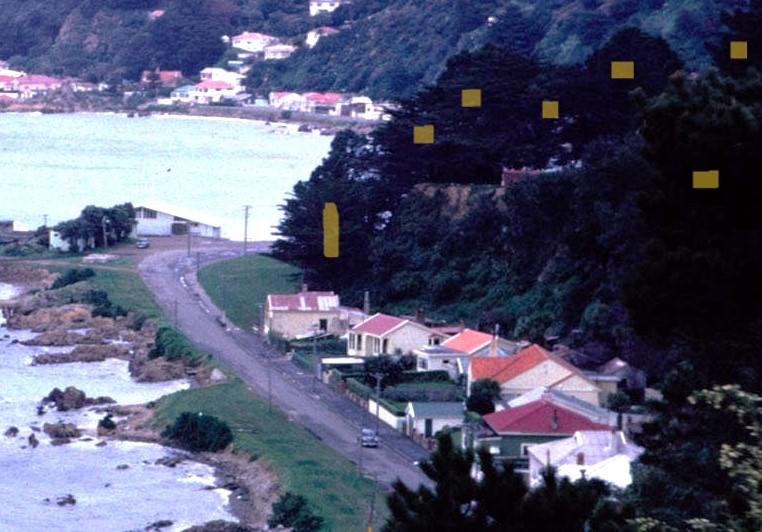
Source: ‘Worser Bay and Seatoun’, Ron Clarke Collection, Auckland Libraries Heritage Collections 1207-1854
It is possible that some of the trees higher up were blown over during the 1968 storm, but that can’t be confirmed. Certainly though, walking around the site there are a number of tree stumps where this group of trees used to grow. They may have been planted as a shelter belt, something very different from what the remaining tree is used for today:
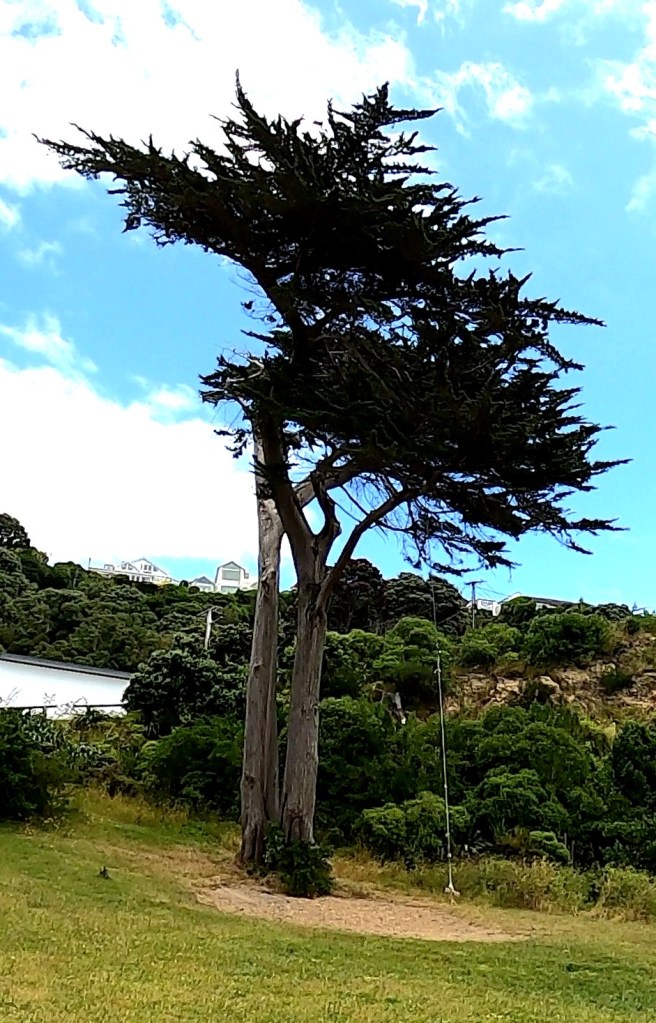
Some clever person has somehow affixed a rope to a major branch, from which the swing hangs. It must be used relatively often as there is a distinct circle of bare ground where feet drag on the ground. The photo makes it look like there are two tall trees, but it is one tree that some time ago used to have three main branches, as shown below:
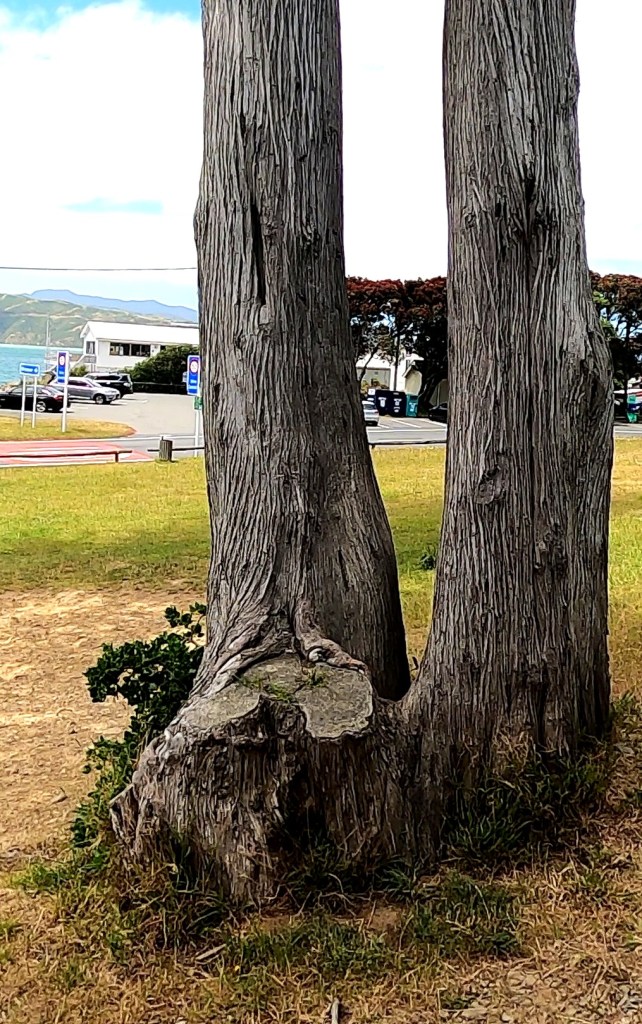
It must have looked quite a sight as a triple-trunked macrocarpa, but as we have already seen from part one of this blog, it is very common for macrocarpa limbs to either be lost due to wind damage, or to be removed by pruning.
Now if we travel about 500 metres south around Worser Bay and into the Seatoun shopping area, we see another fine example of a robust macrocarpa, with a different form.
2. Seatoun Shops Listed Tree
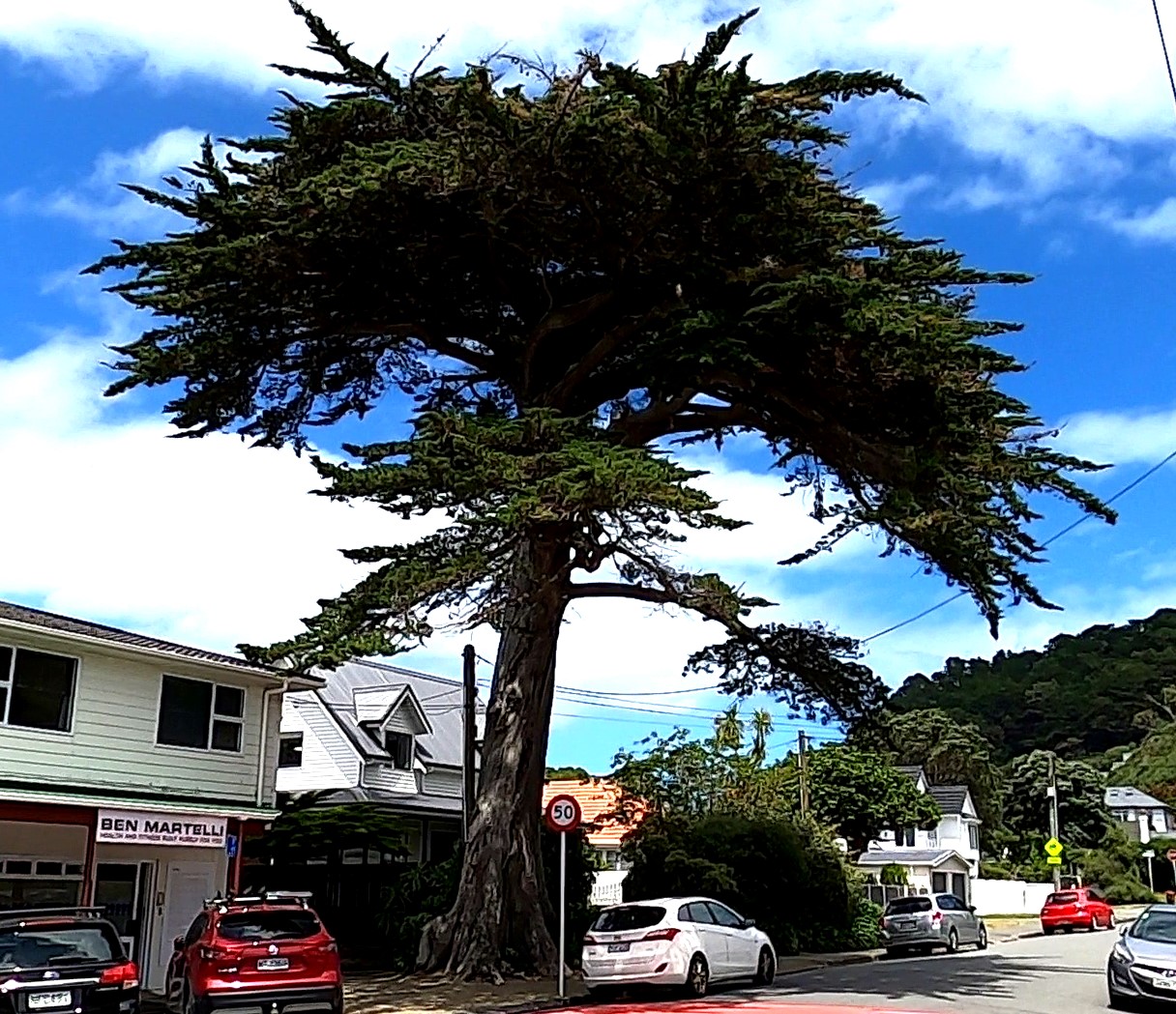
This is the first tree from all those discussed above that has had formal recognition of a valued status, in this case being included on the Wellington City Council Schedule of Heritage and Notable Trees. It grows on the road verge just next to the local Four Square and a small fitness centre.
It clearly has robustness and height, but it is interesting for the way it combines the beginning of a distinct weeping tendency with the more typical upwards-pointing branches, almost as if it is in transition between two types of haircut (a type of mullet?). Another photo shows that the shapely base of the trunk (often called the ‘bole’) adds to its qualities:
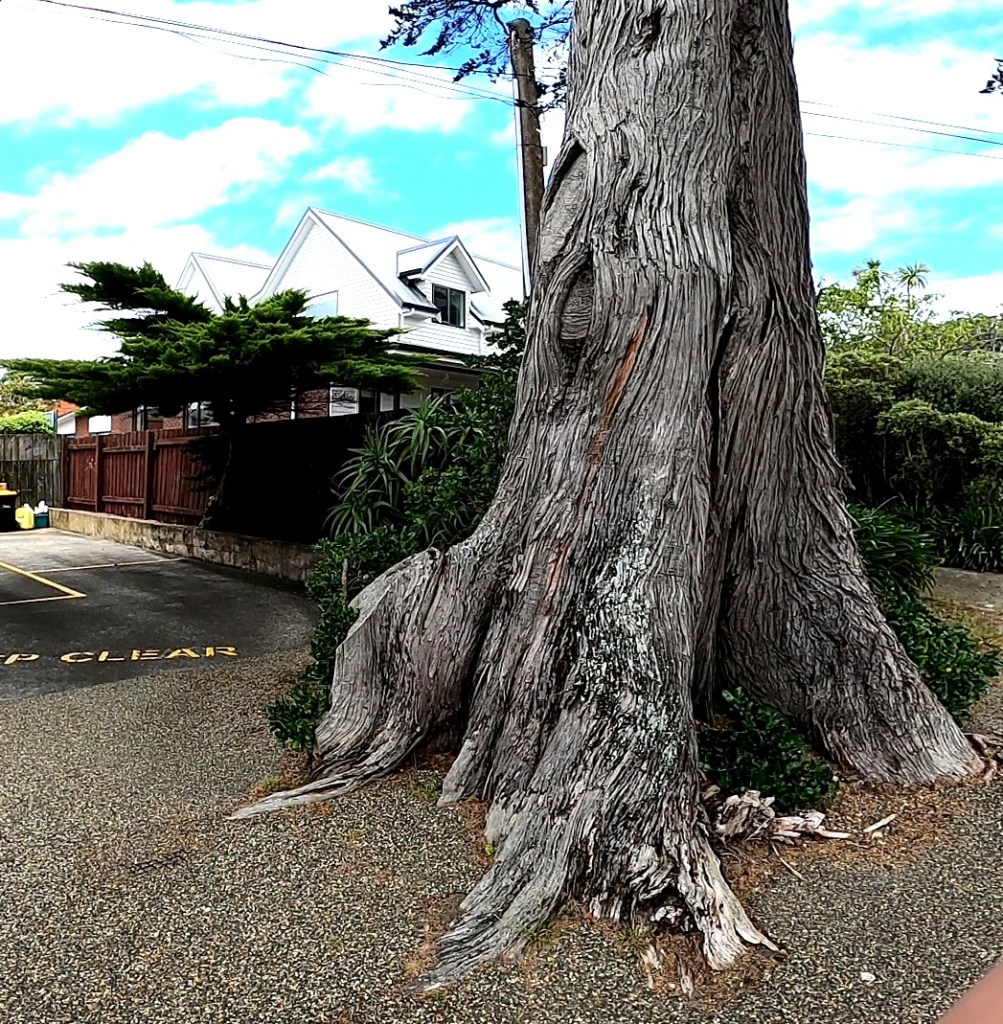
Observant readers will also see that behind the tree in a small space between the fence and a carpark-driveway is a much younger macrocarpa, which presumably is a seedling from the listed tree. It doesn’t have much space to grow, but it is hanging on.
3. Days Bay: Various remnants from a shelter belt
If we took a boat trip from Seatoun across Wellington harbour in an east by north direction, after about 30 minutes we would get to the well-treed suburb of Eastbourne. In Days Bay there is a jetty to disembark at, and upon walking ashore we would pass through a collection of large trees. Amongst these, two types have been included on the Lower Hutt Register of Notable Trees, the website for which conveniently maps and details each listed tree, as seen here:
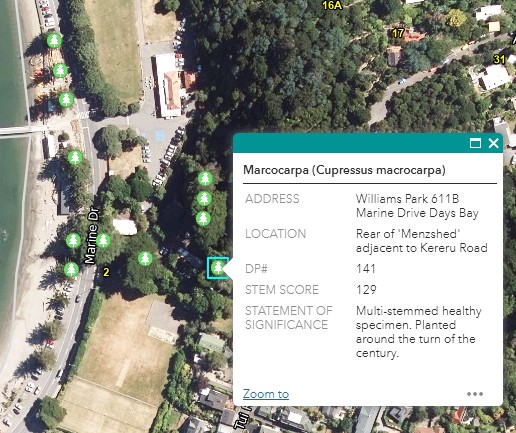
There are six macrocarpa on the register in this site: the three to the north of the detailed one, and the two to the immediate west. The five other trees listed here, as shown by the tree symbol, are all Norfolk Island Pines, described as planted between 1911 and 1918. Walking past those, we find the following two stately and robust macrocarpas (photographed on a rainy day hence the blur to the top right):
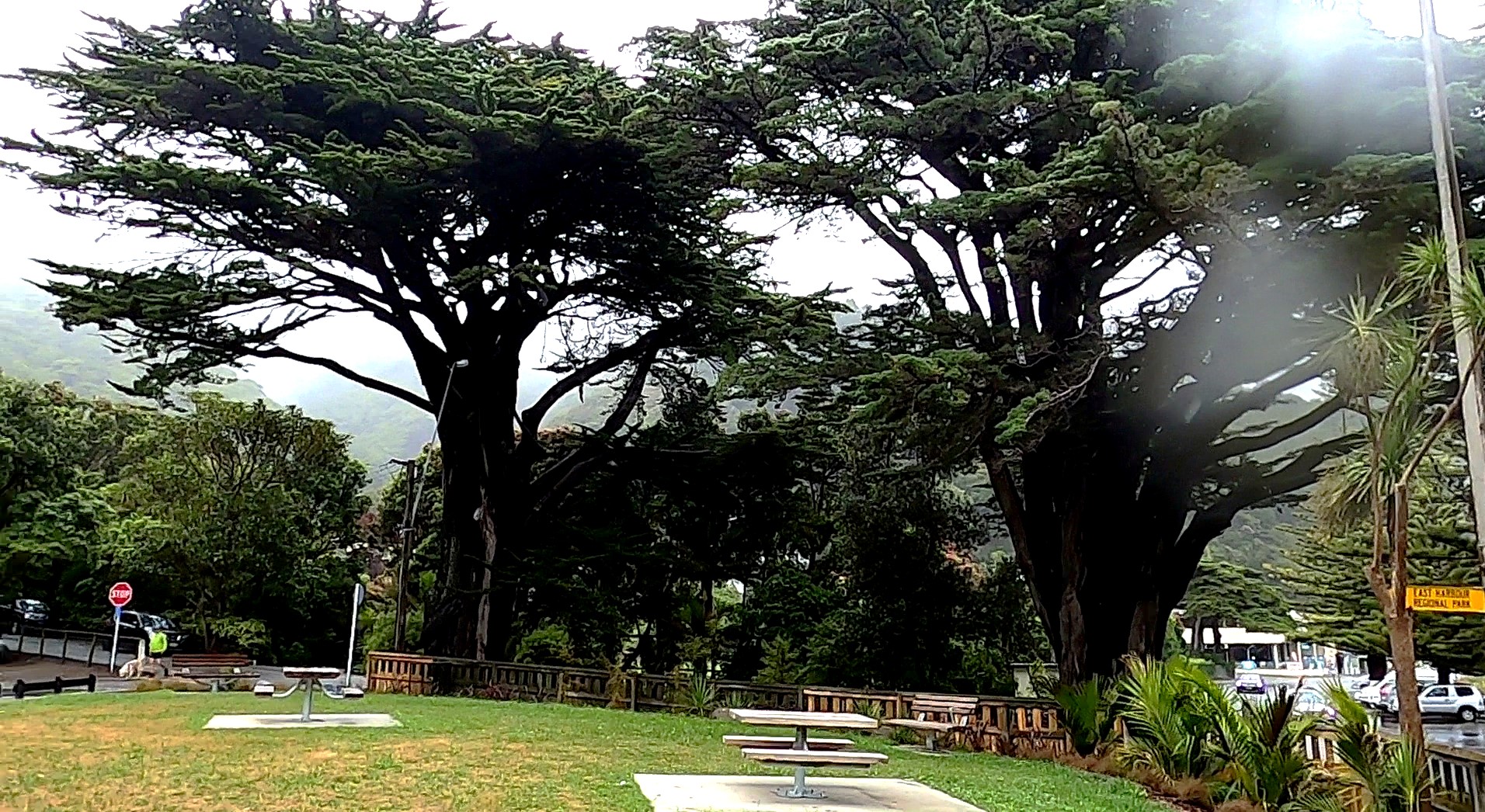
The photo doesn’t do justice to the size of the trees. The circumference at the base of both is about 12 metres, which is what we would expect for a tree planted about the turn of the century, as the Lower Hutt register details. This date is accurate (I would maybe estimate 1890), as the following historic photo taken circa 1910 clearly shows the trees already at a significant height:
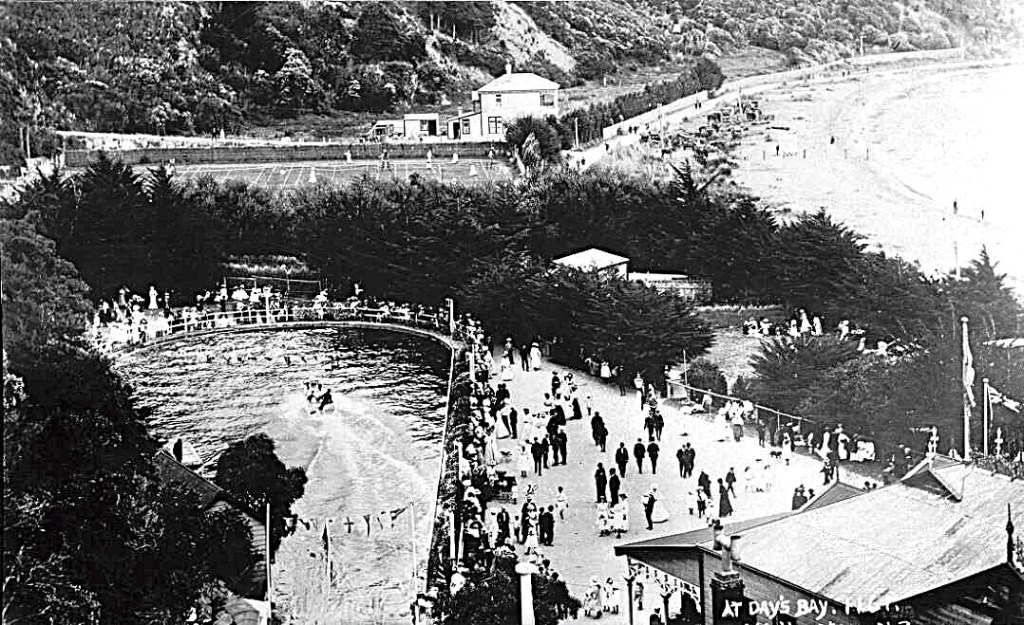
Source: Days Bay, Eastbourne, Lower Hutt, with water chute in Williams Park. Photographer unknown: Wellington harbour ferries. Ref: 1/4-018460-F. Alexander Turnbull Library, Wellington, New Zealand. /records/23187052
If you compare this photo with the map from the Lower Hutt Notable Tree register, you can try to pinpoint where the remaining trees were in circa 1910. The word ‘remaining’ is important, as clearly there were initially many more planted than still grow today. This is no great surprise, but what interests me is the row of trees alongside the house at the middle and top of the photo. Magnification of the digital image suggests there may well be some more macrocarpas right at the corner of the grass tennis courts. There is a photo from circa 1930 which does indeed show some macrcocarpas here, and they are of decent size:
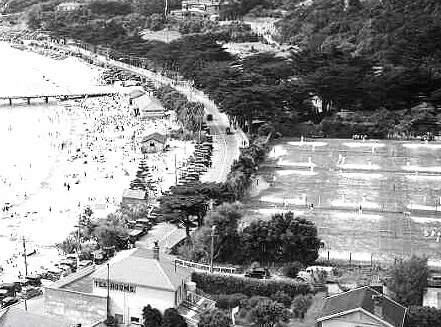
Source: Days Bay, Lower Hutt. New Zealand Free Lance : Photographic prints and negatives. Ref: 1/2-100712-G. Alexander Turnbull Library, Wellington, New Zealand. /records/22757467
The water slide seen in the 1910 photo was gone by this time, but clearly the crowds were still flocking to the seaside suburb. If we focus on the two trees to the corner of the tennis courts, across the road from the Tearooms, we see another interesting aspect of the Days Bays macrocarpas:
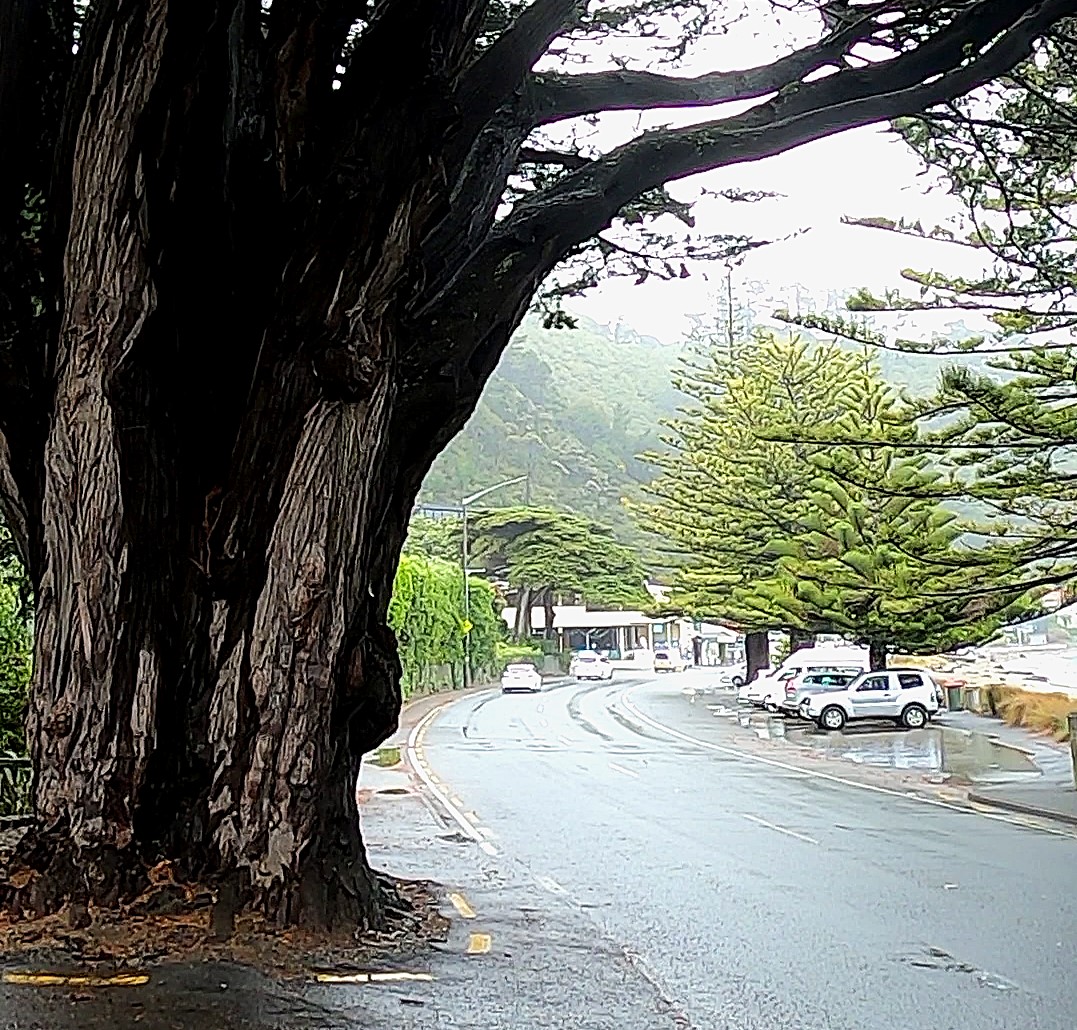
This is a view looking south past one of the big trees listed on the Lower Hutt register. Centre-frame is what looks like a single macrocarpa with exactly the same graceful weeping form that we previously saw in Part 1 of this blog, that is, ‘Jack’s weeping beach tree’. As we draw nearer, we learn though that it is actually two trees, but as a single canopy they do have the weeping form. Several photos are useful here to convey their form (again the rain results in some blurriness):
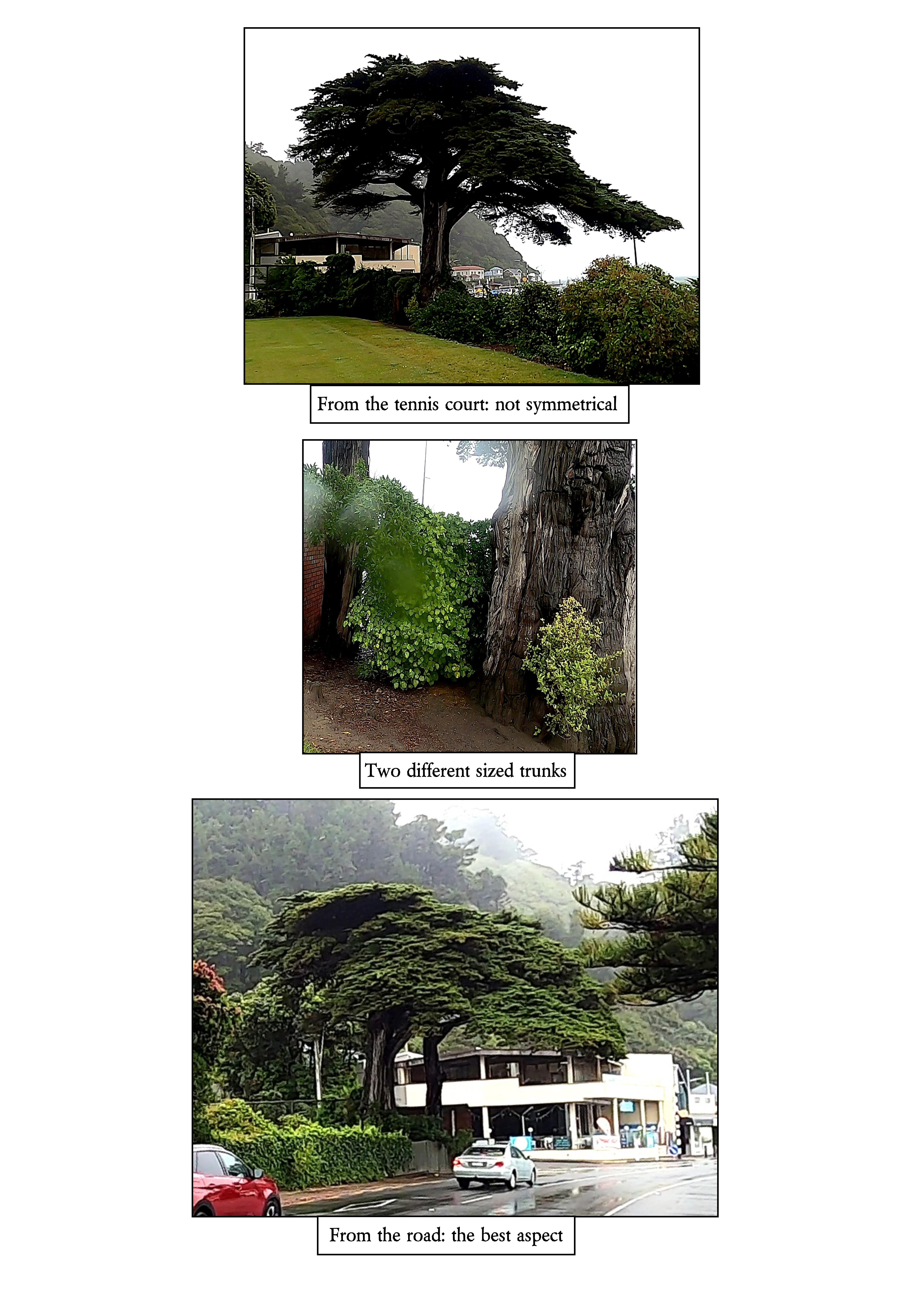
Serendpity is at work in what we can see here. To generalise, most people passing through this part of Days Bay would be travelling on the road, and by chance this affords the best aspect of these two macrocarpas. It is not known when exactly they formed the graceful weeping pair, but the photo from the 1930s above, if magnified, suggests that already at that time they were similar in height, even if the trunks are vastly different. When viewed from the tennis court side, the trees are obviously not symmetrical, nonetheless they still offer a pleasing view, which from this viewpoint is set off against a blank-frame of the lighter tone of the sea and sky.
To draw the two blogs on macrocarpa together, it is interesting to reflect on the information above about Notable Tree Registers. That is, amongst this gallery of macrocarpa, only two sites have representatives on regional tree registers: the Seatoun shops tree, and the six trees in Days Bay. Of course, peoples’ preferences and aesthetic judgements will always vary, but I hope there is enough in the examples above to ponder the question of why some macrocarpas have been listed as notable, and others have not. Certainly, the construction of Notable Tree Registers requires some research, but in the meantime we’ve seen considerable variety in the forms and usage of macrocarpa. Personally, I’m drawn to the weeping form, but the others still appeal very much: the bonzai sandhill tree, the Raumati beach trees, the swing tree, and the Seatoun shops (mullett?) tree, all have their appeal. Macrocarpas are far from a simple tree, homogenous in nature. Even if most New Zealanders do share the local intonation of ‘macracarpa’, as these trees grow their heterogeneity belies a standard naming. By giving them a detailed second glance, we can move beyond the assumption that they are all the same.

 The Local Arboretum: Noticeable trees and their stories