Here’s a New Zealand seaside scene from one of the bays close to downtown Wellington showing two plants known to many:

Centre frame is a Phoenix palm (Phoenix canariensis), that from its size looks to be about 30 years old. Above and to the right of the descending walkway are several Pohutukawa trees (Metrosideros excelsa), which are probably about the same age as the Phoenix palm. Neither of the two grow naturally in the Wellington region: the Phoenix palm is an import from the Canary Islands, a part of Spanish territory off the coast of Morocco. The Pohutukawa is a tree native to New Zealand, but prior to its planting throughout the country, was naturally found north of a line from New Plymouth to Gisborne. There are a lot of Pohutukawa planted in Wellington, and whereas the Phoenix palm was not so heavily taken up in Wellington, it is very common throughout the North Island, especially in Auckland.
Other common plantings in the New Zealand seaside are Norfolk Island pines, macrocarpa (see blogs 2 and 3), Pinus radiata, and cabbage trees. But the reason to focus here on the Pohutukawa and the Phoenix palm is that, due to features of both, they sometimes become inextricably intertwined. Here is how this frequently begins:

This shows the base of a quite large Phoenix palm with a Pohutukawa seedling growing in the fibrous gaps between old frond scars. Many other types of trees and plants with small wind- or bird-distributed seed can likewise be found growing in this part of Phoenix palms. If left to grow the Pohutukawa will send down roots, grow larger, and within a few years will look like this example photographed in Titahi Bay, Porirua:

Of course, the flowers are very attractive, and at this size there is no real detraction from the typical columnar effect that Phoenix palms provide. Even when such ‘intruder’ Pohutukawa grow larger, they may still offer a strong visual effect. After all the front page of The Local Arboretum blog features this scene, photographed at Ellerslie Racecourse, Auckland:
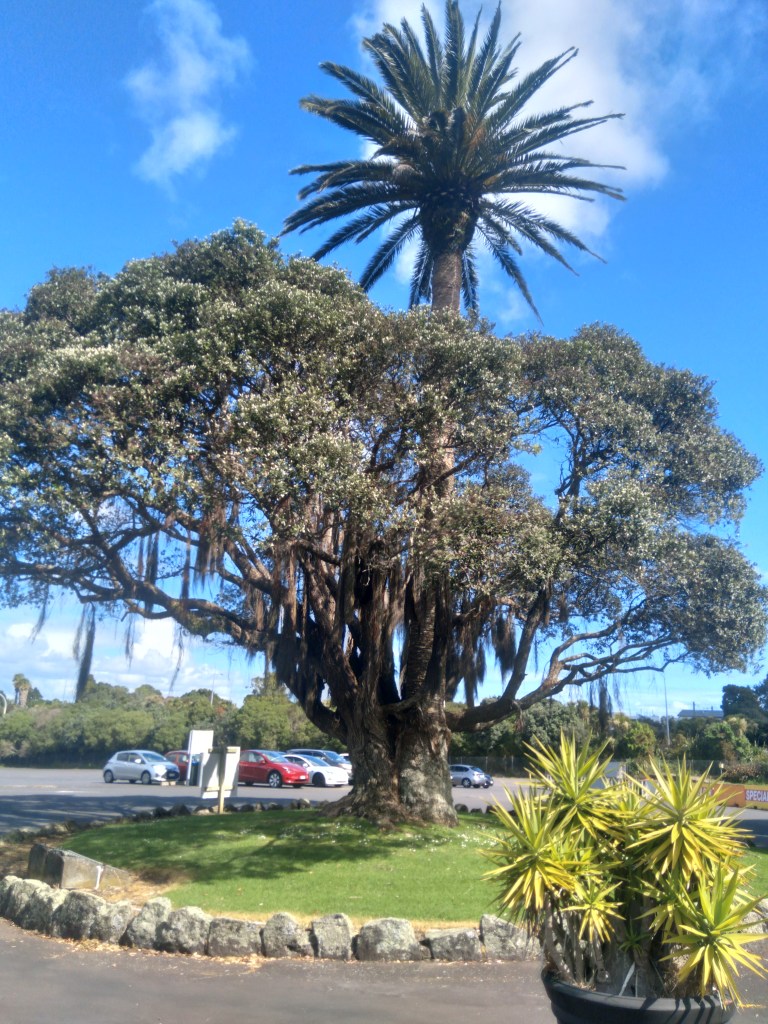
Here the pair look fused, even though as members of different plant families they cannot perform the equivalent of a graft, that is, a real fusing of two different species. Nevertheless, a closer shot at the base does encourage anthropomorphising:

It looks for all the world as if the Pohutukawa has an arm out embracing the slightly taller Phoenix palm. But there is no real gesture of friendship here, in fact, with time, that reaching branch has the potential to swamp the Phoenix palm. Like all plants the Phoenix palm requires light, and a feature of Pohutukawa growth is their strong horizontal spread, often being wider than they are tall. This can be shown with several shots from Wellington Botanic Gardens.
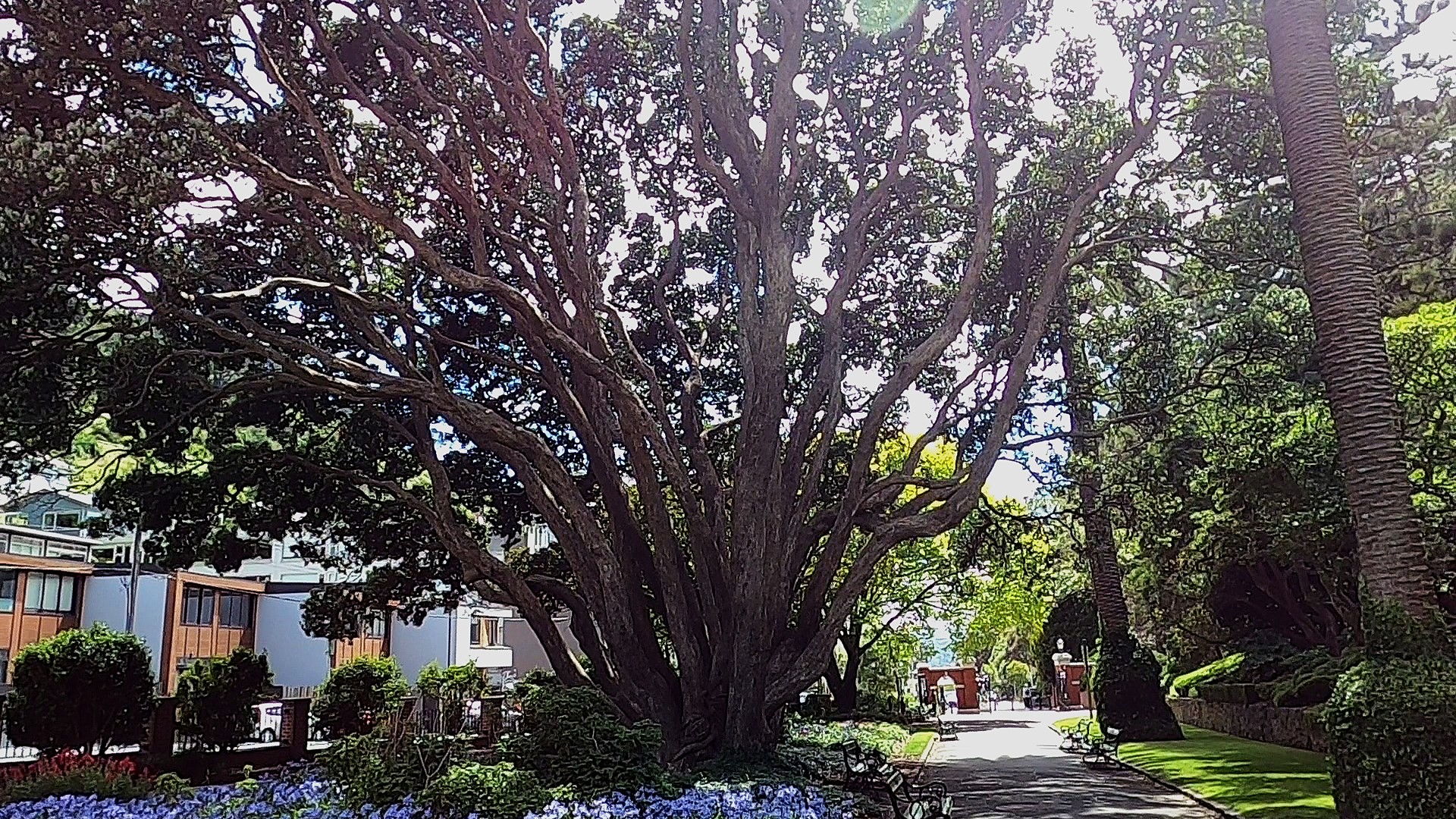
This shows a very large Pohutukawa planted about 1906 and next to it two of three Phoenix palms that were planted a little later in 1929. My research suggests these are the oldest Phoenix palms in the Wellington region, even though publicity from the Wellington Botanic Gardens gives 1938 as their planting date. All of the plants in the Botanic Gardens are well tended to, and that includes the palms seen here, however, further photos show what has happened to the palm in the middle of the trio:
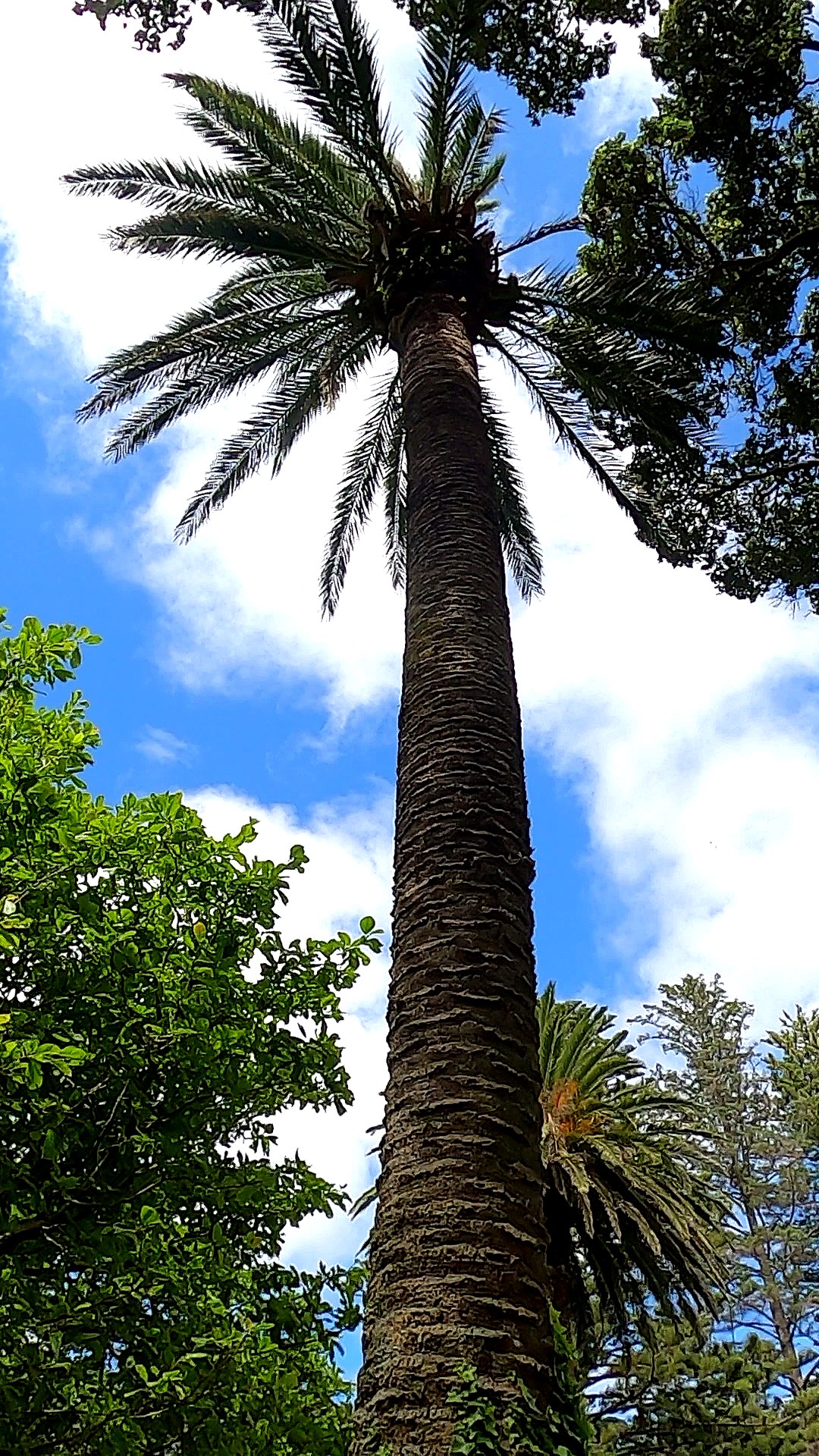
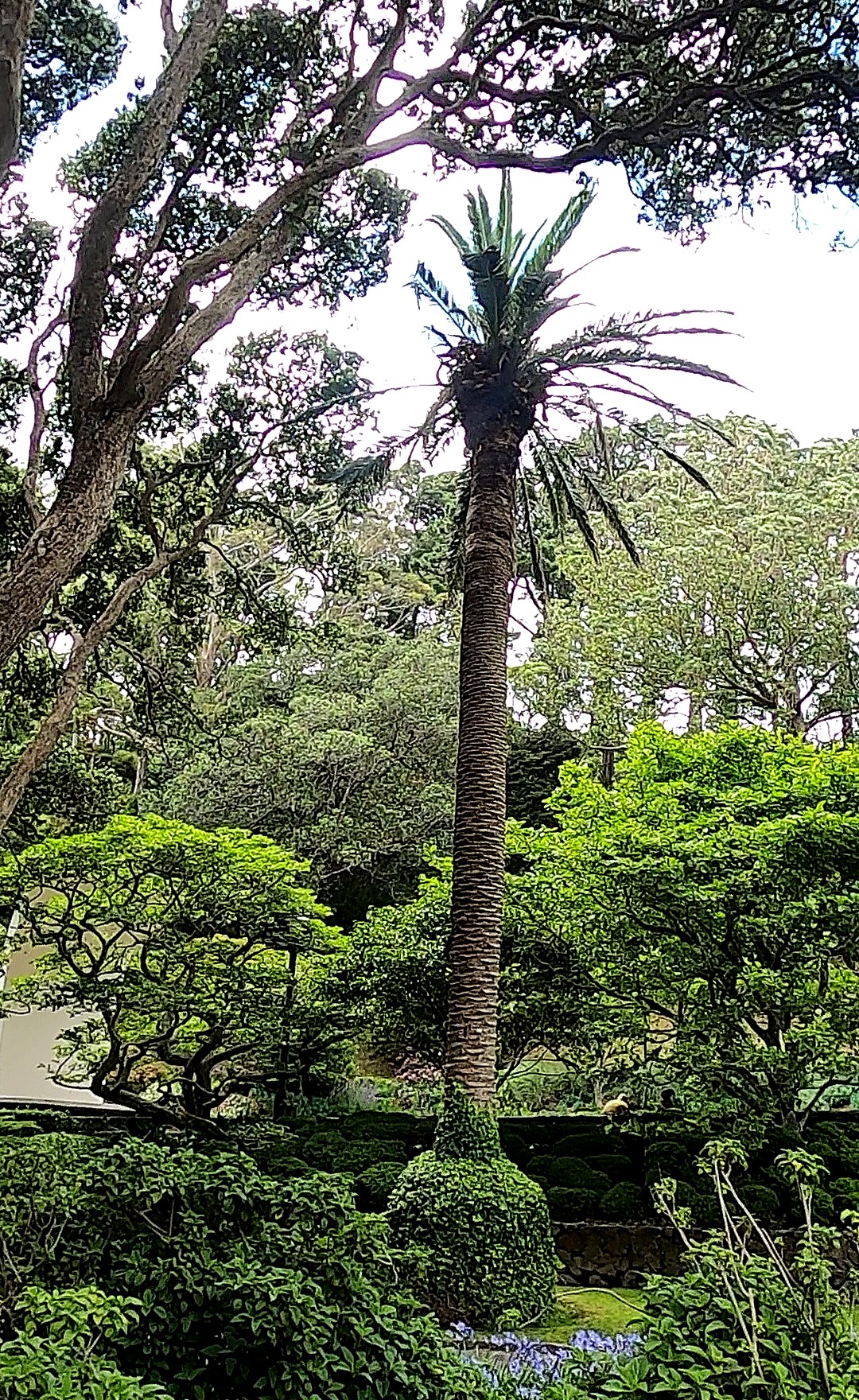
In contrast to the crown of the palm seen behind, the middle palm has shed a lot of fronds and its crown looks distinctly sparse. I had regularly viewed this palm, thinking at one stage it was dying, but just after this photo it seemed to gain extra light by just managing to extend beyond the wide spread of the massive Pohutukawa. Clearly, if we were going to anthropomorphise here it would not be a story about a friendly, reaching arm, but more a reach intended to strangle?
We don’t need to be tempted by either type of story, for really the point here is not to preach, but just to note that when we are dealing with trees and palms that grow close together, due to their different ways of growing such problems can always occur. So, sooner or later, choices involving values have to be made: should the Pohutukawa seedling growing at the base of the Phoenix palm be cut out earlier, or maybe, being brutal, the Phoenix palm should be removed as it is not a native? This is a complicated question, one that begs returning to in the New Year, perhaps with several posts telling the complex story of Phoenix palms in New Zealand.

 The Local Arboretum: Noticeable trees and their stories