I finished the last post noting that when pohutukawa grow close by, or within the fibrous parts of Phoenix palms, sooner or later a decision will have to be made about which of the two plants is to remain. If a Phoenix palm crown grows above the spread and height of an old pohutukawa, it is not really doing justice to either plant to have them growing together in this way. The pohutukawa naturally spreads very wide, and its rugged multi-trunk is worth preserving as a sight, whereas the columnar form of the Phoenix palm requires space around it to get its full effect, and often that effect is enhanced by a group planting, not a mixture with other trees.
In a later post I’ll detail how, beginning in Auckland in the early 2000s, the Phoenix palm increasingly lost favour, leading to it being classified as a ‘pest plant’, At the moment, this often means that in situations of co-growing, it would be the palm likely to be chopped out, not the pohutukawa. But in other parts of the country, this is not necessarily the case as the following shots from Alma Gardens in Whanganui show:
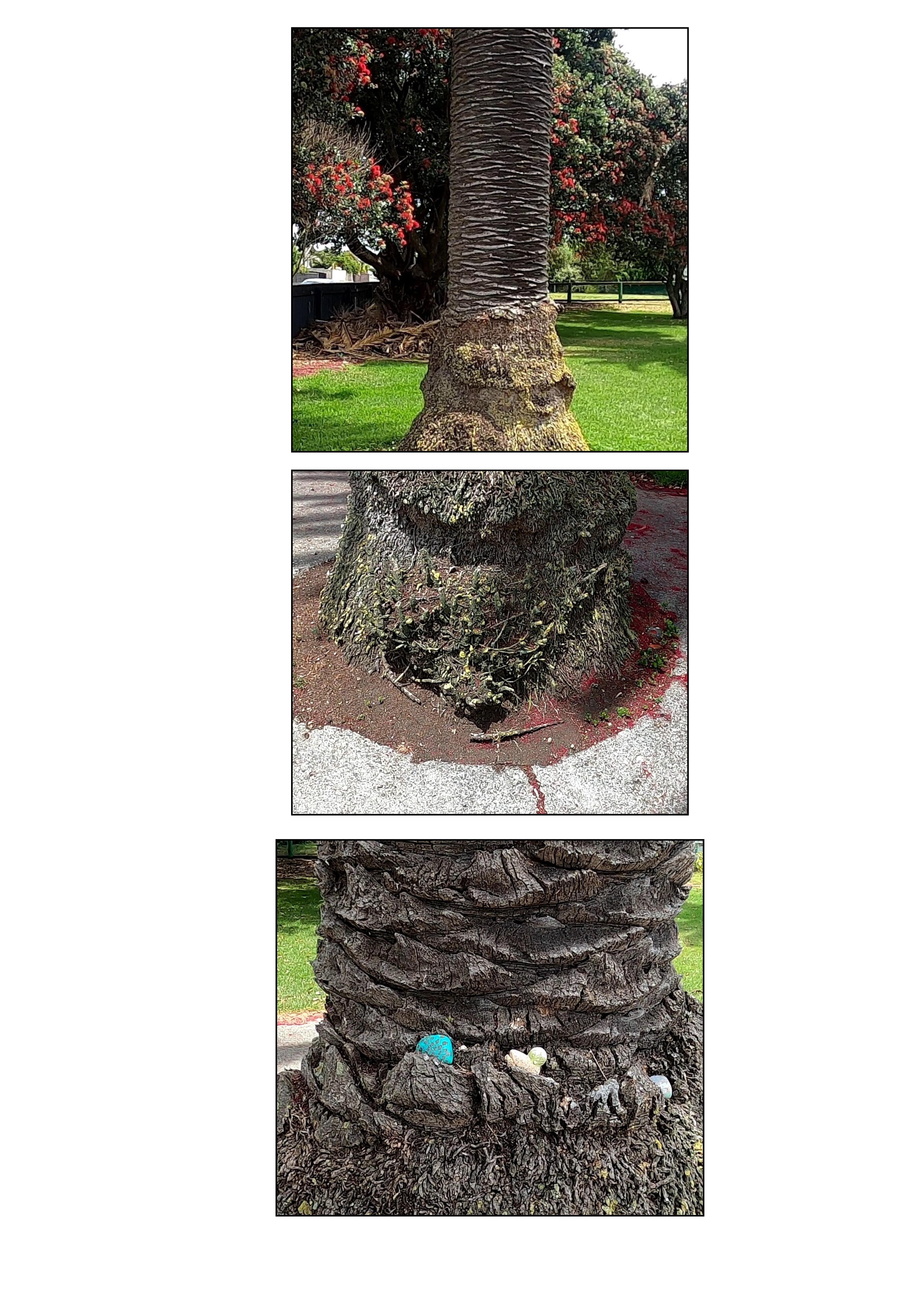
The top photo shows a large Phoenix palm growing very close to a number of pohutukawa that are flowering. The seeds that will shortly result from this flowering are very small and light. They will easily reach the fibrous parts of the Phoenix trunk, within which they will readily germinate. This has indeed happened from a previous flowering, as seen in the middle photo. However, we can clearly see that the juvenile pohutukawa have been cut back, presumably by the garden staff who tend this small garden. I have not talked to any staff here, but in the final photo we can infer a reason for the prompt removal of any (and there will be many) germinating pohutukawa. We can see three ‘painted pet rocks’ that are lodged in a part of the skirt of the Phoenix, thus holding the pet rocks relatively securely. Alma Gardens is a facility for people with intellectual disabilities, so perhaps the rocks were placed there by people attending the centre. This could indicate an emotional attachment to the Phoenix palms (there are 4 here) as a significant tree itself, and also because of their convenient ability to safely hold the pet rocks. I’ve never seen pet rocks placed in a Phoenix palm like this, so the sight is a very specific glimpse from the local arboretum, perhaps difficult to find again.
What is not difficult to find again is frequent germination of pohutukawa seeds, nor the almost as easy spread of Phoenix palms, both in places where they were not necessarily wanted. Pohutukawa in particular need very little foothold to grow, as this photo clearly shows:
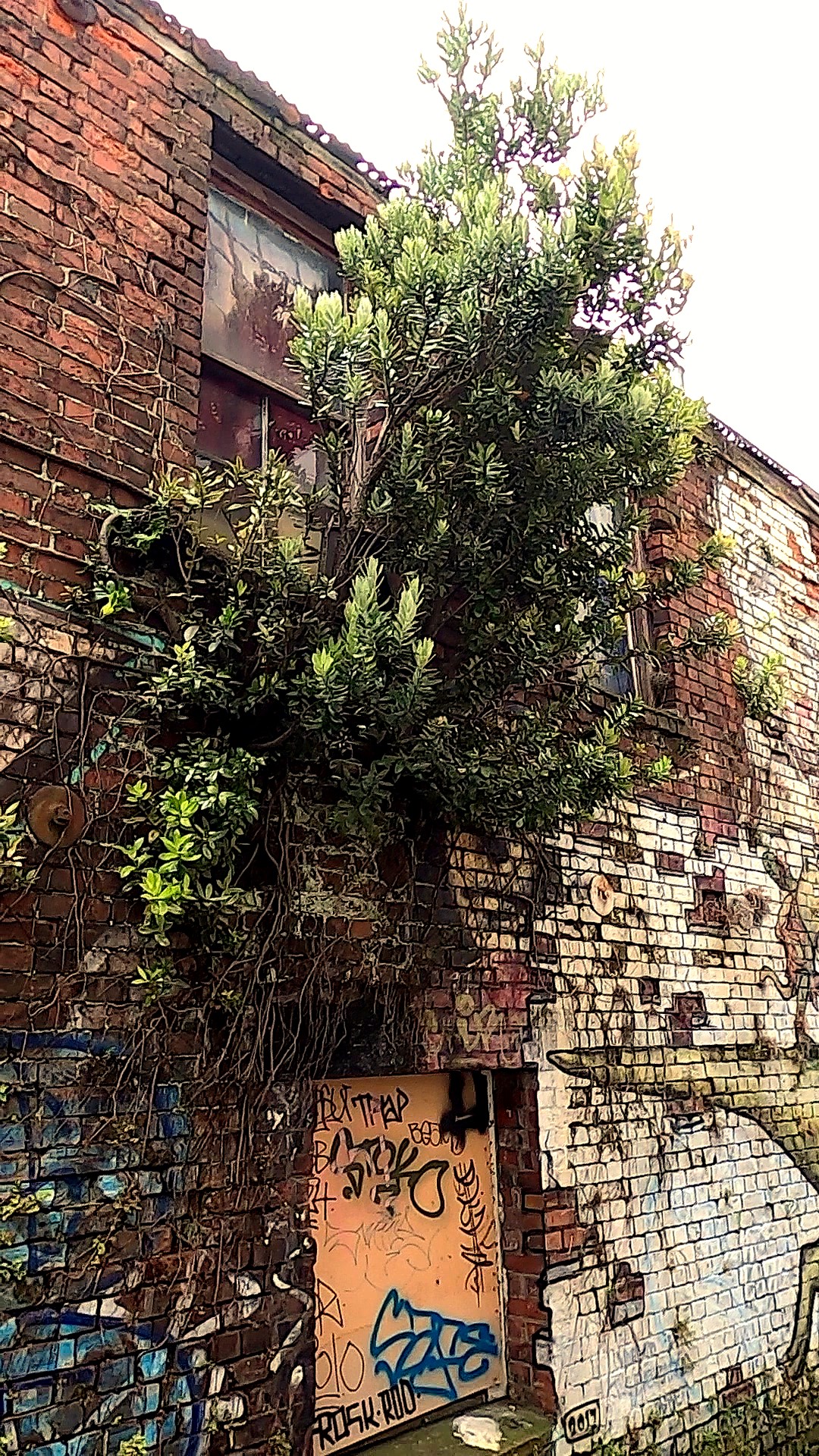
This is in the CBD in Wellington, where a graffiti-covered and almost derelict brick building seems to be sprouting pohutukawa. Just how they manage to grow so healthily, given they are literally growing in mortar, is something of a mystery. And here is an interesting shot of seedling Phoenix palms from a double avenue entrance to a farmhouse in Kai Iwi near Whanganui:
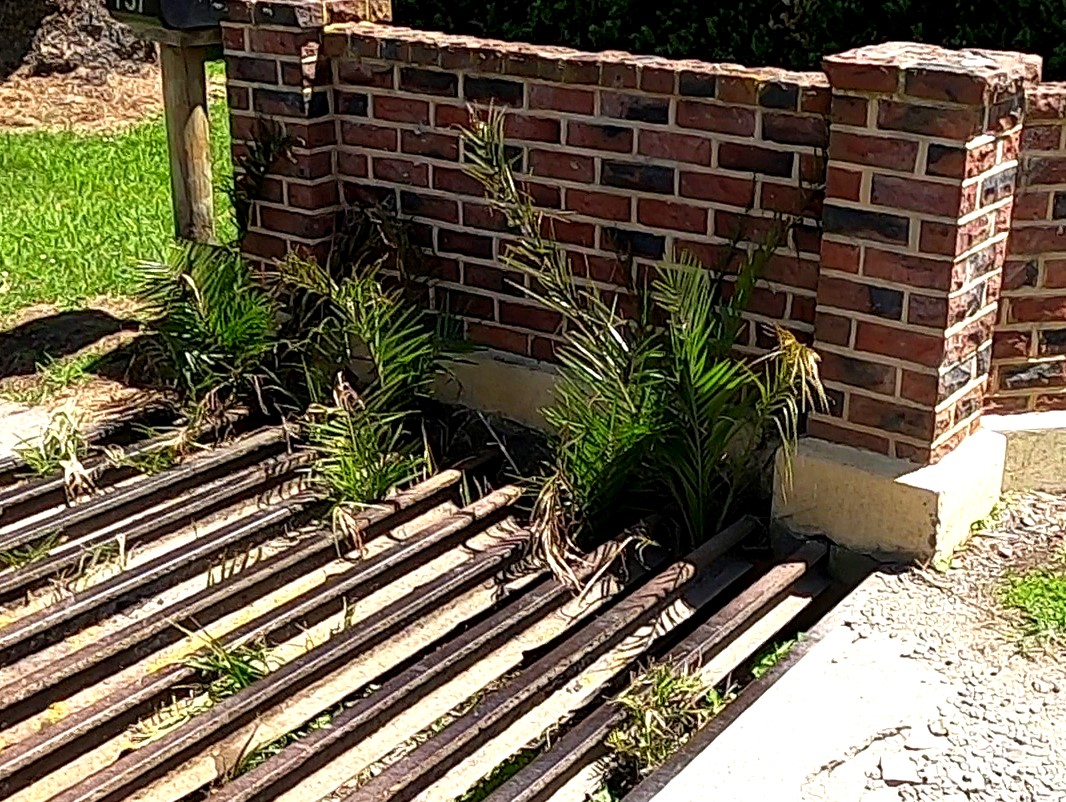
There are 19 large Phoenix palms beyond this farmgate entrance, obviously indicating strong appreciation of the palm. It has to be assumed that the seedlings here will be removed before they get much larger. But, with many other palms setting seed, it won’t be long before the process has to repeated.
Moving back to Whanganui
Perhaps the double avenue of Phoenix palms in Kai Iwi deserves to be famous, but it may take a bit of publicity. Moving back to Whanganui, we can find an interesting interaction between pohutukawa and palms in quite a famous small reserve by the riverside. The reserve was originally known by local Māori as Pākaitore, then in 1900 it became known as Moutoa Gardens, but then in 2001 returned to being called Pākaitore. There is a long history behind these changes (see a prior Garden History Research Foundation blog for some detail), but here we are focusing on one small corner of the gardens, beginning with a photo from 1920:

Some of the trees seen here have some size but it is clear that the gardens are relatively newly established. A magnification of the image shows the small corner that is of interest:
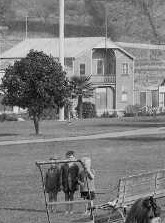
Just behind the flagpole we can make out a young fan palm. Luckily a Papers Past search turned up information which strongly suggests the palm we see here – a Washingtonia robusta or Mexican fan palm – was planted in 1911, as one of 12 palms imported from Australia and planted in probably three locations in Whanganui. Other palms were planted in Pākaitore after 1911, but this was probably the first.
Fast forward to December 2024 and of course many changes have occurred, but we can see some interesting changes in the specific corner where the Washingtonia grows:
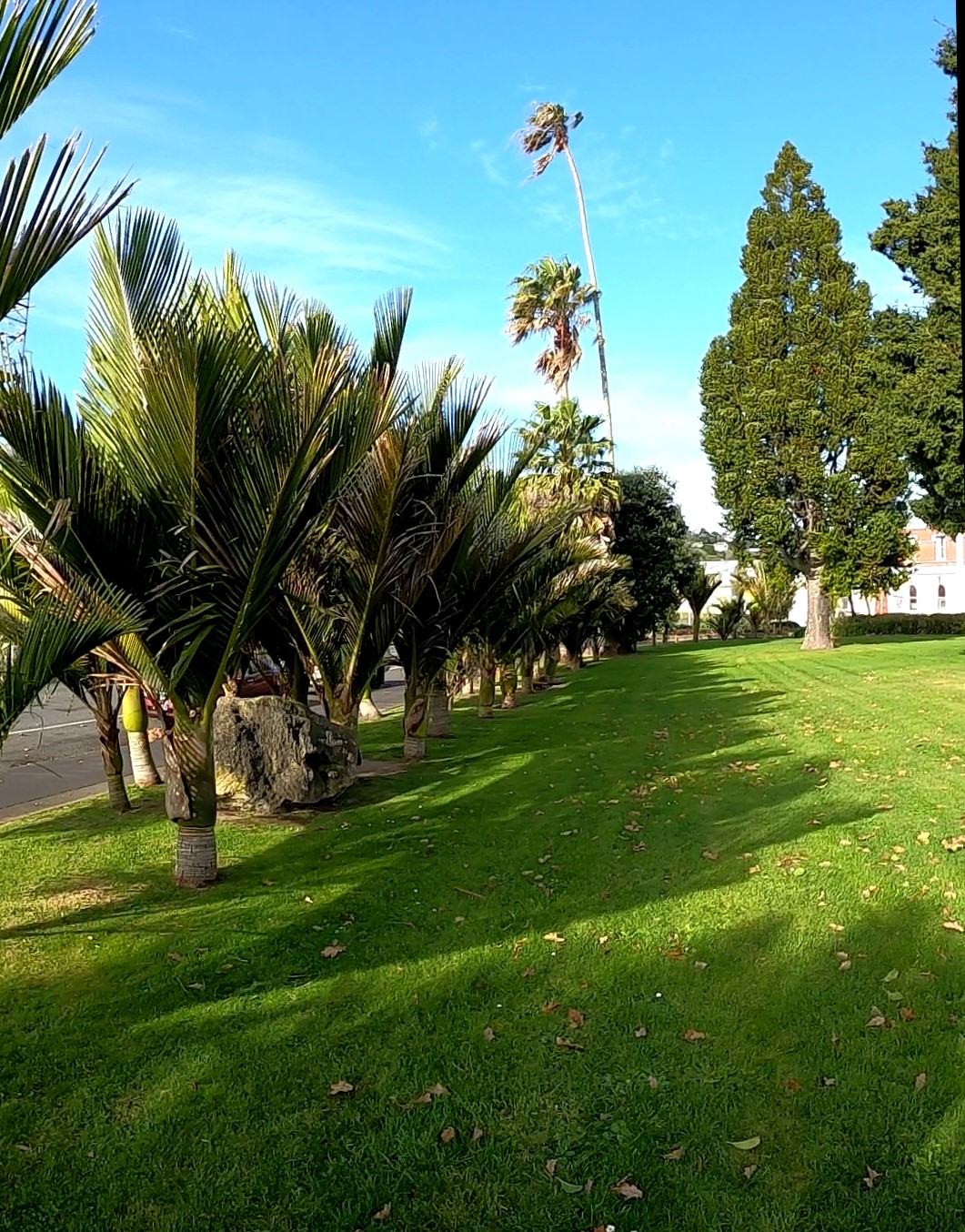
This view south towards the river shows a double row of nikau palms, with the towering Washingtonia now looking over two younger specimens, and quite a decent sized kauri a little to the right in front of it. But it is the greener mass directly below the palm that is of interest, and as might be guessed it is a pohutukawa, shown more closely from this view looking north:
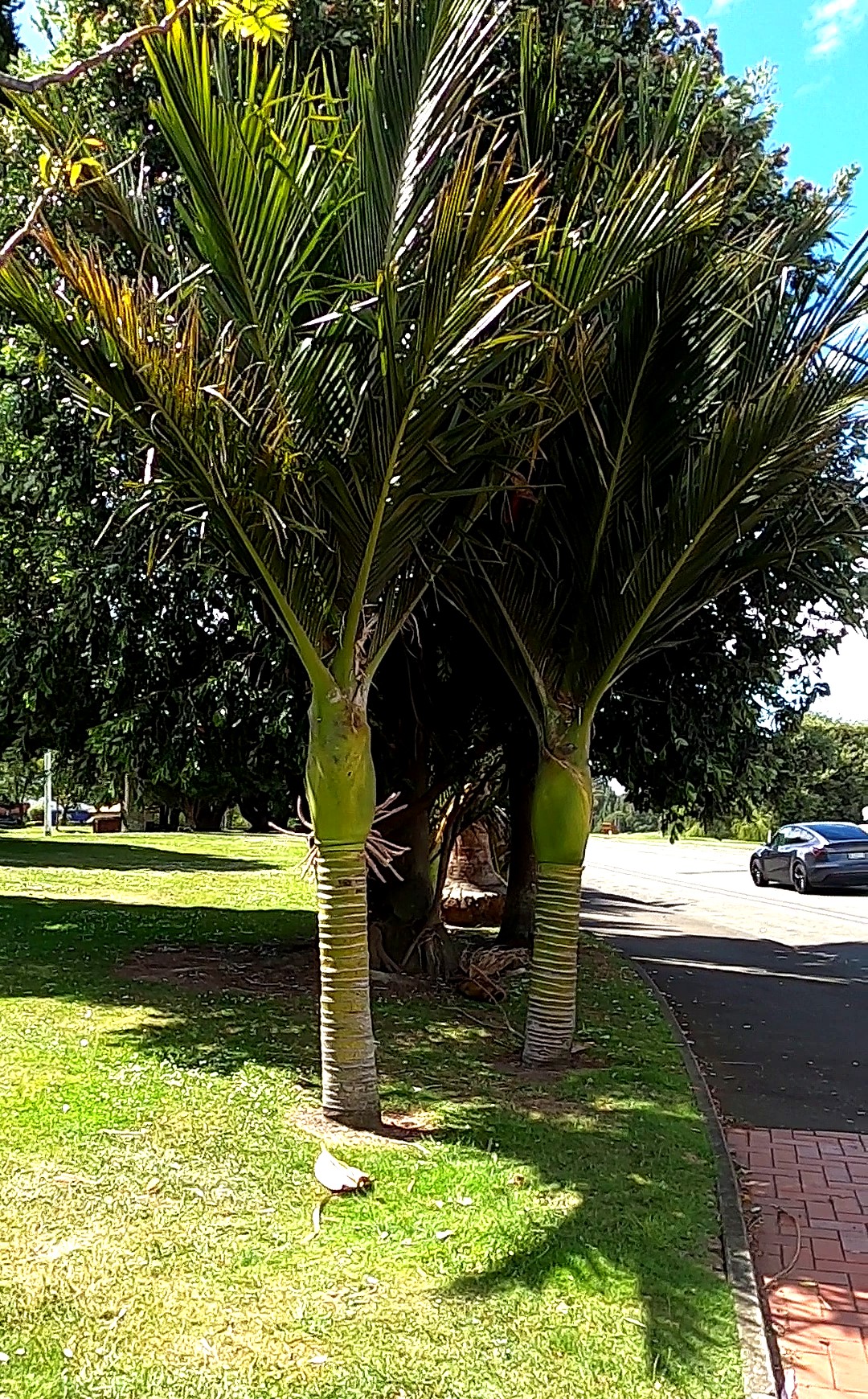
We see here a continuation of the double row of nikau palms, with the pohutukawa behind it. A closer view is needed to see the base of the 113 year old Washingtonia, which is shown here from three angles:
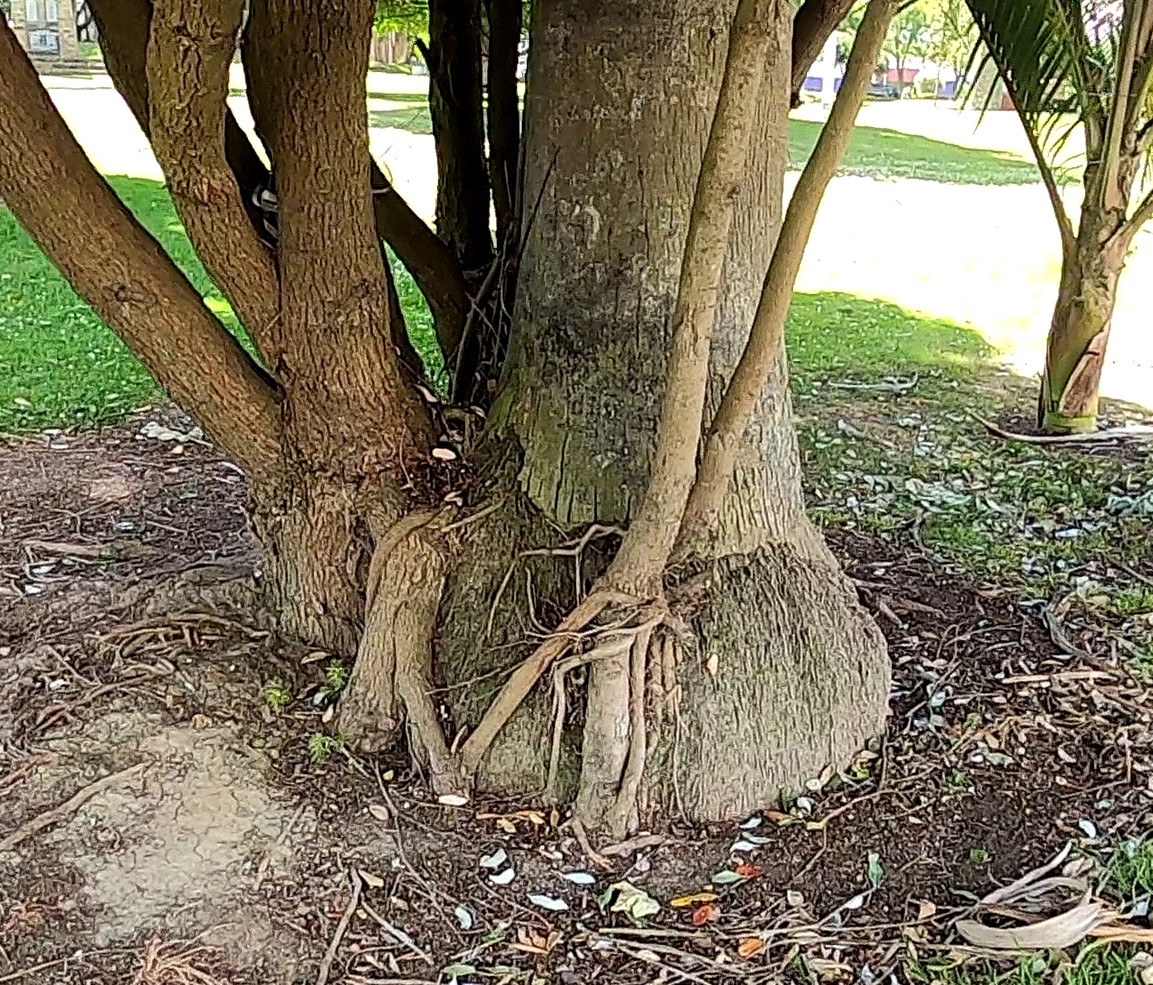
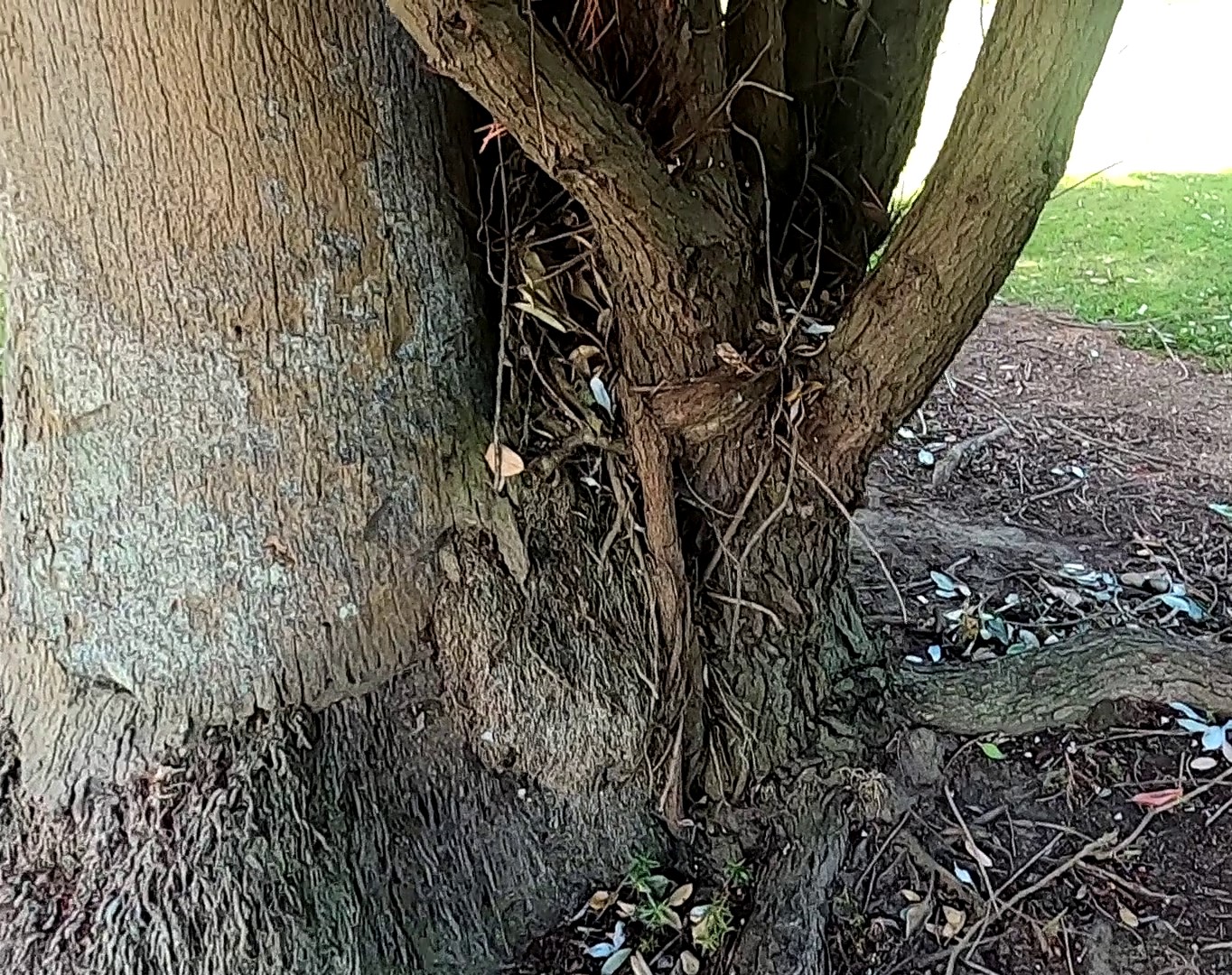
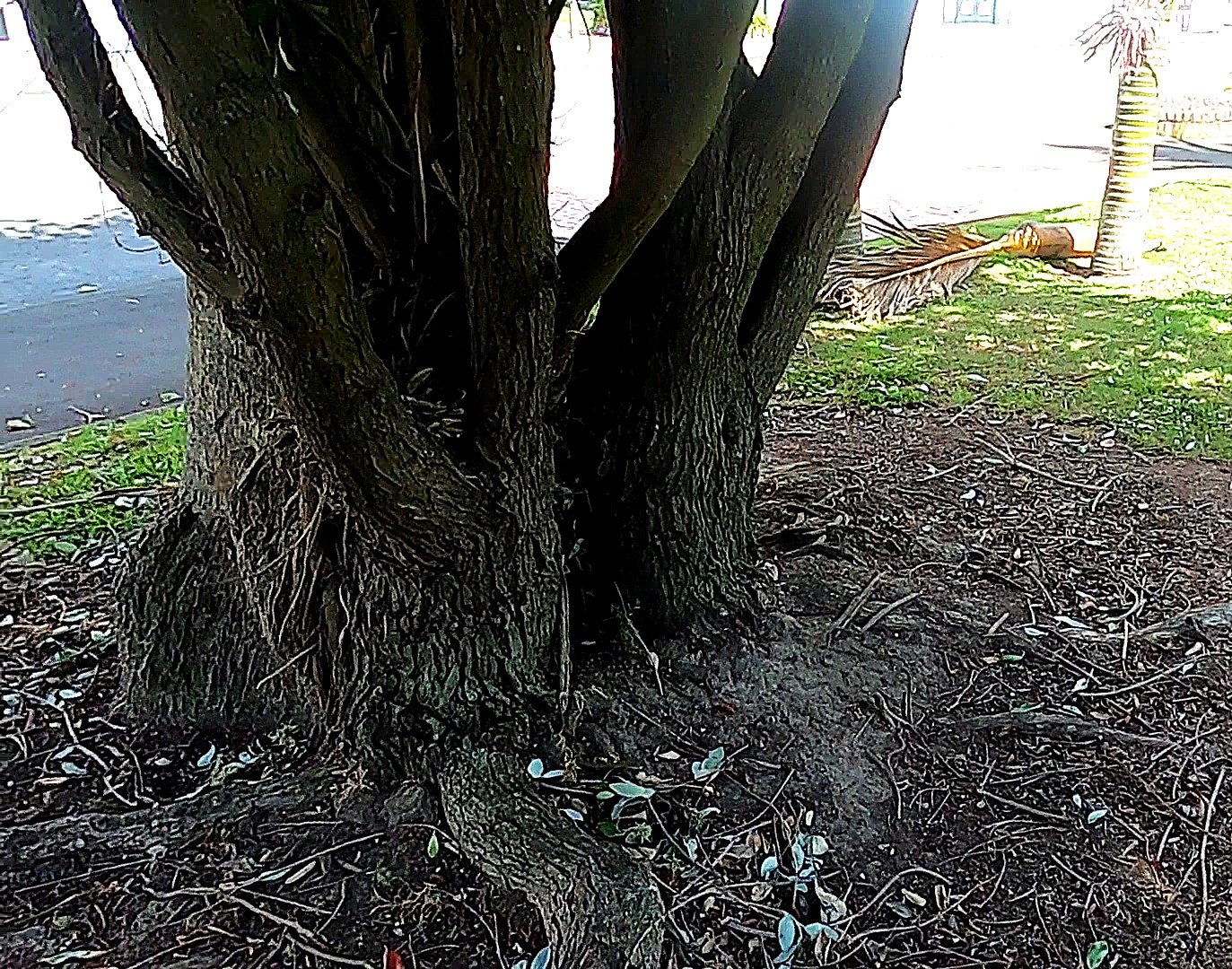
Clearly it is encircled by seedling pohutukawa which have grown very successfully, probably beginning in the fibrous part of the palm’s base. Whereas this is not as large nor as fibrous as that of the Phoenix palm, it is clearly a seed-catching and growing area. Interestingly, none of the nikaus, some of which can be seen in the above photos, have seedling pohutukawa encircling them. This is not because they have been weeded out, but simply because the trunk base of the nikau palm has a different morphology, not having the fibrous base of the two palm relatives we have been focusing on here (there is also a very stout Chilean wine palm near this site, and this also has no seedlings around its base). It would not be surprising to find research by botanists focusing on this difference, but that is not the concern here. A couple more photos are useful here before finishing off:
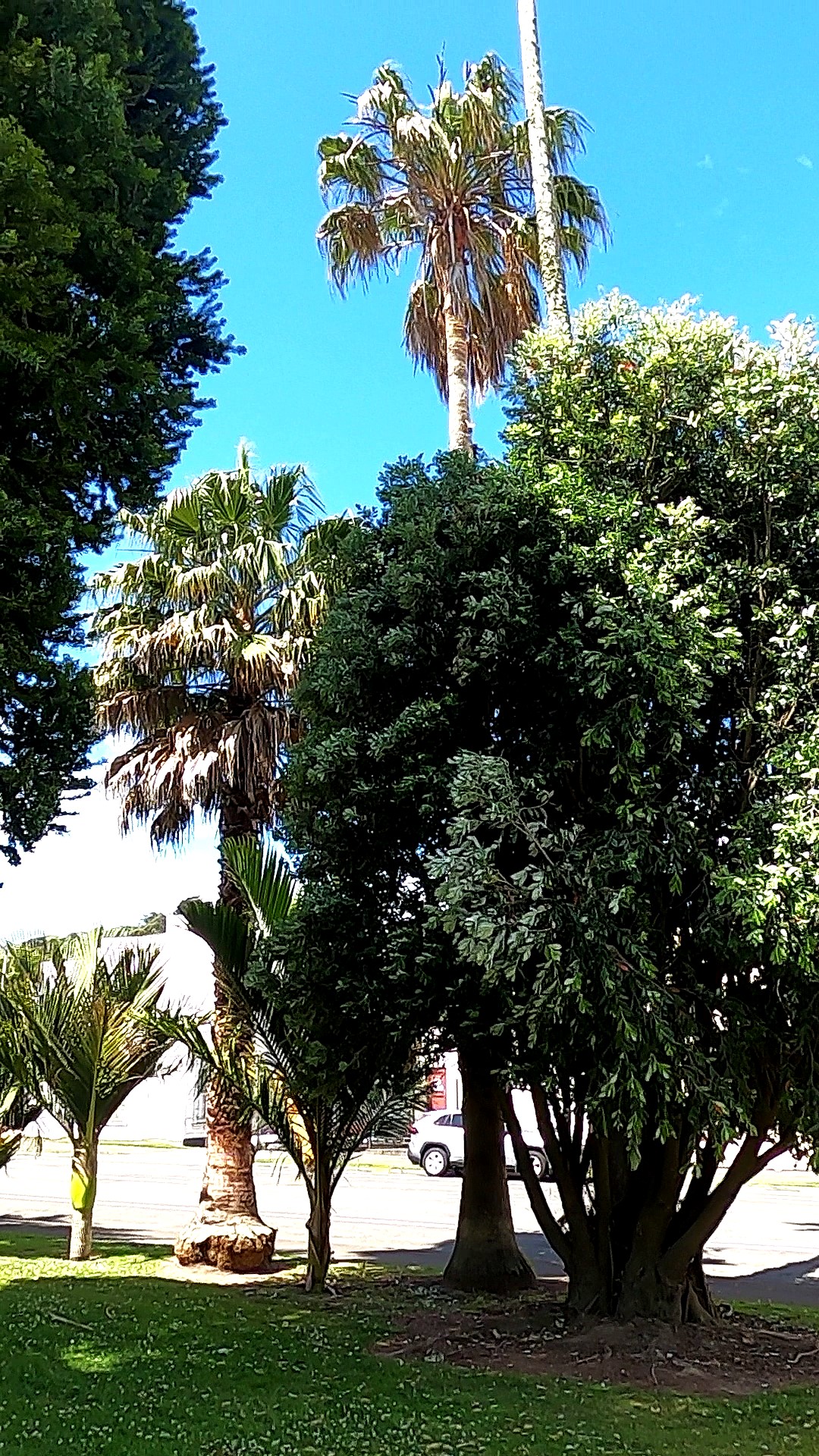
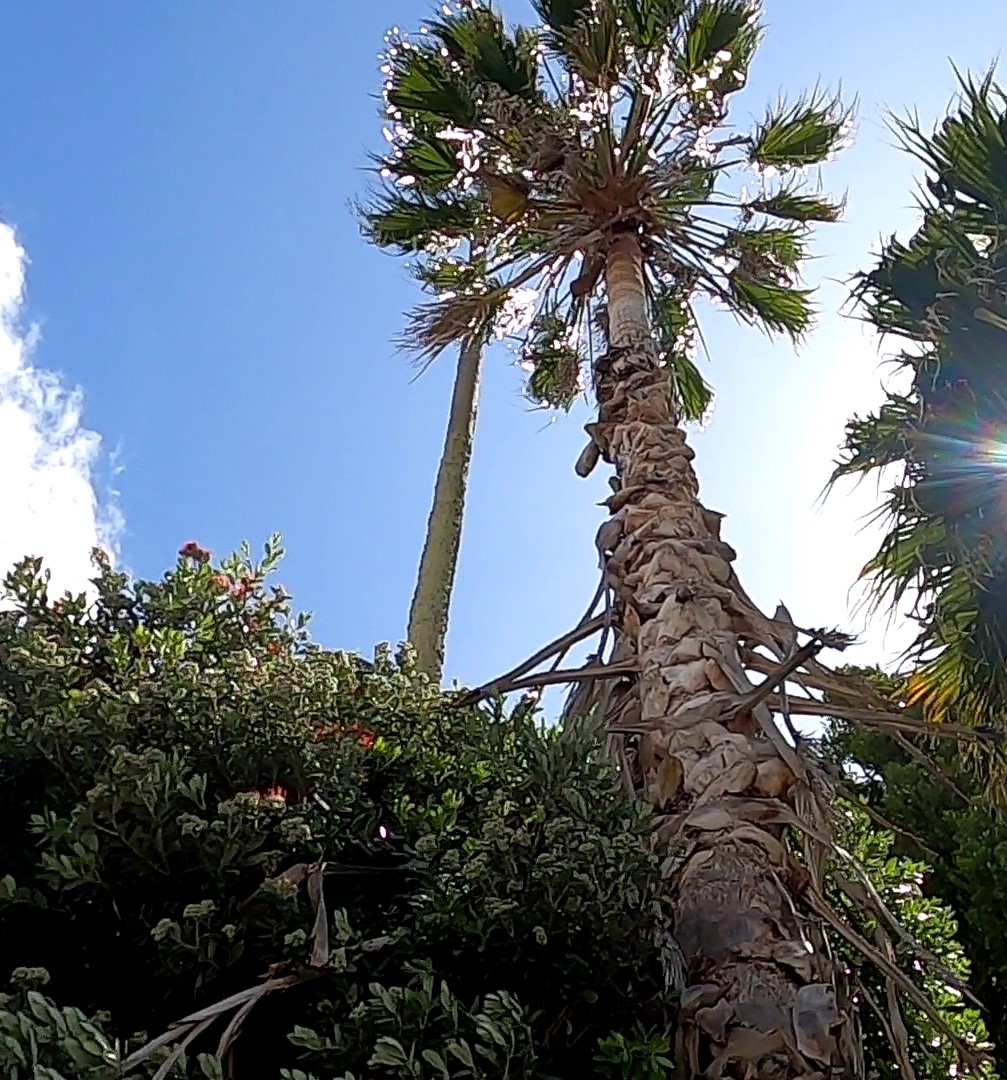
If the palms and trees here were playing basketball, currently the old Washingtonia would be hard to beat. Within a few decades the kauri will probably challenge that dominance. But if we stick to ground-level views, the stunning thing is how the very tall Washingtonia becomes almost invisible – instead we see the encircling pohutukawa. Their maximum height will never challenge that of the palms or the kauri; the problem is their spread, and the encircling roots. Pohutukawa are not a so-called ‘strangler’ tree like their close relative the northern rata, nevertheless the ability of the aerial roots to spread and encircle does not lend itself to nice-and-tidy garden views. At the moment the views seen above are certainly not unpleasant, but if left untouched within a few decades the spread of the pohutukawa will encompass not only the three Washingtonia, but also several of the nikau palms and the kauri, at least to mid-height.
Concern over such an encircling clearly troubles any neat distinction between a preference for native over imported exotic plants. If that distinction is opened up, it should be noted that of the plants on view above, only the nikau palm naturally grew in the Whanganui area before Europeans started planting the then Moutoa Gardens. Interestingly, a search of the local council’s list of notable trees turns up two trees on view here: the kauri and the oldest Washingtonia. Two older pohutukawa, presumably the source of the seedlings encircling the Washingtonia, are also on the list. It is possible that in a few more decades the whole grove of nikau will be included – they will be a stunning site – but perhaps not the encircling pohutukawa. By then more time may be spent reflecting on how to quietly get rid of it, rather than have it registered as notable.
Coda
In the north-western Spanish City of la Coruña the pohutakawa is so highly regarded it has been adopted as the city’s floral emblem. Owing to the existence of one very large tree, there was a debate about when pohutukawa arrived there, but the consensus now seems to be it was taken back to Europe by British explorers (possibly Cook). La Coruña also has several iconic group-plantings of Phoenix palms. I have visited the city, but cannot remember any problem with pohutukawa encircling the palms. I have contact with a local arborist so will endeavour to find more information. One memory I have of my visit is walking along a seaside esplanade to find a sign indicating that the spot was the antipodes point for Dunedin, New Zealand. The sign featured an image of a penguin, not a pohutukawa. La Coruña has a warmer Mediterranean climate than Dunedin, and whereas pohutukawa grow in Dunedin it is regarded as probably their southern-most limit. There is known to be a Phoenix palm growing in Invercargill; it appears unlikely that encircling problems will develop this far south.

 The Local Arboretum: Noticeable trees and their stories