I’ve lived in Wellington for 30 years now, and when I moved up from Christchurch, fairly claimed to be a ‘garden city’, I was a bit startled by the relative lack of tree planting in the central city. An exception though is the number of pohutukawa you can find either as street trees or planted where there is a bit of spare space. It wasn’t until I started researching the spread of Phoenix palms in the North Island that I became acquainted with a character known as ‘Pohutukawa Mac’, that is J.G. Mackenzie, director of Wellington parks from 1918 to 1947. The reason I could think of Wellington as a ‘Pohutukawa town’ has a great deal to do with this man’s fondness for and ability to plant the tree throughout the Wellington region. ‘Pohutukawa Mac’ deserves a blogpost of his own at a later stage. In the meantime this post draws its inspiration from the attunement on pohutukawa provided by the last two posts, and really a simple noticing as I walked about the city one morning. The noticing then was backed up by the wonderful resource of DigitalNZ, which turned up something I was unaware of. First, the noticing:
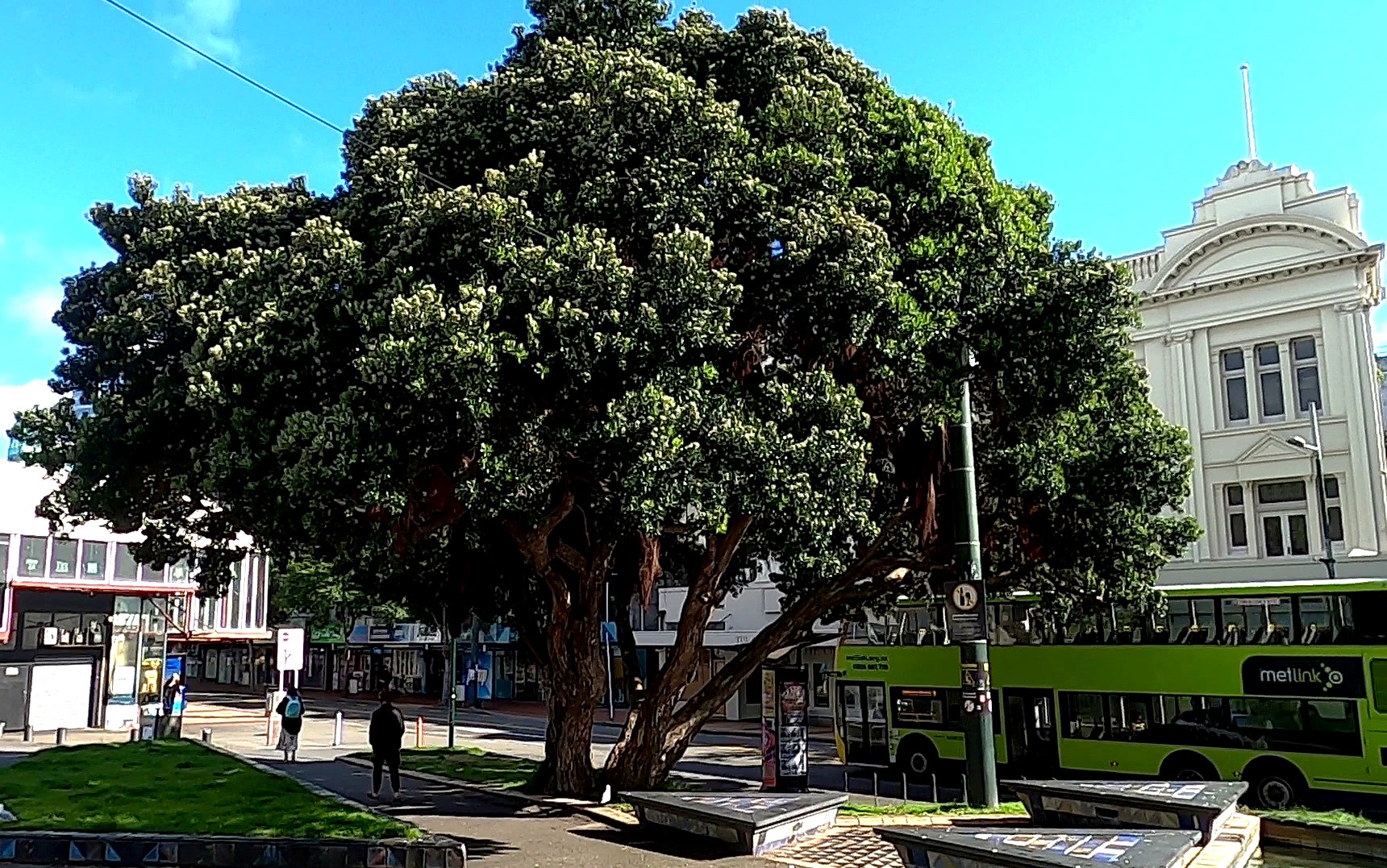
This large pohutukawa is found in Te Aro Park (often called Pigeon Park), just before what used to be known as Wellington central’s ‘party’ street, Courtenay Place. The passing bus gives a good indication of the size of the tree. Some other photos establish that it has the multi-trunk and aerial roots that often make the tree noticeable, giving it in a sense ‘crowd-pleasing’ features:


The aerial roots seen above can often be several metres long, so it is possible the council gardeners have trimmed these, possibly to avoid getting in the way of pedestrians as they walk by (see the first photo above). It takes a little closer investigation to find the pohutukawa also sports a pair of hanging sneakers.

I’m not sure this qualifies the pohutukawa as a so-called ‘shoe-tree’ or a good example of ‘shoefiti‘, but I guess it adds a little to the tree’s noticeability.
But to be honest it wouldn’t take much more walking around central Wellington to find many other pohutukawa like this (maybe apart from the shoes). Obviously I was interested enough to take some photos, but it wasn’t until I got home that something I often do with candidate noticeable trees proved fruitful. This is the very simple task of searching on DigitalNZ to see if there are any historic photos that might be interesting. This was indeed the case, and luckily these photos can be reproduced here without any copyright issues. The first is dated circa 1940:
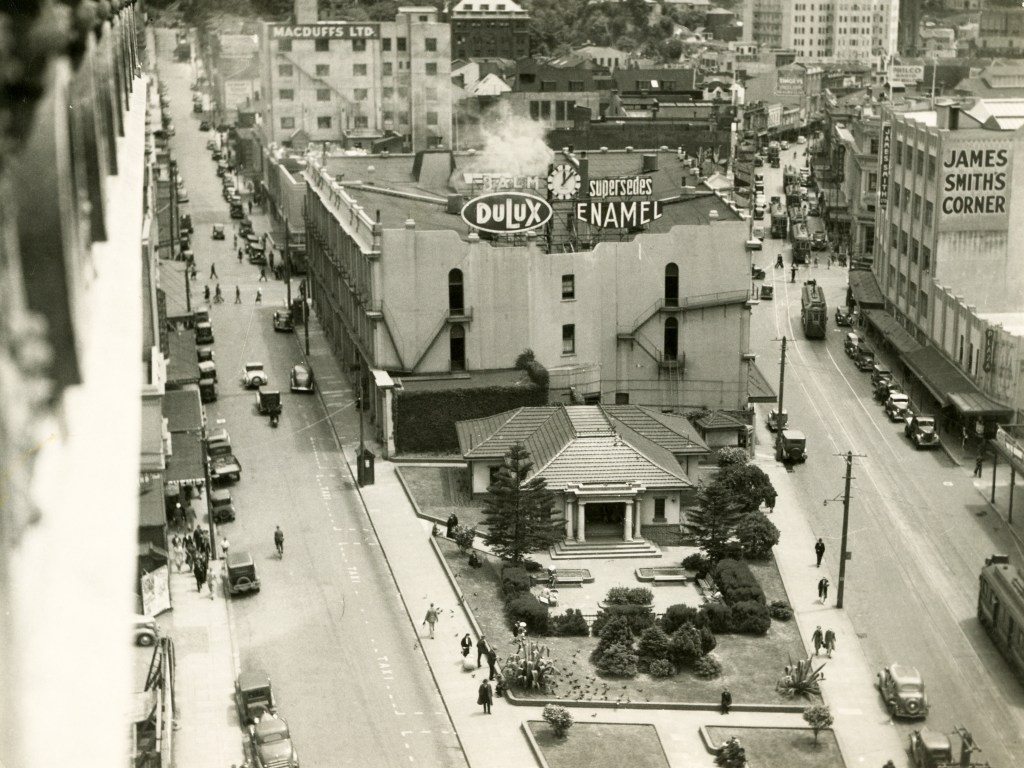
The large building with the Dulux sign was the Royal Oak Tavern, with the Women’s Rest Rooms in front, spread about with some relatively young planting. Amongst the planting are two larger specimens, which even in this distant photo clearly have the form of Norfolk Island Pines. A photo from 1927 confirms this, as when magnified the one member of the pair can clearly be seen, showing the typical symmetrical form of the tree:
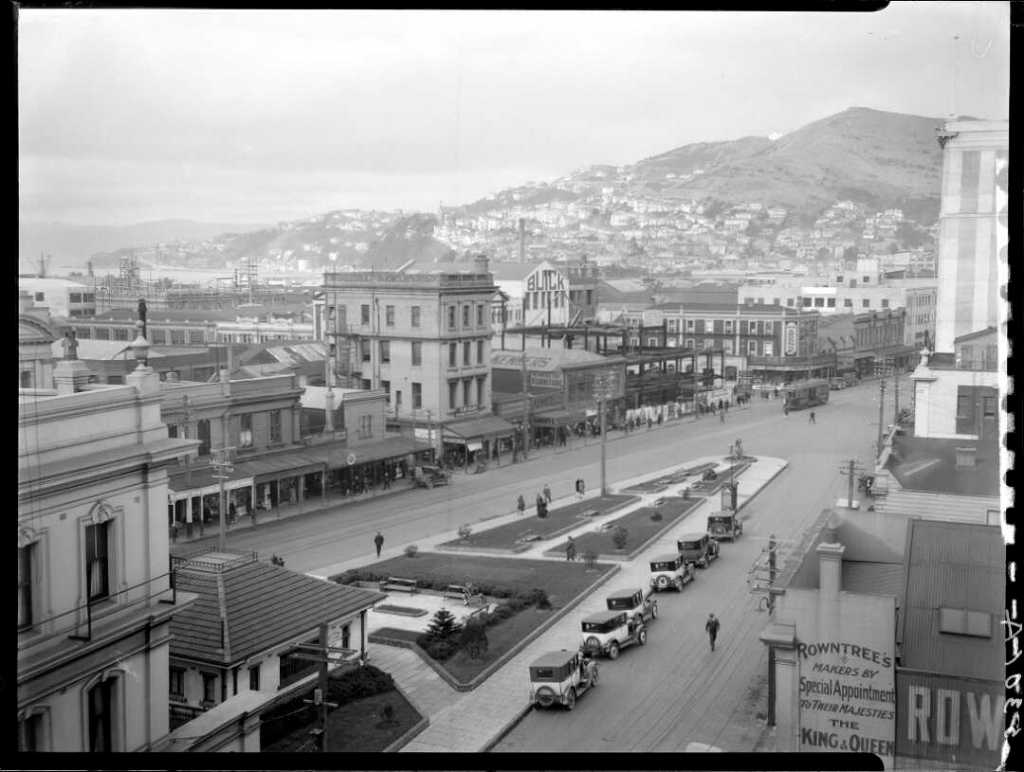
Given the tree in this photo is about 2 metres tall, circa 1925 looks a reasonable planting date for the pair of Norfolk Island Pines. This doesn’t make them the oldest in Wellington, but it does mean they pre-existed perhaps the most well-known Norfolk Island Pines in Wellington, the group planting in Oriental Bay. Later photos show how their size progresses with age, first with a 1957 photo, where we can also clearly see the pohutukawa at quite a reasonable size:

Then by the 1970s the pair have a slightly different height:

By 1987 the smaller of the pair has been removed:
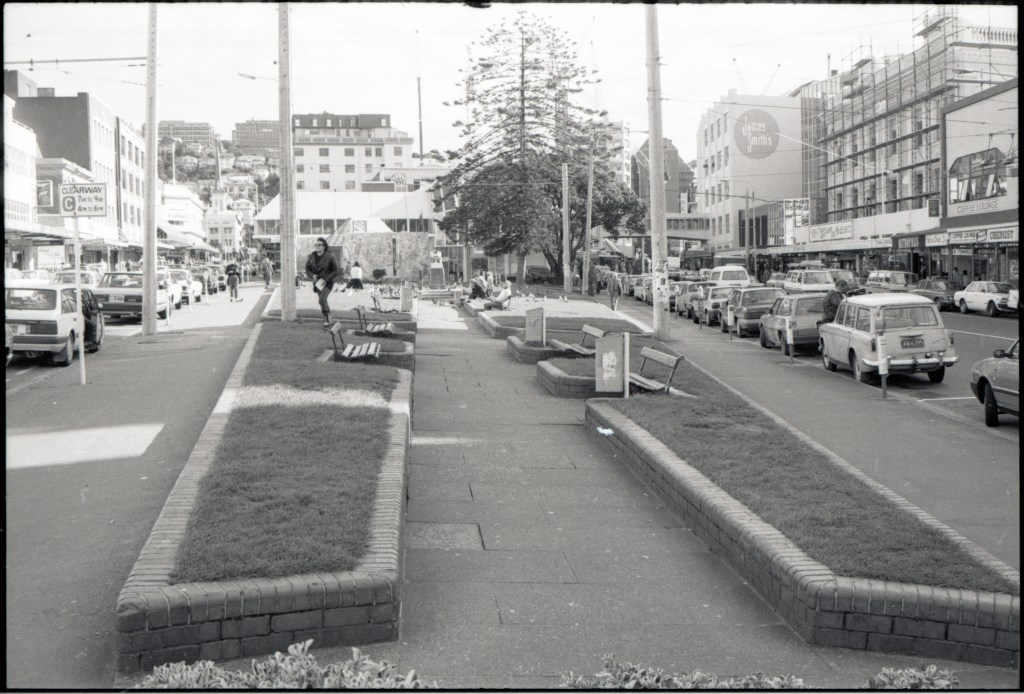
Unfortunately, the remaining Norfolk Island Pine was also removed shortly after. In 1988 the Wellington City Council began a ‘Pigeon Park’ re-development project. There is probably a record somewhere of the decision to remove one or both of the pines, however, given the time and effort needed to find this it is beyond my resources for this current blog-post.
Avoiding speculation on the reasons for removal, the lesson we can learn here actually sets up further investigations. In short, when we come across a noticeable tree, while it may seem obvious, we need to reflect upon what I’d like to call the ‘entangled life history’ of the tree. By this term I’m just drawing attention to what we have seen so clearly here: where one tree remains, growing large over time, it always pays to wonder what else grew there previously, sometimes several decades ago. At the time I saw and photographed the pohutukawa I certainly had no idea that it had shared its growing space for many years with two Norfolk Island Pines. Luckily via resources such as DigitalNZ we can sometimes quite accurately track down these changes.

 The Local Arboretum: Noticeable trees and their stories