Recently I spent two days in Manakau helping a friend with plum picking. This small country town is about halfway between Otaki and Levin, with the main highway going through its middle. The bulk of houses are placed to the east on a gentle slope towards some foothills, giving it a distinct microclimate. If you google Manakau trying to find information, even though the spelling is slightly different, you tend to get links about the large south Auckland suburb called Manukau,. Manakau is so small it does not have a library, and with no help from Google I couldn’t draw upon readily available information in trying to uncover details of the arboreal features of Manakau. Just by looking off the road though, some interesting things emerged.
Taking a break from plum picking, I got on my bike and took a quick cycle around the town itself and then continued a little way further into the rural countryside. There are many large trees in Manakau, but a first thing I noticed was an interesting feature of a verge-planting outside St Andew’s Anglican Church. My eyes were drawn to a small cluster of kowhai trees, which had nice features to their bark and trunks:
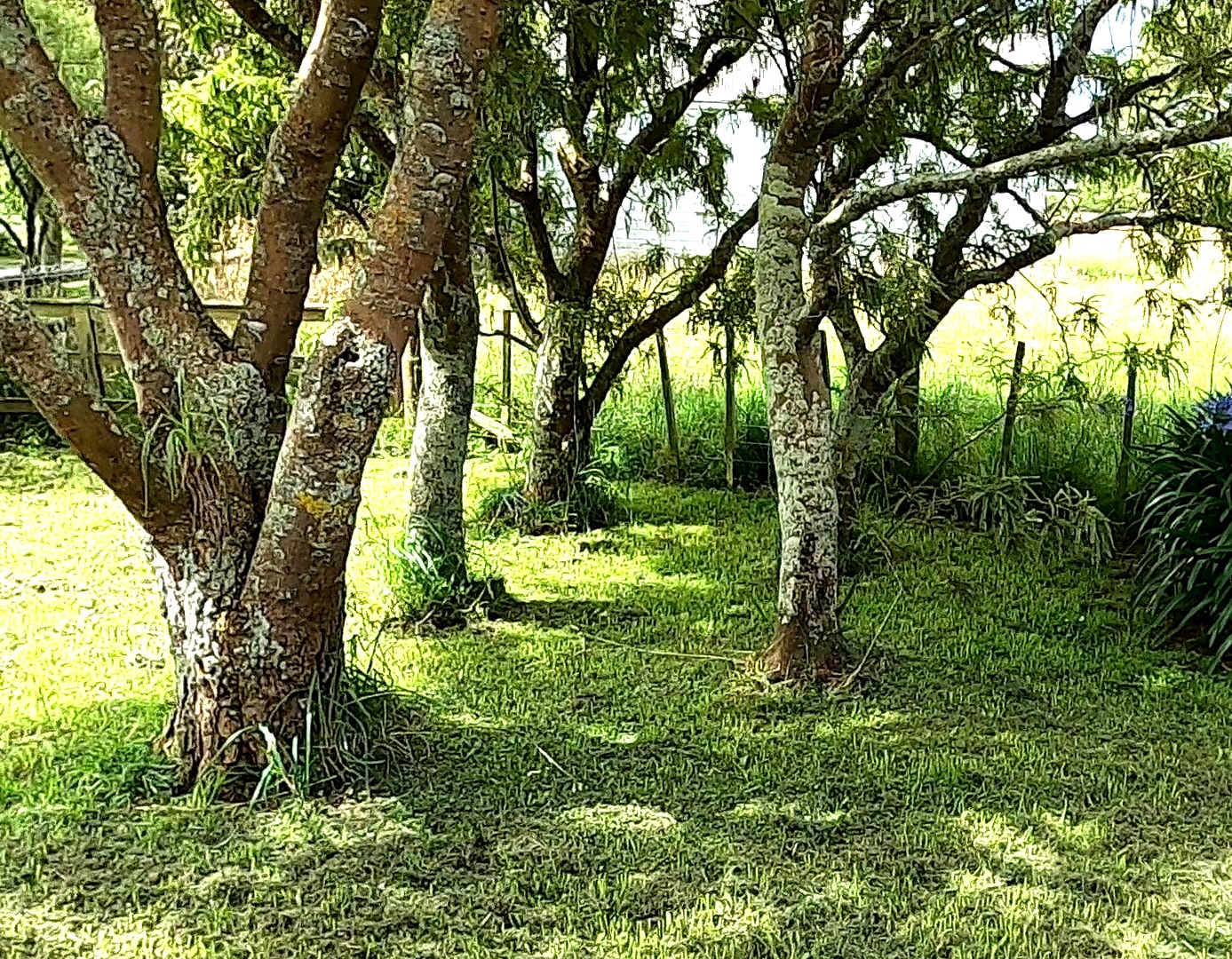
Content with taking some photos I almost biked off, but then decided to walk into the church grounds to have a quick look. It was there by the church gates I noticed something I hadn’t seen while drawn to the group of kowhai:
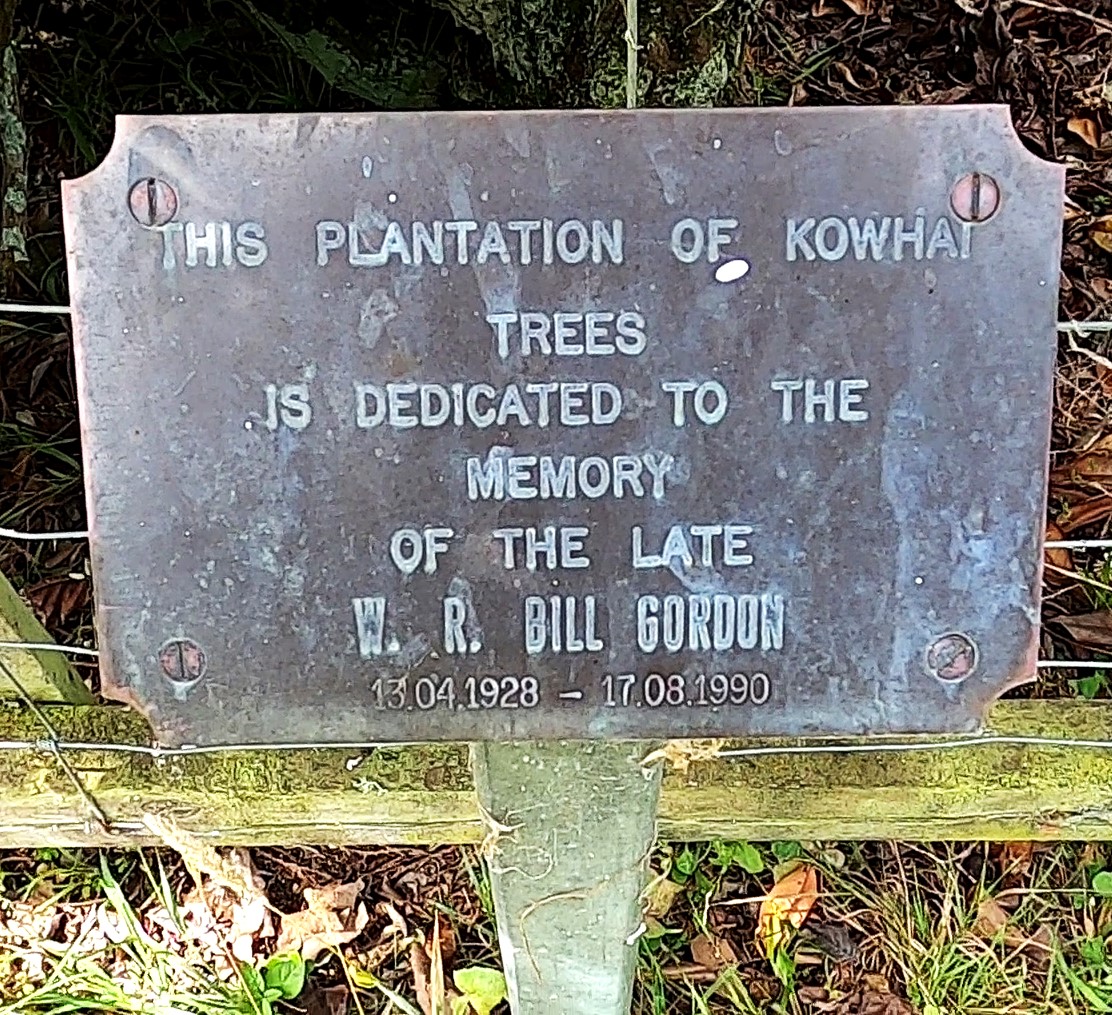
The immediately intriguing thing was why the plaque – attached to a small post – was placed about 20 metres away from the five kowhai trees, as marked in the left margin of this photo:

Standing there looking at the distance between the five kowhai and the plaque I couldn’t answer this question, but the word ‘plantation’ set my thoughts in motion. Five trees wouldn’t normally be called a plantation, so I wondered if formerly there was a whole row of them along the front verge of the church. Perhaps at some stage this ‘plantation’ was deemed too large for the space and some were removed? Maybe my line of thought here was influenced by all the other times I had learnt about tree removals, such as in the previous post. I haven’t been able to find any further information on the late Bill Gordon or whether the planation was larger at some time. Tracking down such information would require tapping into local knowledge, and the only contact I have in Manakau is not a permanent nor long-time resident. In the meantime I’ll have to be content with taking some pleasure from what I would call a ‘cluster’ of kowhai.
I saw no further intriguing plaques in the remainder of Manakau, but a different interest arose a little further out of town. As I turned off the main highway to bike down South Manakau road, I saw a cemetery sign which had a Chinese fan palm (Trachycarpus fortunei) alongside.

We briefly met this palm in the post on plant identification. I wasn’t entirely surprised to see it as they are quite common, but it piqued my interest and so I walked up into the cemetery to have a look. The cemetery is rectangular in shape, bordered by the main highway on one side and a small plantation of Pinus radiata on the other, as shown by a screensnip from Google Maps.
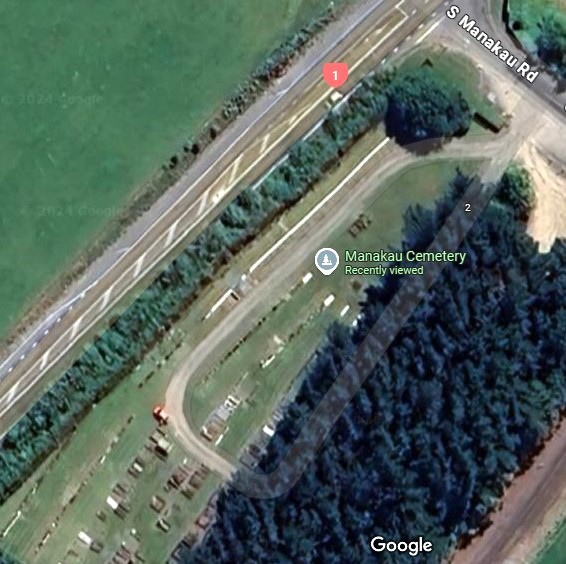
What was interesting as I walked south from the entrance was the part of the map that shows the eastern part of the loop drive through the cemetery. As shown in the map, the pine plantation overlaps it, looking like this on the ground:

The large pines, as typical of forestry blocks, are closely planted. They can be seen growing over a fan palm, a golden chamaecyparis, and some of the gravestones. Both the palms and the golden conifer are managing to grow reasonably well in this situation:
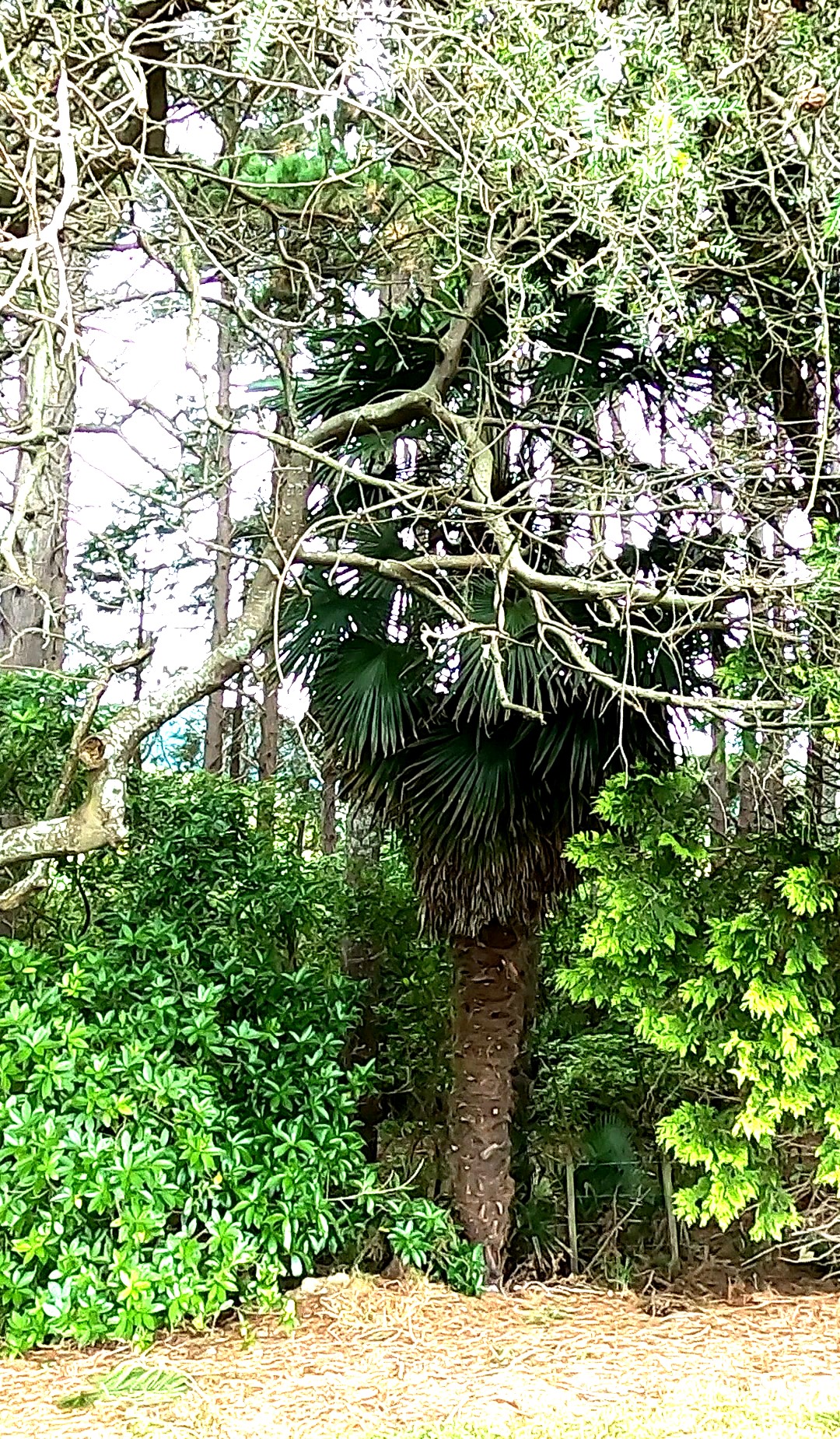
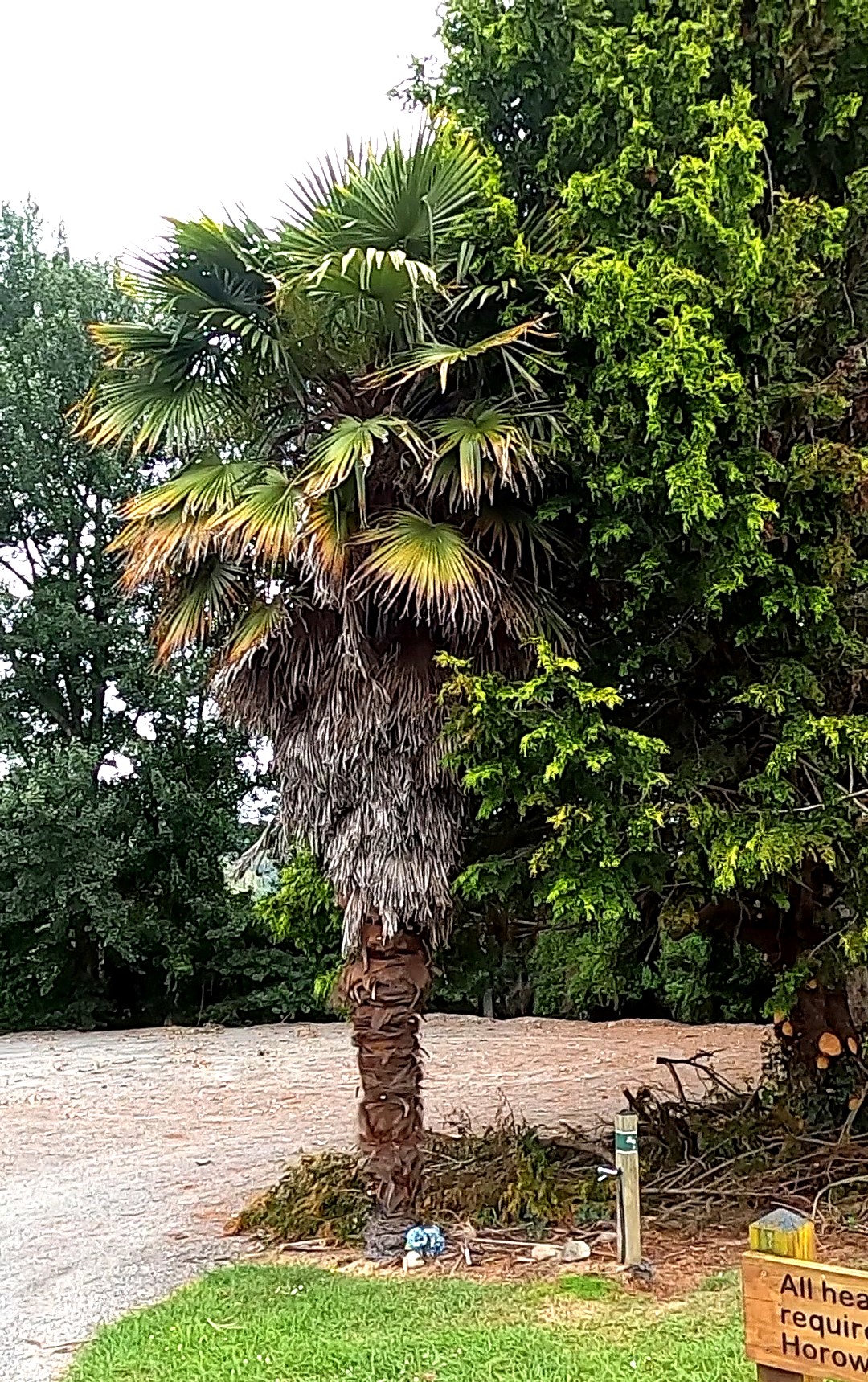
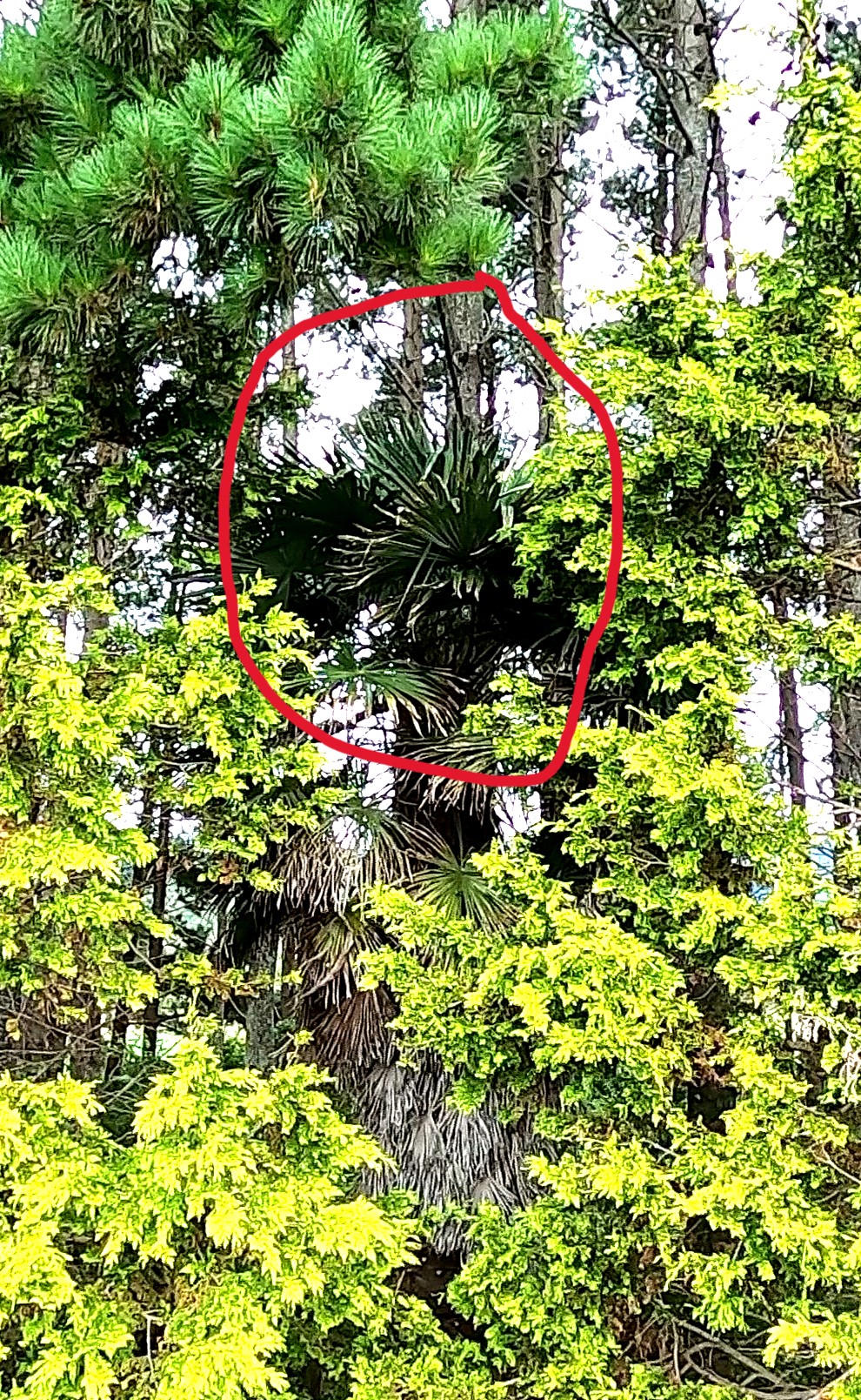
Obviously, neither the fan palms nor the golden conifers are reaching their intended landscape effect in this overcrowded situation, as can be seen from the contrast between the centre and two outside panels above. Interestingly, the fan palms have even managed to encroach into the pine block by self-sowing.

Of course, these seedlings, if left to grow, will never compete with the pines even though their parents were most probably planted before the pines (they are slow-growing). Originally the intent was likely to be something like this well-known early planting of the fan palm in Auckland’s Albert Park:

Currently at 143 years old, one of the cluster in Albert Parrk has just died, suggesting that this kind of age may be the lifespan of Trachycarpus fortunei. The Manakau cemetery palms are probably about half this age, so they still have plenty of years growing ahead of them, pushing up admidst the pines as best they can. Presumably when the pines are harvested, where they overlap into the cemetery, care will be taken to avoid falling branches damaging either of the row of golden conifers and fan palms. In the life of trees, however, nothing is guaranteed, but the risk of damage to the gravestones may help in this case.
Acknowledgment: thanks to Roger and Brenda for hosting me in Manakau, and to Brad, Janine and Mike for companionship during the plum-picking.

 The Local Arboretum: Noticeable trees and their stories