In an unplanned manner, previous posts have often featured what New Zealanders know as ‘macrocarpa’, or as they are called elsewhere, ‘Monterey Cypress’.The latter name is because it is Monterey, California, where the cypress has the smallest extant range of any North American conifer. Included in that small area is the Lone Cypress of Carmel Bay, described as probably one of the most photographed trees in North America. If you visit the wikipedia site where the tree is described and illustrated (see the previous link), you can see the cypress growing on a rocky point over a Pacific Coast bay. The site is impressive, offering a great frame for the tree, helping to explain its photogenic nature. Perhaps adding to the tree’s allure is how over its well recorded history it has lost a number of trunks in various storms. Whereas Its canopy is now significantly reduced, it hangs on, still looking impressive on its vantage point over the sea.
Slope Point, the southernmost part of the New Zealand’s South Island, is a long way from Carmel Bay, but it too has some famous macrocarpa. I don’t know where it would rank in a list of New Zealand’s most photographed trees, but in 2016 a group of macrocarpa at Slope Point made it onto a list of the 16 most beautiful trees in the world. This resulted in many photographs being taken and shared. The New Zealand Tree Register entry describes the group as ‘extraordinary’, noting however that their description as beautiful ‘may be arguable’. I tend to agree: beautiful is not the first word that comes to mind when viewing the trees (via the photos). ‘Beat-up’ seems a more apt description, as it is their strongly weather-beaten and contorted growth that strikes the eye. They are relatively tall, still growing, but in a remarkably constrained manner. The article on the wind-contorted macrocarpas at Slope Point and the other 15 ‘most beautiful’ trees can still be viewed, but in wandering around various places it has become clear to me that there are dozens more such beat-up macs.
In Under the Macrocarpa Part 1 we came across a tree hut in a Raumati Beach macrocarpa, so let’s start here with another tree-hut macrocarpa, this time in a central urban area of Wellington:

This tree hut does not have a view out over the sea. From a wider shot we’d see that the hut is amongst a large group of macrocarpa and pine trees growing on land too steep to be built on (called Kelburn Reserve). In 2024 the Wellington City Council built a track that winds up past the trees, connecting Aro Valley with the suburb of Kelburn. The three trees we see here are not particularly beat-up, but plenty more close by have been hit hard by Wellington’s notoriously strong winds. Many trees have broken branches, or have been partly felled, however, as we can see the macrocarpa have survived:

The tree hut can be seen upper left, but what we can also see is that one of the macrocarpa that it sits amongst has in fact been partly blown out of the ground. It’s trunk has a strong lean, but it continues to grow. Moreover, the trunk we see in the bottom left corner, whilst almost horizontal, is also still growing:
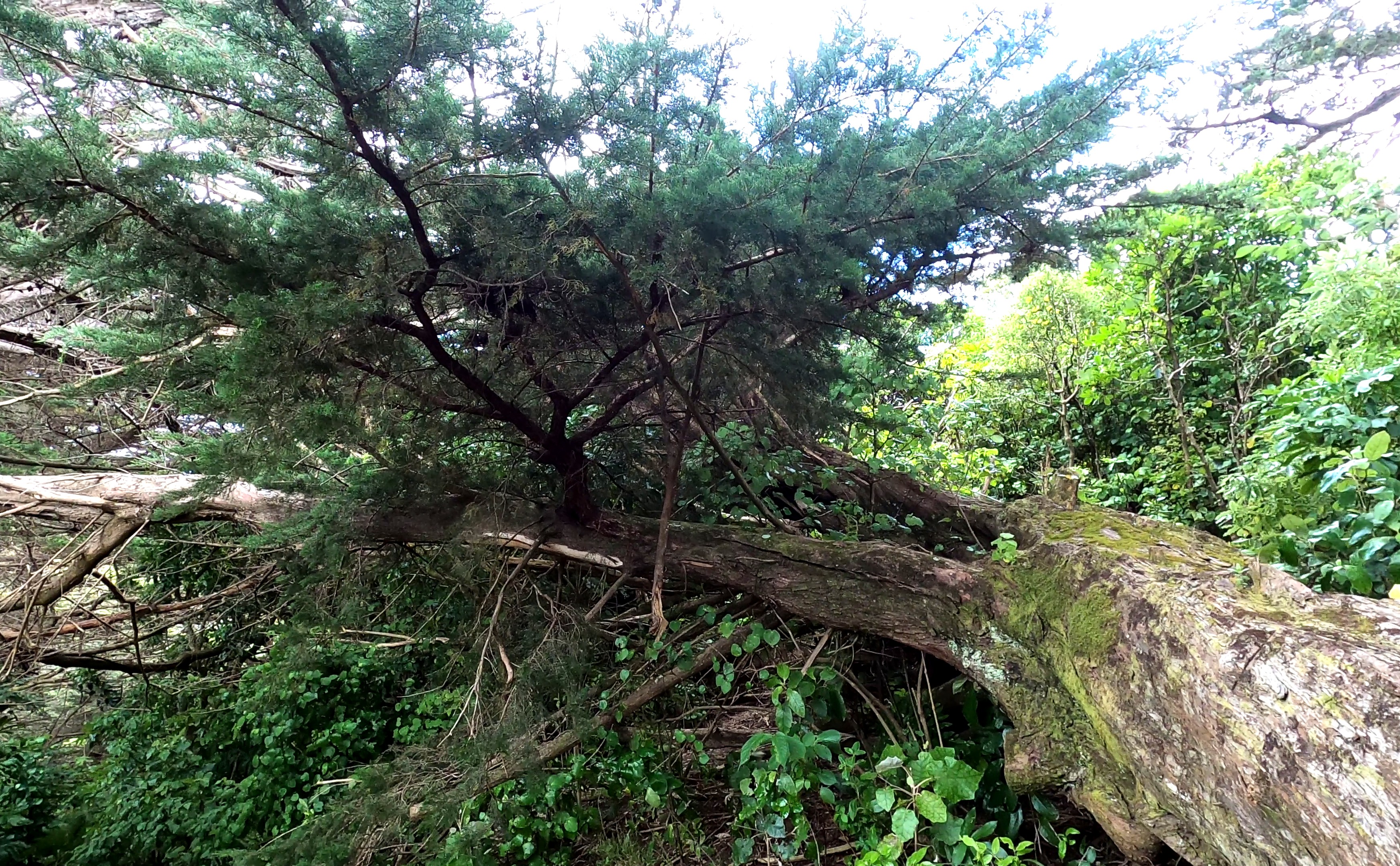
These are clearly ‘beat-up’ macs, but apart from me there aren’t many people stopping to take photos of them. This is probably because in New Zealand macrocarpa are so common, and in this case they are somewhat hidden in a seldom used track, on steeply sloping land.
It might help then if we find an example where the macrocarpa are more easily in public view. Here is something I saw out the window of the train between Upper Hutt and Wellington:
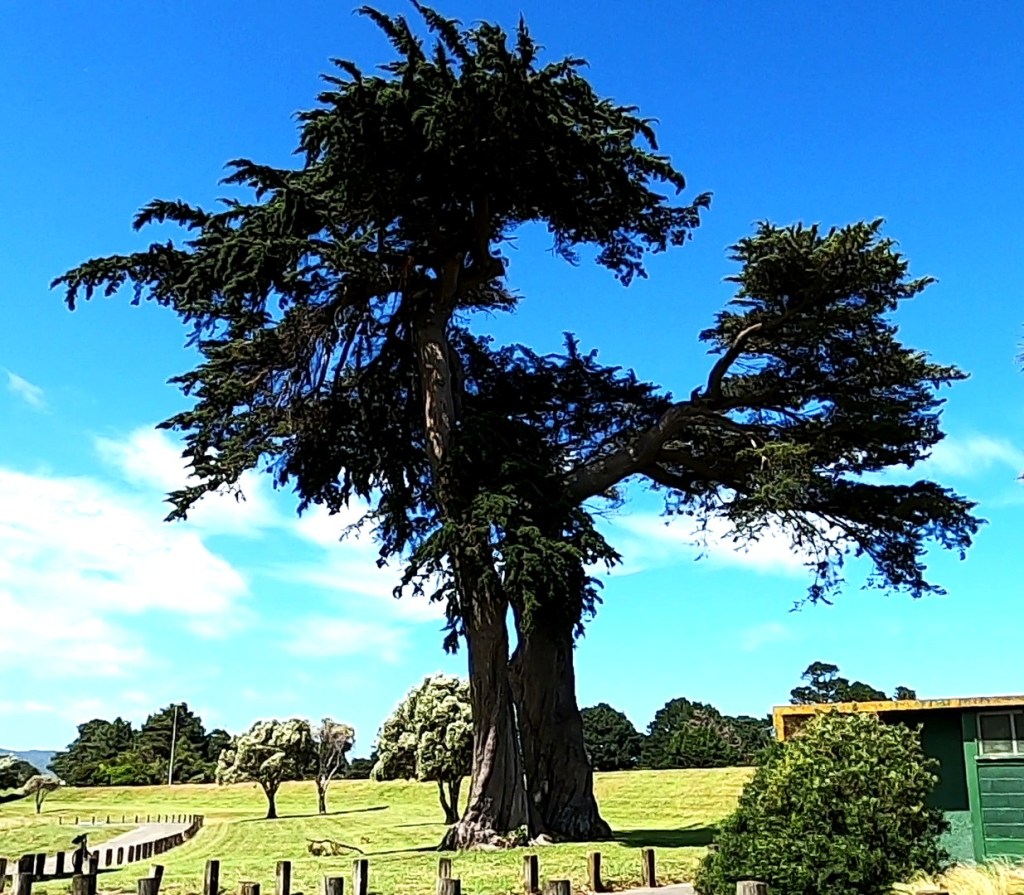
This is a closer view than I had from the train, but the interesting form of the tree is the same. I’m not sure what animal it looks like, but it definitely has an animal-like structure. The train went past relatively quickly, so it was not until I biked out to Sladden Park and looked more closely that I discovered that there were two trees, joined at the base:

Nothing of these views so far suggests we are looking at particularly beat-up trees, but on the day I visited the wind was strong and the tree branches were giving off constant creaking noises. Also, a large branch on the left member of the pair had broken and was hanging down, twisting in the wind. The photo does not show it clearly so I’ve marked where the large branch was hanging down, twisting in the wind:
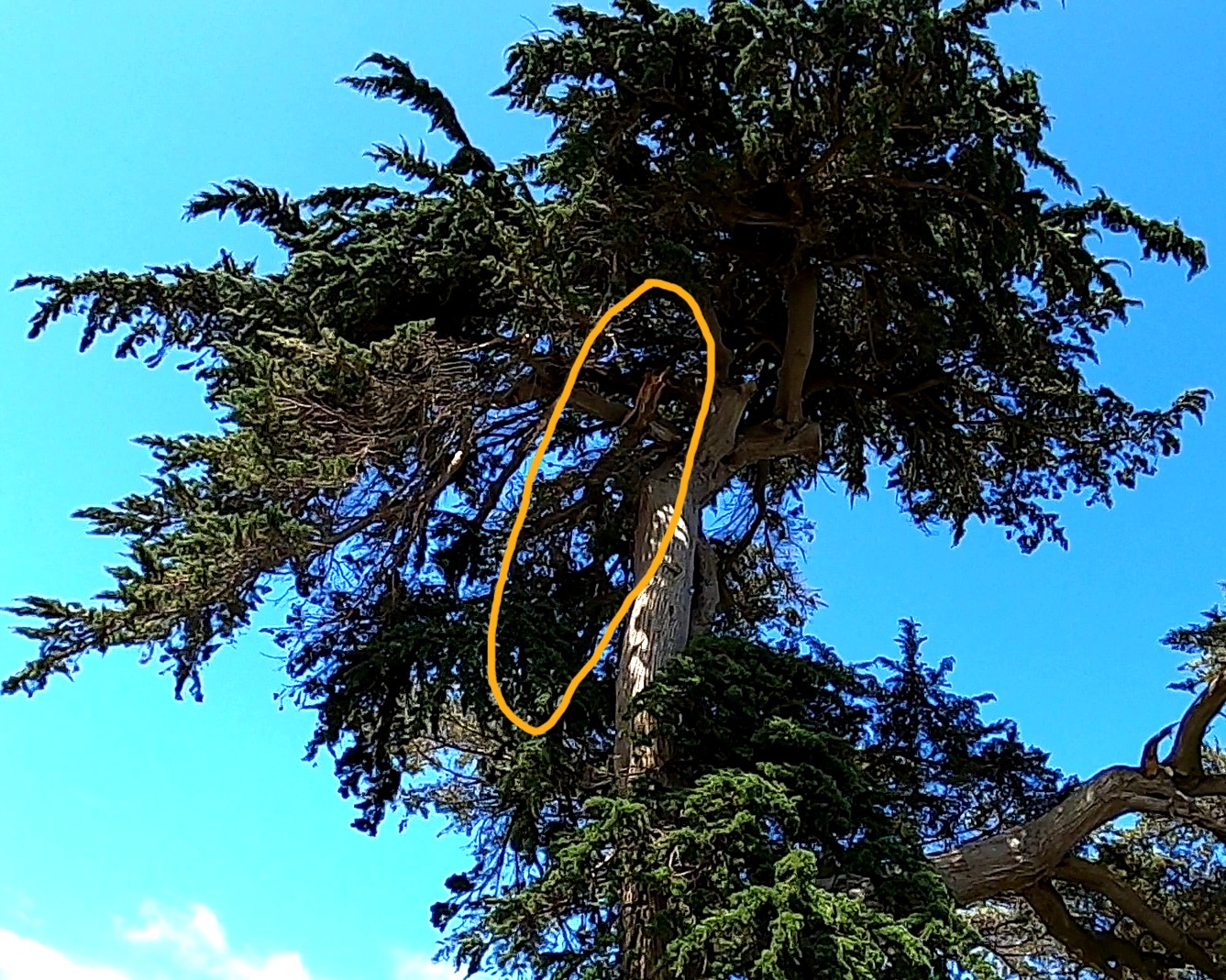
I haven’t been back to check, but I’m sure that it would only be a matter of days until the branch would have finally separated and fallen to the ground. Given the age of the trees and the number of high branches exposed to Wellington’s winds, this is going to be a constant feature of the life of these trees. This may also mean the evocative shape changes significantly over time. Undoubtedly, such branch loss has already contributed to the shape of the tree, something not quite as photogenic as the Carmel Bay Monterey Cypress, nonetheless noticeable in the broader vista:

Into the countryside
Macrocarpa have been used as a hedge or shelter belt tree in New Zealand farms since the 1860s, so it is no surprise that the rural countryside is where we can find many more beat-up macs. I wrote about some trees in Manakau in a previous post, but while biking about there I also glimpsed in the distance a tree at first not identifiable, but which upon closer inspection was found to be a very impressive beat-up mac. It is worth several photos:
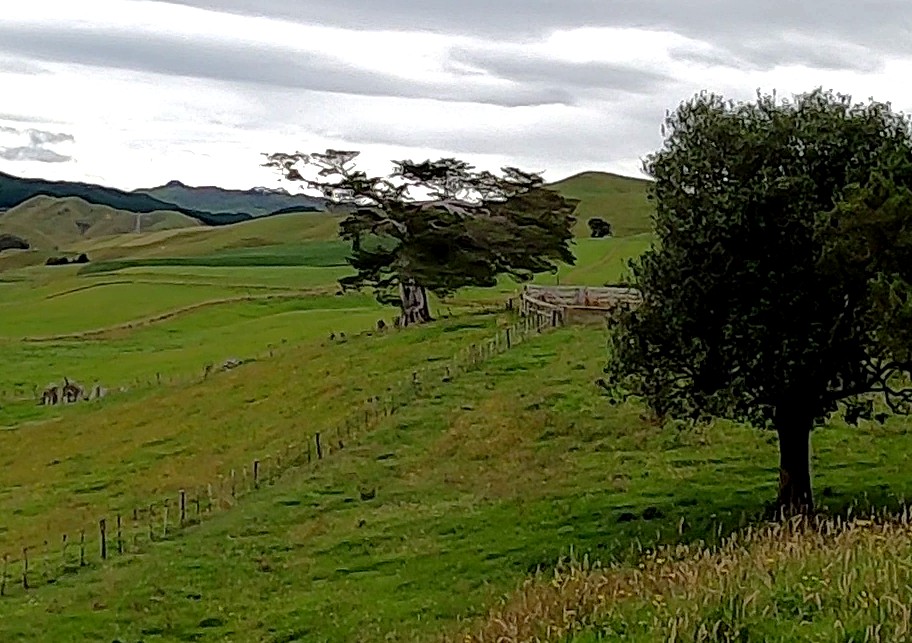
This is the view once onto the farm, by which stage it is clear it is a macrocarpa. It is of considerable size and has a very interesting form. Getting closer still, both the wide spread of the canopy and how much cutting the tree has had over a considerable period become clear:
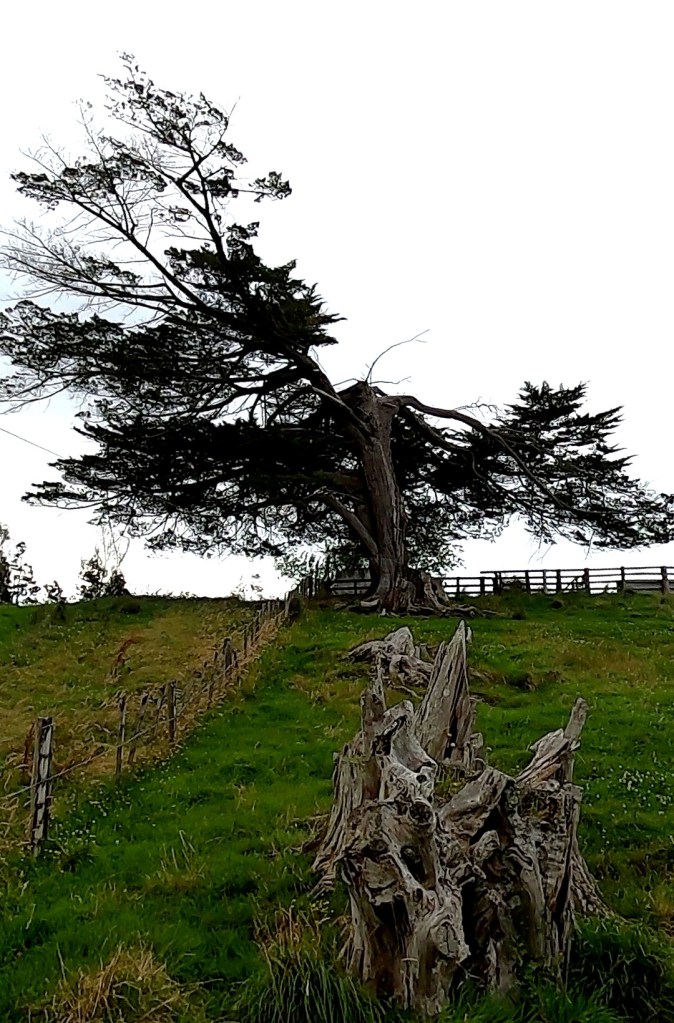

The view from down below looking up gives the best sense of the scale and gravitas of this beat-up mac:
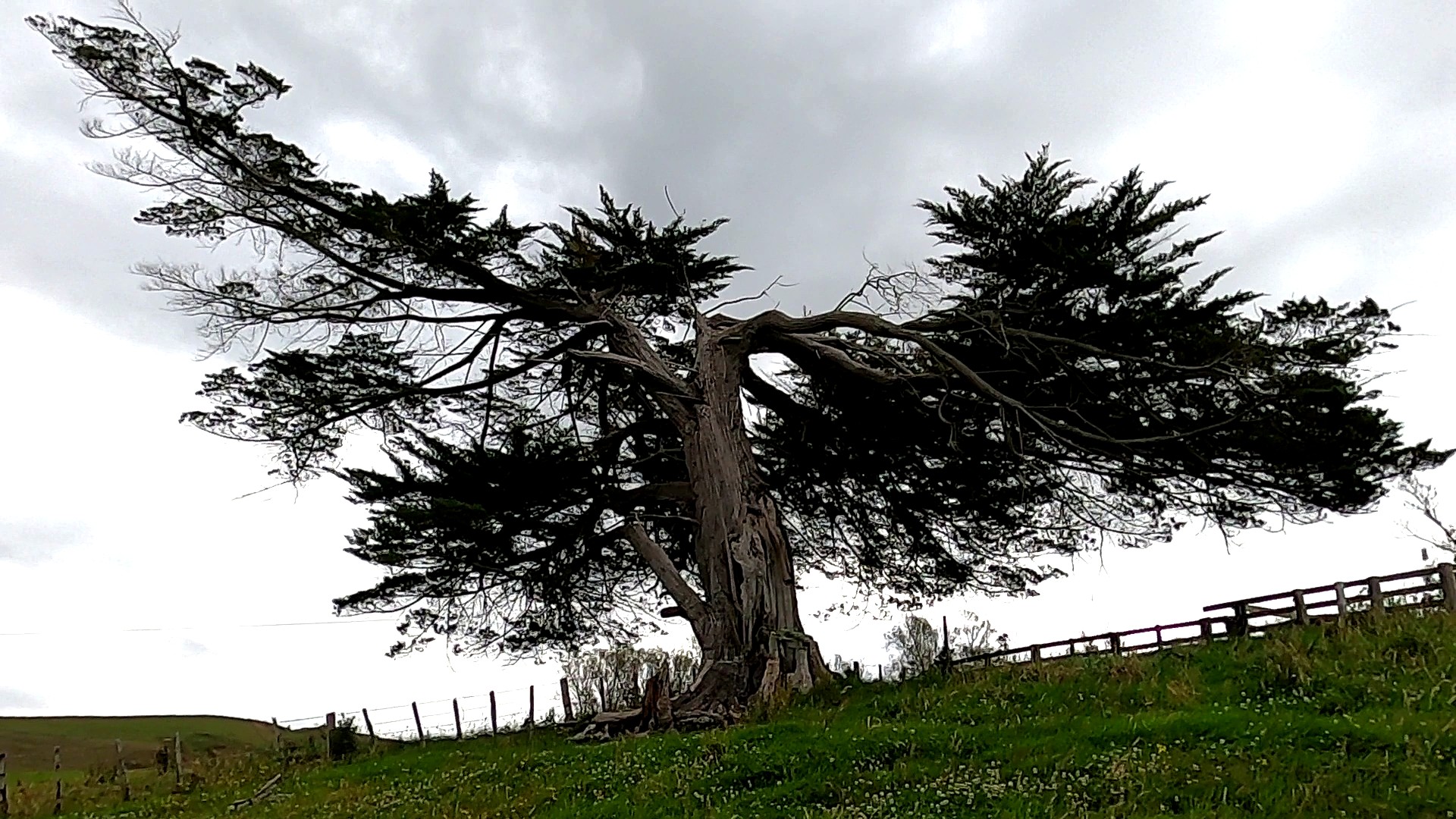
Obviously it has at some stage had its central leader blown out, leading to the broad width of the tree’s canopy. The photos fail to do it justice, but walking around it I felt this was a remarkable tree.
Just over a hill from Wellington
South Makara valley is literally a 10-minute drive from the western Wellington suburb of Karori. It has a golf course and access roads to a large wind farm, but the dominant use of the land is still farming. This 1956 photo shows very bare pastures, though even then the pines and macrocarpas were fairly large:
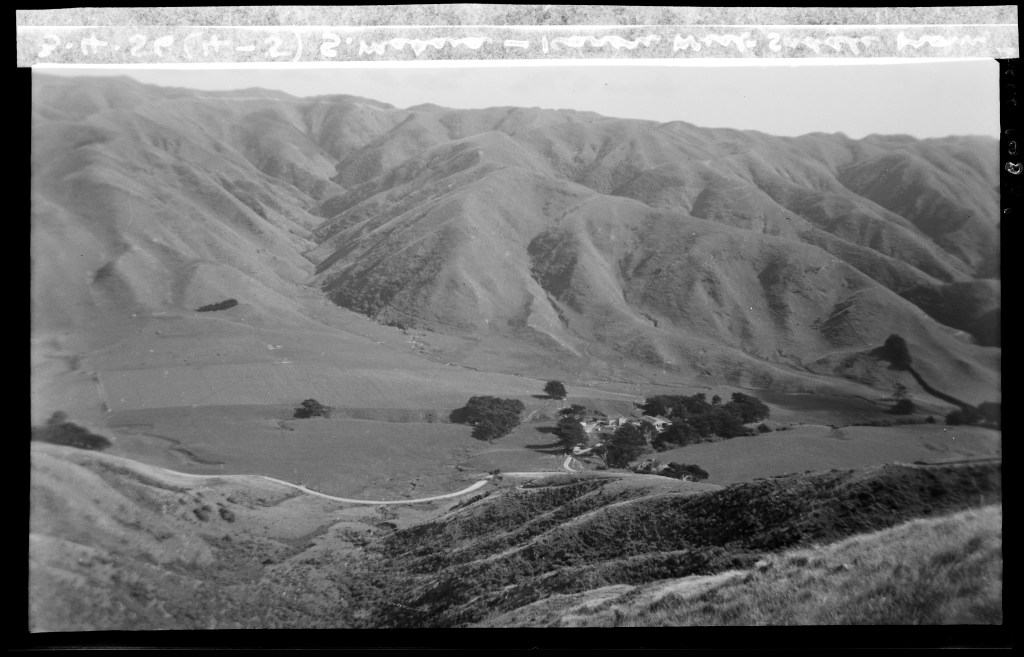
Source: South Makara – Karori West saddle from Hill, 1033 feet, 03 April 1956, by Leslie Adkin. Te Papa (A.008156)
I began my bike through the valley a few kilometres to the right of this scene, actually where there is a large cemetery on a hill site. Coming down from the cemetery I was greeted with this sight:

All but one of the trees seen here is a macrcocarpa, which is not surprising given the 1956 photograph. But looking across the road from the cemetery I was struck by the one macrocarpa to the furthest left. At first glance it looked dead, but then when I looked more closely it could be seen to still have some green foliage. Walking down to get a closer look, the trees I walked through presented a fairly common sight in farm paddocks:

Crossing a small creek I got to the very obviously beat-up mac. To the left of the tree is where the southerly wind would hit, and perhaps this explains why the remaining growth – still quite green – is on the side away from the force of this wind.
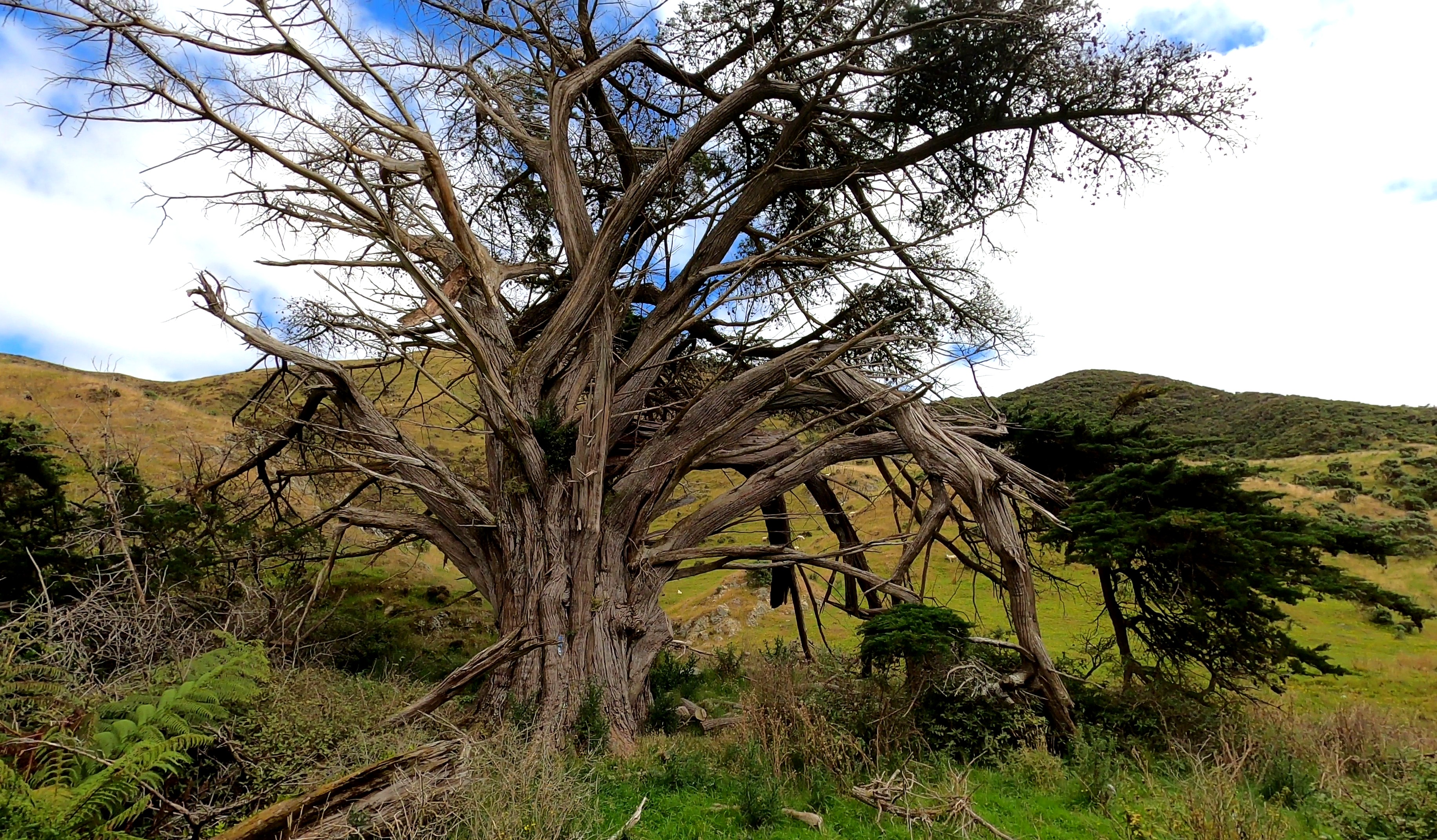

It is hard to say how much longer the tree will hang on for. In contrast to the Manakau farmland mac, the beating this one has suffered seems to have come solely from natural elements. Though, of course, with the Manakau mac the basal trunks may have been cut after they sustained some initial wind-damage. Either way, the fact these trees have survived for so long is impressive. I don’t expect bus tours of such trees will begin anytime soon – this would seem to require a framing akin to Carmel Bay (or Slope Point). But they have certainly proven photogenic for me, and if it is not traditional beauty one is after in a tree, then these beat-up macs are undeniably eye-grabbing.
More than photogenic?
In the Carmel Bay area where the Monterey Cypress has its home artists, writers and poets have built it into their creative endeavours. Weick quotes a line from Jeffers’ 1925 poem ‘Granite and Cypress’: ‘White-maned, wide-throated, the heavy-shouldered children of the wind leap at the sea-cliff’. I’m not much of a judge of poetry, but this is undoubtedly powerful and evocative. Of course, macrocarpa can be found in New Zealand seascapes, which are equally as prone to the forces of wind and sea, but perhaps it is the predominant association with rural farm scenes that is holding our local poets back? I’d be happy to be proven wrong: is there an extant poem appreciating the charismatic beat-up macs that so heavily populate our pastures? In the meantime I hope this spread of comment and imagery has not been too celebratory. Beat-up macs are not beautiful, but they are extremely noticeable.

 The Local Arboretum: Noticeable trees and their stories