In the ‘Pohutukawa Town‘ post I mentioned a man nicknamed ‘Pohutukawa Mac’. I suggested he deserved a post of his own given his role in promoting pohutukawa in Wellington. Recent reportage on the removal of some pohutukawa has convinced me to do this sooner rather than later. A Dominion Post article, ‘Pohutukawa felling causes concern‘ (15 January, 2025), has some fascinating detail, though the basic story is familiar enough. Wellington Girls’ College had decided to remove some pohutukawa in a part of the school bordering a central Wellington street. They wanted to install a court cover, with the trees being in the area required for this development. The Ministry of Education did a letter drop to nearby residents informing them of this work, and some residents expressed concern about the removal. Their concern did not stop the removal: I visited the site on the 21st of January and the trees had indeed been removed. Trees get cut down all the time so there is nothing unusual about this, but some of the other detail in the article was intriguing, worth quoting:
The council in 2020 has 13, 385 trees recorded in the city’s streets, of which 42% were pohutukawa. Council arboriculture team leader William Melville said at the time pohutukawa were ubiquitous in Wellington because they were such “vigorous” growers. … The trees were not endemic to Wellington, though they were endemic further north, and it was unclear why they were chosen to line so many of the city streets, he said. The council discourages planting pohutukawa in new suburbs in order to increase diversity.
I was well aware the tree was very common in Wellington, but I had never seen this quantitative breakdown. Forty-two percent of the city’s street trees is a stunning figure. It means that if the trees were randomly distributed nearly every second street tree seen in Wellington would be a pohutukawa (assuming the figure is correct). Compare this to media reports on ‘fire-prone iconic’ palms in the Los Angeles wildfires, where the ‘iconic’ palms are reported to be 12% of street trees in a central urban area (the palms are Mexican and Californian fan palms, and Phoenix palms).
I was further surprised with the statement that ‘it was unclear why they were chosen to line so many of the city streets’, with their ‘vigorous’ growth being the only reason given. The council arboriculture team leader must be too busy with day-to-day tree matters to brush up on the history of Wellington trees. It takes surprisingly little internet searching to find an answer to explain why there are so many pohutukawa planted in Wellington. If you google ‘Pohutukawa in Wellington’ near the top of the list is the Ministry of Culture and Heritage’s 15-page article Living Memorials: Pohutukawa at the National War Memorial. Several historic photographs are reproduced and they clearly show how barren the war memorial site was, including this 1932 photograph:

Source:Carillon War Memorial, Wellington. Crown Studios Ltd :Negatives and prints. Ref: 1/1-037971-F. Alexander Turnbull Library, Wellington, New Zealand. /records/22304459https://natlib.govt.nz/records/22304459
Naturally, not long after this, planting began in earnest. Given the significance of the site, Lord and Lady Galway – the then Governor General and his wife – were enrolled in the 1935 planting of pohutukawa, as seen in this Evening Post photograph:
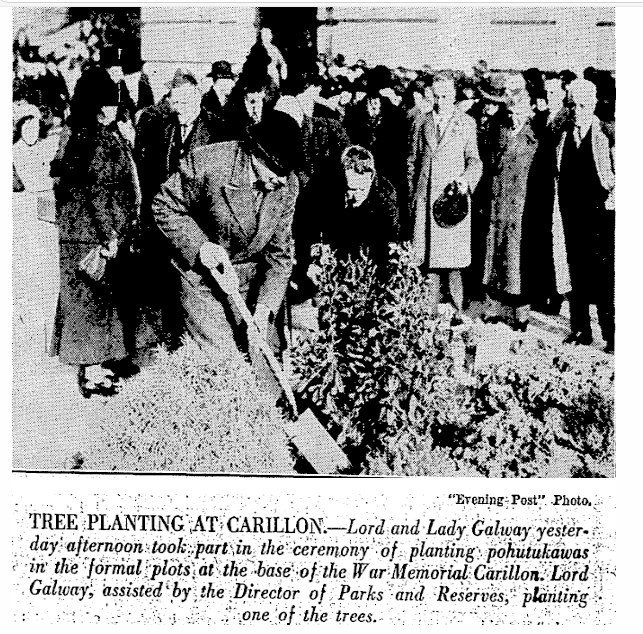
Lord Galway is holding the spade, and the man to his left is J.G. MacKenzie, Wellington City Council’s Director of Parks and Reserves. It is easy to assume that the Governor General and his wife were purely there in a ceremonial role, but they were actually keen gardeners (see NZTR entry on Government House gardens), however, in this case we have to think that it is MacKenzie who chose the pohutukawa. As detailed on page 11 of the Ministry of Culture and Heritage article, MacKenzie was nicknamed ‘Pohutukawa Mac’ for his role in persuading garden groups and citizens to plant pohutukawa in Wellington suburbs.
If we jump forward 90 years from this joint planting activity we can see how much the pohutukawa have grown:

At the time of this photograph the carillon was undergoing refurbishment, but clearly the pohutukawa look splendid and there are many more equally large specimens around the war memorial site. So, it looks on the surface as if we should give due credit to Pohutukawa Mac, however, if we extend our internet searching here, a second search route turns up more interesting detail.
Moving down the search results we come across reference to the New Zealand Tree Register, a freely available national register of New Zealand’s native and exotic notable trees. Opening that link, and then searching the database under ‘Metrosideros excelsa and Wellington’ gives 7 results. Three of these are actually in Lower Hutt, meaning it is a quick job to look at the remaining four. Doing so quickly turns up a listing for the pohutukawa in the Wellington Botanic Gardens, which we met in the earlier post the pohutakawa and the Phoenix palm. If we read through we find it is described as being ‘planted about 1906 in the home of George Glen who was Parks Supervisor from 1901 to 1918. Glen was an advocate for all native trees, but he obviously recognised pohutukawa as a great tree as he made use of it in numerous plantings [Duthie, D. (April 1993), Wellington’s Pohutukawas’, NZ Gardener, pp. 24-25.]’. Glen was Pohutukawa Mac’s predecessor, which clearly shows that MacKenzie didn’t begin the trend of a strong liking for planting pohutukawa.
It doesn’t take much effort to search and locate Duthie’s NZ Gardener article, which is cited in the NZTR entry. Reading it we find that whereas George Glen may have begun the planting in Wellington, MacKenzie extended it to city and suburban parks, the town belt, further plantings in the Botanic Gardens, and extensively as street trees. Writing in 1993, Duthie notes that the latter were particularly notable in Miramar, Seatoun and Kelburn. The group plantings in Miramar and Seatoun are still there, but as I live in Kelburn, it is useful to source an early historic photo and compare this with what we can see now. Here is an historic photograph of Upland Road, Kelburn in 1926:
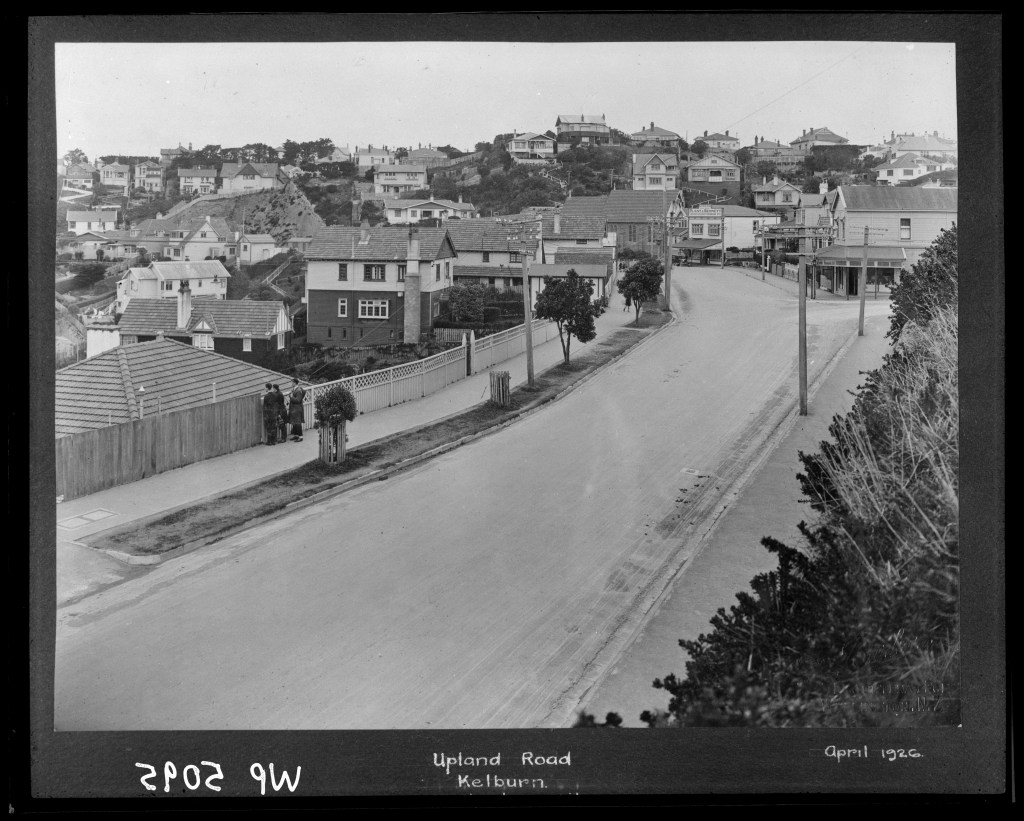
Source: ‘At Plunket Road intersection’, April 1926. Wellington City Councial Archives, 00138-5095
The two trees about 3 metres tall on the road verge, and the one by the group looking over the fence, are pohutukawa. Others were planted on the bank to the bottom right of the frame (which looks to be growing gorse), and whereas it is not possible to take a photograph from the same location as the 1926 photograph, it is easy enough to show how ‘vigorous’ the pohutukawa have been in the intervening 99 years. First is a photo from higher up, and then down at the roadside:
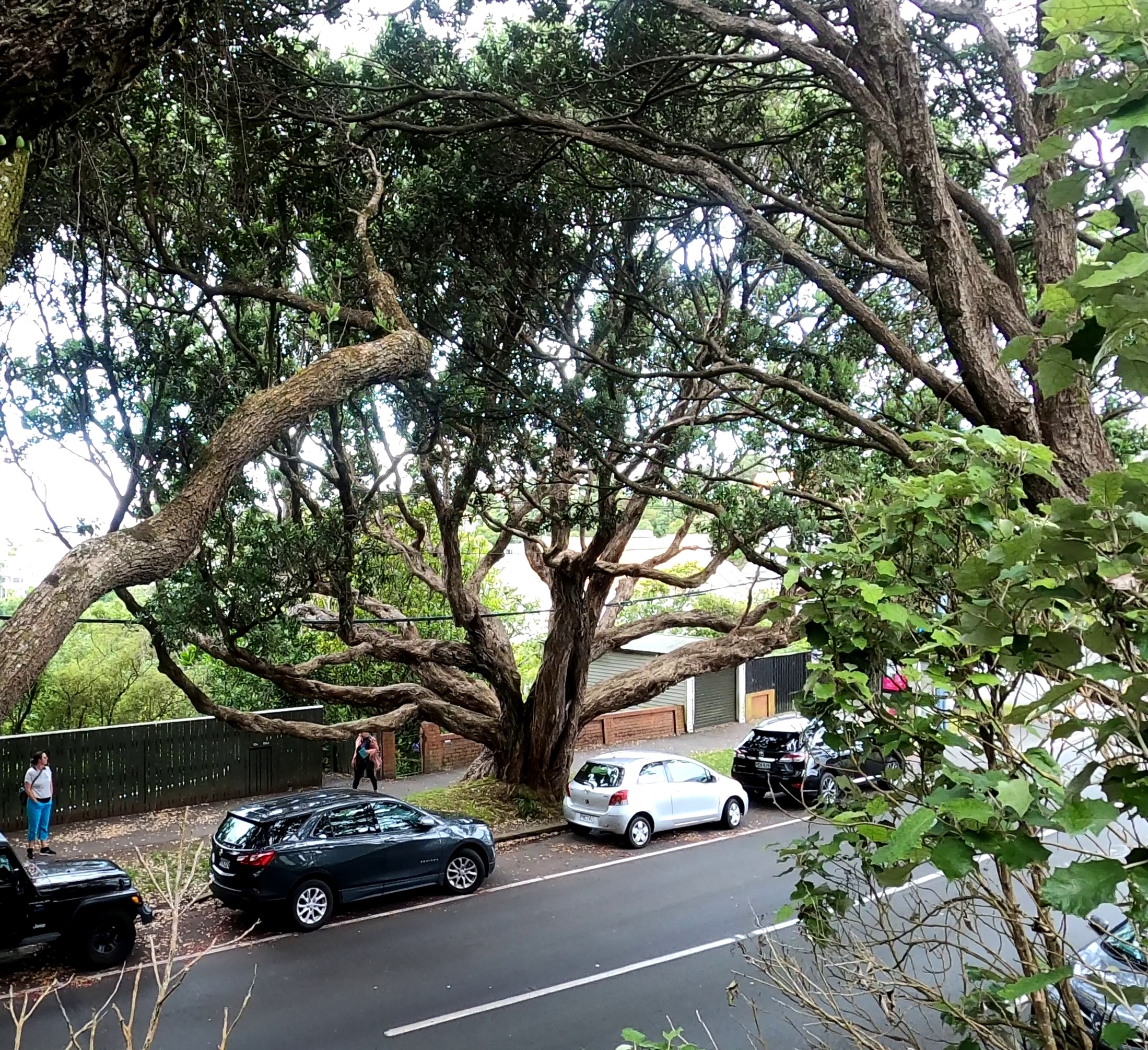

Clearly, the pohutukawa is now taking up the full width of the footpath, and actually extends across the road in a tunnel-like effect. The multi-trunk form of the tree shows a distinct advantage here: the tree can be pruned to accommodate the overhead power line without destroying its natural form. Of course, it is not known whether Pohutukawa Mac was actually involved with choosing the trees for this location, nonetheless the height of the trees in the 1926 photograph would suggest a planting date somewhere about 1920-23. This is only a few years after MacKenzie began his directorship of Wellington Parks and Gardens – certainly enough time for him to put into action his strong preference for pohutakawa planting in Wellington.
Contemporary Times
I know little about the processes whereby Wellington City Council currently chooses what to plant, but you have to think that it would be very unusual for one person to be able to exercise their plant preference as Pohutukawa Mac clearly did. Pohutukawa are a beautiful tree, with many assets: the stunning red flowers, the gnarly multi-trunk, the hanging aerial roots (often red-tinged), and indeed their vigorous growth. But forty-two percent is a figure admitting talk of monoculture (do a bit of reading on the Irish potato famine to see how disastrous that can be). Forty-two percent of 13, 385 is 5, 621 pohutukawa trees in central Wellington, and that is not including private gardens. We have to take the Council arboriculture team leader’s word for it when he says planting is now being discouraged in suburban streets, but not too long ago (about 2005) when Wellington’s waterfront Waitangi Park was re-developed (see Nina Price’s MA thesis on this) one thing that emerged is seen in this January 23, 2025, photograph:

No surprise, this is a double avenue of pohutukawa. Without doubt, it will look stunning when the trees on either side grow together, and even more so when they flower. But perhaps at that time if the tourists are still flowing off the cruise ships, and they have walked through the Wellington CBD past plenty of other pohutukawa, there will be no need to take another photo of the ‘New Zealand Christmas tree’. Instead, they may simply puzzle ‘why so many?’

 The Local Arboretum: Noticeable trees and their stories
Leave a comment