In the course of searching for historical information on the Norfolk Island Pines of Patea Cemetery (see the previous post) I came across an article discussing ‘the shelter problem’ in the Patea region. The anonymous author uses phrases like ‘salt-storms’ and ‘southerly busters’ to convey a serious wind problem. After suggesting that ‘it behoves. all to seek for shelter trees which will stand against them’, advice is given about which trees to plant, including this interesting note:
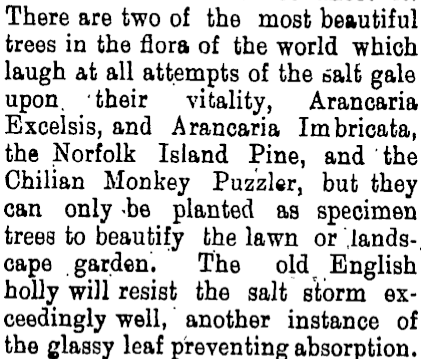
There are a few mistakes in this: it should be Araucaria not Arancaria, excelsa not excelsis, and Chilean not Chilian. Initially, I also thought it should have been Monkey Puzzle not ‘Monkey Puzzler’, as I’d always seen the former as the common name of what is now called Araucaria araucana. So it was a bit of a surprise upon consulting Wikipedia to find the tree was indeed initially known as the Monkey Puzzler tree:
The origin of the popular English language name “monkey puzzle” lies in its early cultivation in Britain in about 1850, when the species was still very rare in gardens and not widely known. Sir William Molesworth, the owner of a young specimen at Pencarrow garden … was showing it to a group of friends, when one of them … remarked, “It would puzzle a monkey to climb that”. As the species had no existing popular name, first “monkey puzzler”, then “monkey puzzle” stuck.
Writing in 1897, the author of ‘the shelter problem’ clearly knew it by its initial name (and an outdated botanical species name). He or she also reiterated the British view that Monkey Puzzlers made great specimen trees.
Forward a few years …
When I was a young nursery/garden centre worker in the early 1980s the Monkey Puzzler name had disappeared. We did not have any for sale in the garden centre, so my familiarity with it probably came from the specimens in the Christchurch Botanic Gardens, which I periodically visited. There were two specimens near the entrance where I would have parked my bike, and luckily there are both historical images of these and details in the New Zealand Tree Register.
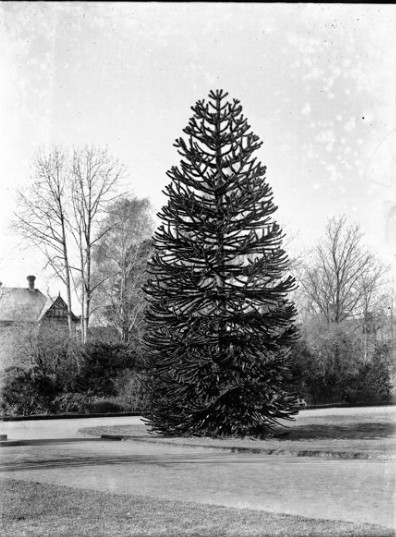
Source: ‘Monkey puzzle tree in the Botanic Gardens’ circa 1900-1906, Collection of Christchurch City Libraries
Obviously the tree I saw in the 1980s would have been much larger than this, but the photo gives a good indication of why the trees were recommended as appealing specimens: they have a remarkably symmetrical form. Of course, this was also true of the Norfolk Island Pine which was being heavily planted about New Zealand at the time the above photo was taken. But the added tightly whorled nature of the foliage of the Monkey Puzzler perhaps gave it more noticeability than the Norfolk Island Pine, which was most often used in seaside plantings (like Patea).
The New Zealand Tree Register (NZTR) database entry tells us there were at least two Monkey Puzzle trees planted in this location in the Christchurch Botanic Gardens. They were planted by Governor George Bowen on 10th April 1870, unfortunately being removed in October 1996 (the entry has four excellent historical photos). At the date of first entry on the NZTR – 1970 – one tree was 21 metres tall, so clearly by the date of their removal they would have been a significant sight. Luckily one Monkey Puzzle tree was planted at a later date and still remains in the Christchurch Botanic Gardens, also having an information panel beside it, as I saw on a visit in November 2024:

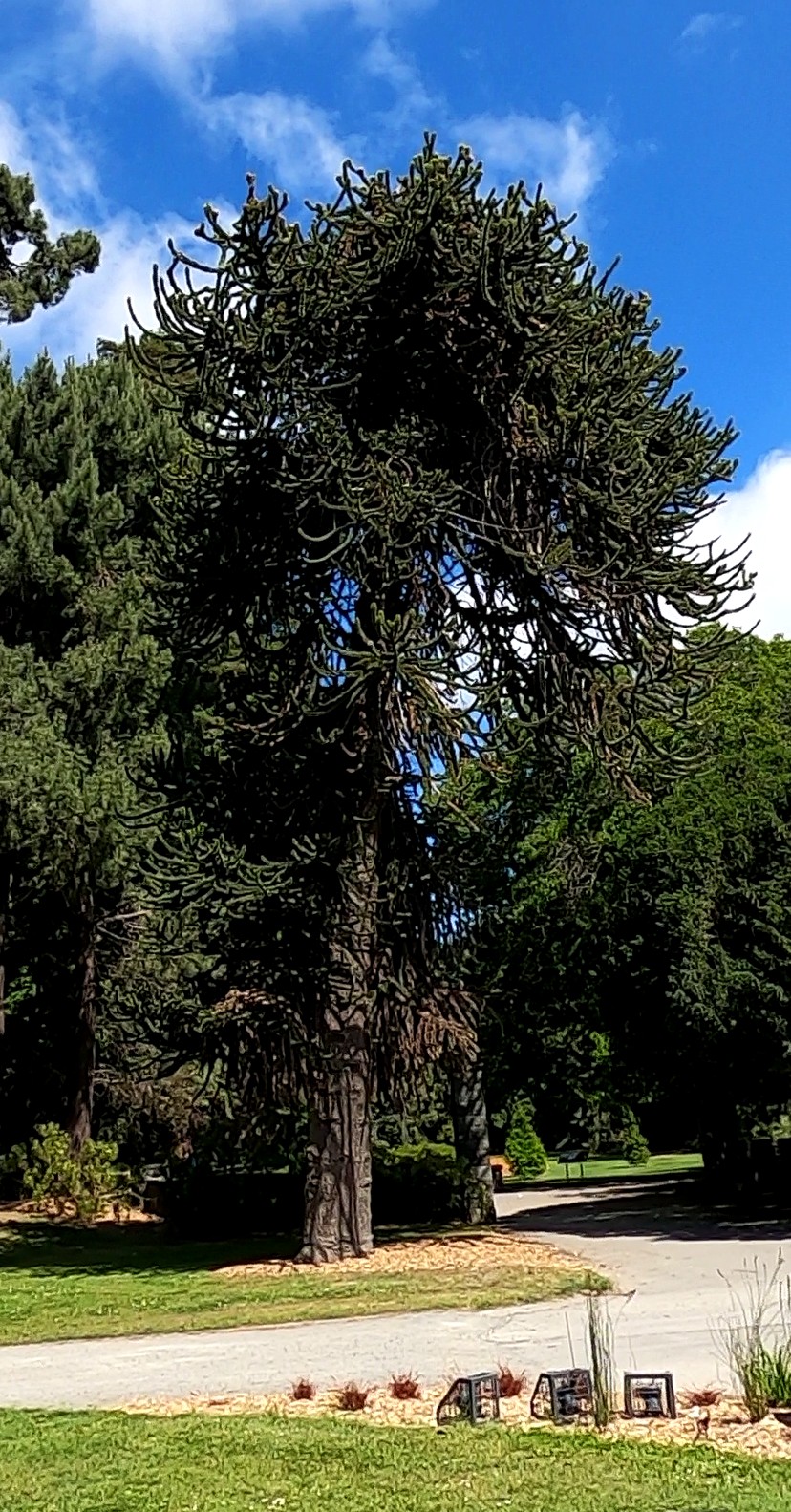
Source: Author, November 2024
A must have ‘Botanical Curiosity’
I’m sure the staff at Christchurch Botanical Gardens would have researched the history of Monkey Puzzle planting, so the characterisation as a ‘botanical curiosity’ will be well-justified. Interestingly, I came across some visual evidence to back this up:
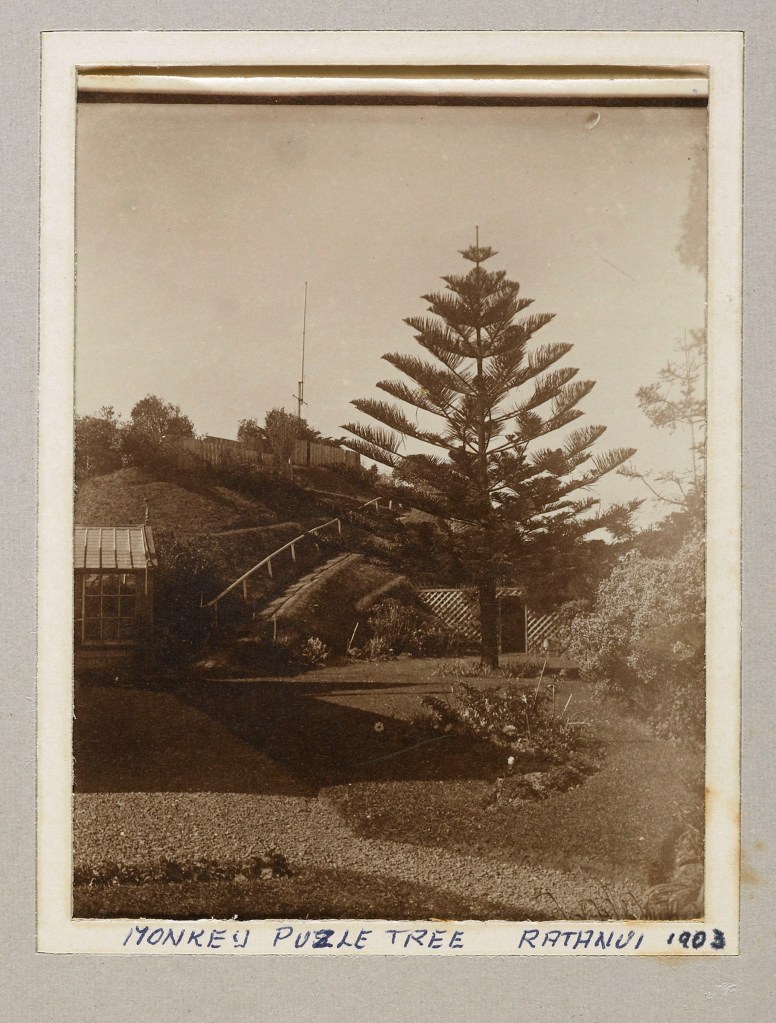
Source: Monkey Puzzle tree Ratanui 1903 unknown photographer, Te Papa 0.042222
A bit like ‘the Shelter Problem’ newspaper article there are several mistakes on view here: ‘Puzle’ instead of puzzle, and more interestingly, the tree is wrongly identified – it is clearly a Norfolk Island Pine. Even a non-gardener should be able to see the difference between this tree and the ones we’ve already seen above. It is a member of the same genus, but it is a different species, ie. the Norfolk Island Pine is Araucaria heterophylla. What makes this worth noting here is not so much the mistake, but an extra inference. Ratanui was the Wellington residence of James Hector, who besides being the first manager of the Wellington Botanic Gardens in 1869, later managed the New Zealand Institute which in 1933 became The Royal Society. In short, Hector would not have made such a simple mistake in tree identification. So perhaps it was the photographer or some other person (a child?) who mistakenly captioned the photo. While getting the identification of the tree wrong, their mistake nicely indicates the then desirability of a Monkey Puzzle specimen tree for gardeners of the period.
Three final historic photographs
It is very rare to be able to trace the first planting of an introduced tree in New Zealand. We can often get close though, and in the left corner of this photo we see probably one of the first Monkey Puzzle trees planted here:

The NZTR entry (Cadwallader 2015) for this young Monkey Puzzle tree says it was planted at J. Acland’s Mt Peel Station in 1859. The photo is undated, but we can at least say via the resource of Google maps that the tree is still present. At 166 years old it is very likely to be one of the oldest in New Zealand.
If the Mount Peel Monkey Puzzle tree was one of the first in the country, it is reasonable to assume that word about it would have rapidly spread in the local region. In those days, this was more likely to be by word of mouth or actual viewing, so it is interesting that we can find other South Canterbury homesteads proudly displaying their own Monkey Puzzle tree. The first is in Temuka, the second in Rakaia, both nowadays a short drive from Mount Peel.
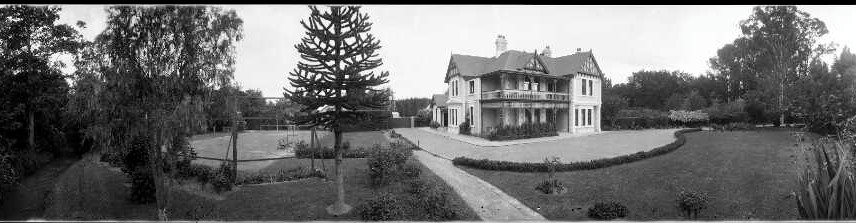
The 1925 photo gives a good indication of the wealth of the Trevenna’s owners: the house is large as is the garden, which is carefully planned giving central space for the ‘botanical curiosity’ of the Monkey Puzzle tree.
Also photographed circa 1925 is this photo of Langley homestead in Rakaia:
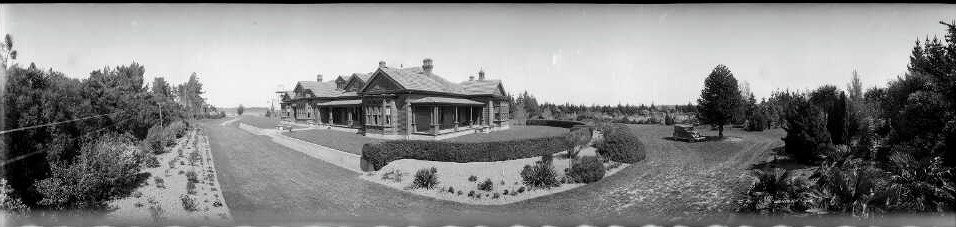
Magnification of the right-hand side of the photo is useful here:
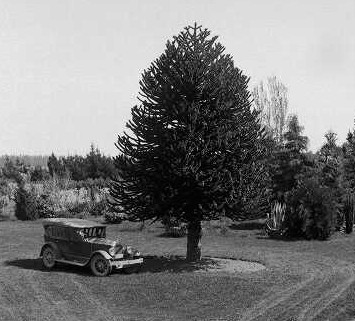
Just like any contemporary ‘published selfie’ we have to think the elements in the photo were carefully placed and made presentable. Thus, putting the new-looking car right next to the obviously prized (look at the neat mowing circle) Monkey Puzzle tree, clearly emphasises the understanding that in the early 1900s they were indeed a special tree.
Sad Recent News
From about 2012 recent news from Dunedin indicates a mysterious decline in the health of mature Monkey Puzzle trees. Gillian Vine gives a good background to the trees and interviews an arborist who has removed several large trees in Dunedin. There are theories about the reason for the decline, but ultimately no definitive explanation. Other trees about New Zealand will have been removed for different reasons, and it is not known if their ill-health is more widely spread. As the article is titled ‘It’s a puzzle’ (but not a puzle).

 The Local Arboretum: Noticeable trees and their stories