In ‘Photogenic ‘beat-up macs‘ I quoted this line from Jeffers’ poem Granite and Cypress: ‘White-maned, wide-throated, the heavy-shouldered children of the wind leap at the sea-cliff’ (1925, quoted by Weick). This powerful expression needs contextualising: the poet is celebrating the tree in Monterey Peninsula, a landscape different to where most macrocarpa are found in New Zealand. Here they are predominantly used as farm shelterbelts, though noticeable seaside specimens do exist. The dramatic elements in a ‘sea-cliff’ scene can’t be easily matched in typical farmland, but the forms that macrocarpa take can be quite surprising. Longevity is something that can add to the practical functionality of farm environments. Given the tree has been heavily planted since the 1860s in New Zealand, the exposure to the conjoint forces of wind and human alteration over time has left us with plenty to look at. This justifies one further post on macrocarpa, though this is the last on the topic for a while.
Here the photos are chosen to present some of the examples I’ve been struck by. Some indication of where the trees were found is given and some commentary is made, but the aim is to let the images do most of the work. They are all in black and white as this seems to give the best visual effect.
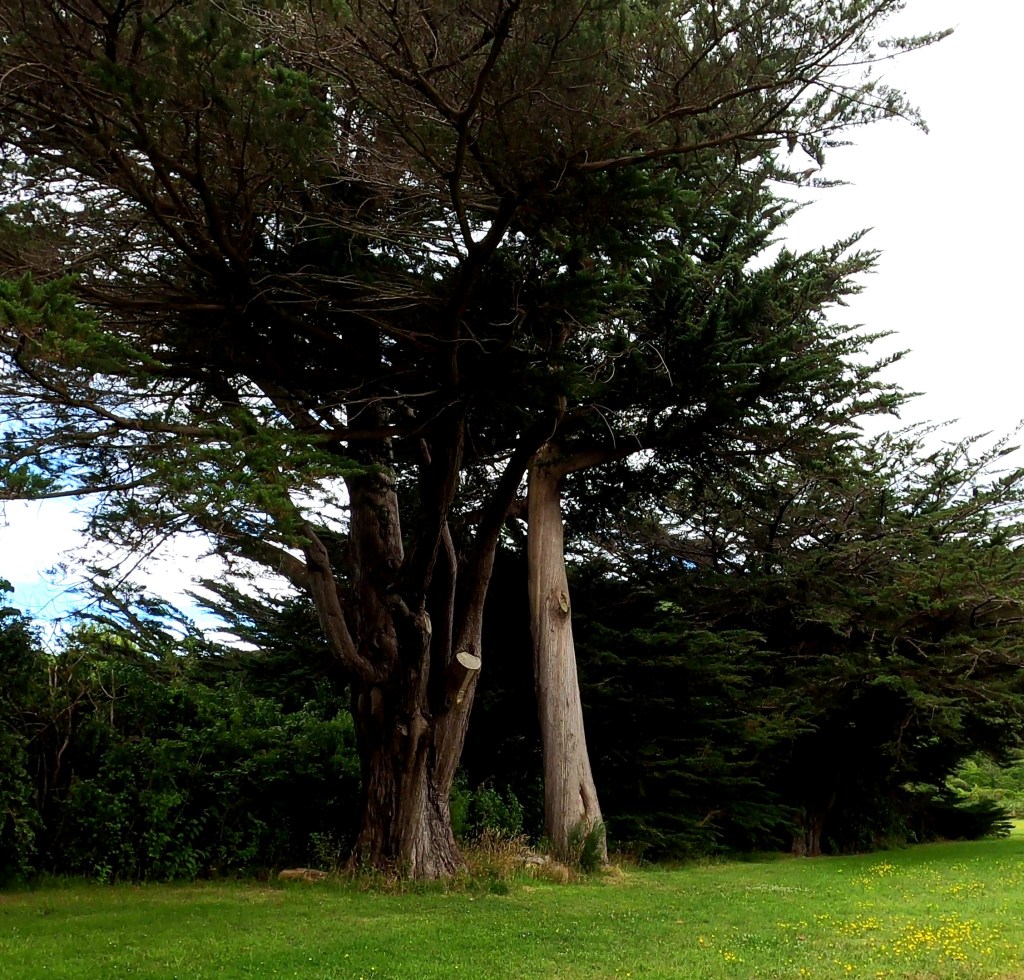
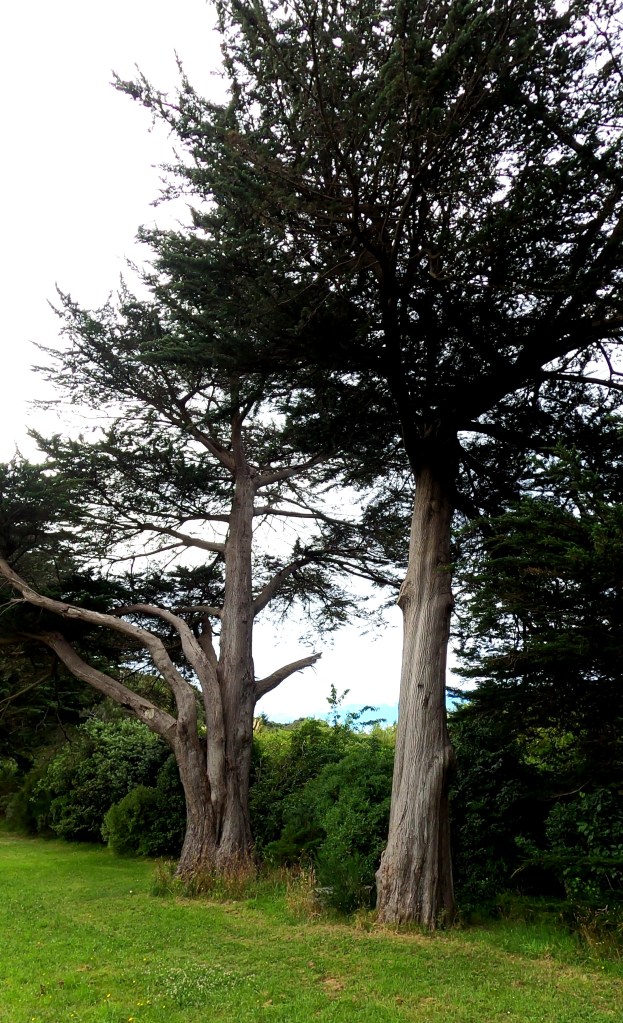
Ngaturi Park, Coast Road, Wainuiomata.
This is a useful pair to start with as it is the contrast between the two, more than anything remarkable about either, that is interesting. Found in a park border, the pair were part of a long shelter-belt of trees that looked to be about 80-90 years old. It would have been very easy to drive by, but the tree on the right stood out and made me stop for a closer look. It has a very white, almost metallic looking trunk, which seems almost bare of pruned or broken-off branches. This bareness is accentuated by the contrast provided by the tree next to it, which shows the much more common multi-trunk, wide-spreading form of the macrocarpa.
The value of looking closer at a group of macrocarpa is shown in the next example from another shelterbelt planting, probably about the same age, this time in Whanganui. From a distance the group look indistinct, but once underneath the trees a more powerful view is gained:


The trees are slanted due to the predominant northerly wind that comes off the nearby sea. There is no single tree particularly noticeable here, rather it is as a group that they become noticeable, especially the subtle variation in the slants they have taken on.
Even a group as small as three can display surprising variation in form. Consider this group in Tongaporutu, strangely enough sighted within a kilometre of a seaside rock feature known as the ‘Three Sisters‘. The first photo looks from the seaward side to some foothills:

As the stump in front shows, the state of the three trees is not solely due to strong winds – chainsawing has occurred – though a close look at the middle tree clearly shows it has also taken a beating from the elements:

It is not until we get past the first two macrocarpa that we see the third tree, one that has taken on aspects of the weeping form that we first saw in ‘Under the macrocarpa, Part 1‘ :
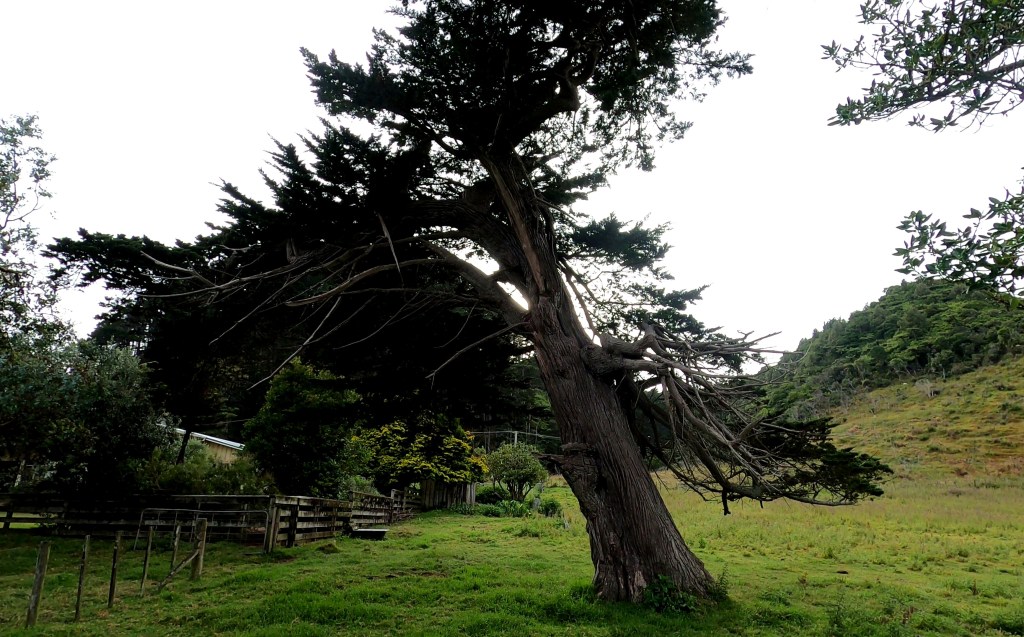
It is still showing the effects of wind – look at the heavy slant to the trunk – but this final shot looking towards the nearby sea suggests the two larger trees may have partly sheltered the third, helping to explain its more vigorous canopy:
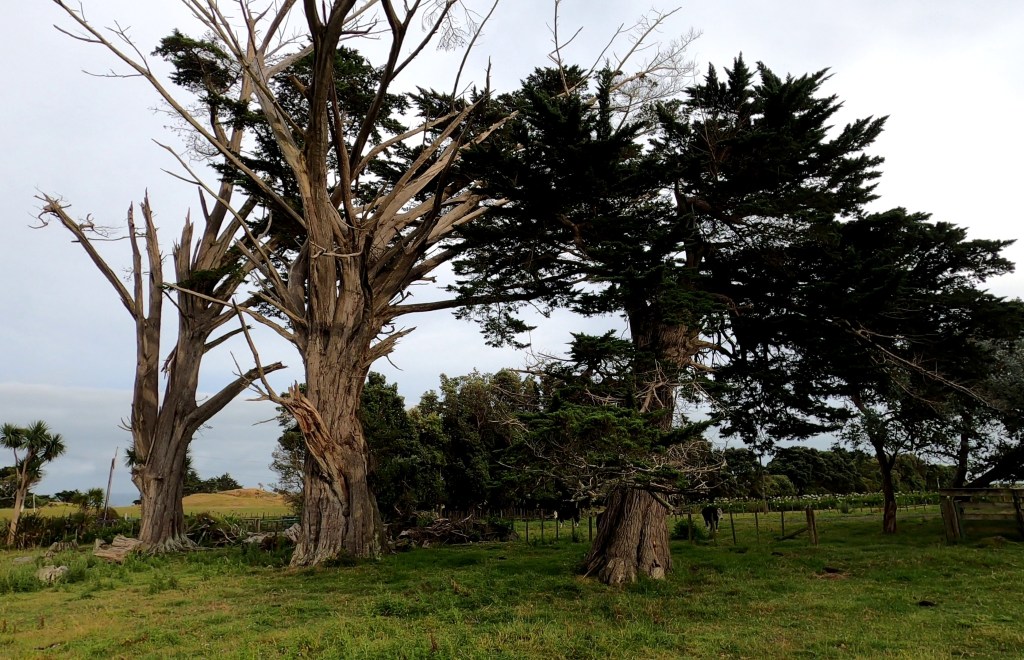
There is little doubt that at least the first two larger trees will soon become firewood. A google map image and a photo I took near the roadside shows the precedent for this:

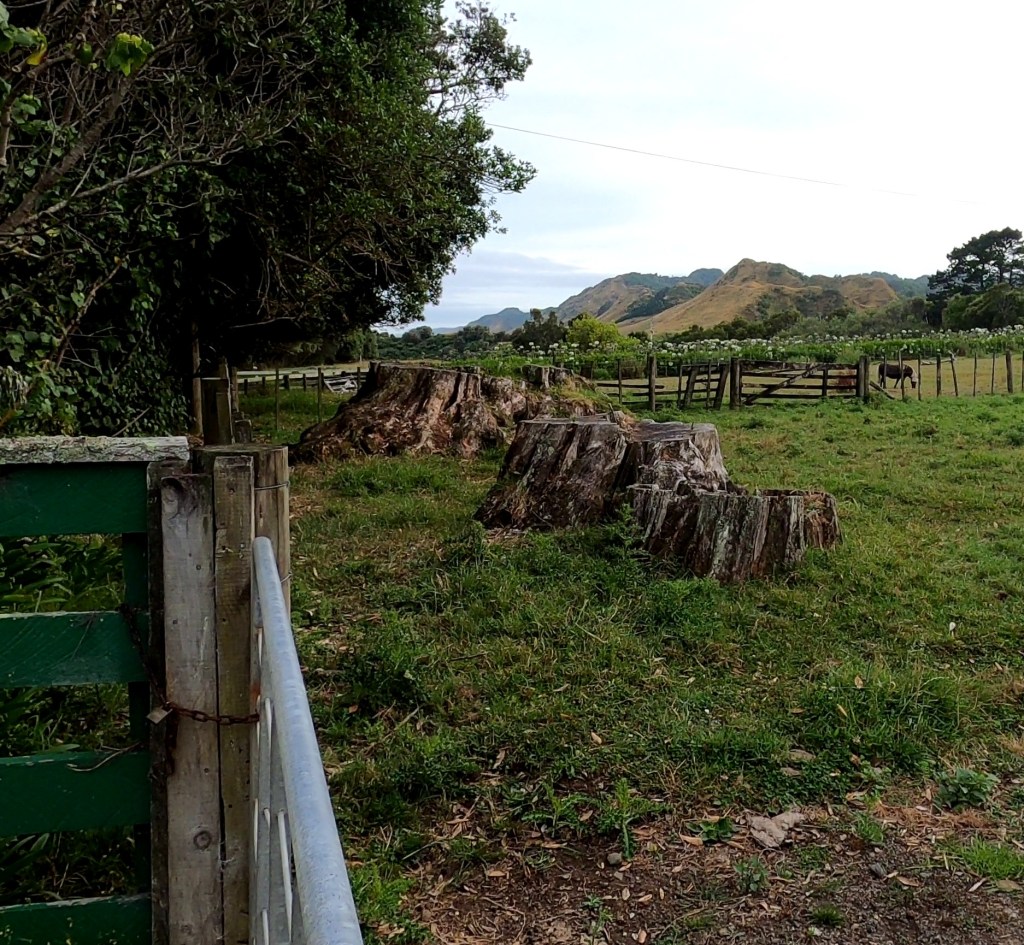
It is possible that the third smaller tree may survive when the other two become firewood. Perhaps it will get a reprieve due to its less battered, weeping form, and if so it will then become a solo macrocarpa in a paddock. We’ve already seen a good example of this in Photogenic ‘beat-up macs‘, but that tree is worth a second look:
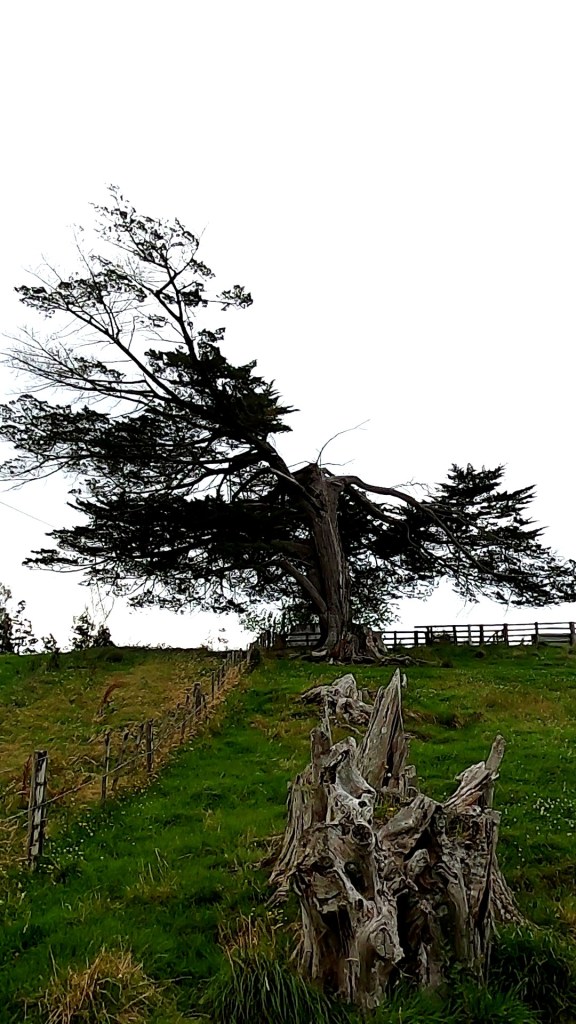
Here we can see two stumps, presumably other macrocarpa removed some time ago leaving the survivor to dominate the skyline. It too has had branches sawn-off at the base, but this only seems to add to its significant gravitas:

We obviously don’t know exactly why the farmer left the one tree in this part of the paddock. But in a final example we can at least see how important the reduction of surrounding trees can be in shaping a solo macrocarpa. This involves a standout macrocarpa just across the road from the Patea Cemetery, the Norfolk Island Pines of which featured in the last post (Patea Cemetery Trees: A circa story). Luckily there is a Retrolens aerial photo from 1949 which includes the cemetery area:

The entrance to the Patea Cemetery can be seen at the bottom left, and across to the right we see pasture and a farmhouse sheltered by smaller hedges and several larger trees. Most probably these were a group of macrocarpas, but at some stage post-1949 both the farmhouse and most of the shelterbelts around it were removed. This then produced quite a stunning scene, as shown in a January 2025 photo (the solo macrocarpa is identified by the semicircular mark in the aerial photo):
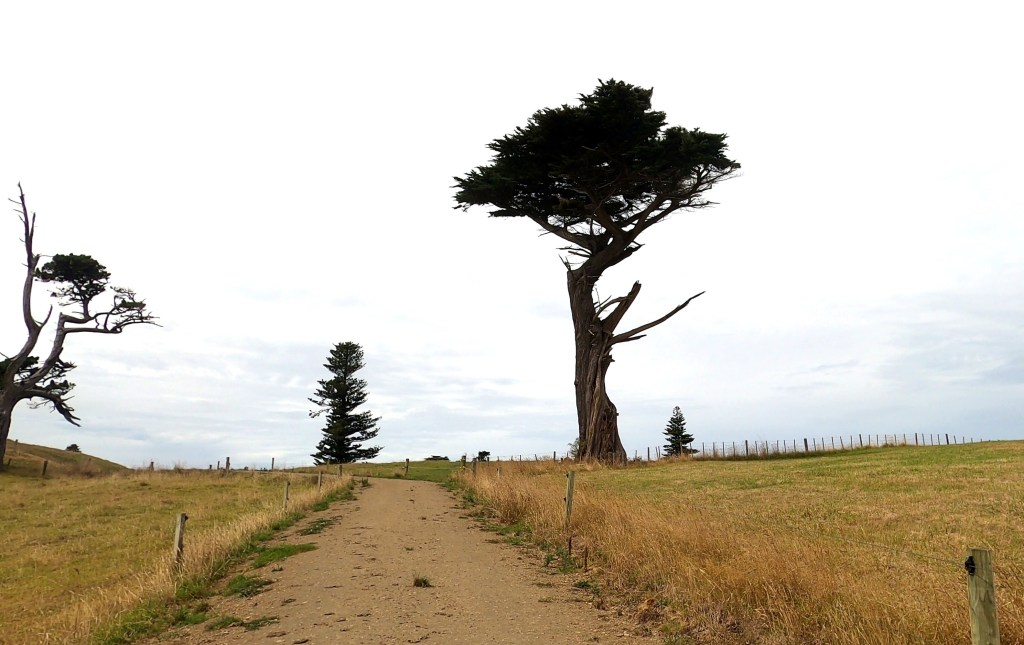
In the distance are two Norfolk Island pines, and to the left a badly beaten Pinus radiata. The bareness of the farmland provides a stark frame for all of the trees, but especially the massive macrocarpa. Words can’t properly convey the size and solidity of this tree, but a photo from closer up does help convey its eye-catching nature:

Given the tree’s canopy size in the 1949 aerial photo, this solo tree must be at least 120 years old. Its current shape is a result of a combination of factors. Humans have chain-sawed some of the lower branches, but probably before this the removal of the other shelterbelt trees exposed the solo macrocarpa to the shaping effect of the strong winds which buffet the Patea region (see the previous post). Obviously though it is still standing strong. It is quite a remarkable and visible sight in the local area, so much so that according to a local source people sometimes stand beneath the tree for a ‘photo op’, including once for a wedding party.
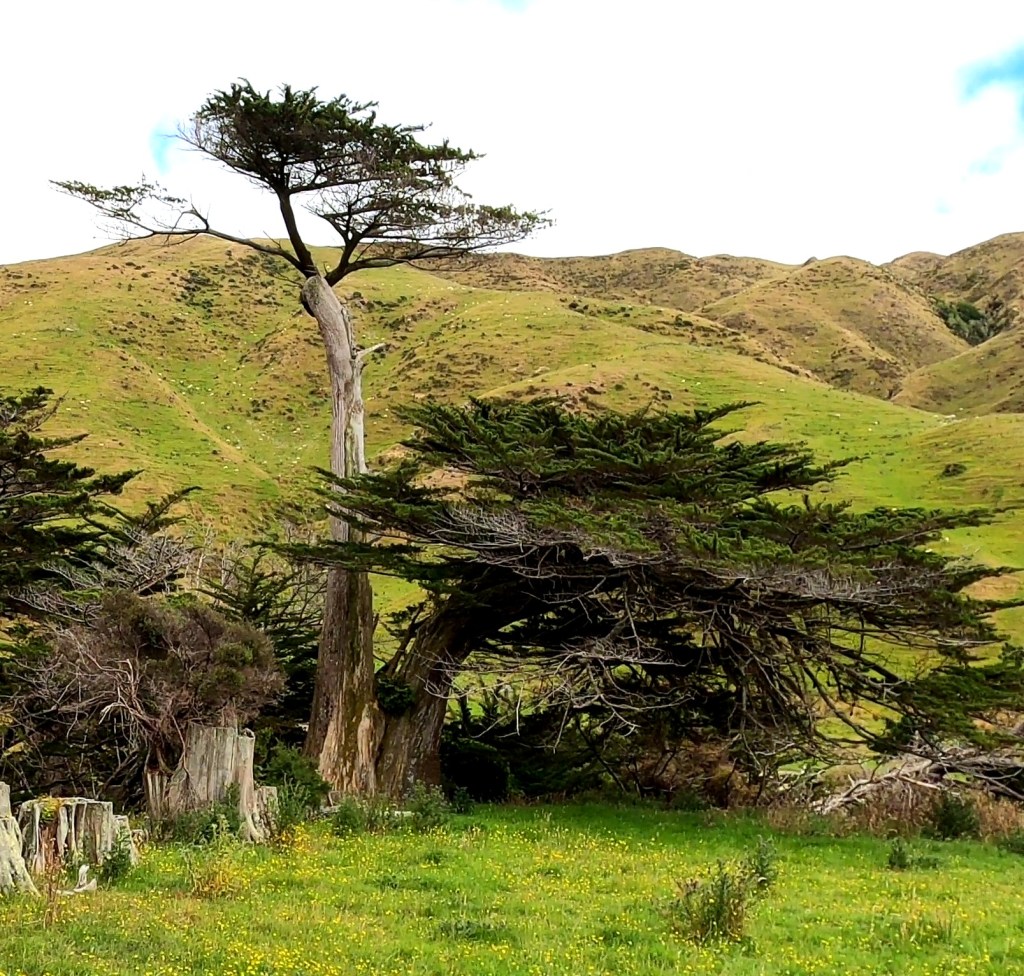
There is little doubt that New Zealand’s countryside is full of macrocarpas like these, though of course I have selected more photogenic examples. As already noted, macrocarpas were planted in New Zealand primarily for timber or shelterbelt purposes, and partly because of this it is a good idea to add the word ‘bastard’ to the poetic celebration of Jeffers. That is, macrocarpas such as these are ‘White-maned, wide-throated, heavy-shouldered [bastard] children of the wind’. But the bastard label takes nothing away from the vigour and sheer ability of the tree to survive. A short gallery is useful to finish with (locations are listed below):

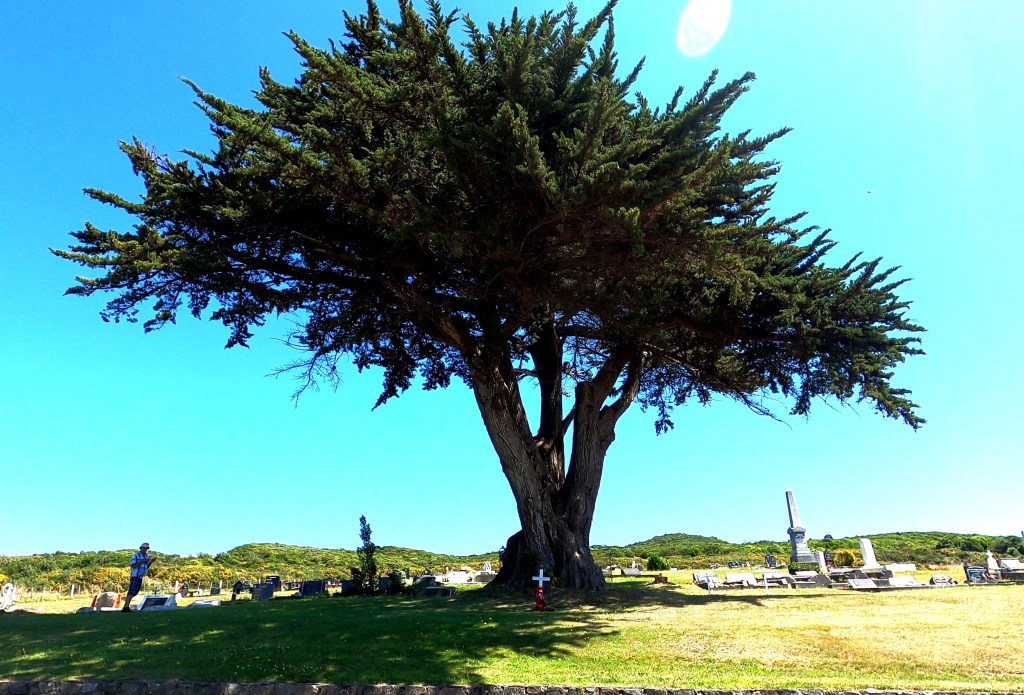

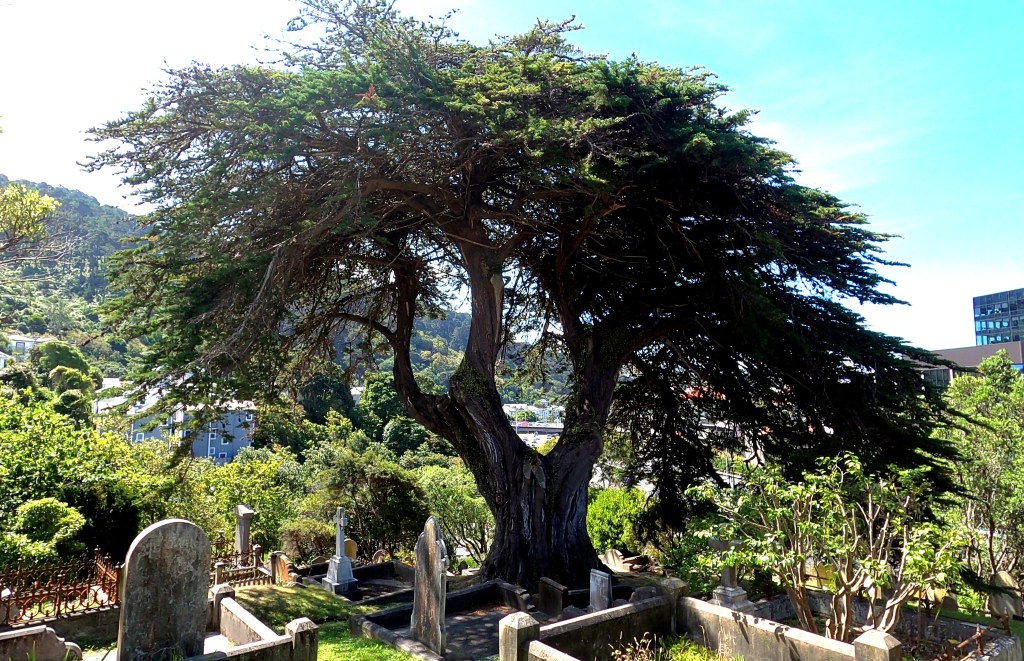

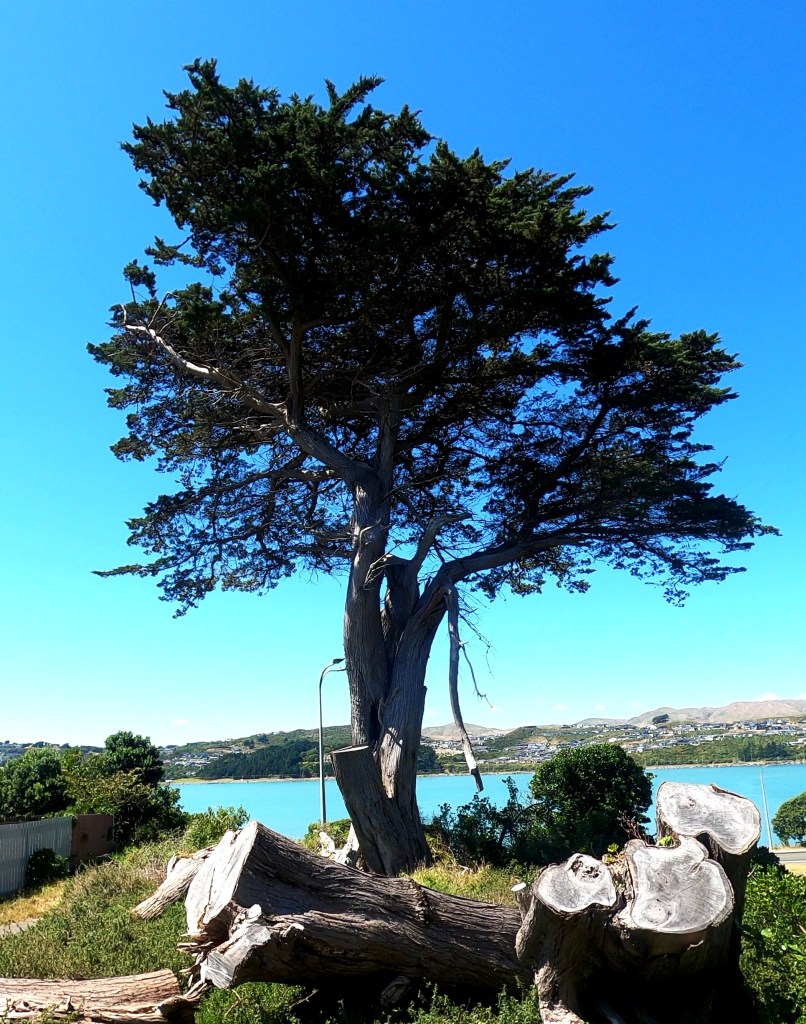
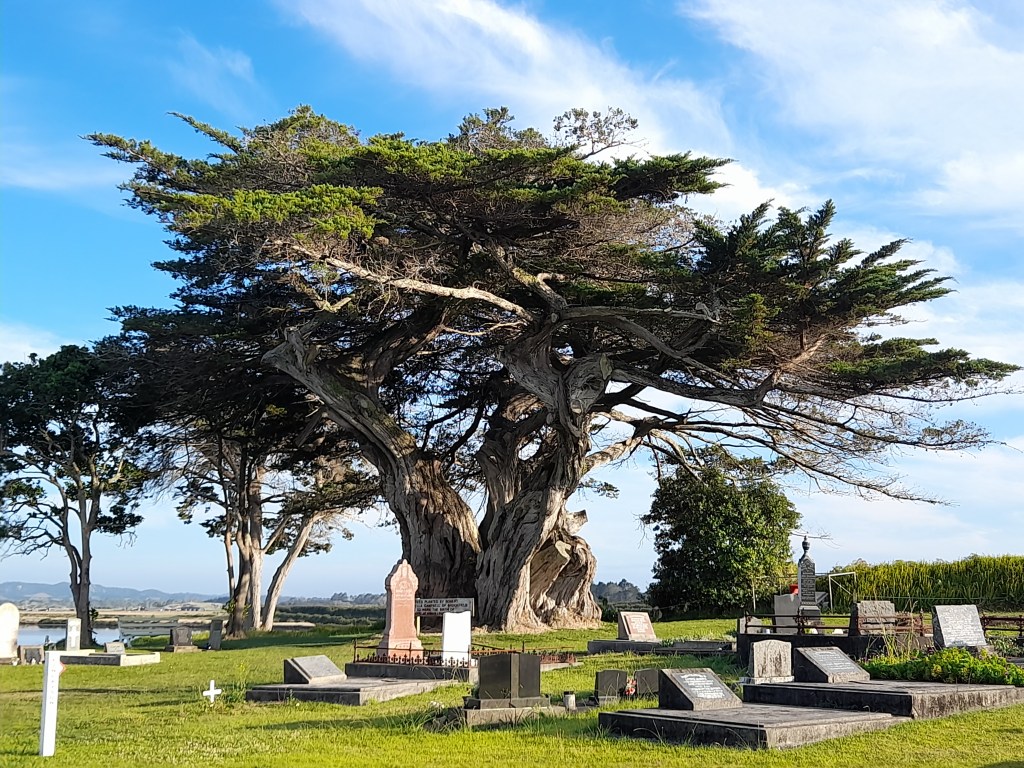

Locations:
- South Makara
- South Makara
- Titahi Bay urupa
- New Brighton pier (Source: Kete Christchurch Canterbury Earthquakes)
- Bolton St Cemetery, Wellington
- Wainuiomata Coast Rd
- Takapuwahia Reserve, Titahi Bay Rd, Porirua
- Waipu Cemetery, planted 1864. Thanks to Michael & Karen van Beek for photo and information
- Patea (next to cemetery), under a smaller macrocarpa looking across to solo icon.
Acknowledgment: Thanks to Michael Brown for spotting the Wainui big mac, and for earlier ‘arbor-nauting’ trips.

 The Local Arboretum: Noticeable trees and their stories