The last few posts have been on Phoenix palms, and we’ll return to the question of why their removal is now increasingly common, but before that a bit of an interlude is useful. This will focus on a different tree endemic to the Canary Islands – Dracaena draco – but just by chance there were a couple of Phoenix palms in the same location that set off this post, hence the ‘combo’ written about here.
An ‘oddity’?
Not long ago for $3 I picked up Trees of Santa Monica by George Hastings at my local second-hand shop. I’m not intending to go to Santa Monica anytime soon, but from a quick glance at the book there were several trees described that I didn’t know so was happy to hand over three dollars. Included in the book’s list of trees is Dracaena draco, or dragon tree, which I vaguely knew, but the description of it as an ‘oddity’ was intriguing:
A small tree with thick trunk and a few thick branches with clusters of sword-shaped leaves at the ends. The small flowers are followed by large clusters of orange-colored berries. Native of the Canary Islands. Occasionally planted as an oddity. (Hastings, G, revised by G. Heintz, 1981 [1976], p.103)
During a holiday in Whanganui in early January 2025 I chanced upon a cluster of the ‘oddity’. I was driving over a railway crossing at a Y-type intersection and as I looked right to turn left I saw two reasonably tall Phoenix palms. A Google Street view is the best way to get across my initial sight:
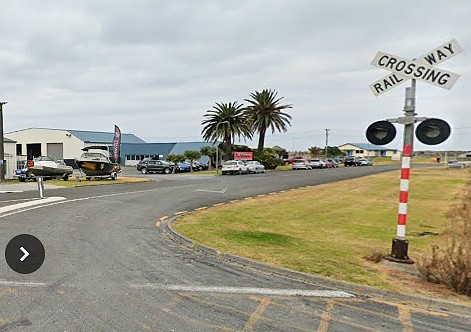
Source; Google Maps, Street view January 2024
Of course I had to take a closer look at the Phoenix palms so did a u-turn. But as soon as I got closer it was the Dracaena beneath the palms that proved more interesting:
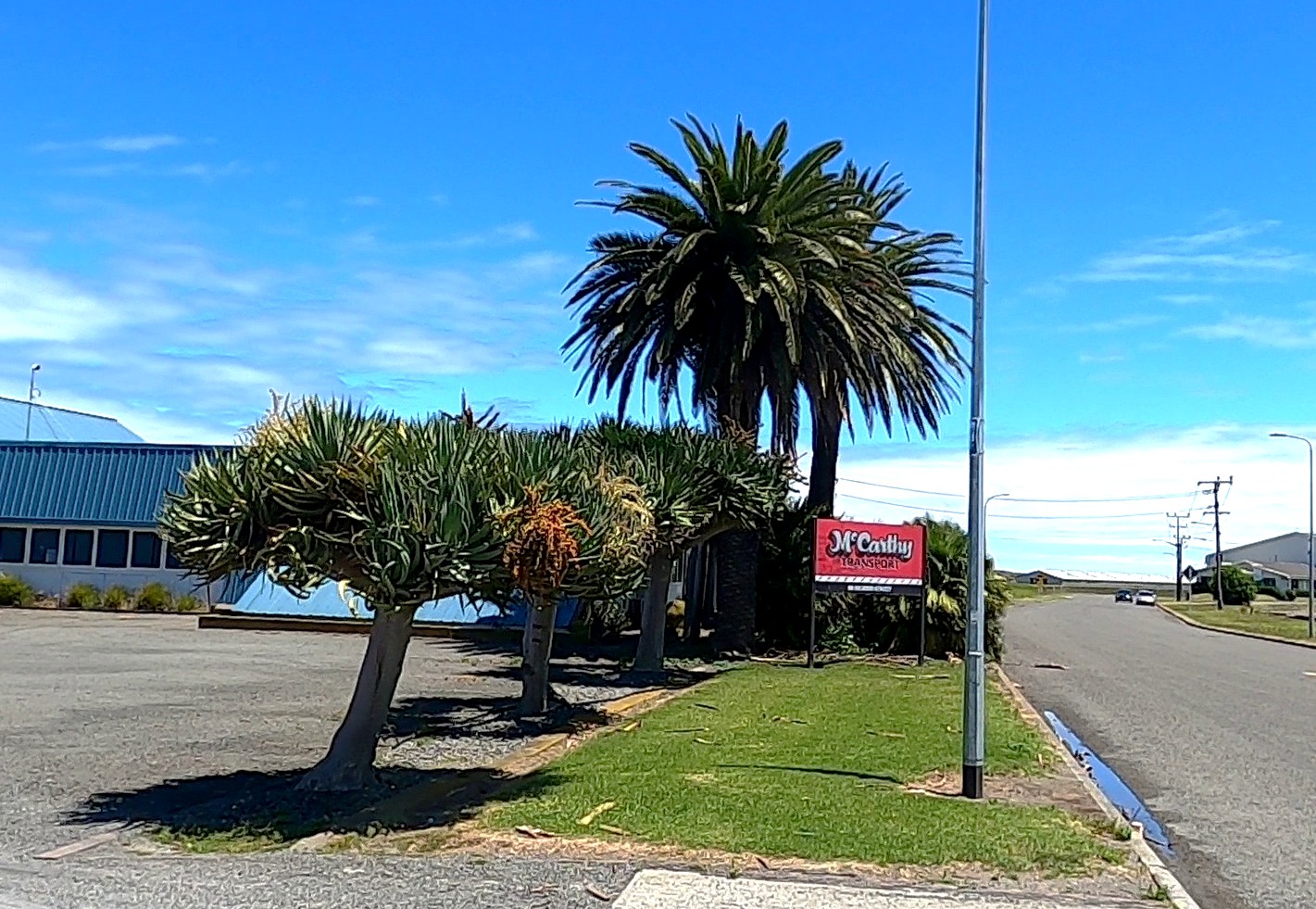
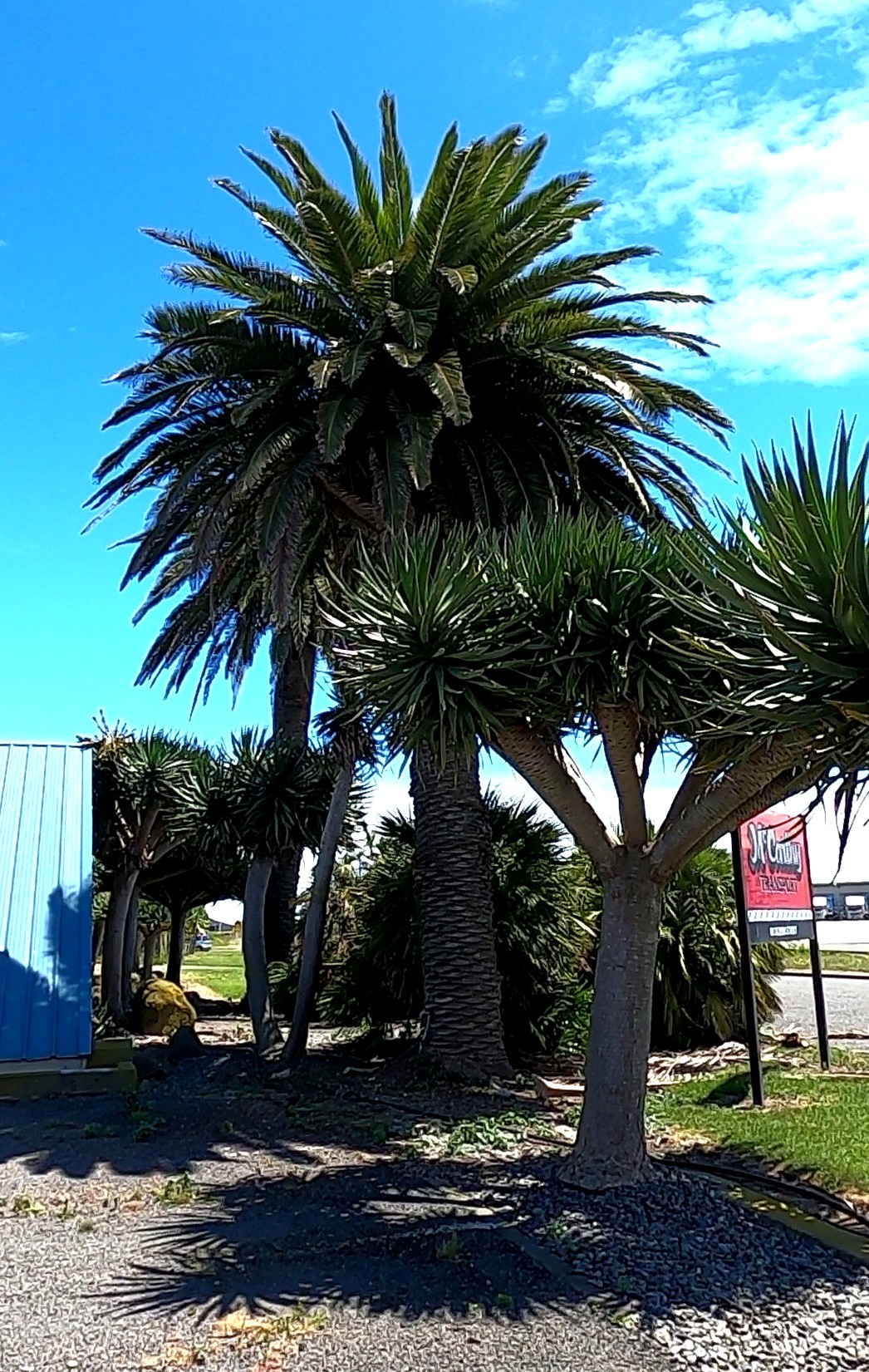
On the carpark edge beside the grass verge of the McCarthy Transport building is a decent-sized group of Dracaena draco. This is in an area full of warehouses, factories and such like, so this little bit of careful landscaping was a pleasant surprise. There were three Dracaena leading up to the sign, with more on the other side:
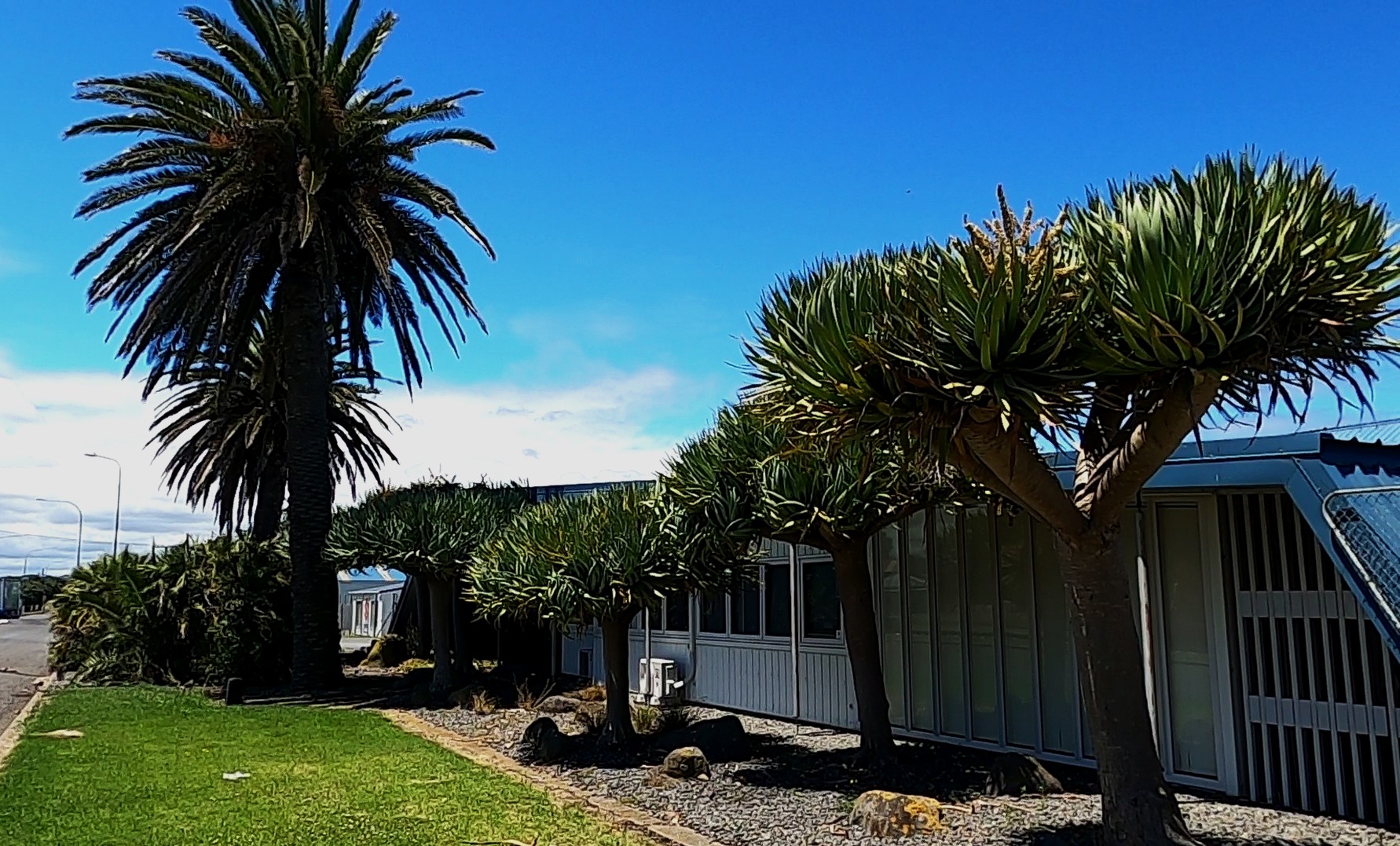
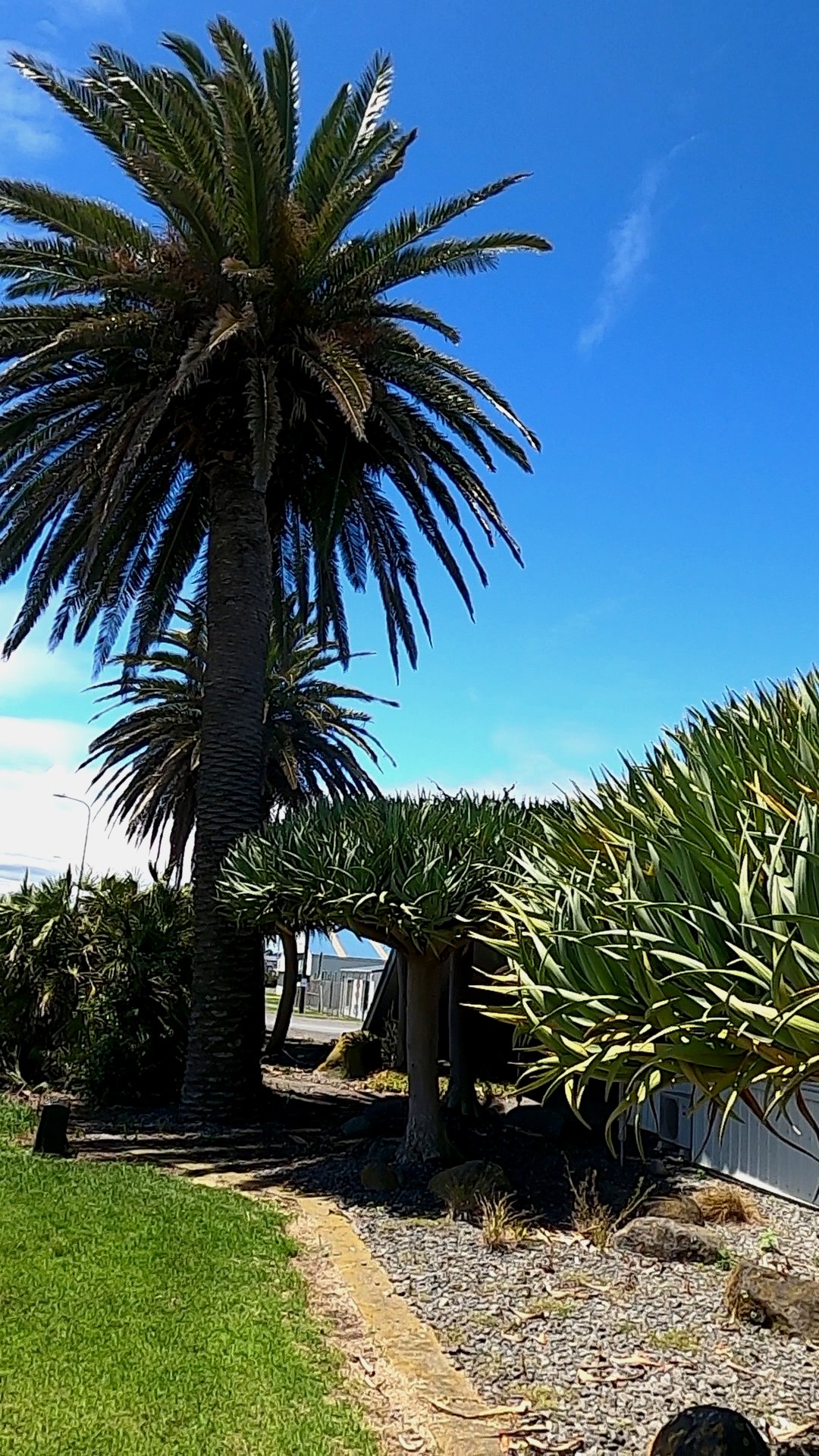
By their size the Phoenix palms look to be about 40-50 years old. The Dracaena are clearly quite tall (see photo below) so may have been planted at the same time, but that would be a guess. I don’t think the landscaper, presuming the planting was done professionally, was making anything significant of both the palm and the Dracaena being endemic to the Canary Islands. It is more likely that the desired effect of using them both was to accentuate the tall trunk and opened-out crown that both have. They do go well together even if in the Canary Islands they are found in different situations. Some more photos get across how impressive the McCarthy Transport combo is, the first featuring me just to give an indication of scale:
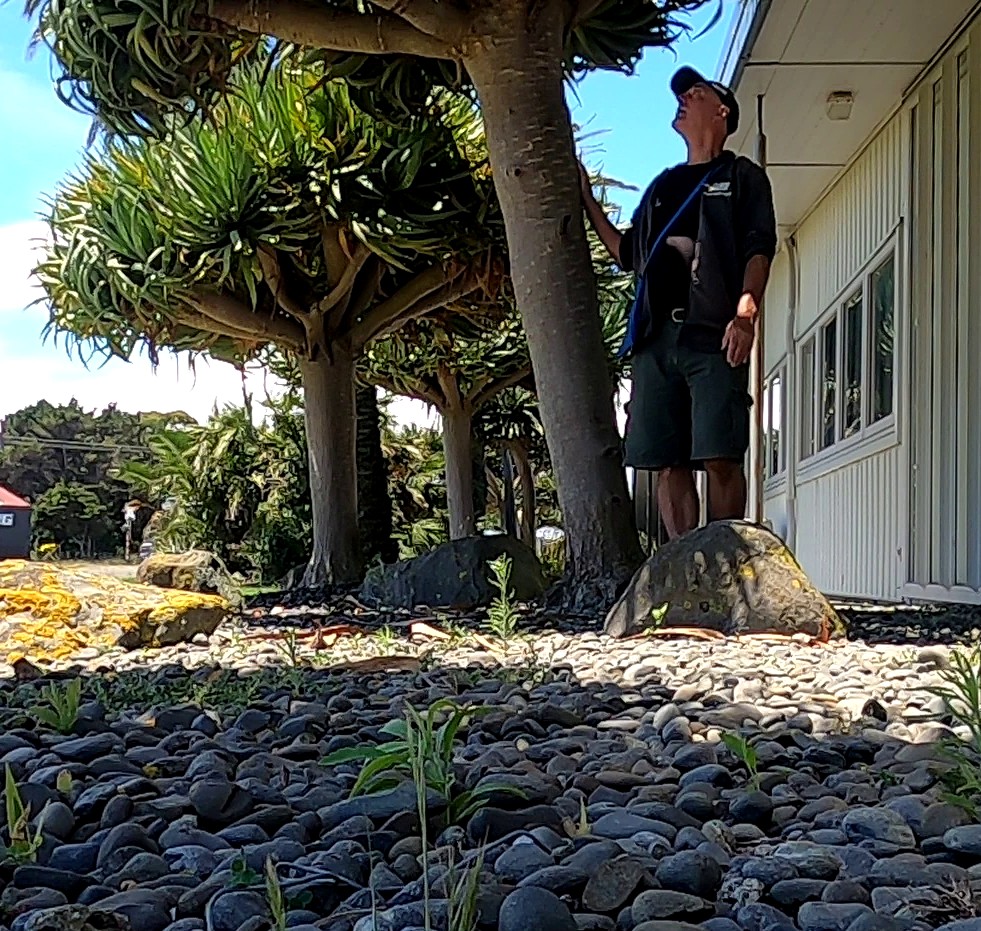
I am nearly 1.8 metres tall so you can gauge the height. Also, as the final two photos of this McCarthy Transport site show, the trunks of both make a good combo:
Oddity, or just interesting?
It is certainly true that the Dracaena are not commonly planted in New Zealand, but there certainly are some older and taller ones around if you keep your eyes open. Strangely enough when I was photographing Phoenix palms in Myers Park, Auckland, I chanced upon another group, smaller in number but larger in size:
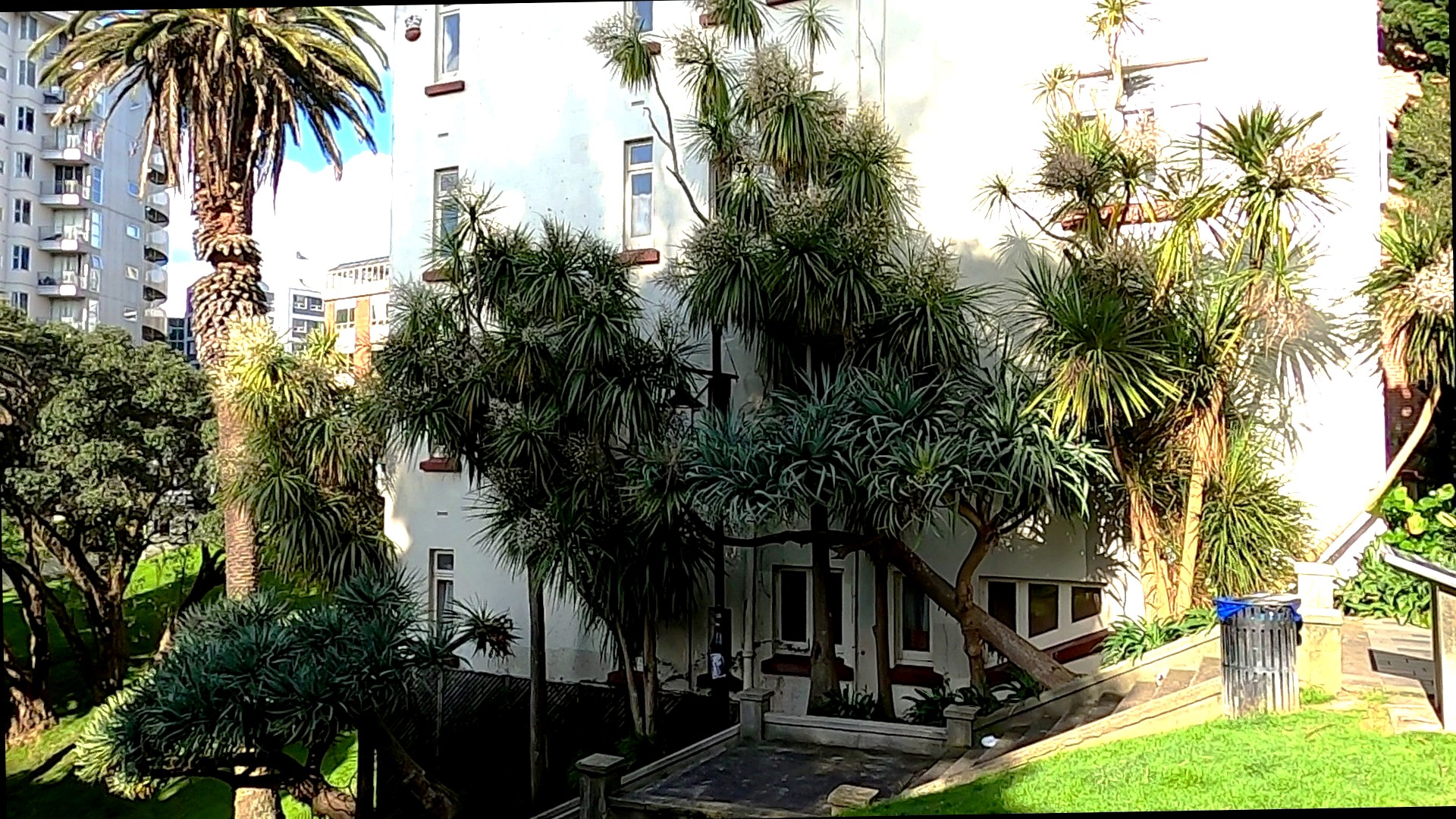
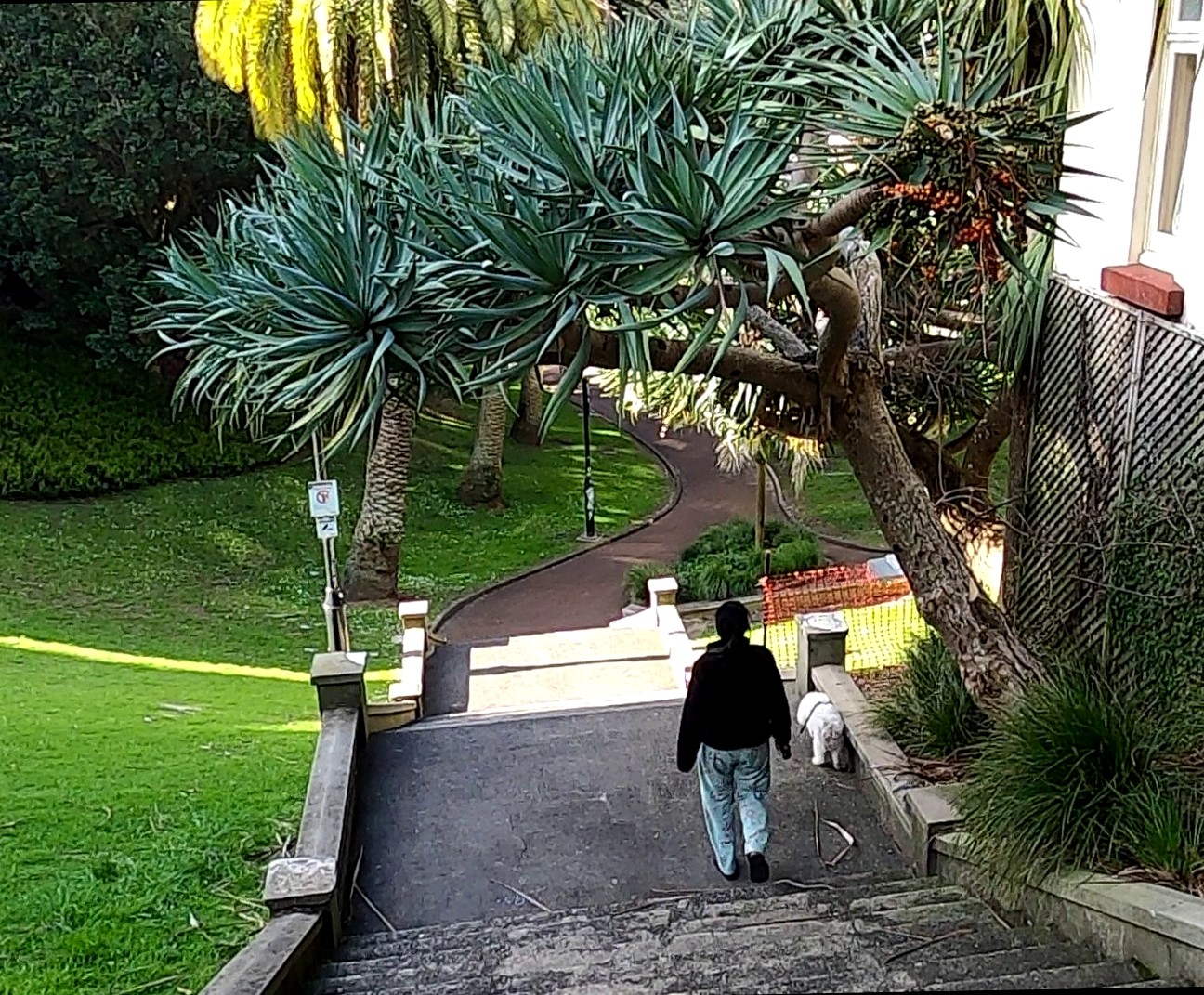
These are at least 5 metres tall, and as can be seen in the path ahead of the dog-walker, they lead into a double avenue of Phoenix palms (25 palms planted circa 1915). However, the largest Dracaena I am aware of is a solo specimen, not far from Myers Park in the Auckland suburb of Parnell:
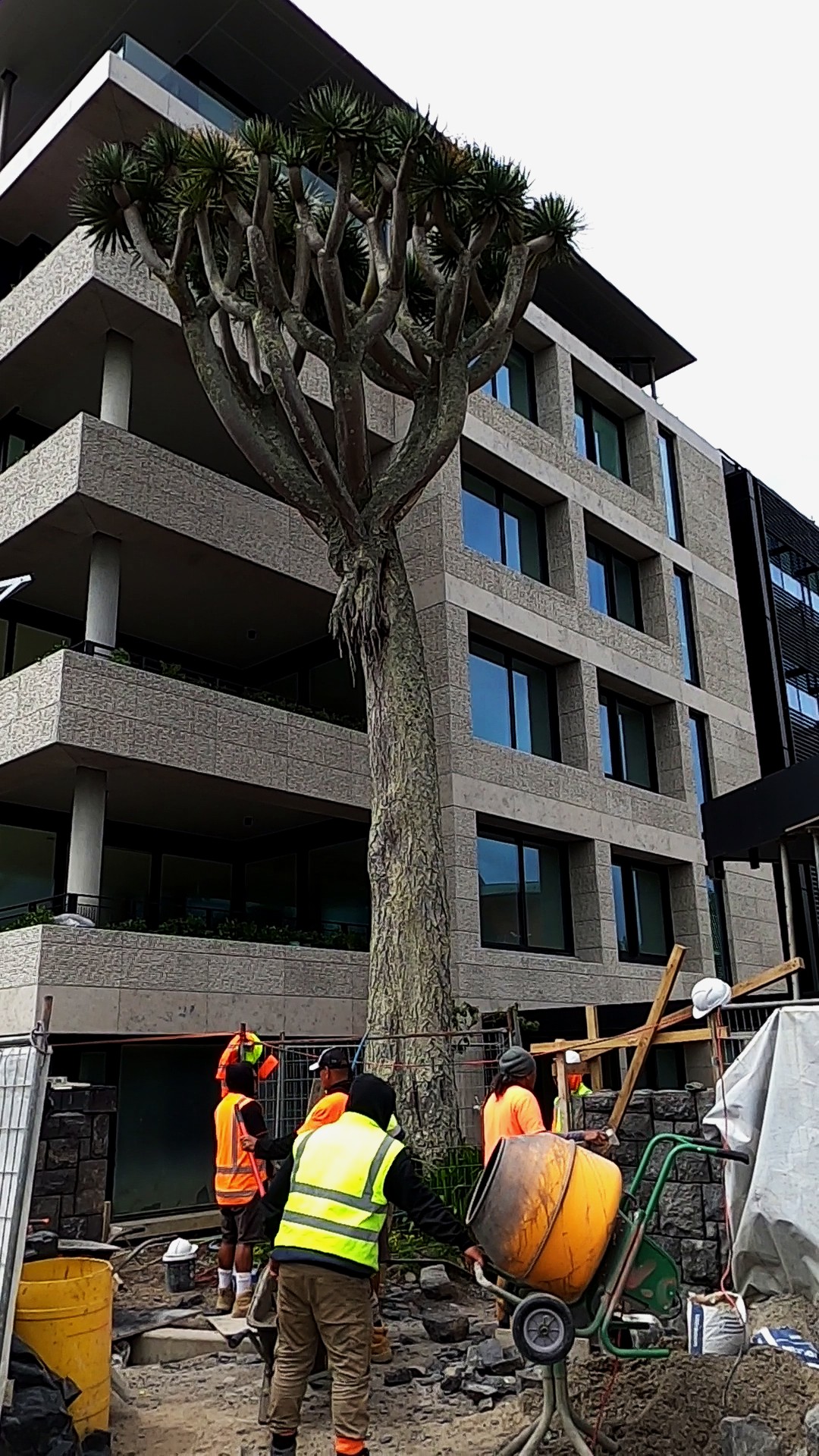
At the time of the photograph – October 2024 – the Dracaena was carefully being built around. Originally it was in a corner of the grounds of the Holy Trinity Cathedral, St Stephens Avenue, Parnell, but this new building has sprung up next to it. The Dracaena was measured at 11 metres tall in 2015 and Cadwallader describes it as ‘likely the largest specimen in New Zealand’. At this height it is as high as a 60 year old Phoenix palm, so it will be interesting to see what the Canary Island combo outside McCarthy Transport looks like in another 40 years.

 The Local Arboretum: Noticeable trees and their stories
Leave a comment