‘Araucarian’ sounds like some kind of alien, but actually it is a term used for members of the Araucaria family. We’ve met a few representatives in previous posts: Norfolk Island pines (A. heterophylla), which are very common in New Zealand, particularly in the North Island; the Monkey Puzzle tree (A. araucana) from Chile and Argentina, which went through a worldwide phase of plant-celebrity status; and the odd mention of Kauri (Agathis australis), New Zealand’s sole endemic araucarian. In this post we’ll get to know Araucaria columnaris, commonly called the New Caledonia pine or Cook pine, which has the fascinating feature of being the ‘leaning araucarian’.
The tree is not common in New Zealand, though as we’ll see I have found a handful. Here’s a photo of the first one I can remember noting, photographed in Whanganui in early January 2025:
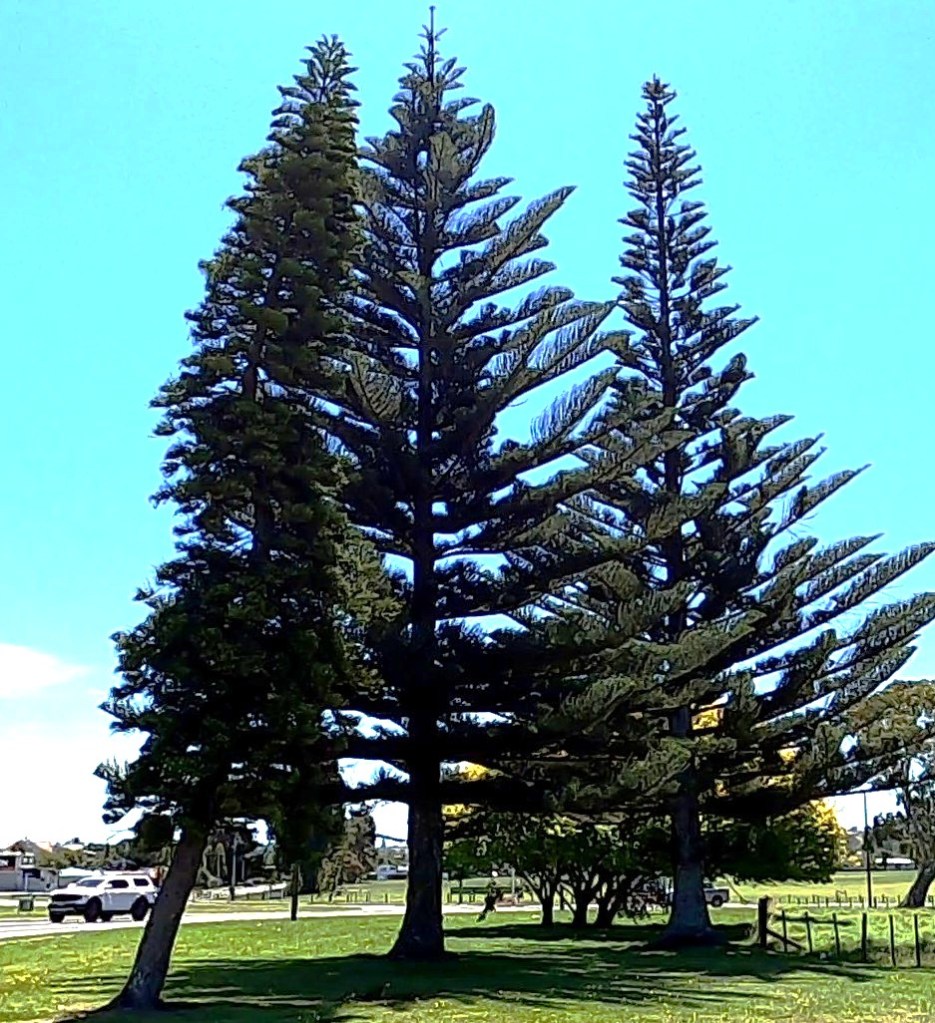
To the right are two upstanding Norfolk Island pines, showing the tree’s typical symmetrical branch structure. If you didn’t give the tree to the left a second glance you might assume it is also a Norfolk Island pine, albeit a bit skinnier and for some reason heavily slanted. As we know, trees show natural variation in form, and it is not unusual to find departures from standard forms. However, in this case it is not a variant Norfolk Island pine but the species Araucaria columnaris. A closer up shot, in colour, shows more of the distinguishing features of the tree:
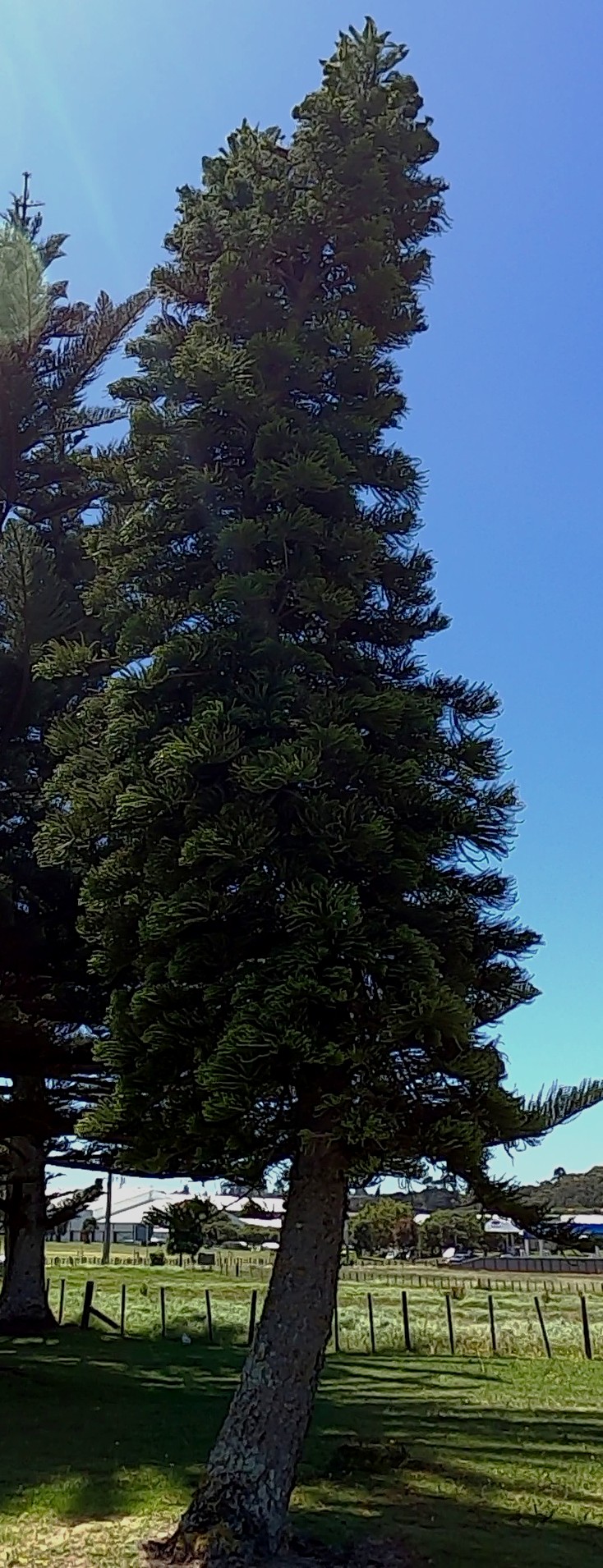
As the botanical latin ‘columnaris’ suggests, the tree is column-like in its form (also called ‘fastigiate’), whereas the Norfolk Island pines are more pyramidal. The branches of the Cook pine are much shorter coming in whorls about the trunk. But perhaps the most striking thing about it is the lean of the trunk. In this case, as the second photo shows, the tree has developed a corkscrew-like form. The frequency of the corkscrew form is unknown, but without doubt the lean of the trunk is a distinguishing feature of the tree, as noted by some recent research:
When grown outside of its native range, this species has a pronounced lean so ubiquitous that it is often used as the identifying characteristic for the species. J. Johns et al. (2017) ‘Worldwide hemisphere-dependent lean in Cook pines’, Ecology 98(9): 2482-2484.
Moreover, as the term ‘hemisphere-dependent’ suggests, the lean has a systematic variation: trees in the northern hemisphere lean south, and trees in the southern hemisphere lean north. Also, as you go further from the equator the trees lean more. Johns et al studied 256 trees on five continents and made a good case for this phenomenon to be further studied, particularly because they conclude there is no known explanation for the lean. Six other publications have cited it since 2017, but as far as I can see only one has attempted to provide an explanation for the lean:
Since trees try to maximize light absorption, a lateral incidence of light—as given in the mid-latitudes—is expected to result in trees inclined towards the equator. This effect has been verified for 256 Cook pines located around the globe by Johns et al (2017).S. Lamprecht et al. (2020) ‘ALS as tool to study preferred stem inclination directions’, Remote Sensing 12(22).
This argument makes perfect sense, but on closer inspection I wonder if Lamprecht et al. have read Johns’ et al in detail. I say this because if the explanation of leaning for maximum light absorption was strong, why aren’t there more trees that do it? On this Johns et al are very clear: ‘the pronounced lean in A. columnaris is rare in other species, including other Araucaria native to New Caledonia’ (p. 2483). There are 20 species of Araucaria worldwide, with 14 being endemic to New Caledonia, which reinforces the uniqueness of the lean of A. columnaris. It really is a decent ‘tree mystery’.
Looking at a local Sample
Johns et al’s research has found a statistically significant pattern in the lean of A. columnaris, but interestingly about 9% of the 256 trees they measured do not fit the pattern. I’m not qualified to explain the lean pattern, nor can I muster a large sample of the trees, but in the small sample I have collected we can see some interesting variation deepening the mystery of this interesting araucarian.
If we take the Whanganui example above as number 1 in my sample, we can note that it does lean to the north, but it also shows what I’ve called a ‘corkscrew form’. Next, I discovered five A. columnaris on Wellington’s Oriental Bay. These are planted amongst an iconic seaside cluster of Norfolk Island pines, the oldest of which were planted in 1921, with the Cook pines planted at a later date. Given the small number, we can look at all of them and note the direction of their lean. I’ll number them as I go, and proceed from south to north along Oriental Parade, covering a distance of about 600 metres (NB: it was a rainy day when the photos were taken):
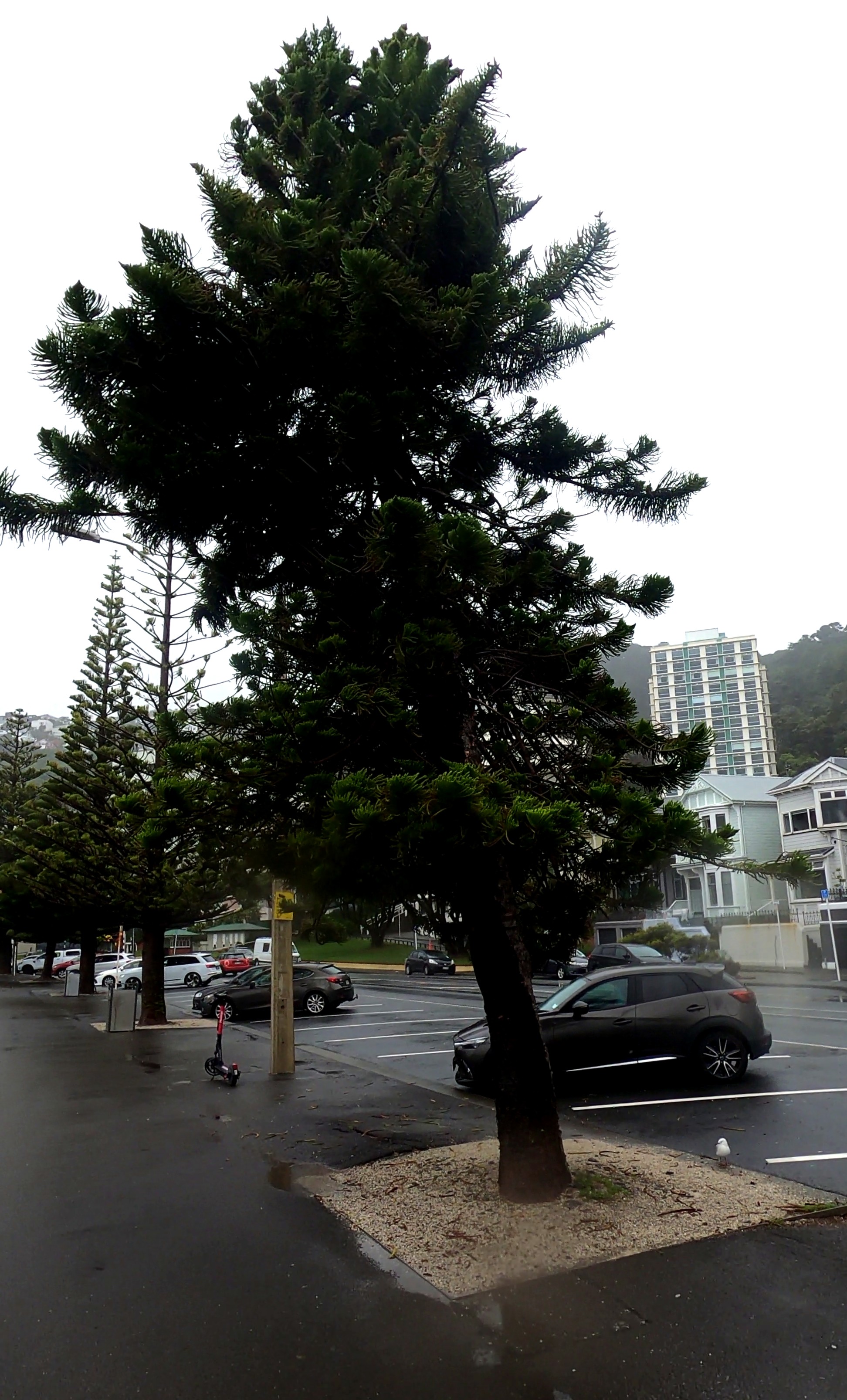
Number 2 has a double leader which explains the increase in width as it gets taller. It clearly shows a definite north lean.
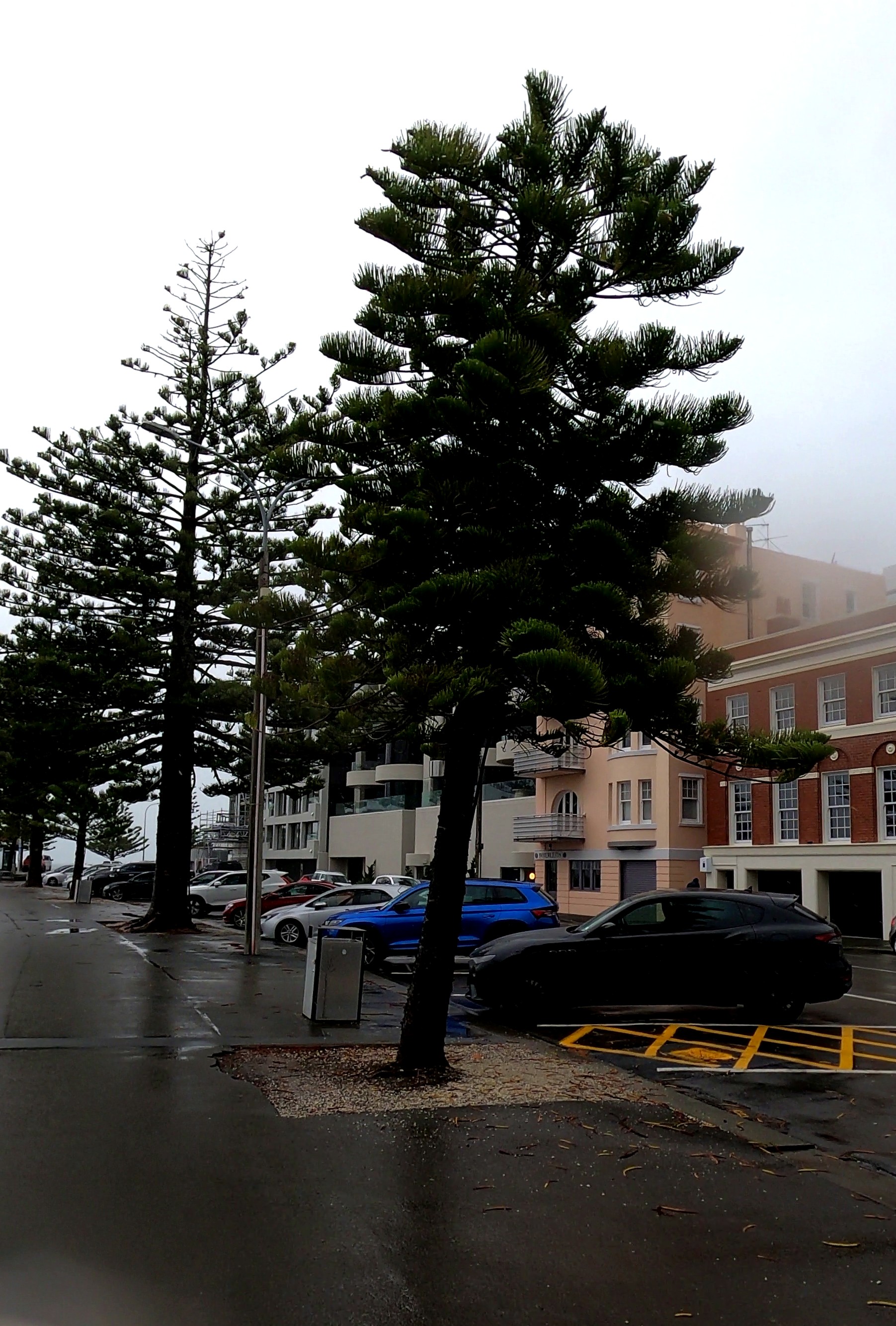
Interestingly, number 3 has a lean in a south-east direction, at least in the lower trunk. It can’t be seen from the photo but it is also developing a corkscrew form, with the top of the trunk going more in a north-east direction.
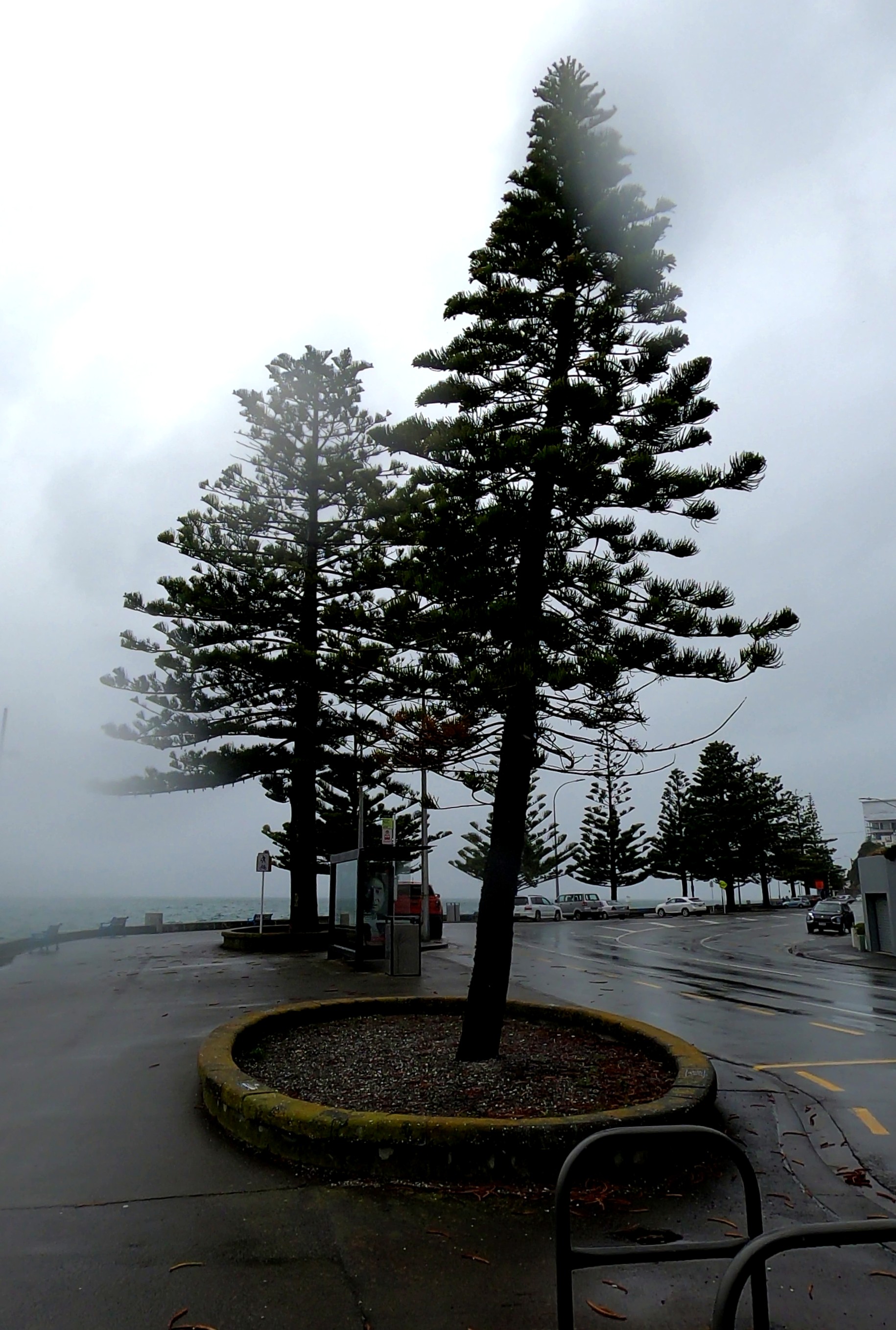
Number 4 presents a clear contrast to the perpendicular Norfolk Island pines to the north and in this case has a north-east lean. The next photo shows numbers 5 and 6 in one frame, possible due to their close proximity to each other:
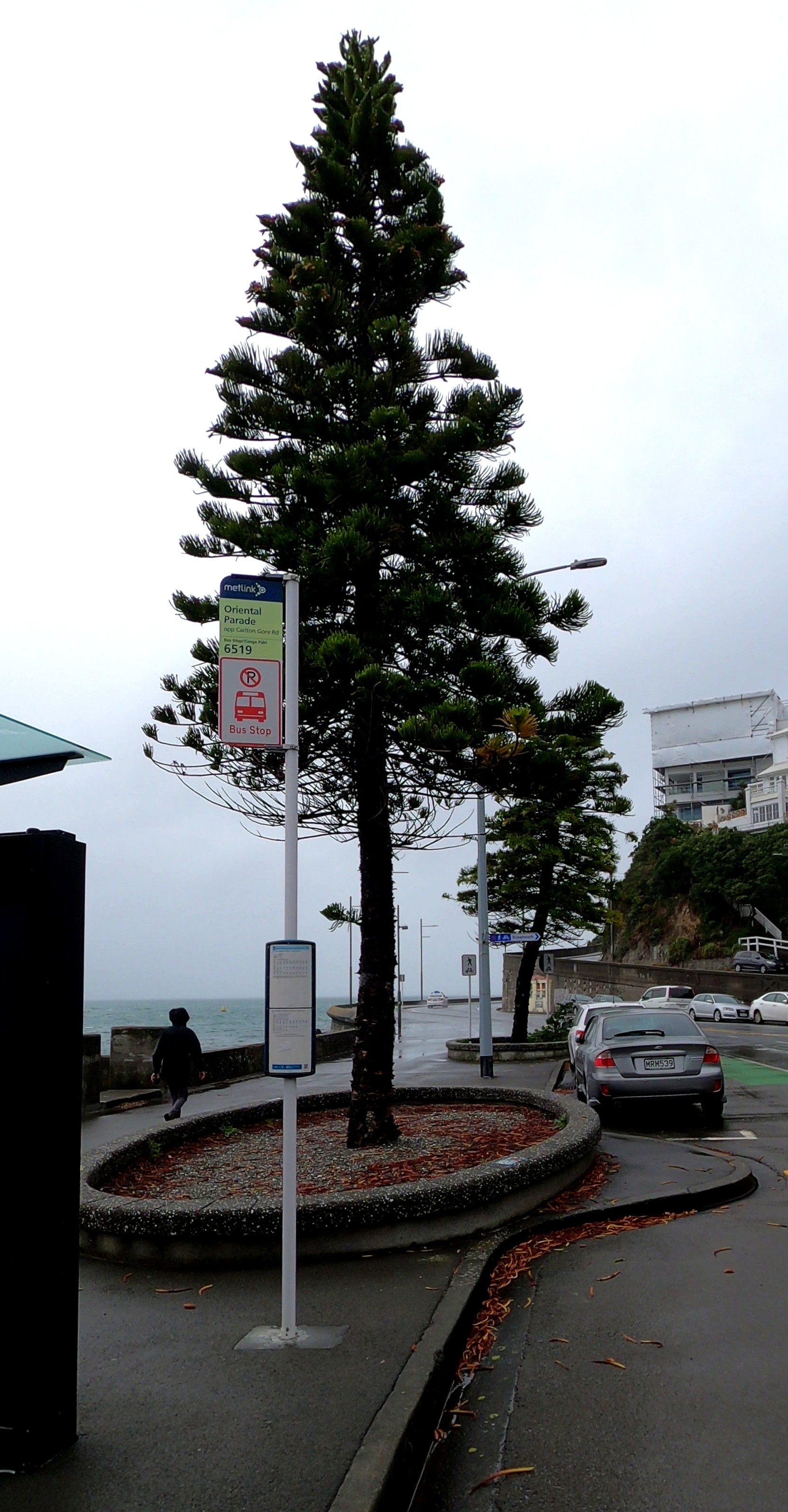
The bus-stop poles are useful here to show the very different leans of the two trees. What we see is that number 5 is the most perpendicular of the ones we have seen, though it does have a small wave in the trunk, perhaps a mild corkscrew in development. In contrast number 6 has the characteristic lean, but very definitely to the south.
Even at six A. columnaris viewed we are seeing considerable variation. Another two examples from the Wellington region are worth considering:
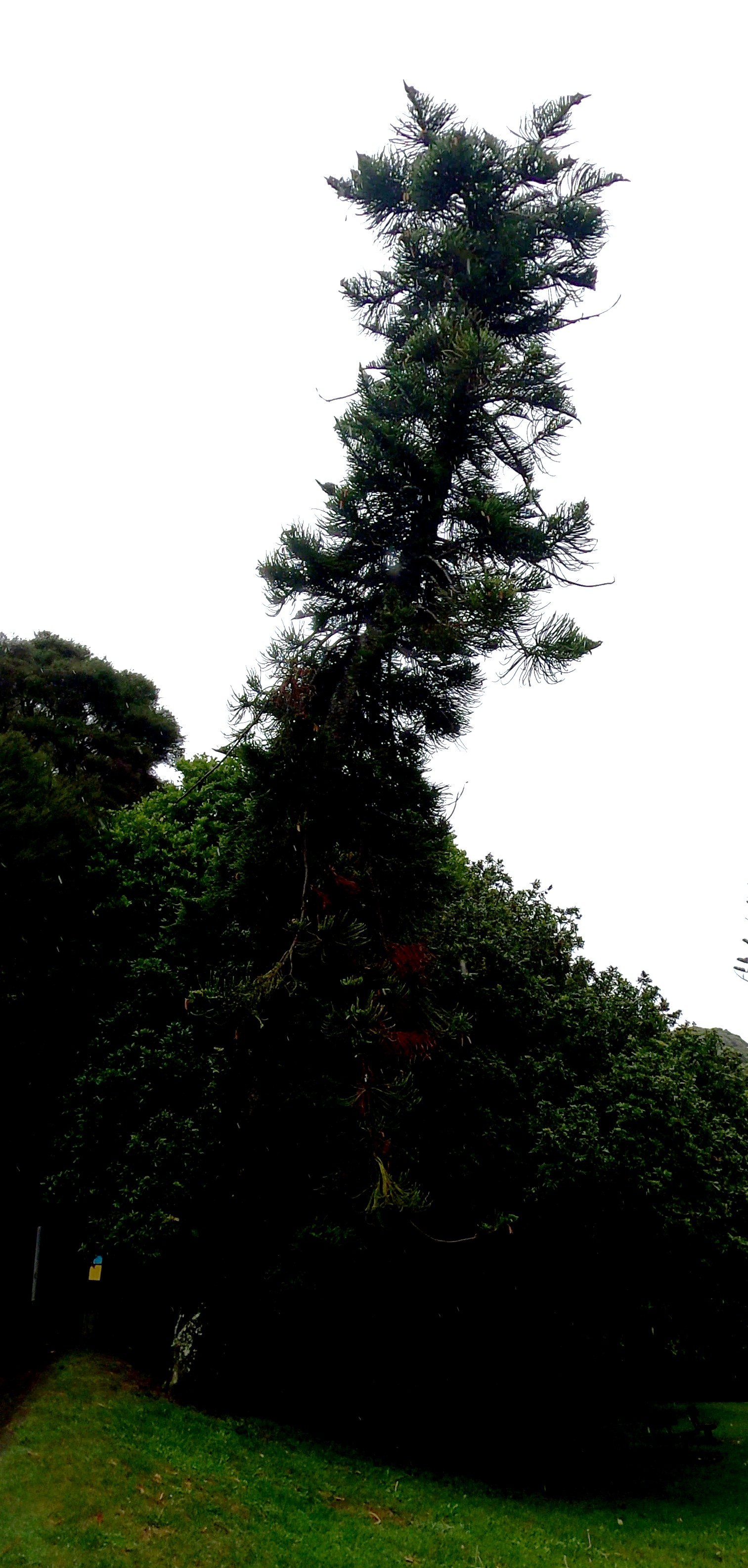
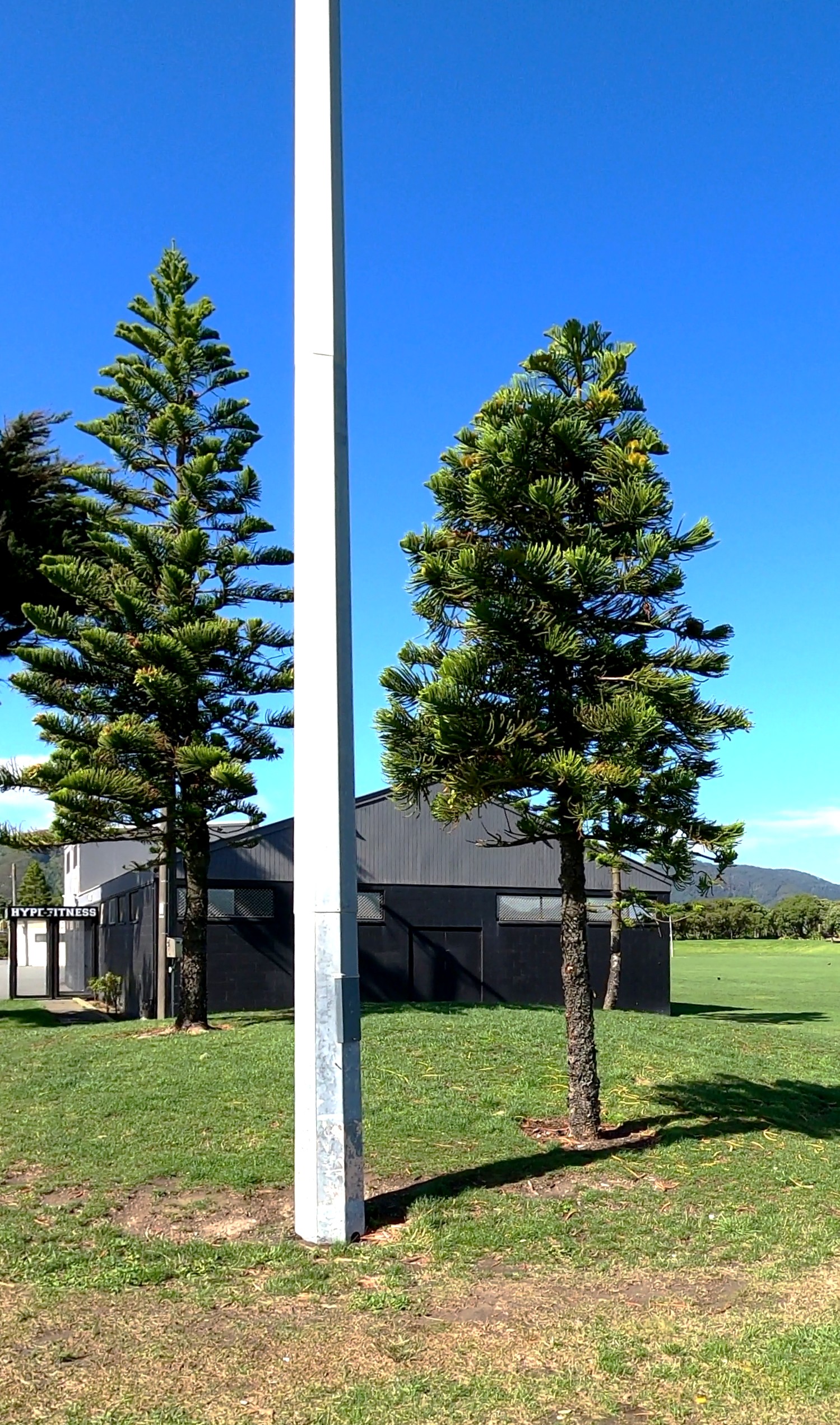
The specimen to the left is in the Wellington Botanic Gardens. It has a very strong north lean, and is also the slimmest of the A. columnaris that I have seen. The specimen on the right is in McEwan Park, Petone, again with Norfolk Island pines as a contrast. It is a relatively young tree, and as the floodlight post shows has a minimal north lean.
Finally, specimen number 9 is in Atawhai, Nelson. I have not personally sighted this tree but it can be seen via Google Maps:
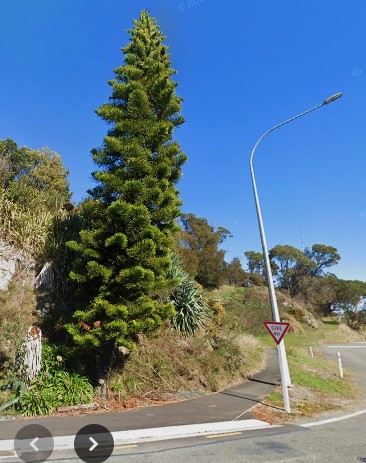
Source: Google Maps Street View, April 2024 (corner of Todd Bush Rd & Wakapuaka Rd)
Brad Cadwallader of the New Zealand Tree Register has visited the tree and assures me the tree is still present (Google ghosts do occur). The camera lens of Google Street view has a fishbowl effect making the streetlight appear at an angle, but there is little doubt the tree itself has the typical distinct lean to the north.
The Mystery Remains
The sample of nine specimens of A. columnaris is clearly not enough to make any meaningful comparison with the interesting findings of Johns et al., but such comparison was not the intent of the exercise. What can be emphasised though, from even the small sample considered here, is the remarkably varied growth form of the tree. In this collection of leaning araucarians we have seen conformity with the southern hemisphere lean to the north, but sometimes this is quite minimal. We also saw one definite lean to the south (number 6), and one (number 3) with a south-east lean in the lower trunk, in conformity to Johns et al. 9% departing from the predicted lean direction. We also saw a few that were almost perpendicular, and then there were several displaying a distinct corkscrew form. Brad Cadwallader has recorded a 100-year-old tree in Auckland Domain – see NZTR entry – and at 38 metres tall in 2014 it still had the corkscrew form, so it doesn’t seem to be something the tree ‘grows out of’.
I don’t have expertise in botany nor the resources to further pursue these interesting findings, but hopefully this mystery won’t fall off the radar, and sooner or later some bright botanist will pick up this question. Of course, it may remain unresolved. In the meantime if you see what you think is a Norfolk Island pine with a lean, have a closer look because it is quite possibly the leaning araucarian, A. columnaris.
Acknowledgement: thanks to Brad Cadwallader for putting me onto the Atawhai tree and for information on the Auckland Domain tree.

 The Local Arboretum: Noticeable trees and their stories
Leave a comment