It is well known that New Zealand has only one endemic palm, the nikau (genus Rhopalostylis with several species). It has come up in a few posts within this blog, but more commonly discussed have been Phoenix palms (Phoenix canariensis) and the Chinese fan palm (Trachycarpus fortunei). This weighting is not due to dislike of the nikau, but simply because the other two palms are far more common in New Zealand garden and amenity landscapes. A full understanding of this would require a lengthy discussion, but one obvious factor is the worldwide ‘palm craze’ of the 19th Century. Reference to this can be found in many sources, but one of the best discussions is in KateTeltscher’s book Palace of Palms: Tropical Dreams and the Making of Kew (Picador, 2020). As she notes
… palms occupied an unrivalled position in nineteenth-century natural history, literature and art. Supplying every neccessity of life, palms were thought to surpass all European vegetation in terms of beauty and abundance. They were associated with effortless bounty and dreams of exotic locations. This book recovers the nineteenth century’s extraordinary fascination with palms. To explore the role played by palms in Victorian culture is to show how much of the world was conceived in terms of a palm zone: a broad region encircling the globe. (pp 4-5)
The nineteenth century palm craze was carried by British migrants throughout the colonies where they settled, including New Zealand. At times this led to an appreciation of the nikau, but relative to the palms Europeans were used to celebrating in their newly built palm houses (like the famous one at Kew), the nikau was perhaps a bit underwhelming.
It was thus far more common for exotic palms to be selected for new garden and amenity planting (perhaps not helped by the fact that the nikau is slow growing and hard to transplant). But the selection of palms from the large number of exotics was initially relatively small. This was partly due to both availability and knowledge-limitations. In terms of the latter, in New Zealand’s early days of gardening, detailed knowledge had yet to be gained on climatic and growing conditions: given many favoured palms came from tropical or sub-tropical climates, cautiousness was understandable. This clearly explains the early choice and spread of the Chinese fan palm, which while attractive enough had the key advantage of hardiness: it could withstand strong frosts, being found in the mountains of China in altitudes up to 2,400 metres. This helps explain its wide planting throughout New Zealand.
The planting of Phoenix palms followed closely on the heels of the Chinese fan palm and shortly supplanted the smaller palm in terms of numbers and popularity. Initially though, there was cautiousness about its suitability with early nursery catalogues describing the palm as an indoor plant. But this began changing from the 1890s, for example, the 1899 annual catalogue of D. Hay’s nursery at Montpellier stated, ‘Beautiful palms for domestic purposes; will grow in the open in sheltered situation’. It probably wasn’t long after this that the Phoenix palm was discovered to be perfectly hardy outside in New Zealand conditions. Whereas it is unknown where the current oldest specimen may be, certainly from the early 1900s the palm began to be heavily planted, especially in Auckland (see The Significant Phoenix Palms of Central Auckland). This was so much so that by 1929 complaints about over-planting of the palm were being made. In a letter to the editor regarding a planned mass planting at the Auckland War Memorial Museum, ‘Pro Patria’ declaims ‘It is not as if Phoenix palms were rare or possessed any special beauty. They are in evidence ad libitum and ad nauseum about Auckland’ (‘In the Public Mind’, Auckland Star, 22 Aug. 1929, p. 6; NB ad libitum means ‘without restriction’). Pro Patria’s letter could not have had much impact, as the spread of the Phoenix palm, often planted in rows or double avenues, continued in earnest throughout the 1930s to 1950s (see Monumental: a Phoenix Palm Gallery)
The Amazing ‘Arrowsmith Resource’
As I’ve noted in previous blogs I have two articles forthcoming which provide much more detail on the history of the Phoenix palm in New Zealand. It was in the midst of researching this history that I made the accidental discovery of what I’m calling here ‘the Arrowsmith Phoenix Palms’. When searching for images of Phoenix palms in Whanganui’s Moutoa Gardens I came across a 1962 photo showing two Phoenix palms in front of the old courthouse bordering the gardens. The link in DigitalNZ takes you to the original source in the Auckland Libraries Heritage Collections, where my fortuitous discovery began:
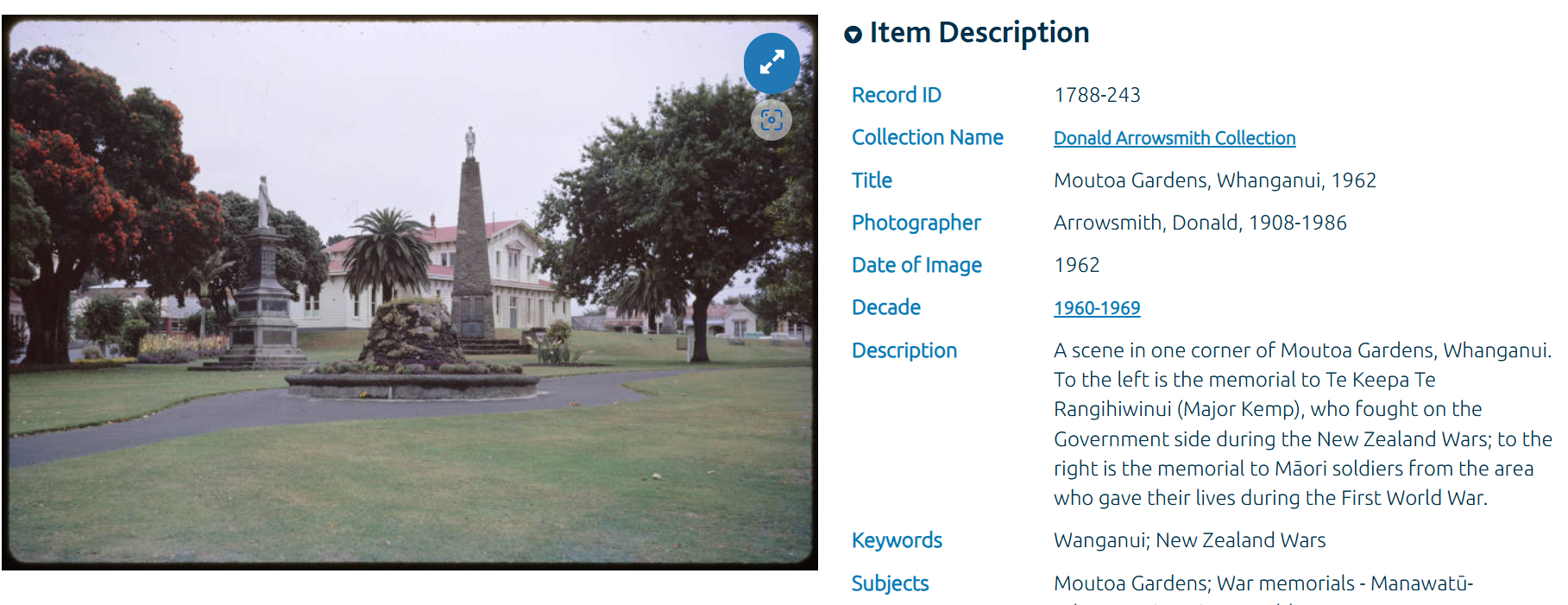
What this photo shows will be discussed below, but the key thing to note is in the ‘Item Description’ where the photo is said to be from the ‘Donald Arrowsmith Collection’. Clicking that link opened up for me the ‘Arrowsmith Resource’. The first item in the collection is authored by David Arrowsmith, titled ‘My Father’s Lens. A journey through Donald Arrowsmith’s photographs of rural South Auckland in the 1960s’. David is Donald’s son, and this is how he sets out the rationale for making the Donald Arrowsmith collection and his 106 page discussion which is publicly available:
My family emigrated from the United Kingdom in 1958 when I was six years old, bought a farm at Mauku 50 kilometres south of Auckland, and for the next thirteen years it was home. Now sixty years later in early retirement, I return to a box of my father’s Kodachrome slides from the early 1960s. … In these extraordinary images, I began to experience my father’s response as a recent immigrant from the United Kingdom to his new country. In vivid colour, there were photographs of school life, church activities, farming events, family occasions, day trips, a royal visit, the A & P show, multiculturalism. I realized that what I had in my possession was a visual record of mid-twentieth century rural South Auckland from a newcomer’s perspective. (p. 3)
The full collection of 285 of Donald Arrowsmith’s photos can be scrolled through whilst using David’s document to fill in the context for Donald’s photographic journey. Together they really are a remarkable collection, but my initial reason for scrolling through all the photos was very selective: I wondered if there were further photos of Moutoa Gardens, especially the Phoenix palms. It did not turn out so, however, there were a number of other photos where the palm could be seen, and to me this was a significant discovery. Luckily the photos are not copyrighted so the full set can be reproduced here along with brief comment. We can move through them in the order in which they appear in the collection, using the photo number and full title as given in the collection (all photos sourced from Donald Arrowsmith Collection, Auckland Libraries Heritage Collections).
008 Farmhouse, Mauku, 1959
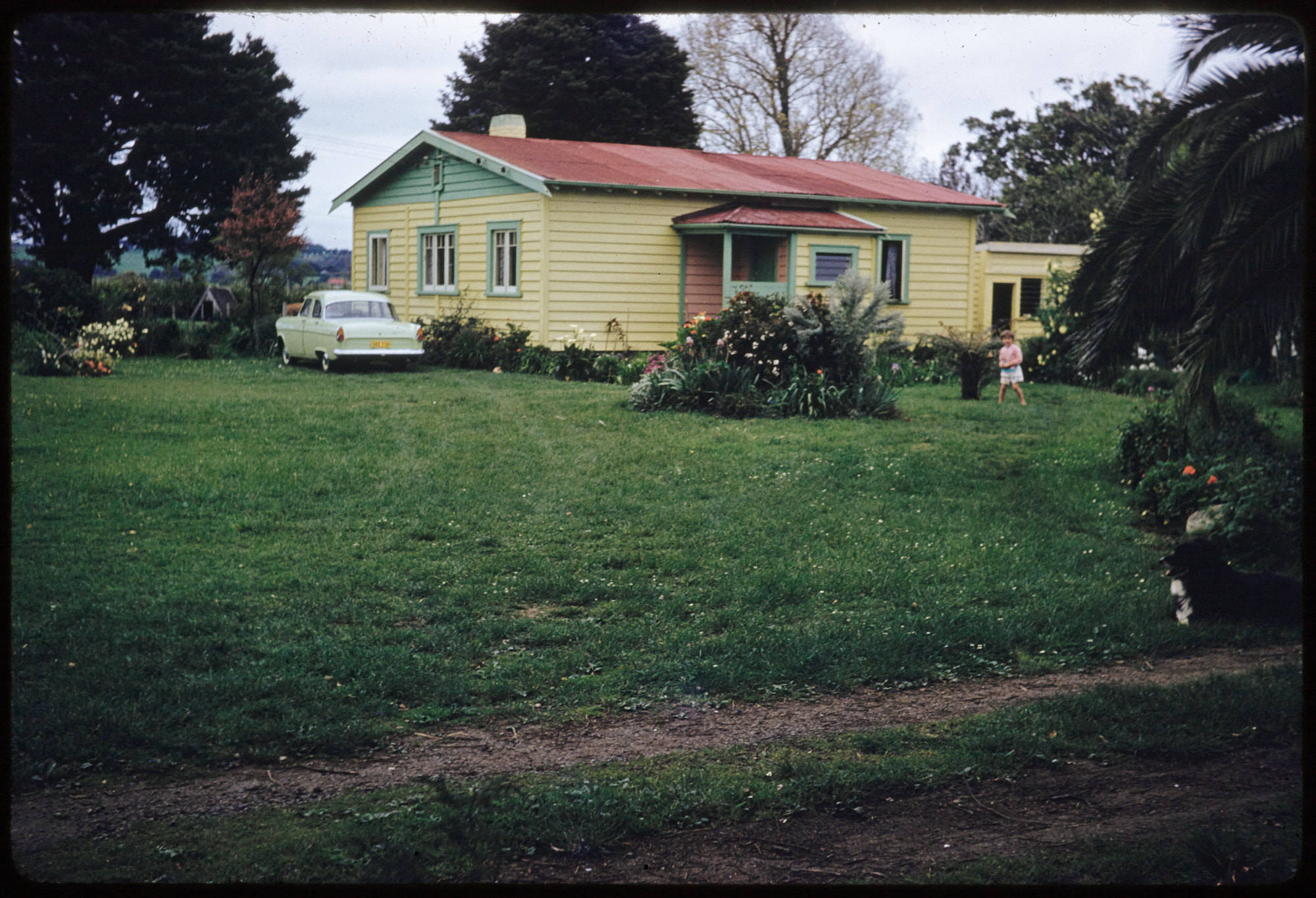
Mauku is about 40 kilometres south of Auckland, with the closest town being Pukekohe. The first photo shows the farmhouse on the small (40 acre) dairy farm Donald bought, and we can also see our first Phoenix palm. The fronds in the top right corner suggest a palm about 10 – 15 years old. Obviously, the palm is incidental to the photo which centres on the farmhouse with Donald’s Ford Consul parked in front. The car had been shipped to New Zealand from the United Kingdom, and it appears in many of the photos.
087 Car dealer, Pukekohe, 1962
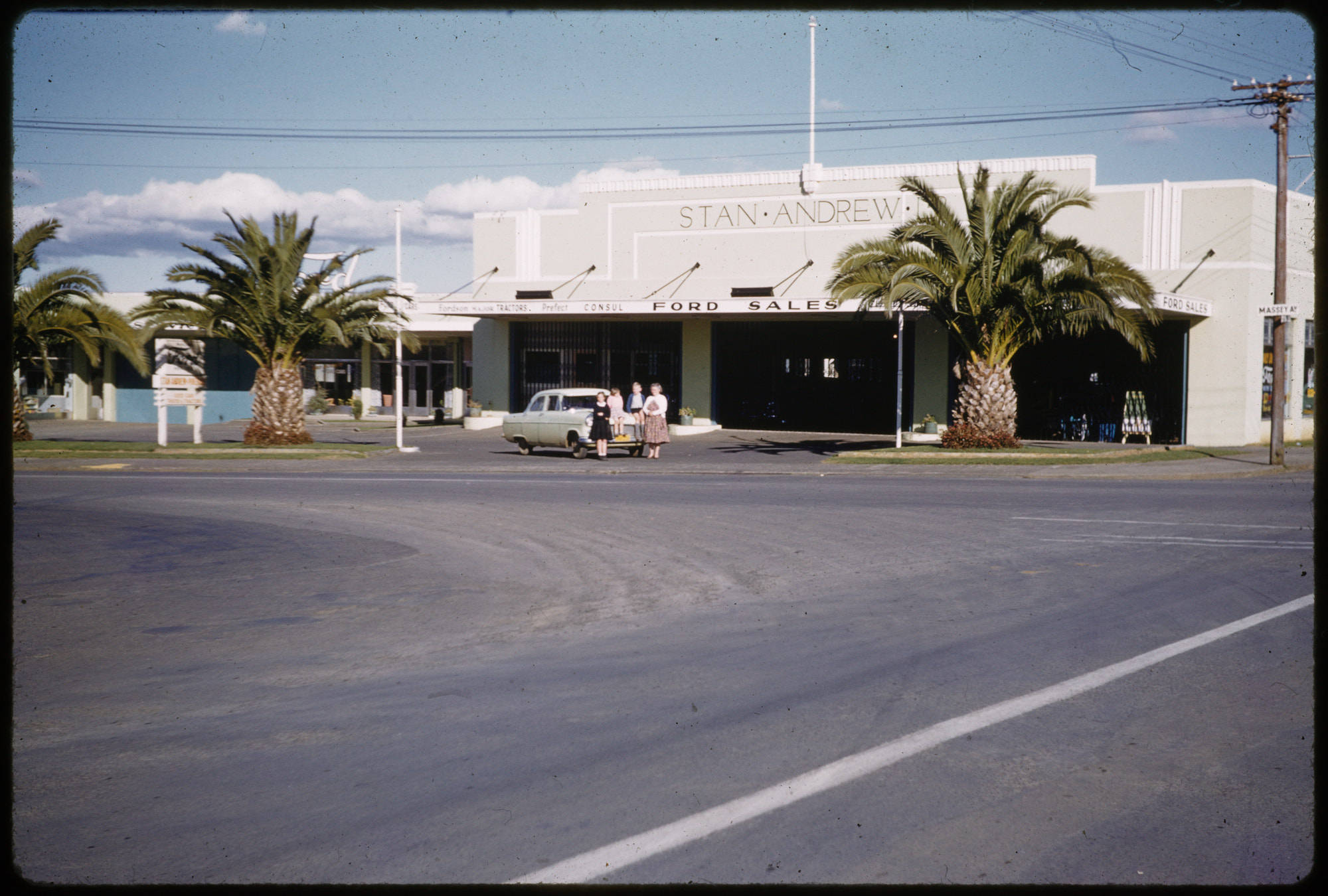
As David details in My Father’s Lens, Donald ‘loved his cars and liked to replace them every eighteen months’ (p. 83). Photo 087 shows the family in front of Stan Andrews Motors where Donald bought his new cars after trading in the imported Ford Consul. Three Phoenix palms at least 15 years old are very visible, but again appear not to be the centrepiece of the photo.
168, Albert Park, Auckland, 1963
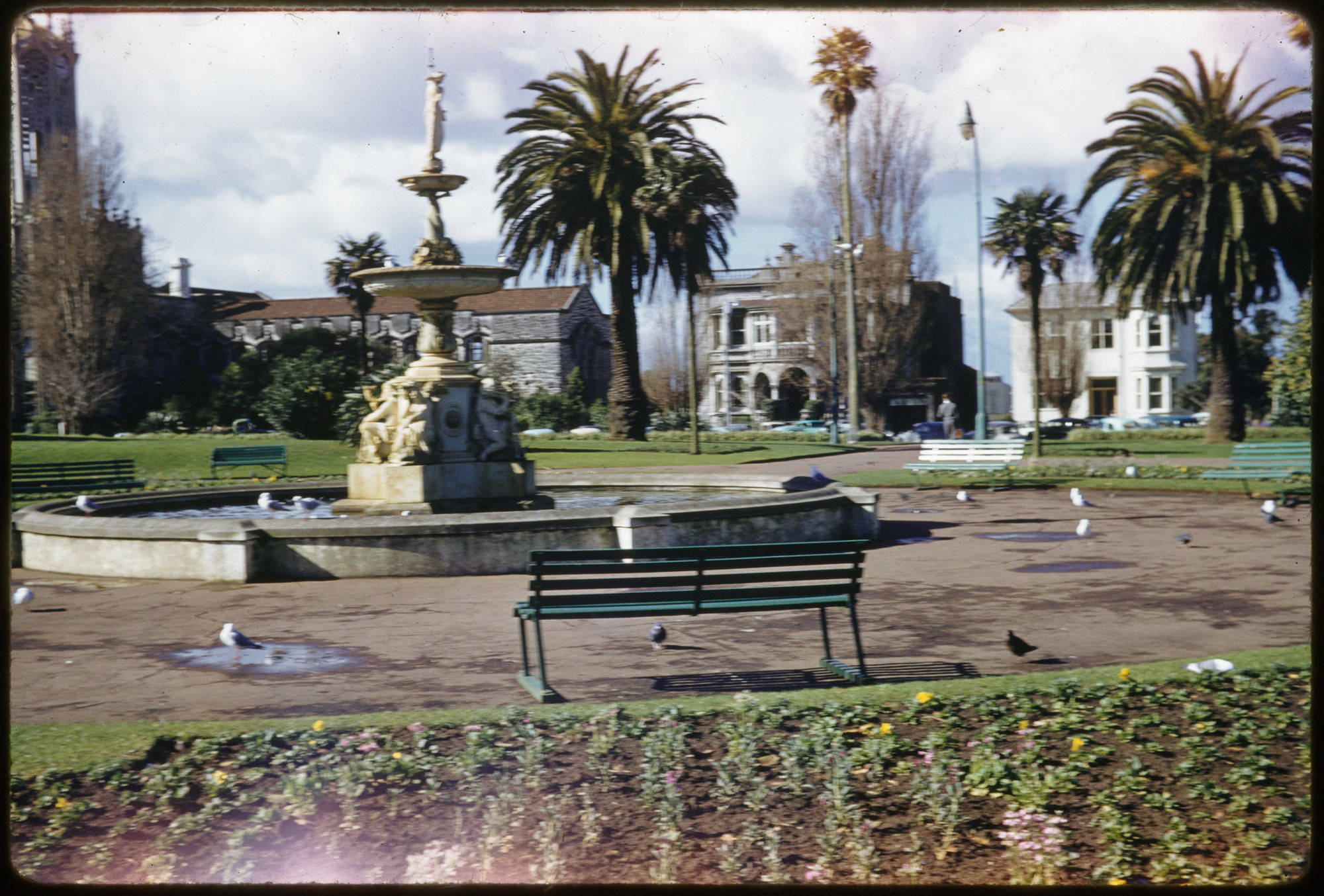
This is one of the few photos that would qualify as a more typical ‘scenic’ shot. Albert Park is an impressive and historic central Auckland park full of statues and fountains, and as seen, impressive palms including Phoenix, Chinese fan and Washingtonia palms. Nearby Phoenix palms in Bowen street were planted circa 1905, and the palms seen in Donald’s photo may date from about the same period, making them about 50 years old when he photographed them.
187, A Day at the Zoo, 1960
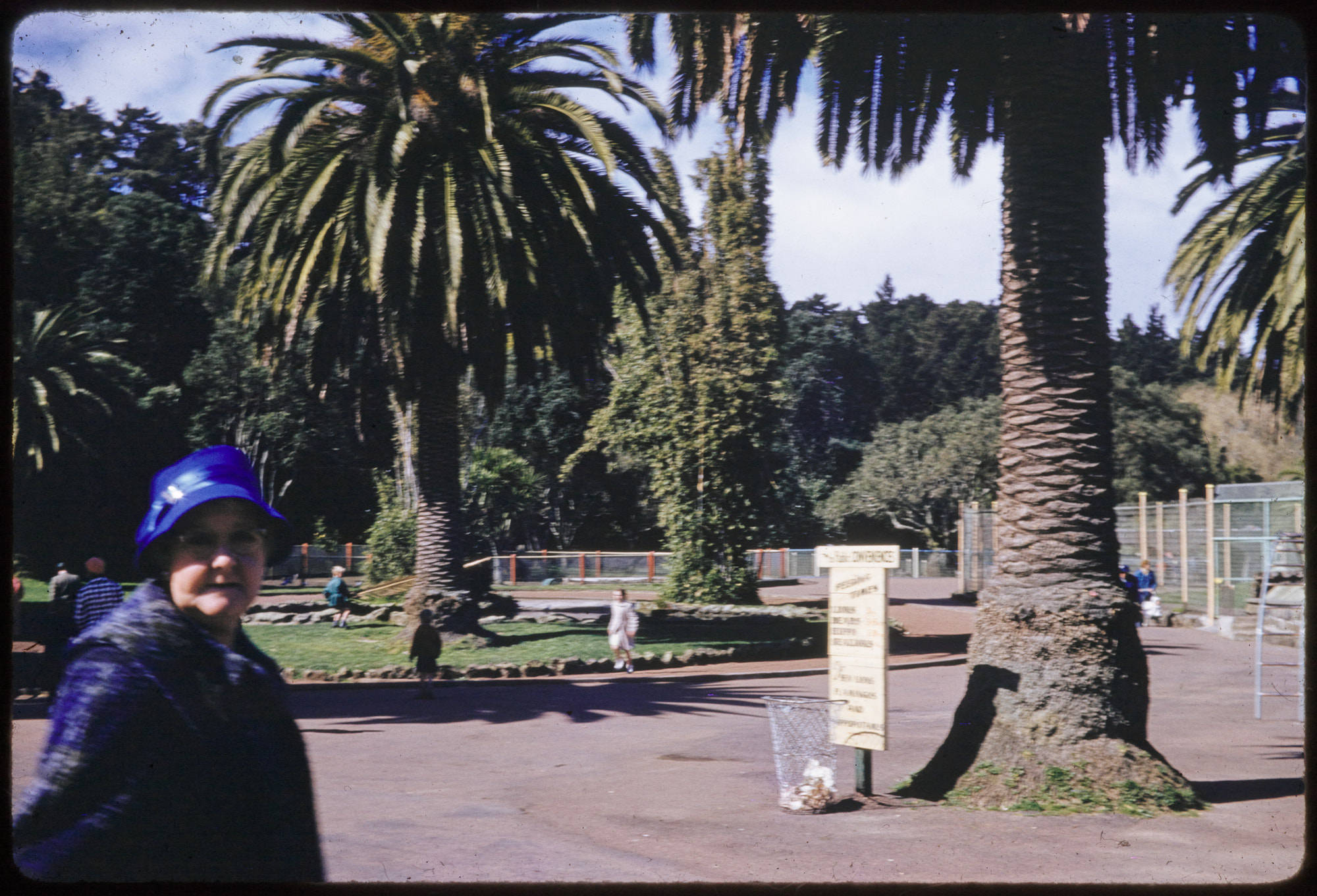
This is one of three photos taken at Auckland Zoo, near the elephant enclosure. As can be seen there is a group of Phoenix palms, which from their size look to be about 40 years old.
215, Bowlers, Rotorua, 1962
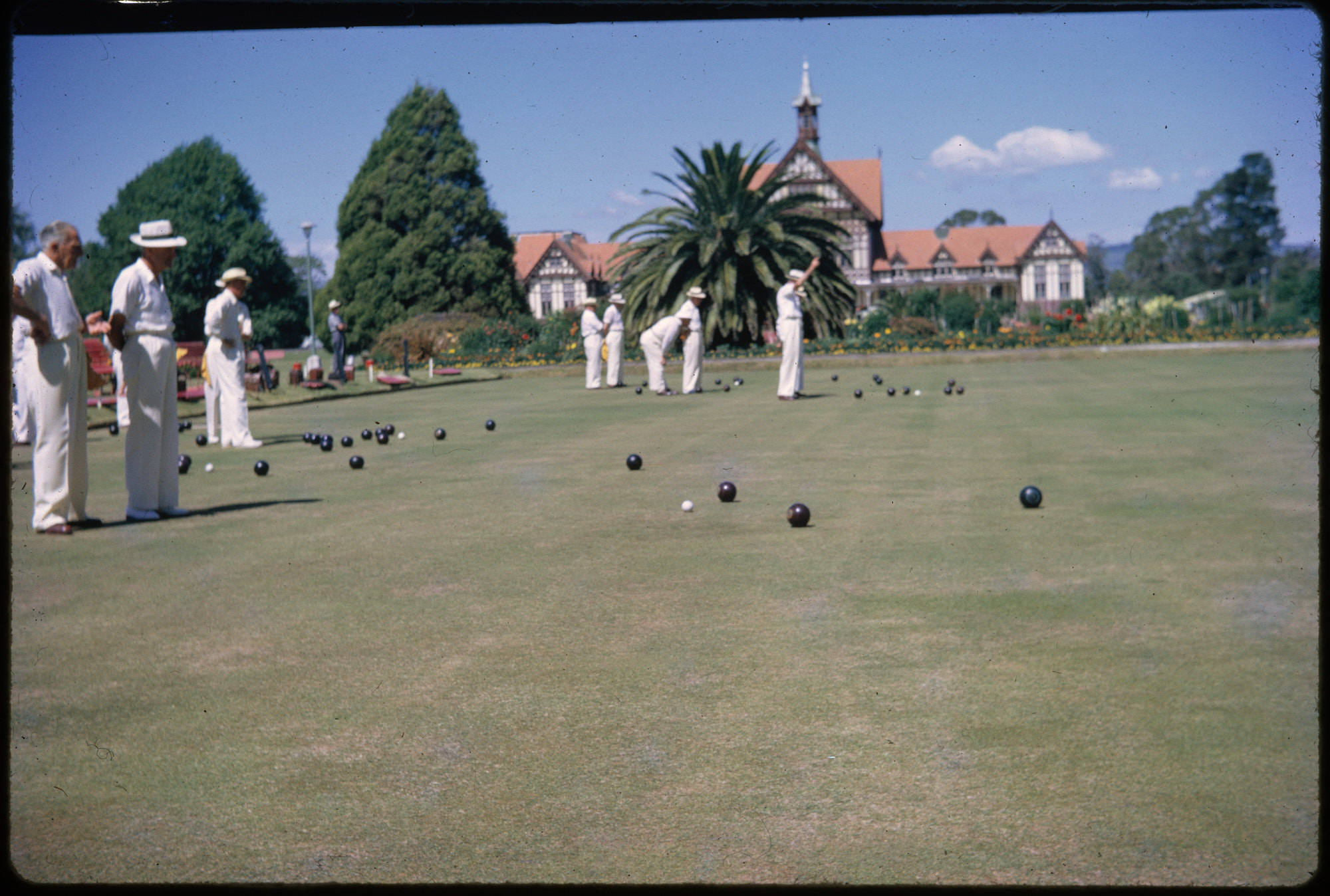
Here Donald seems more interested in the bowling action, but there in the background is one of the significant Tudor style spa bath house buildings in the Government Gardens, with a significant Phoenix palm in front (there are many more around the grounds). This is likely to have been planted about 1930.
227, 229, Beside the river, Gisborne, 1962
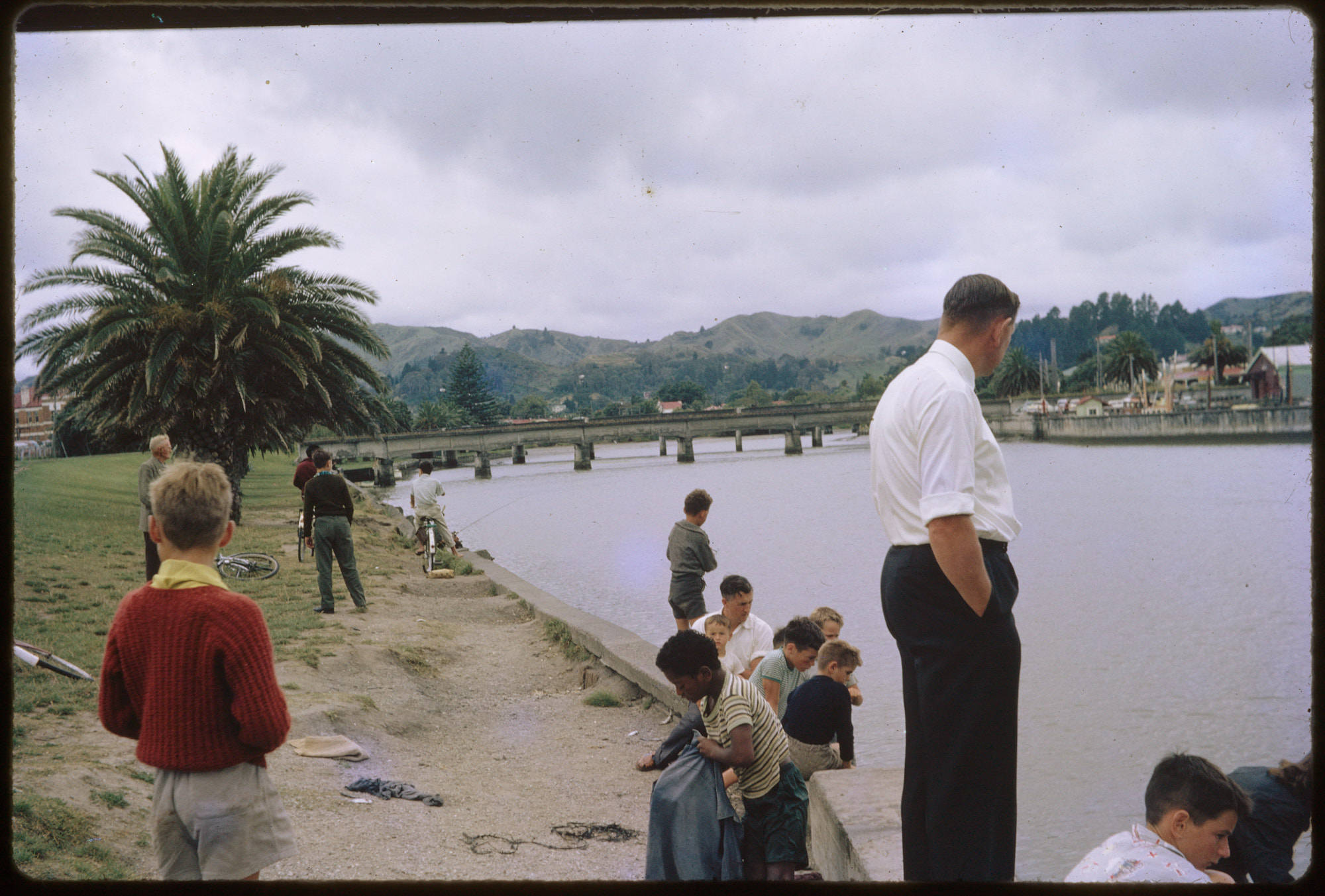
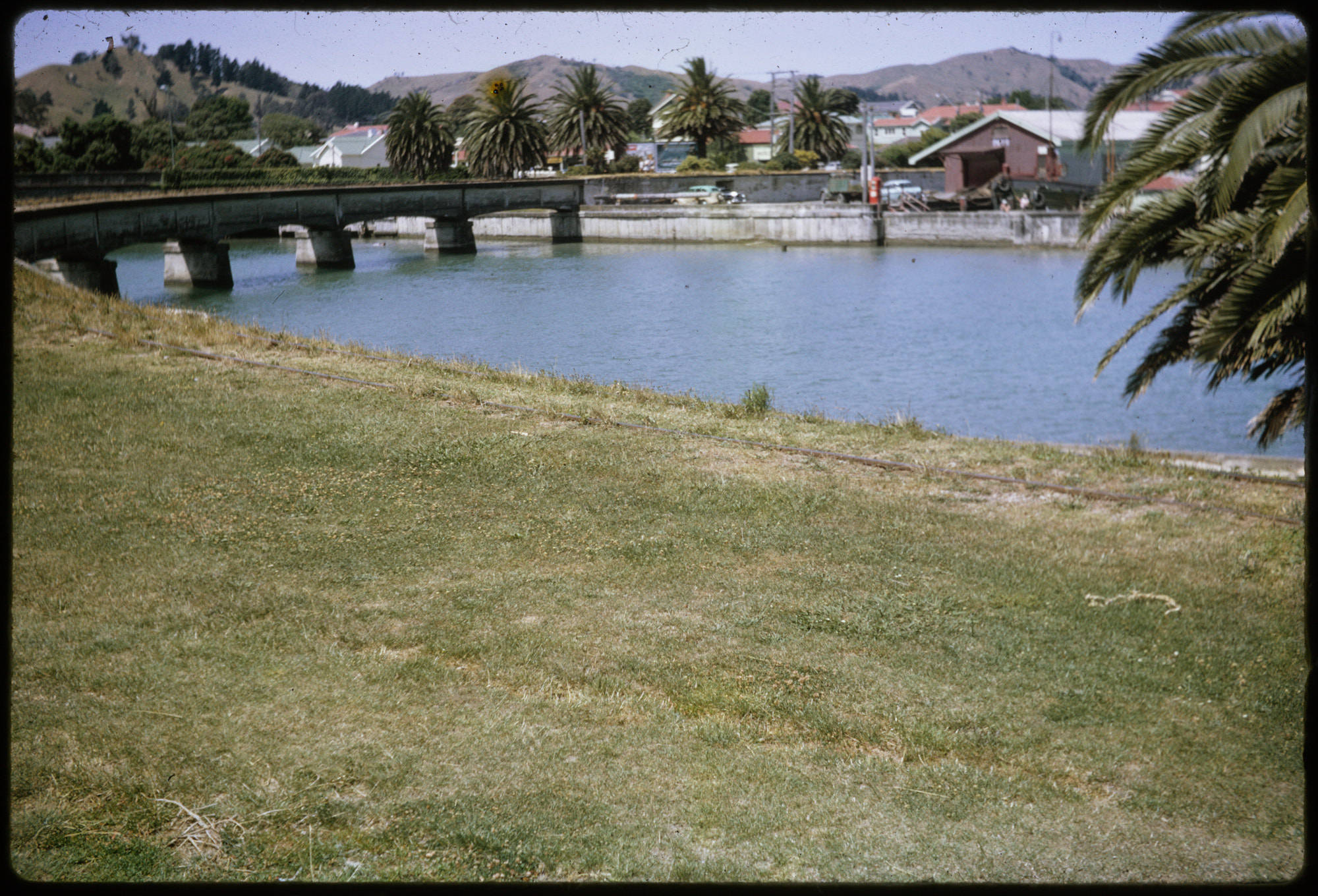
The two photos here are of the area beside the Turanganui River, in the central area of Gisborne. The top photo shows two of a row of Phoenix palms planted in 1935 along Reads Quay, and the bottom photo looks across the river to a group of palms planted in 1934.
239, Pukekura Park, New Plymouth, 1962
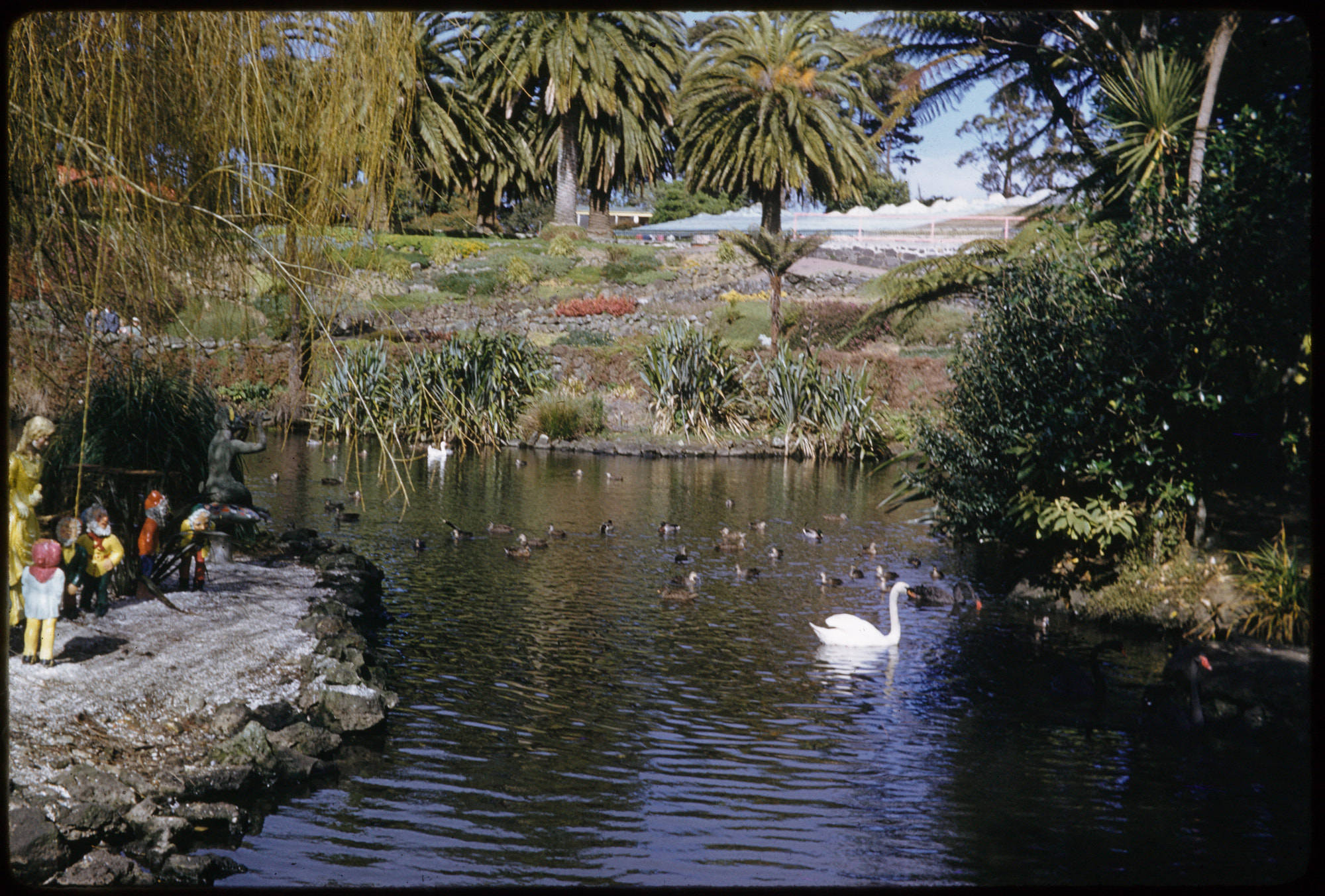
Pukekura Park is a large and well-known garden in central New Plymouth. The photo of a duck pond shows in the background at least four Phoenix palms, by their size looking to be at least 40 years old.
243, Moutoa Gardens, Whanganui, 1962
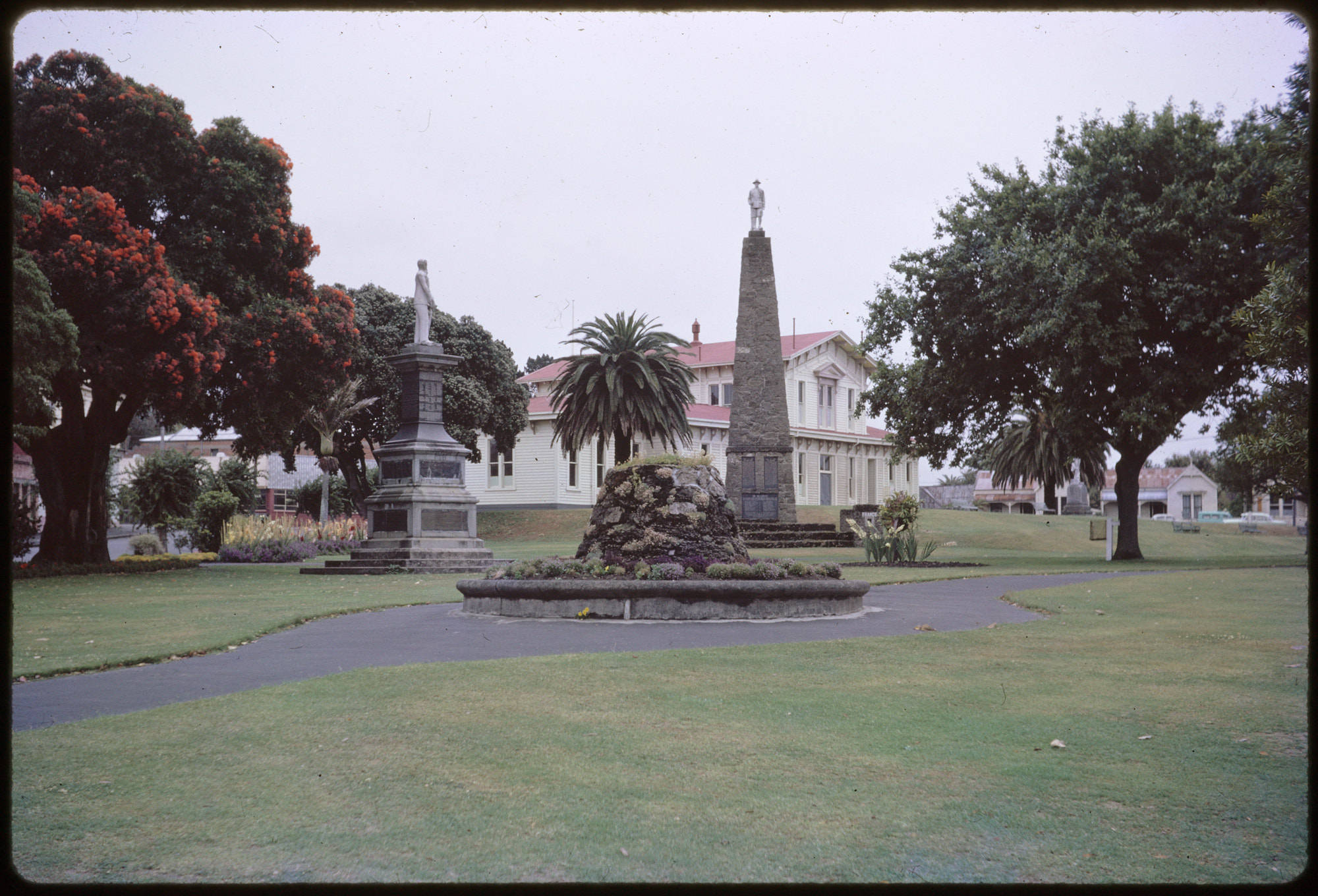
This is one of Donald’s better framed photos, showing two memorial statues, the Whanganui courthouse, and many trees including two Phoenix palms at either corner of the courthouse. The planting date for the palms can be accurately dated as 1928 (see Whanganui’s Pakaitore Palms), making them 34 years old at the time of the photograph.
255, Ruakura Agricultural Research Centre, 1962
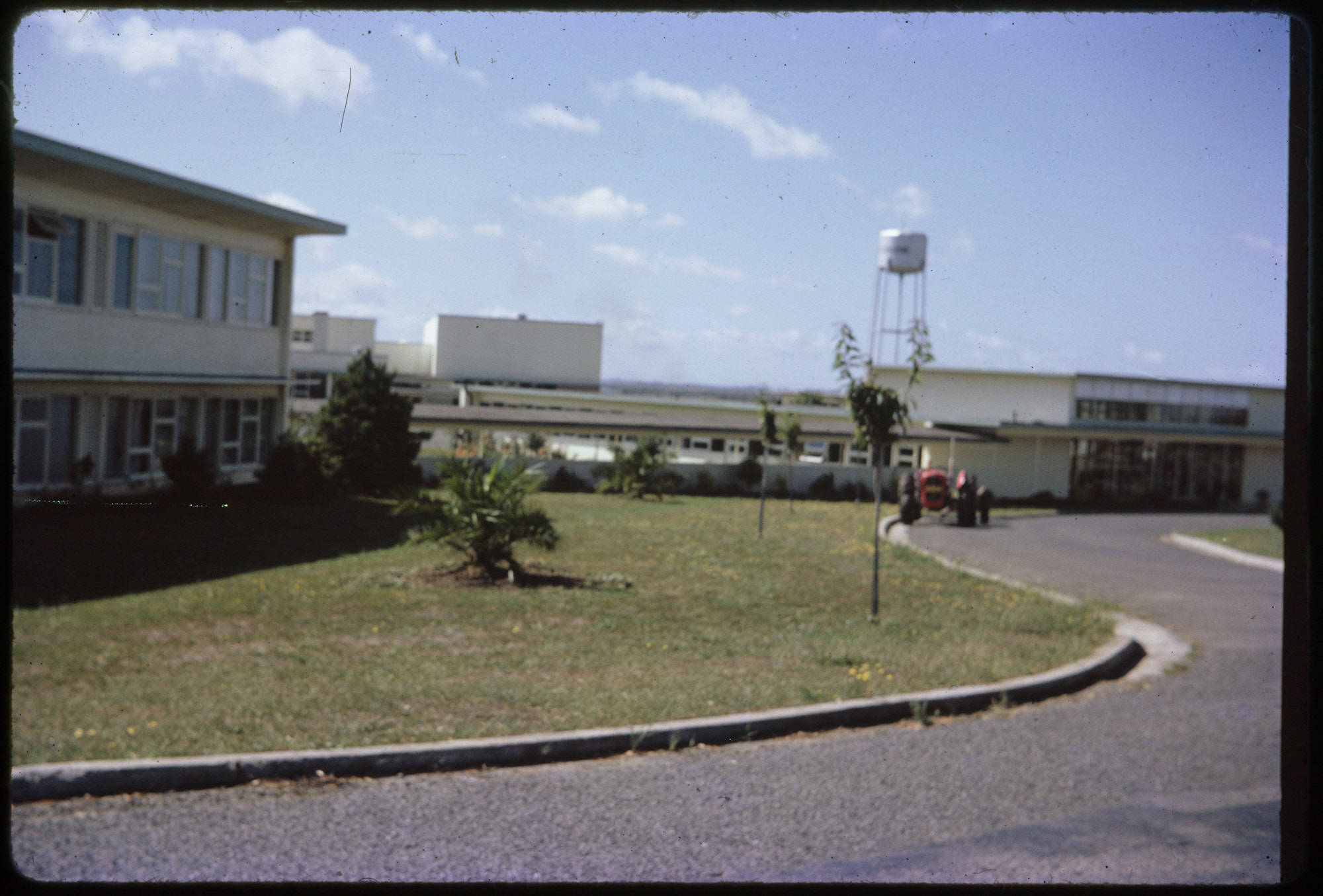
This photo of Hamilton’s significant Agricultural Research Centre shows two young Phoenix palms planted in a lawn area beside the Centre buildings.
258, Street Scene in Hastings, 1962
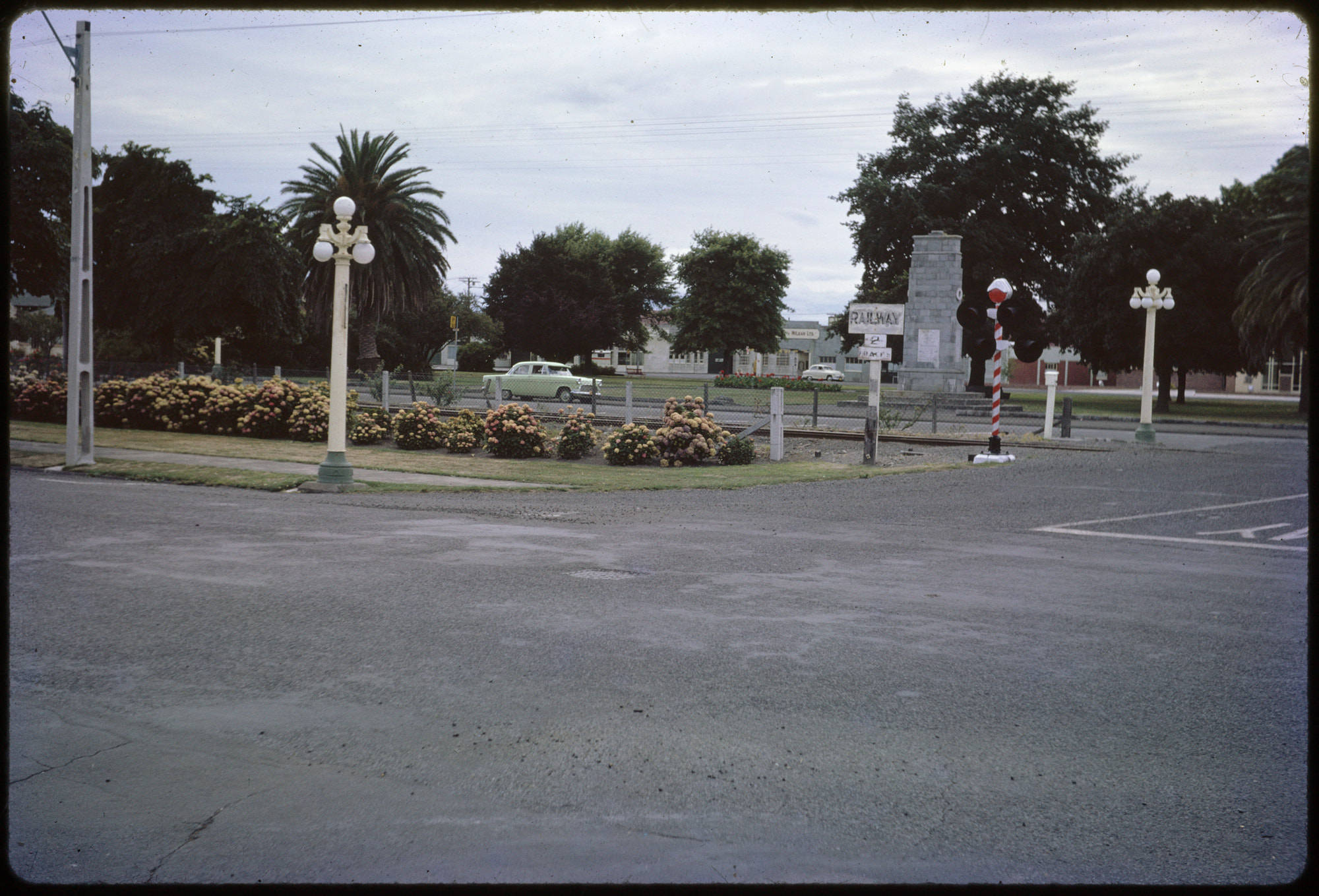
Again we see Donald’s car featuring in the photo, this one being taken at the Hastings World War One memorial. There is actually a second Phoenix palm just at the right border of the photo, and both are at least 40 years old at the time of the photograph.
262, Pukekohe township and hill, 1962
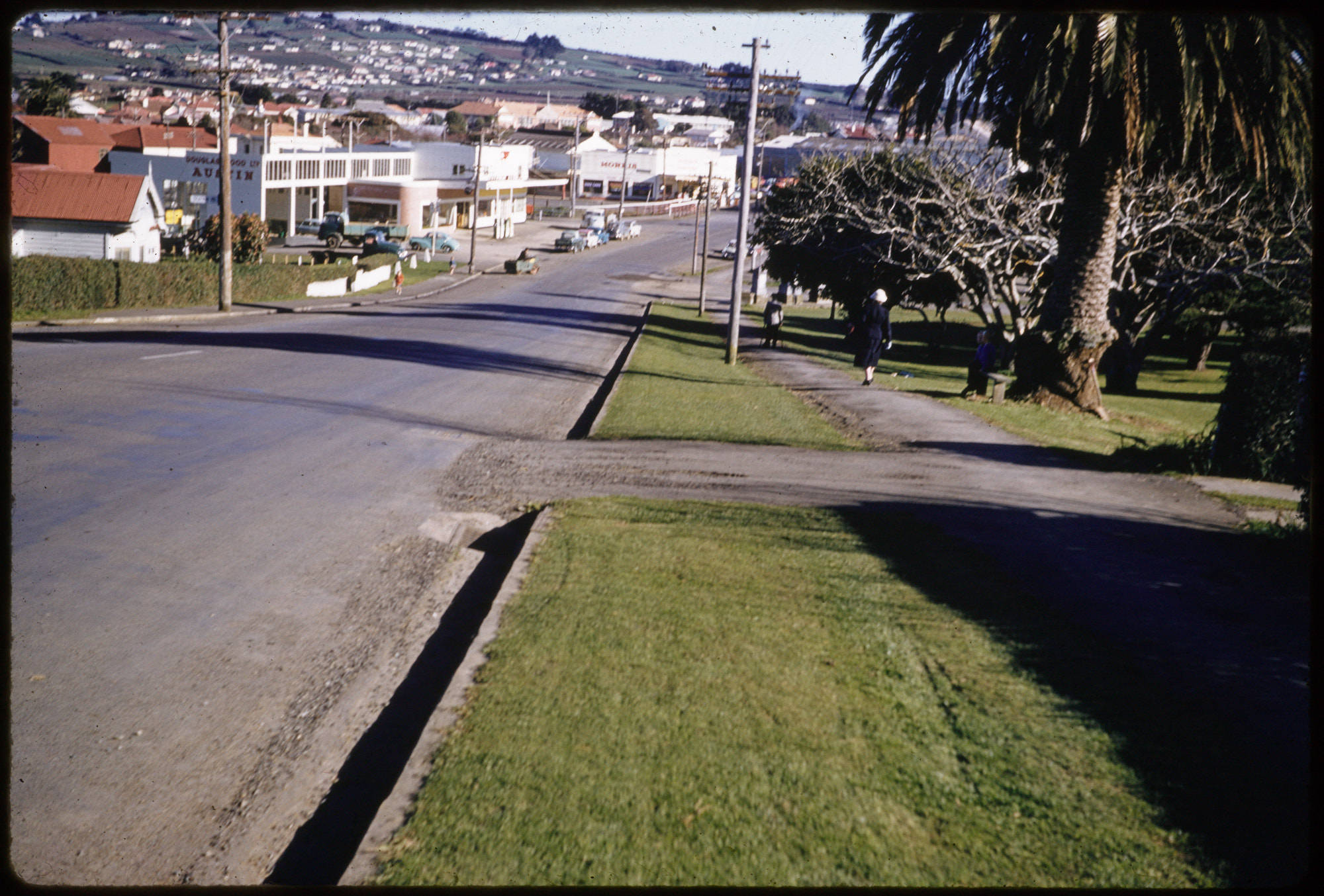
This photo offers a view looking down a small hill towards the centre of Pukekohe. The woman on the pavement walks beside Roulston Park where we see a good-sized Phoenix palm, probably planted in the 1930s.
A Snapshot of the Midlife of Phoenix Palms in New Zealand
If you read David’s engaging account of My Father’s Lens many more details can be found both about his family’s history and the full collection of Donald’s photographs. The history includes details of a change from a dairy to a beef and chicken farm, new cars Donald bought, and the fact that Donald stopped taking photos in late 1964. Sometimes the reasons why Donald took particular photos are given, or at least a context is provided. Amongst the latter is a father-son road trip around the North Island, and it is likely many of the photos above were taken during this trip. Regardless of the reasons for taking the photos, given my arboreal interest, they constitute a remarkable record of the midlife of Phoenix palms in New Zealand. It should be noted that as such it is an unintended record, that is, Donald had no obvious interest in the Phoenix palm (or it seems anything gardening-related). Consequently this remarkable resource really is a serendipitous snapshot of the presence of Phoenix palms in New Zealand’s North Island.1
The fact that there are 14 out of 285 Arrowsmith photos with Phoenix palms shows that by the early 1960s the palm had become part of the arboreal background to our lives. The interesting question then becomes, ‘what changes have occurred since this midlife point?’ In part two of this post we’ll jump forward to 2025 and see what has happened to the snapshot sample Donald (and David) have provided us. We cannot always track down what has happened, but what we can find shows many significant changes. We’ll see that in many ways this is a classic rise and fall story.
- Unfortunately Donald did not venture to the South Island during his photography period so there are no photos from further south that have Phoenix palms in them. Whereas there are fewer Phoenix palms in the South Island they still have a significant presence. There is a specimen growing in Invercargill, and in Timaru’s Caroline Bay can be found what is probably the world’s southern-most cluster (totalling 75) of Phoenix palms (see NZTR entry). ↩︎
Acknowledgement The research for this blogpost was part of a paper presented at the annual conference of the New Zealand Arboricultural Association, Auckland, October 9-11, 2024. Thanks to NZARB for funding, and to Brad Cadwallader for inviting me to present.

 The Local Arboretum: Noticeable trees and their stories