Recently I spent a week in the Wairarapa, based at Martinborough. To get there I took the train from Wellington to Featherston and then biked the 18 kilometres to Martinborough. While biking through Featherston I couldn’t help but notice two large Pinus radiata about which I made a mental note: ‘worth further attention’. Returning to Featherston at the end of the week I’d noticed a couple of other Wairarapa pines that I thought befitted a post, and so I finished the trip by indeed taking photos of the originally noticed pines. It was a misty rainy day, nevertheless the size and presence of the pines stood out. Several photos are worthwhile, the first of which has an SUV in frame usefully showing the size of the trees:

A photo from the east side gives a better indication of the size of both pines:

Finally, a shot from the south-eastern side and a close up shows that as is common with old trees some pruning of limbs has occurred:
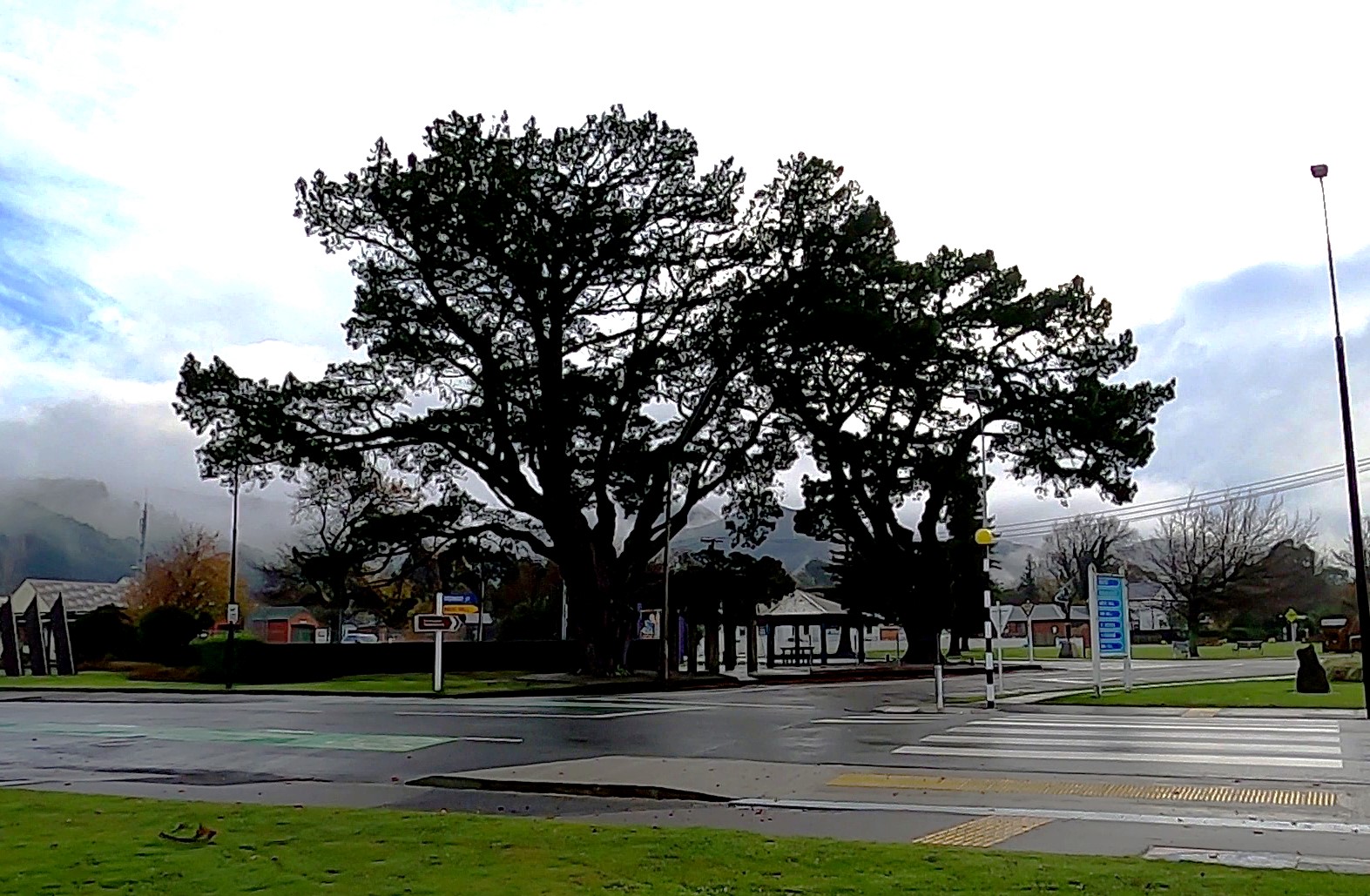

The park that the pines border – seen in the left photo – is now known as Featherston Town Sqaure and given its naming and its location in the centre of Featherston I figured some historic photos might be available. A search of DigitalNZ turned up several including this from circa 1910:
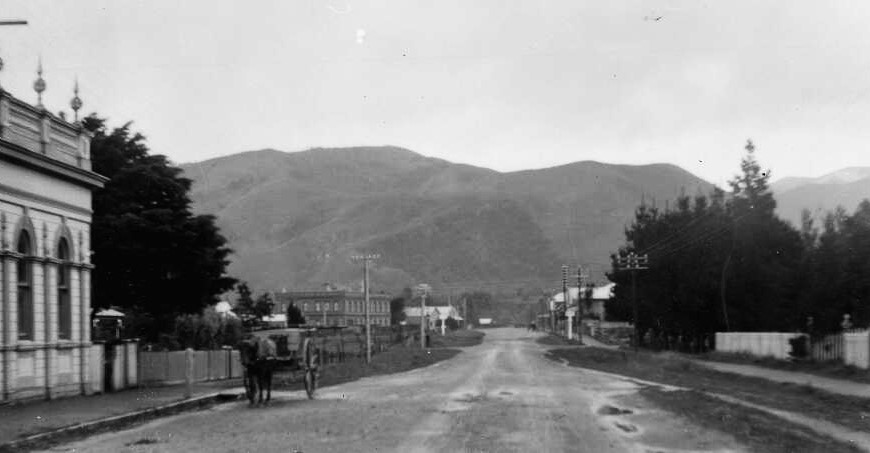
Source: Featherston. Evening post (Newspaper. 1865-2002) :Photographic negatives and prints of the Evening Post newspaper. Ref: 1/2-107039-F. Alexander Turnbull Library, Wellington, New Zealand. /records/22603584
This is only about 200 metres north of where the pines currently grow. The big building to the left of the railway crossing is the Royal Hotel (established 1868), and dominating the right-hand side of the photo is a cluster of radiata pines. By their size in 1910 they must have been planted prior to 1900, possibly about 1890, which as we know from details in the post ‘Some ‘Great Pines’ of Wellington‘ was a time when Pinus radiata were well established in New Zealand.
A more recent historical photo shows that the pines in the 1910 photo did not survive changes in Featherston’s buildings and landscape:

Source: Featherston. Whites Aviation Ltd: Photographs. Ref: WA-11315-G. Alexander Turnbull Library, Wellington, New Zealand. /records/22707492 (cropped)
At the bottom left corner is the Royal Hotel, and at the top right corner the two pines as they were in 1947. In the middle to the north of the main road (Fitzherbert St) we can see where the pines were, and across on the other side of the road a block of trees (possibly macrocarpa) that can be seen where the horse and cart are in the 1910 photo (these trees have now also gone). Collectively, the photos suggest that the two old pines, very noticeable in Featherston’s main road, are survivors from a much broader planting in the town, and now are probably about 135 years old.
True Farmland Pines
Of course there are literally thousands of pines viewable in the broader Wairarapa farm landscape, but I’d like to present just two that caught my attention. The first I saw while biking along Ponatahi Road close to Gladstone:

What made it noticeable given its existence alone in the paddock was the large broken branch pointing up into the sky. It was redolent of what I’d seen so many times before in what I’ve called ‘beat-up macs’, ie. farmland macrocarpas exposed to the elements (see the post Photogenic ‘Beat-up Macs’). On closer inspection another feature of the tree became apparent:

The view from this angle shows more of the damage the tree has sustained over time (look at the base of the trunk), but also shows the mass of roots exposed to the air to the right of the tree. Unfortunately, as the tree was in farmland I couldn’t get a closer shot, but even from this distance it appeared that what best explained the root-exposure was the use of the tree for shelter by stock (sheep I think). The gathering of sheep under the tree has significantly exposed the soil and roots. This is unlikely to damage the tree, but certainly adds to its noticeability. This is also seen in the final example of rural pines, with this tree having an added ‘bonsai’ appearance:
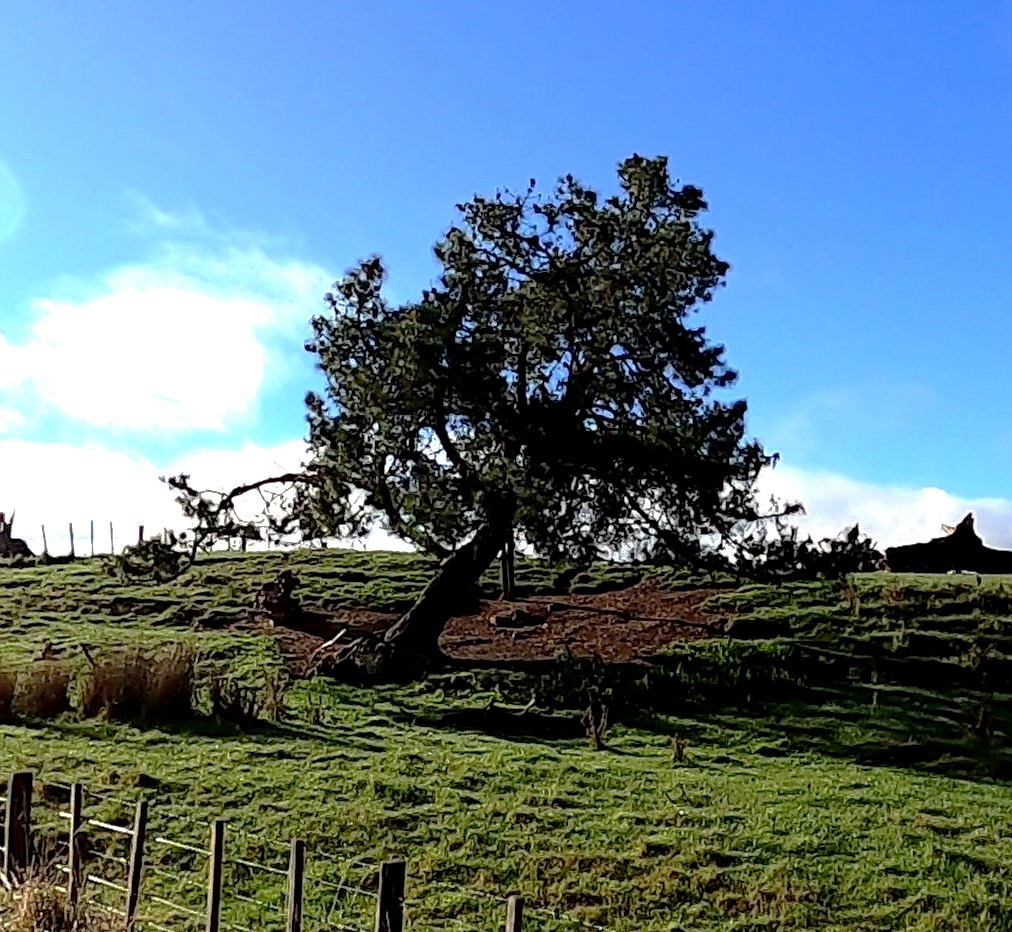
Again the pine was out in the paddock by itself, but noticeable for its distinct lean as compared to any broken limbs. The tree was much smaller than the previous example, but on closer inspection the lean was more pronounced than at first view:

Even though this pine is not large, clearly it has been used for shelter by stock, as indicated by the bare soil underneath. Continuing moving around the tree it was apparent that whereas the lean was a natural result of exposure to the wind, some aspects of the tree’s bonsai appearance were attributable to human action:

That straight cut of the leaning trunk has clearly been caused by a chainsaw. In the course of time the remainder of the tree will no doubt be chainsawed for firewood, but in the meantime we can enjoy the view of a mainly naturally occurring bonsai pine in the paddock.
NB: Part 4 of the Arrowsmith Phoenix pines posts will follow this current post, which is something of an interlude. Additional posts based on trees I noticed during my Wairarapa trip will appear after the final instalment on the Arrowsmith Phoenix palms.
Acknowledgement: Thanks to Penny Evison for hosting me in Martinborough.

 The Local Arboretum: Noticeable trees and their stories
Leave a comment