I’m reading Barefoot Years, Martin Edmond’s wonderful account of his childhood in Ohakune. He starts by reflecting on the childhood game of answering ‘what’s the first thing you remember?’ It’s a difficult task but it gets easier when he describes the second house his family lived in while his father was a teacher in Ohakune. Some of the memories resonated with my arboreal interests, especially his ability to remember the trees and plants in his childhood environment. For example, around the lawn of the house are ‘two low trees, a lilac and a snowball … the coned purple flowers of the one contrasting the opulent white globes of the other’.1 Other trees described include macrocarpas, towai, cabbage trees, and the farmhouse fruit trees of quince, nectarine and peach. But it was the following description that led me to an interesting realisation:
you might glimpse the gingerbread lace, the dormer windows, the veranda roofs, the carpenter’s gothic of a dilapidated mansion, its native timbers falling back into the soil in which the trees they were milled from grew. If it’s the right time of the year, the pink rhododendrons along the drive will be flowering …. (p. 14)
By noting ‘if it’s the right time of the year’, Edmond is perhaps showing awareness that not all rhododendrons flower in the spring. The clear description of the rhododendrons being pink suggests that ‘the right time of year’ in this case is winter, for I suspect the pink rhododendron he remembers is the cultivar ‘Sir Robert Peel’. This old rhododendron was well known for its early flowering, and given the mansion is described as dilapidated in Edmond’s memories from about 1960, it is exactly the rhododendron we could expect to find growing in the garden of an Ohakune mansion built in the late 1800s.
The discovery of ‘early flowering’
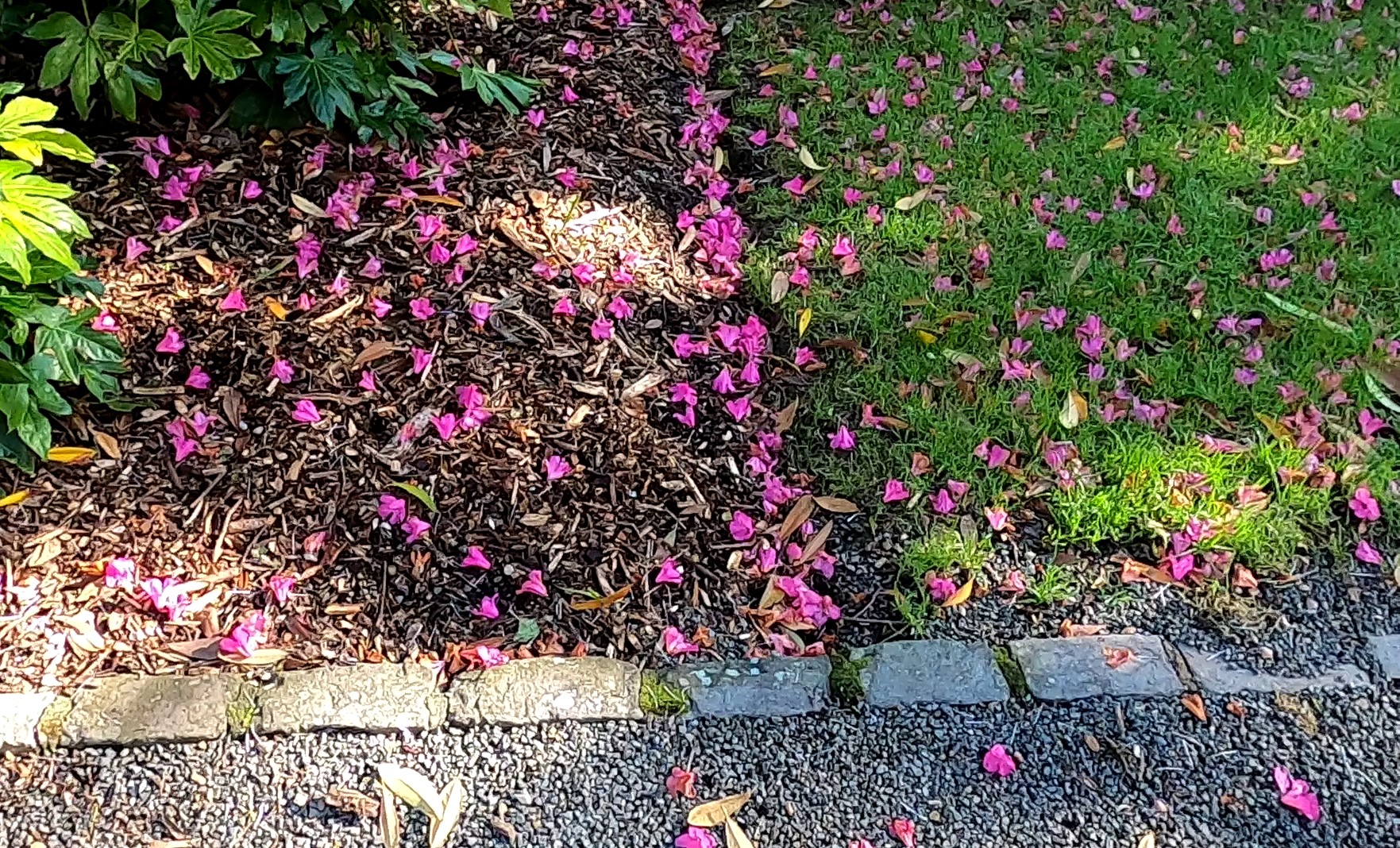
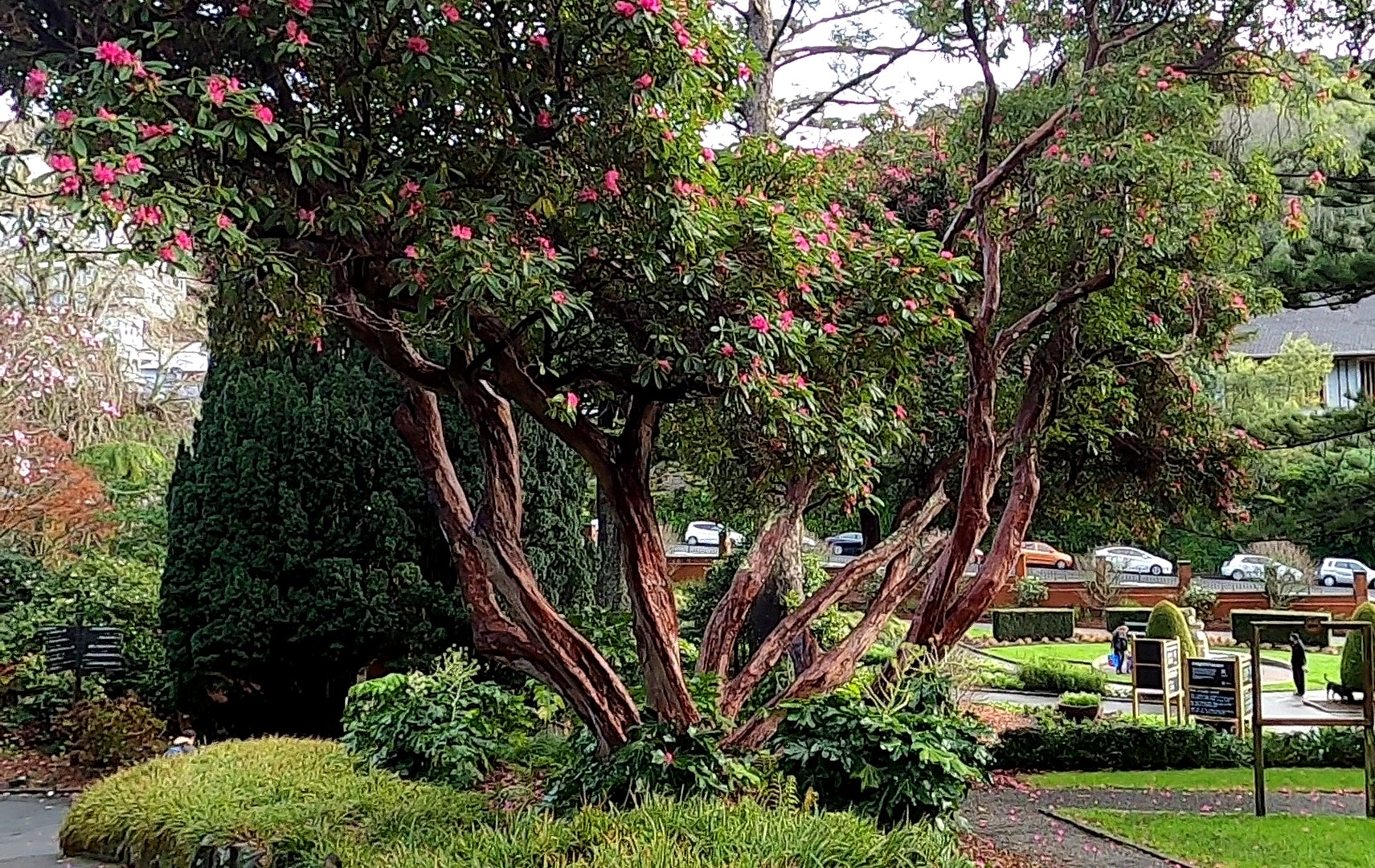
It was late June when I read the passage above, and prompted by a visual memory of pink rhododendrons in the Wellington Botanic Gardens I set off for a walk to the gardens. This was quickly rewarded in the area of the gardens just north of the duckpond. One of the first things I saw was a scattering of pink petals, easily sourced to a large rhododendron:
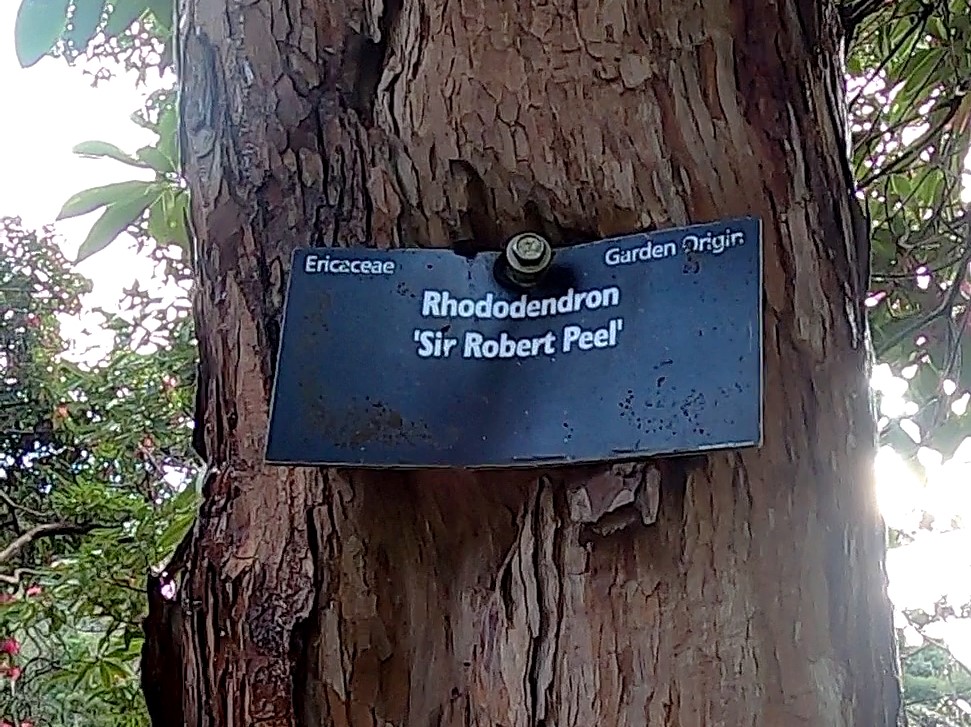
I don’t have the expertise to identify a rhododendron from just its foliage and flower, so I was highly pleased to find this when walking around the base of the trees:
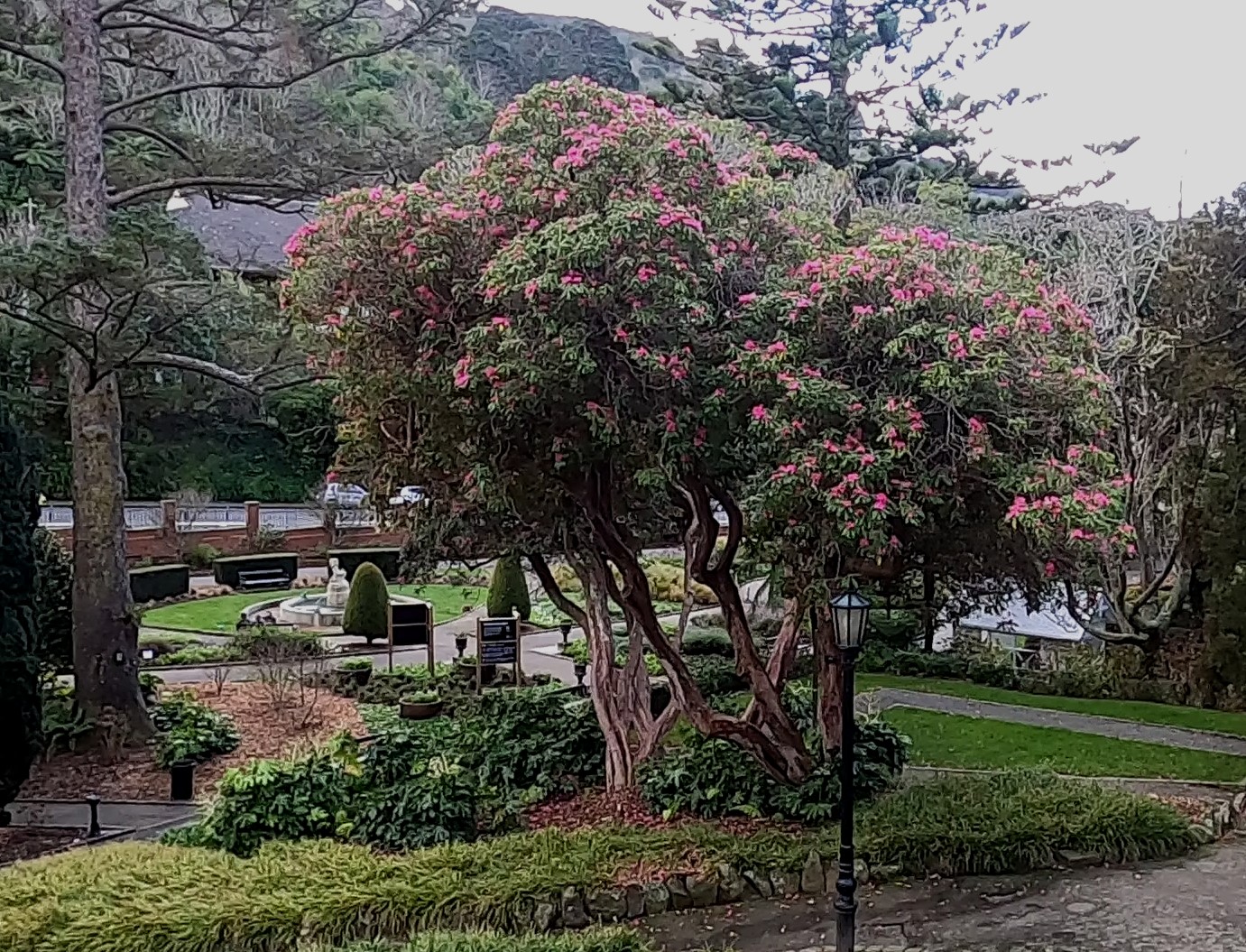
A further photo shows just how large the two trees are:
Once back home some quick Google searching provided some useful information. First, from the Wellington Gardens Facebook page I found a post saying the rhododendron pictured above was planted in 1922. At 103 years old it does seem to qualify as a ‘grand old rhododendron’, a description used for this tree as early as 1932.2 Second, details of the history of this tree were not hard to source, particularly from knowledge of the Victorian gardening era.
The Victorian Rhododendron Story
After the rose, the rhododendron was the most prized plant for Victorian gardeners and horticulturalists. Clive Justice provides a succinct account of the introduction and subsequent breeding of rhododendrons in the United Kingdom. He notes that between 1820 to 1860 more than 500 different hybrid varieties were named and introduced in gardening circles. ‘Sir Robert Peel’ is discussed in a footnote, worth quoting:
The first of the R. arboreum crosses bore latinized hybrid names like the magenta red ‘Altaclarense’ (Latin for Highclere, Lord Caernavon’s estate at Newbury where it originated) and ‘Nobleanum’. Then they began to name hybrids for the nurserymen who developed them: ‘John Waterer’, ‘Gomer Waterer’, and ‘Cunningham’s White’; closely followed by hybrids with names of ladies in the aristocracy: ‘Lady Eleanor Cathcart’ and ‘Princess Ena’, along with important industrialists like ‘Sir Robert Peel’. The latter hybrid was named for a wealthy cotton manufacturer and printer of calico, the father of the British prime minister of the same name. Rhododendron ‘Sir Robert Peel’, a wine red, was planted and is still extant as a street tree in Rotarua [sic], New Zealand. (for source, see Clive Justice link above)
A. Waterer is the nurseryman accredited with hybridising R. arboreum and R. ponticum to produce ‘Sir Robert Peel’, but what interested me more in this footnote was the reference to street trees in ‘Rotarua’. I couldn’t find any other reference to the use of the rhododendron as street trees in other parts of the world, so this seemed important to pursue. It wasn’t hard to track information on the Rotorua case, but as we’ll see a little digging turned up an interesting story.
The Rhododendron Street Tree Capital of the World?
Rotorua is a well-treed town and a good account of the significant trees found there, and part of their history, can be found in Trees of Rotorua.3 Street tree planting began in the late 19th century, sustained into the 1930s, but thereafter there were some removals and rethinking about which trees to plant. Some native trees featured in the early planting, but the majority were exotics, such as English and scarlet oak, strawberry tree, liquidambar, Japanese cedar and maple, Eucalypts, and London plane. ‘Sir Robert Peel’ is not named in the text, with rhododendrons discussed merely in a general sentence on the theme of the extensive planting of the 1930s: ‘Rhododendrons grow extremely well in Rotorua and these particular introductions along with those in Kuirau Park, Victoria Street and Grey Street are some of the biggest in the country’ (p. 18).
We’ll see photos of the rhododendrons in these locations below, but because I wanted to be more definite about a planting date – beyond ‘the 1930s’ – I did a PapersPast search of the newspaper Rotorua Morning Post which was available for the years 1931-1952. This showed firstly that planting of rhododendrons as street trees occurred across several years, so ‘planted during the 1930s’ is a reasonable statement. Secondly, however, there was an important discovery. One article in particular suggested that 1930, or even before, may have been the first planting date. Moreover, this information was found in an article detailing the possible removal of rhododendrons. Here is a snapshot from the article giving the gist of the events:
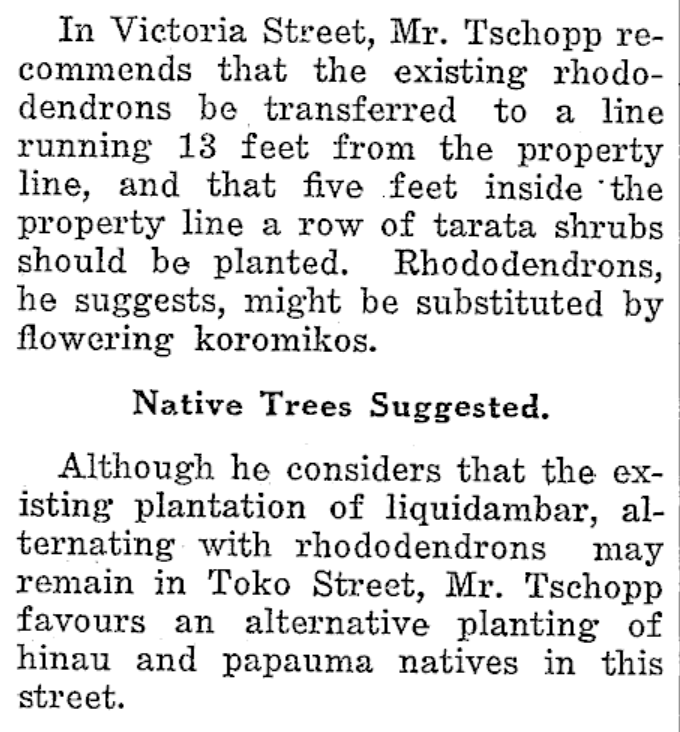
Source: ‘Mr Tschopp’s suggestions’, Rotorua Morning Post, 18 September 1931, p. 5.
There are further articles discussing Mr Tschopp’s report.4 This important report was commissioned by the Rotorua Borough Council, supported by the Rotorua Beautifying Society (formed June 1930), to further the town’s status as a key New Zealand tourist destination, and to make it unique and distinctive. There is academic work available which sets out the history of Frederick Tschopp’s arrival and work in New Zealand, including the argument that he can be considered the country’s first landscape architect. 5
To cut a long story short, whereas praise and criticism of Tschopp’s report came in almost equal measure, the Rotorua Borough Council did not follow through with Tschopp’s strong suggestion to replace exotics with natives. This was actually a preference that he had already displayed in his work in Wellington on a plan for Parliament House grounds. He completed a draft design by April 1930 which gave a clear indication of what he might recommend for Rotorua:
To lend the grounds truly characteristic New Zealand aspect, the whole front end and side planting is laid out with the trees, shrubs, and ferns, and every plant a native of New Zealand. To successfully carry this out this scheme every exotic or foreign shrub or tree will have to be removed from this area. [P5 Specifications.] Quoted in Adam & Bradbury, 2002 (see footnote 5)
By the 1930s when Tschopp proposed the removal of the Rotorua rhododendrons (and other exotics) ‘Sir Robert Peel’ had been in cultivation in New Zealand for at least 50 years. It does not have the most magnificent flowers, but it is undoubtedly robust, has an attractive trunk, and has the advantage of flowering in the New Zealand winter. It would take a few more years after 1930 for it to become no longer well-planted: by 1950 Rhododendron ‘Sir Robert Peel’ was described as ‘scarcely worth planting today’.6
Of course, preference in plants is entirely subjective, and does rapidly change over time. I suspect that in the current environment a council faced with recommendations similar to Tschopp’s would indeed opt for removal and replacement with natives (see the post on Phoenix palm removal).
Conclusion: Look at the Trees!
Perusal of some photos of perhaps the ‘rhododendron street tree capital of the world’, ie. Rotorua, will help the reader make up their own mind. Note that in comparison to the tree photographed in Wellington at the end of June, the large Rotorua trees, photographed at the same time, are not yet flowering. This is probably due to the different climatic conditions: Rotorua is at a higher altitude and has a colder winter than Wellington.
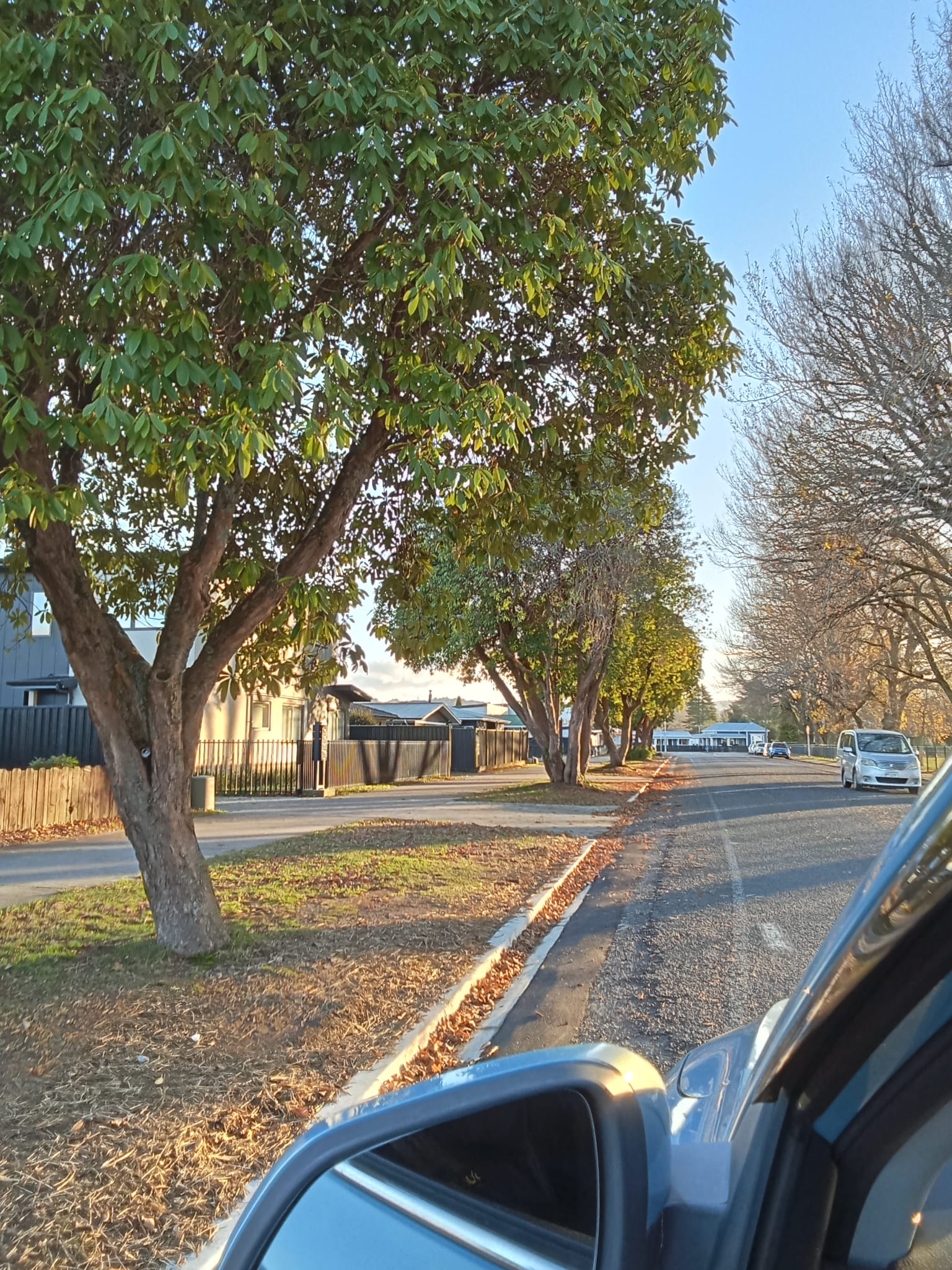
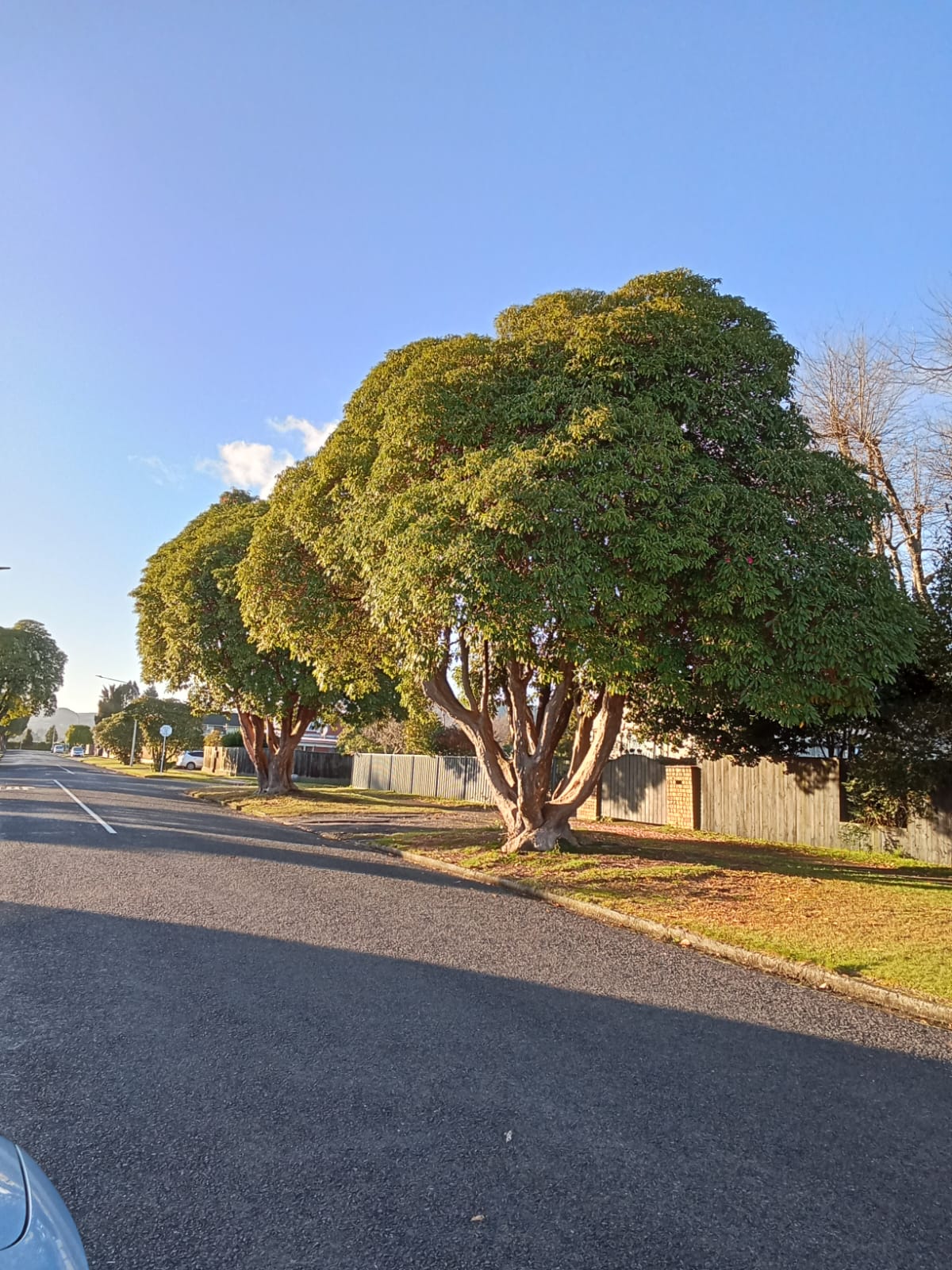
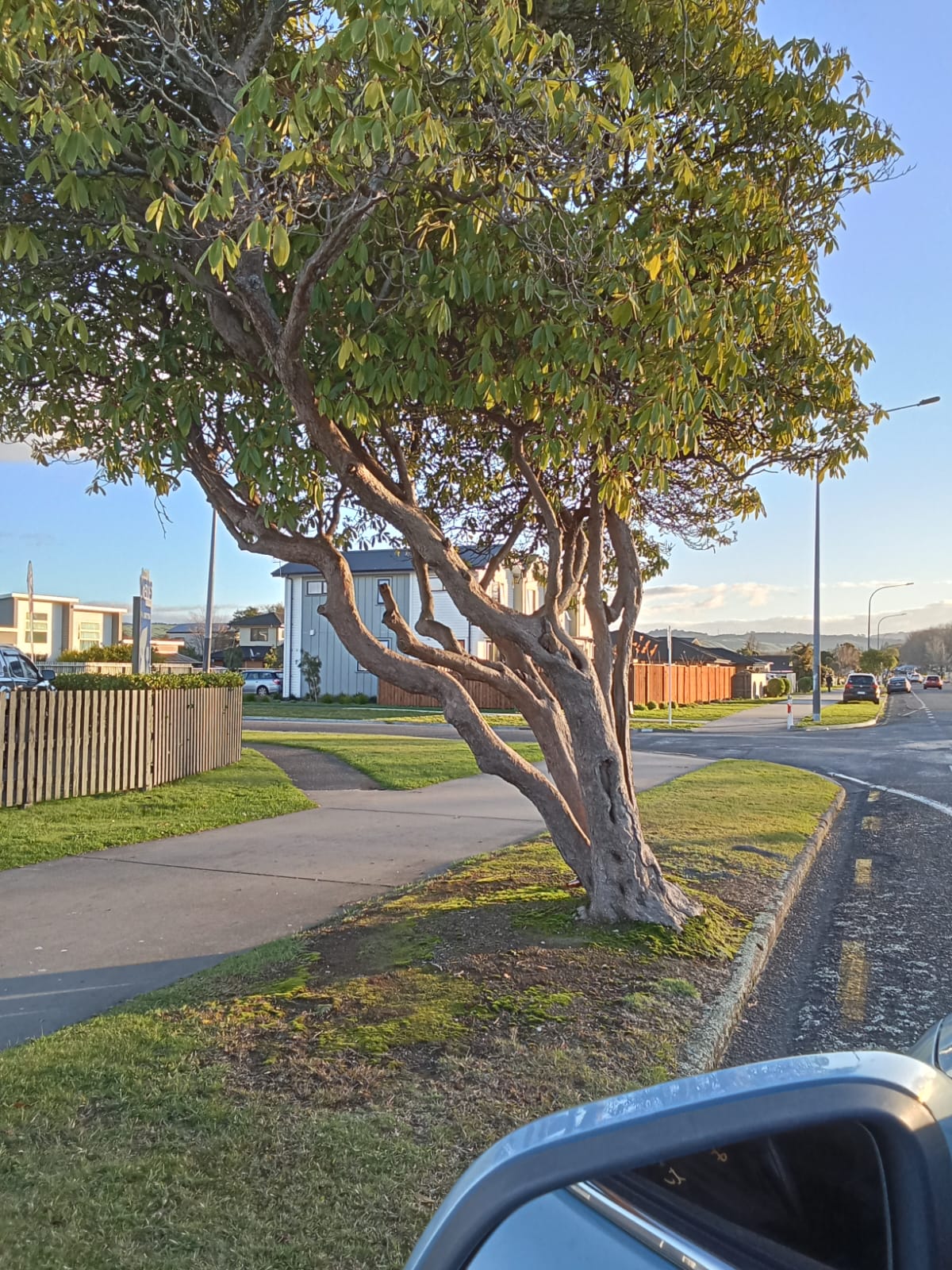
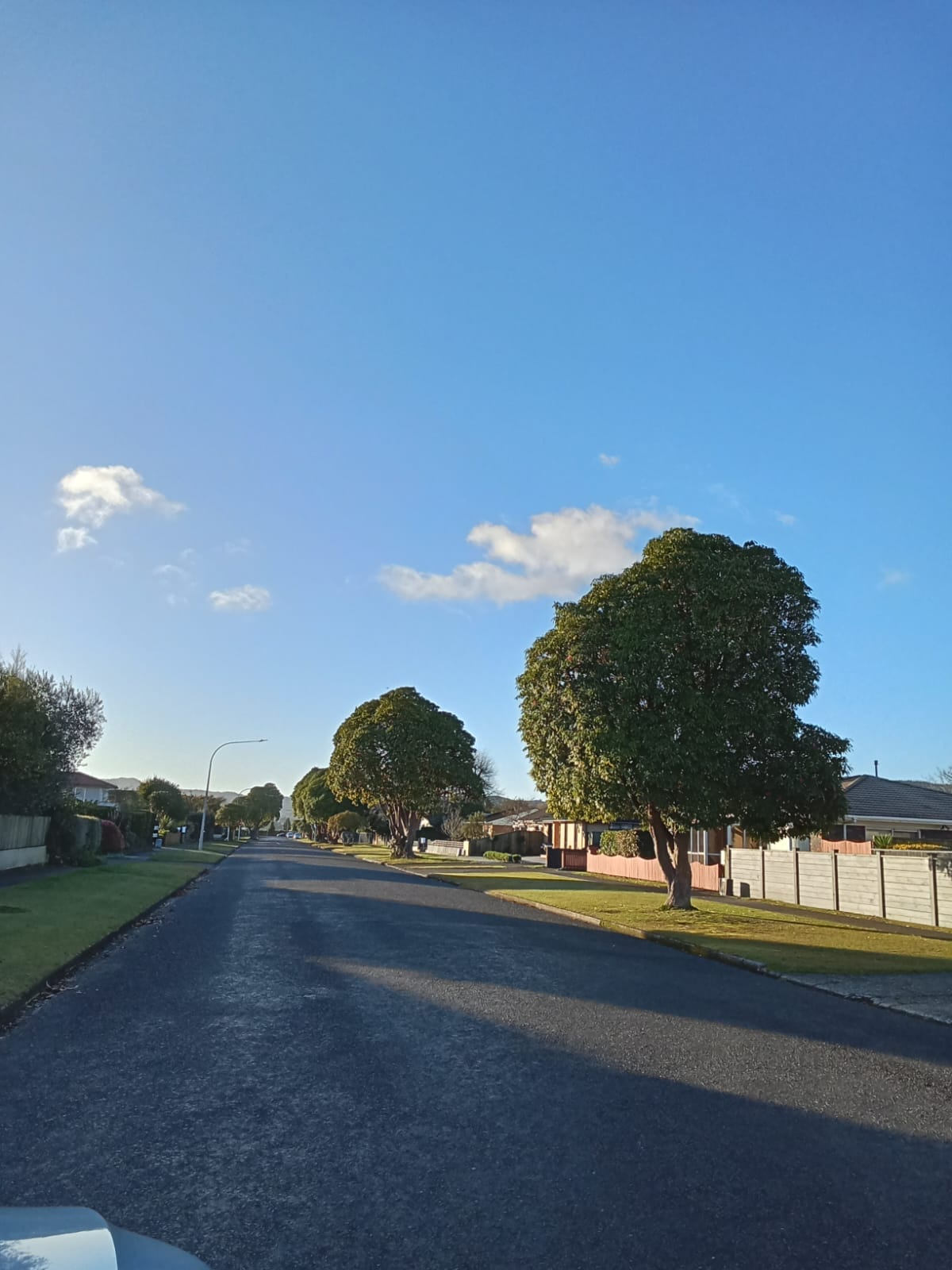
Source: Oscar Montes, July 1, 2025: Grey and Pererika Streets
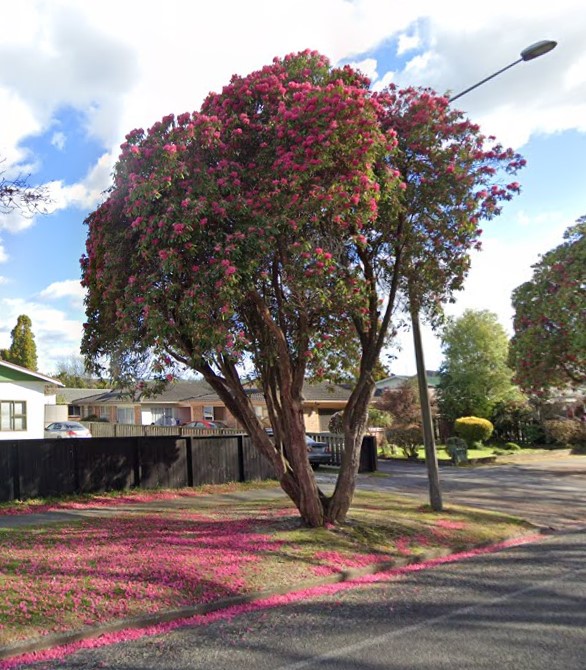
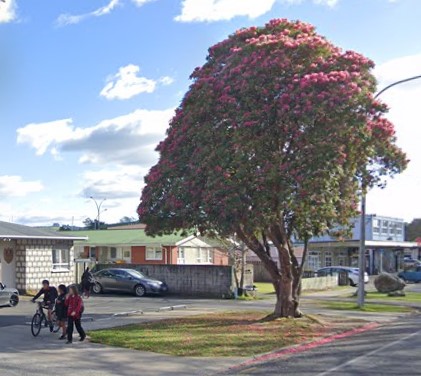
Source: Google Maps Street View, Pererika Street, September 20197
- Martin Edmond, 2014, Barefoot Years, Bridget Williams Books, p. 14. ↩︎
- ‘The flower garden’, Marlborough Express, 24 September 1932, p. 6. ‘Sir Robert Peel’ can be found discussed in lists of rhododendrons to plant in New Zealand from the late 1800s, eg. see ‘The rhododendron’, Lyttelton Times, 8 December 1887, p. 6. ↩︎
- Authorship is ascribed to the Rotorua Tree Council who published this in 2011. ↩︎
- This was 52 pages long, titled ‘Borough of Rotorua Report on Beautification of Streets and Reserves, 1931’. ↩︎
- See J. Adam and M. Bradbury, 2002, ‘Fred Tschopp (1905-1980) landscape architect. New Zealand’s first modern practitioner 1929-1932’, New Zealand Institute of Landscape Architects Biennial Conference Wellington, https://hdl.handle.net/10652/1959: A. Humphris & G. Mew, 2021, ‘Frederick Tschopp, Landscape Architect, OE in New Zealand 1929-32. Architectural History Aotearoa, 18: 59-65. ↩︎
- ‘Work in the garden’, Putaruru Press, 22 June 1950, p. 6. ↩︎
- The final photo nicely shows how large ‘Sir Robert Peel’ can grow. For further examples of large trees see New Zealand Tree Register TR/1824 and the tree behind the Inglewood War Memorial. ↩︎
Acknowledgement: Many thanks to Oscar Montes for taking photographs in Rotorua. In memoriam: Chris Turnbull

 The Local Arboretum: Noticeable trees and their stories
Leave a comment