In previous posts I’ve often used images sourced from DigitalNZ to show something of the history of trees of interest. I’m not the only one who finds this resource useful as the following photo shows:

This view looks south-eastward along Rimu Street in the Wellington seaside suburb of Eastbourne. It shows a good example of the increasingly common insertion of historical ‘photo-reminders’ within a local site. If we take a closer view of the historic image ‘Rona Bay Wharf, 1930’1 we can begin to open up the story of ‘sewers, roots, and sneaky councils’:
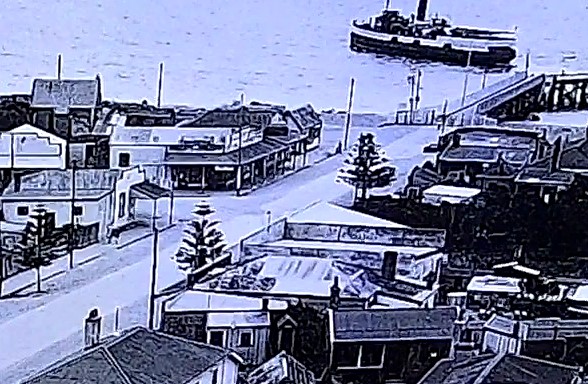
The enlargement allows identification of three of five Norfolk Island Pines, two on the north side of Rimu Street, and one on the south side. All are in the order of four metres tall, consistent with the available information that the trees were planted between 1911 to 1913.2 But if we consult the first photo above, taken in July 2025, we can see that there are no longer two Norfolk Island Pines on the north side of Rimu Street – in the photo they would be to the left of the photo board (in the background can be seen one of three large specimens). As discussed below, two trees were removed in 1984, but luckily a good photo from 1980 shows what the group of trees looked like in-situ before the ‘saga’ of their removal began:
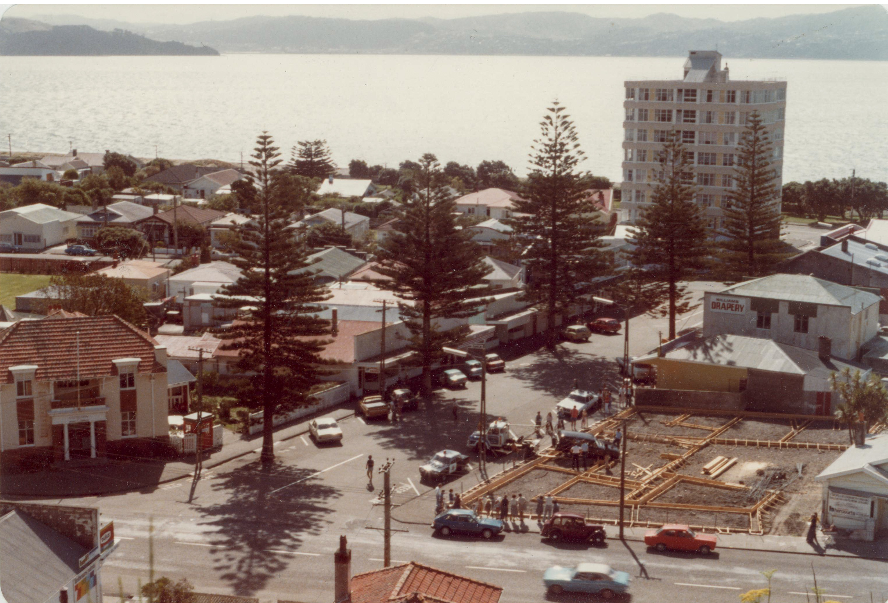
Source: Building site, corner or Muritai Road and Rimu Street, Eastbourne 1980, photographer Macolm Burdan, Hutt City Libraries.
In 1980 the five trees were clearly a significant feature of the main shopping area in Eastbourne. The building site shows, however, that development is always around the corner (in this case, literally), and connected to this will be a need for maintenance. It is the maintenance of sewers that is at heart of the Norfolk Island Pine saga which began not long after Burdan’s photo was taken.
The Saga
The Eastbourne Historical Society has a folder on the saga at least 3cm thick, so only the key details can be covered here. At least as early as 1981 the local council suggested that given a need to redo the subsidiary sewer line down Rimu St at least two but possibly all five of the Norfolk pines would need to be removed. This immediately drew a strong counter reaction from concerned citizens, much of which was reported in local newspapers. A very good example of the flavour of the argument is gained from Simon Walker’s letter, titled ‘Woodman Spare that Tree’:
Norfolk Pines have come to be associated with the Borough. They suffuse the environment. Planting trees in pots along the road will be no substitute. … Councils come and councils go, but these Norfolk Pines have survived 70 years. They have at least another 50 years of life. They should be allowed to live them.3
Despite such letters and an earlier 375 signature petition, the mayor, Mrs Elaine Jakobson, argued that the problem of the sewers being blocked by Norfolk pine roots could not be allowed to continue. Undeterred by this inflexible approach a ‘Save the Trees’ group produced a 35 page report4 which carefully weighed the evidence for and against removal. The report included consultation with a civil engineering company suggesting a new sewer line could be placed down the middle of Rimu Street, obviating the need for any tree removal.
Of course, public meetings were called, motions tabled and so on. Perhaps in recognition of the strength of feeling for the Norfolk pines, the council seemed to offer a compromise: only the two trees on the north side of Rimu Street would need to be removed. This still did not meet with the satisfaction of the save-the-trees group, which came to a head at a council meeting in early December 1983 where the group gave notice of their intention to appeal to the ombudsman to have the council’s decision overturned. Within 24 hours a remarkable development occurred, luckily recorded in newspaper reports:
Just hours after the Eastbourne Borough Council’s decision on Thursday night to fell the two trees in Rimu Street to make way for a new sewer, council employees had drilled the trees and filled the holes with poison.5
A local resident had witnessed these ‘furtive’ actions, reporting that they occurred at 6am in the morning. The journalist who sourced this information from the resident then followed up with a Mr Allan, the town clerk, and ‘Asked why it had been necessary to take the action so early in the morning. Mr Allan replied: it is a quiet time of day’.
One detail not covered in this reportage is the additional fact that simultaneously the council ringbarked the trees, guaranteeing the trees would die. But this action was made public in other newspaper reports which included photos:
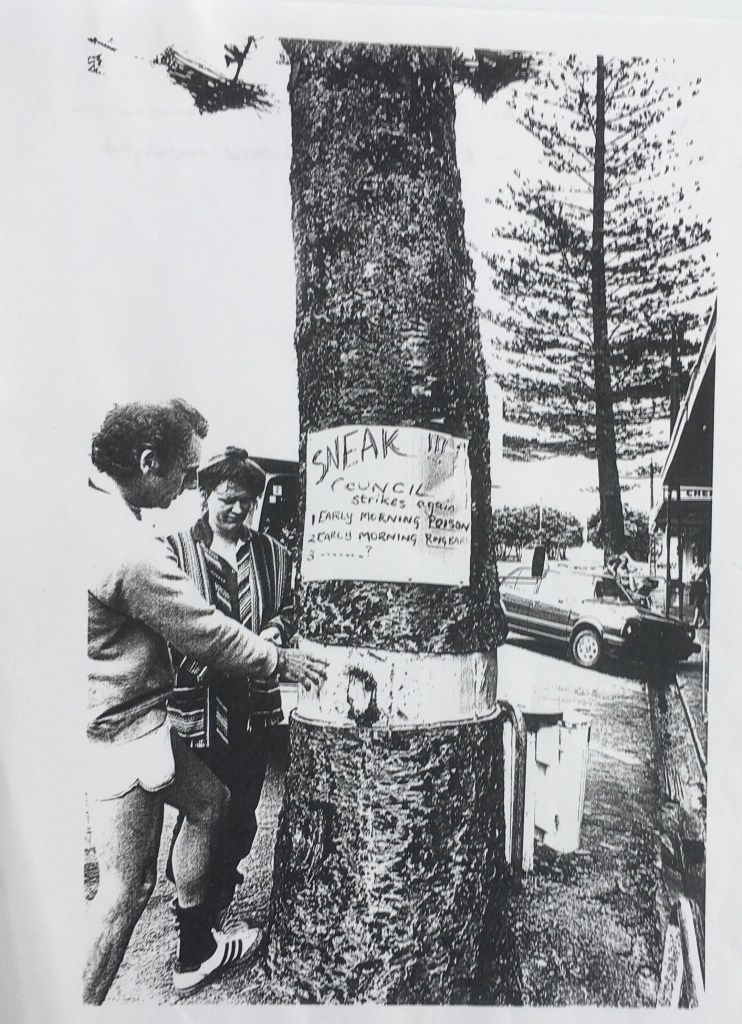
Source: Eastbourne Historical Society
The words on the paper say: SNEAK Council strikes again 1. early morning poison 2. early morning ringbark 3 ……?
Of course, after this the trees’ fate was sealed and on January 9, 1984, the two roughly 72-year-old trees were felled.6 Crowds gathered to watch the felling, but the good news for the large number of residents in the save-the-trees camp was that the decision to remove the other trees just across the road was finally quashed in October 1984. Photos from my visit in July 2025 show what they currently look like:


Clearly now at about 114 years old the three trees are significantly taller. Having survived the threat posed to them during the 1980s there is a further interesting twist to their story, partly indicated by the final two photos:
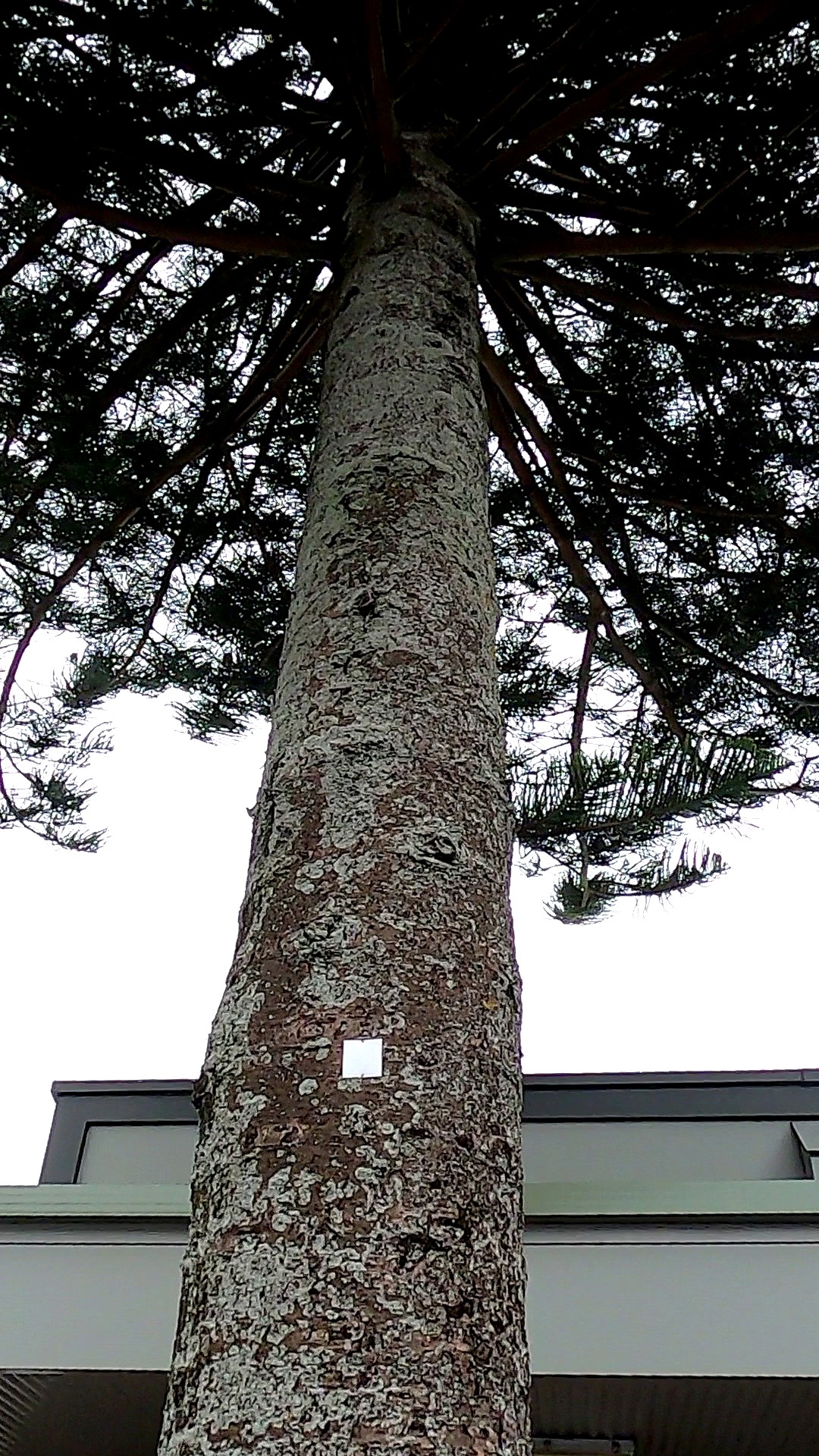
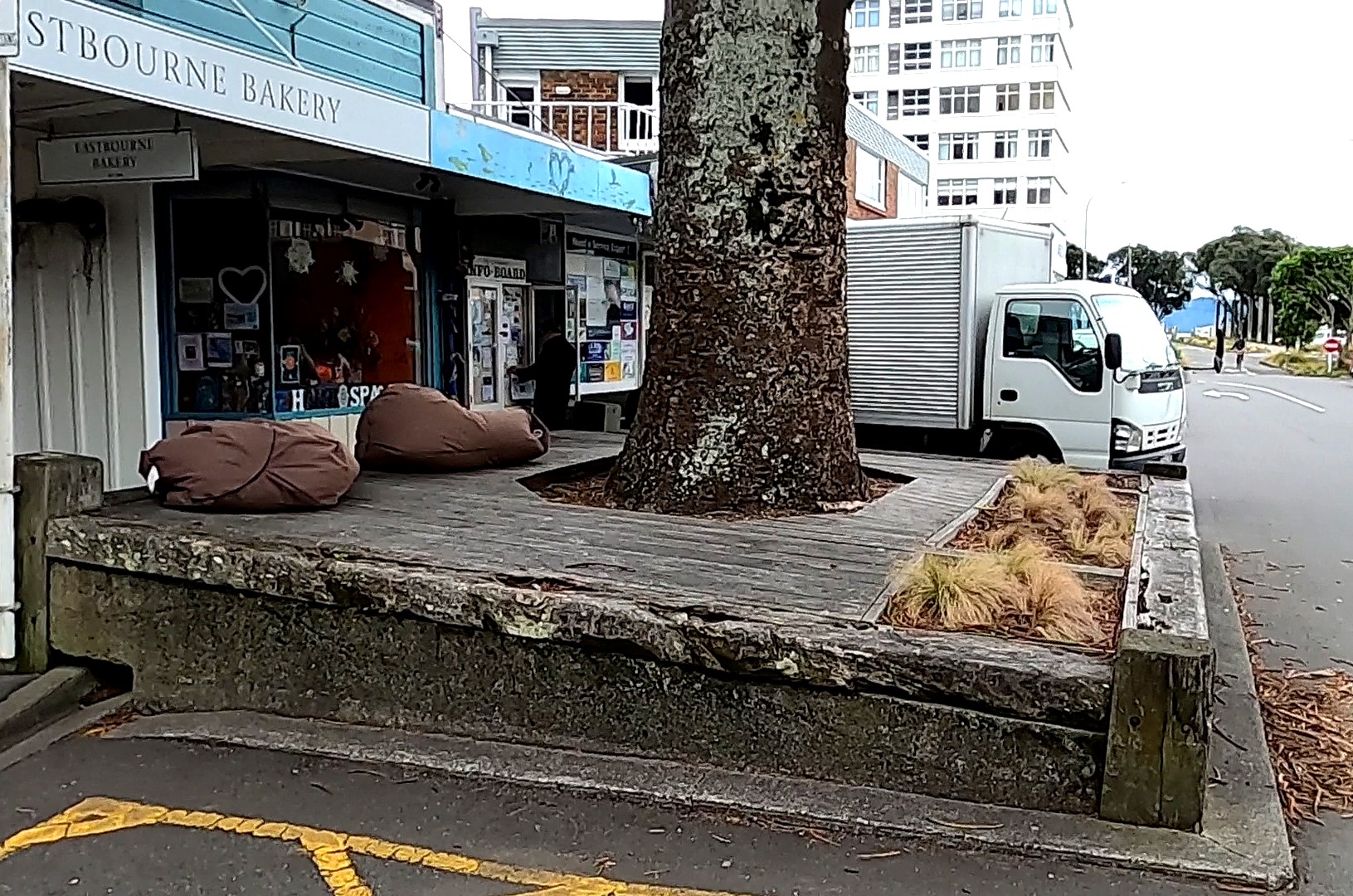
The small square in the middle of the trunk is a Notable Tree register plaque. The second photo shows a significant built-seating area around two of the trees.
All three of the Rimu Street Norfolk Island pines are now on the Hutt City Council Register of Notable Trees, as are 9 other Norfolks close by in Eastbourne. Inquiries to the Hutt City Council indicated that the Norfolk pines were in the council’s radar for Notable Tree registration from 1995, but it wasn’t until 2003 that they officially made the list.7 Decisions to recognise the notability of a tree can take some time, somewhat in contrast to speedy actions to remove trees. Given this current recognition, and the ongoing good health of the trees, it seems highly unlikely that any further ‘sneaky’ council actions will pose them any threat.
Acknowledgement: Thanks to the Eastbourne Historical Society for access to their files on the Rimu Street Norfolk Pines.
- The photo is held in the Eastbourne Historical Society, and was originally a postcard, no.3289, from the R. Staal Collection; several similar photos can be accessed within the DigitalNZ’, website. ↩︎
- See: ‘Tree-planting at Eastbourne’, Evening Post 22 June, 1911, p. 8; ‘Beautifying Eastbourne’ Evening Post, 25 June, 1913, p. 10. ↩︎
- ‘Woodman spare that tree’, letter from Simon Walker in Courier Times, April 19, 1983. ↩︎
- ‘Rimu Street Trees’, Brian Shearer & Diana Menzies, available at the Eastbourne Historical Society. ↩︎
- ‘Sneaky poisoning of norfolk pines’, Evening Post, 17 December, 1983, p. 3. ↩︎
- ‘Eastbourne’s old norfolk pines fall to chainsaw’, Evening Post, 10 January 1984, p. 2. ↩︎
- Information from Nathan Geard, Hutt City Council. ↩︎

 The Local Arboretum: Noticeable trees and their stories
Leave a comment