In the last post we learnt that in1865 Sir George Grey sent nikau palms to Ferdinand von Mueller – the Australian government botanist – who then distributed them about the globe. This obviously suited both men: von Mueller furthered his plant exchanges, and as an ‘amateur botanist’ Grey must have felt he was making a contribution to worldwide plant knowledge. But it is also possible that Grey distributed nikau palms amongst other overseas contacts himself, for it is well known that he did send other New Zealand seed and plant material to Kew Gardens.1 He also indulged his botanic interests more practically on a local scale. This was most obvious in his plantings at Kawau Island, but also in his gifting of plants, which was possibly less well known. A good example of the latter is seen in this newspaper article from 18822:
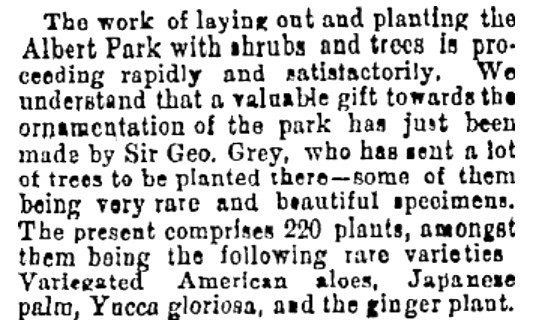
From amongst the 220 plants the focus here is the ‘Japanese palm’, which does indeed grow in Japan, but is more generally known by the common name Chinese fan or Chusan palm (Trachycarpus fortunei). Grey’s gift was of several palms and they were employed in a very early example of a group planting of palms. Two historic photos show the formal manner of this group planting:

Source: Two men beside the fountain in Albert Park, 1898, Henry Winkelmann, Auckland Libraries Heritage Collections 1-W0214A

Source: Albert Park looking towards Princes Street, 1906 Henry Winkelmann, Auckland Libraries Heritage Collections 1-W0879
The 1898 photo shows two palms around a fountain, with the 1906 photo showing a greater number surrounding a statue of Queen Victoria. Given the palms were planted in 1882, they have made good growth and clearly contribute a relatively formal aspect to the garden design.
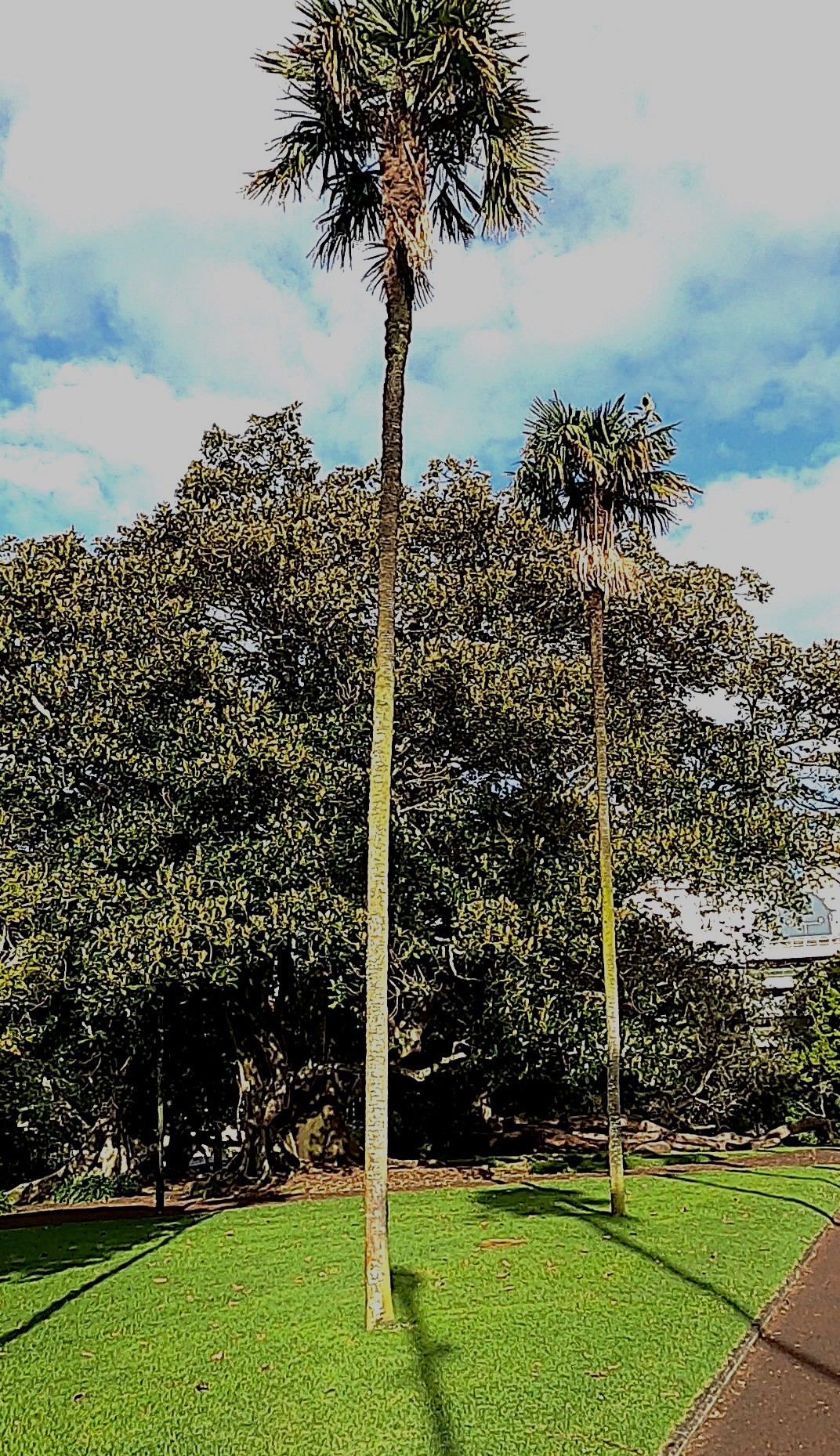
I was in Auckland in early October 2024 and took the following photos showing the palms at 142 years of age:


The left photo looks up a double row of the palms towards the fountain at centre of the 1898 photo3, whereas the second shows the circle of palms around the Queen Victoria statue seen in the 1906 photo. Currently, there are a total of 29 Chinese fan palms in Albert Park, all in good condition, though there was one palm that had recently died:
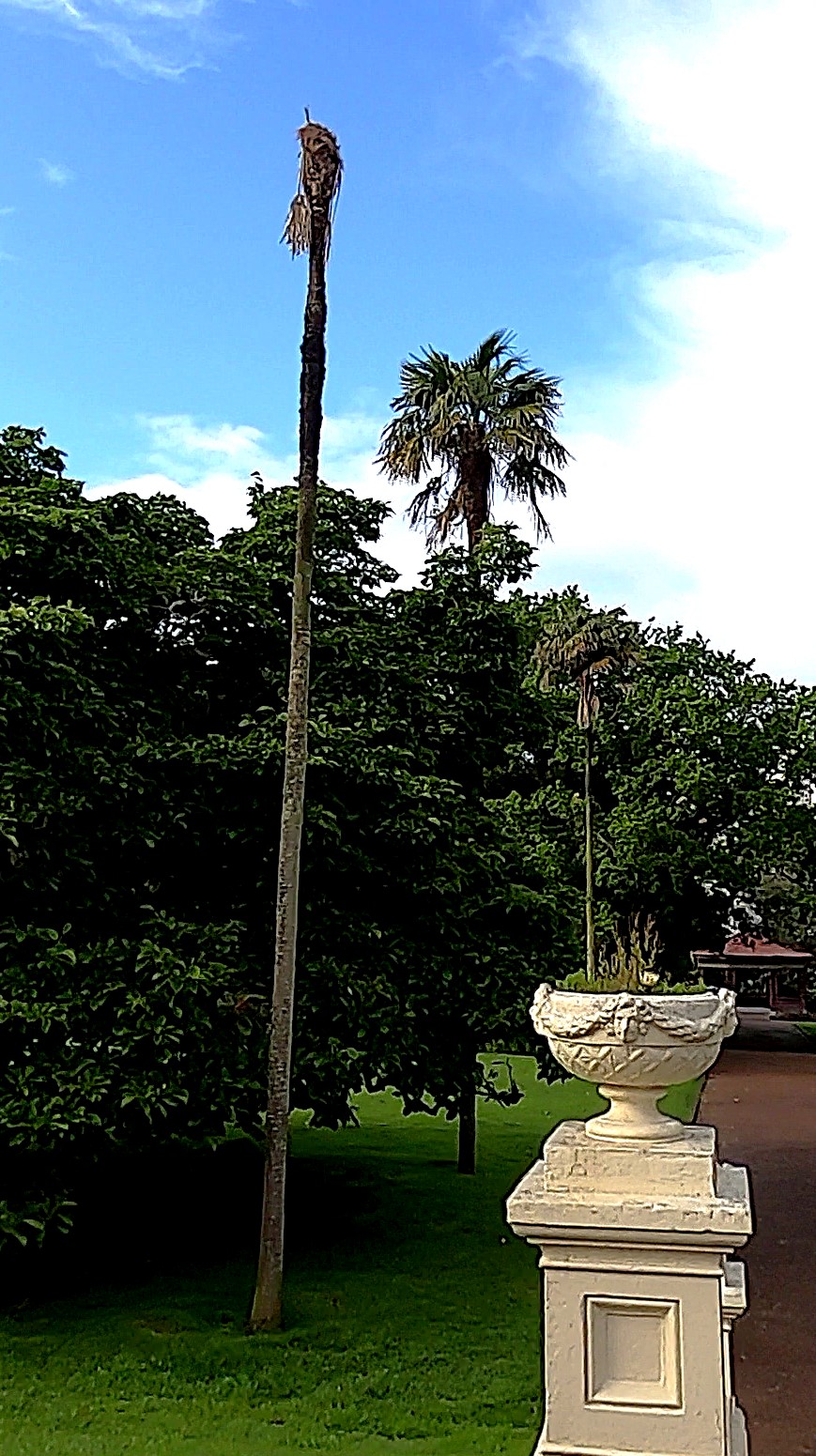
It is hard to say if the death of one indicates the palms are nearing the end of their natural lifespan. An interesting point here is that even by the early 1900s some people would not have been saddened by the loss of the palms. Some outspoken correspondents to Auckland newspapers bemoaned the heavy reliance on palms in Auckland parks. For example, W. Sutton, recently returned to Auckland after 10 years ‘travelling at Home’, saw ‘Albert Park as a mere collection of palms spattered about indiscriminately’.4 But the height of his dislike for palms was saved for Emily Place, with its heavy use of Chinese fan palms, as we can see in this photo from 1927:
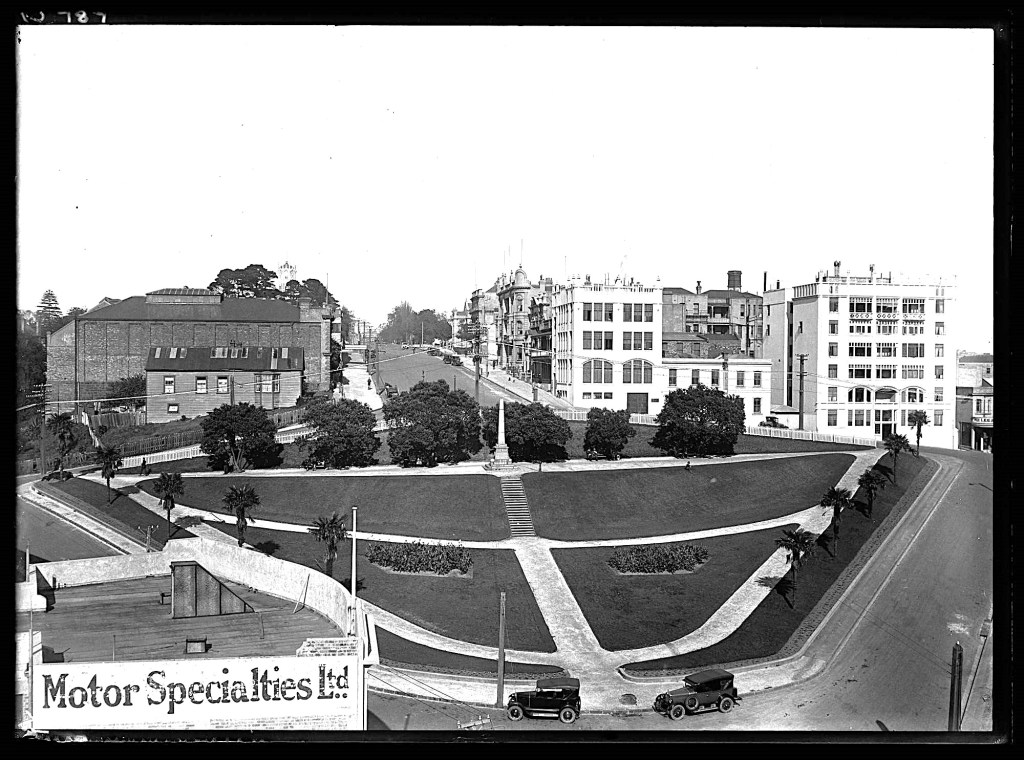
Source: Emily Place and Princes Street, 1927. Henry Winkelmann, Auckland Libraries Heritage Collections 1-W0787
It is unknown exactly when the Chinese fan palms were planted in this historic park, but similar to Albert Park the group planting – five on each side – is used for a relatively formal landscape effect. W. Sutton, after claiming to have inspected ‘all the city reserves’, finds Emily Place to be the ‘culminating point’ of poor landscaping:

W Sutton must have been pleased when the five Chinese fan palms on one side of Emily Place were replaced with Gingko trees, however, the placement of two Phoenix palms in the middle of the park (about 1930) probably would not have left him or her best pleased (the Phoenix palms are still there – see The Significant Phoenix Palms of Central Auckland).
A Hardy Palm for the South
It is possible that the growing popularity of Phoenix palms from the 1920s on, and also the introduction of other exotic palms, especially in the North Island, led to a decreased planting rate for Chinese fan palms. But there is really no way of knowing this for certain. Examples can be found – on Tauranga’s Strand, and Wellington’s Botanic Gardens – of the removal of Chinese fan palms, but this does not seem to constitute an overall landscape trend. What is worth considering before emphasising the remarkable longevity of the palm, is how popular they were in South Island homesteads. Luckily some excellent historical photos are available. Firstly, consider this wide-lens photo of ‘Wharanui’ in Marlborough:
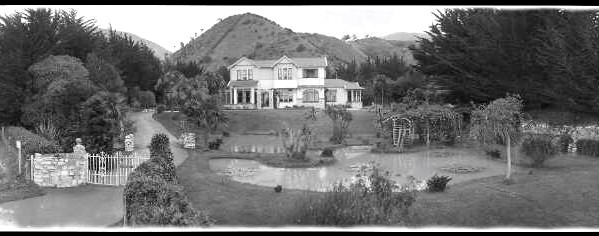
Source: Murray, C. ‘Wharanui’ homestead, near Kekerengu, Marlborough. Ref: Pan-1644-F. Alexander Turnbull Library, Wellington, New Zealand. /records/32265040
The large homestead, surrounded by traditional macrocarpa shelter belts, had a garden landscaped by the famous ‘colonial landscape gardener’ Alfred Buxton,5 who in this case used quite a lot of native planting around the pond in the foreground. If we enlarge a portion of the photo we can clearly see however that Buxton specified a pair of Chinese fan palms as an entrance framing device:
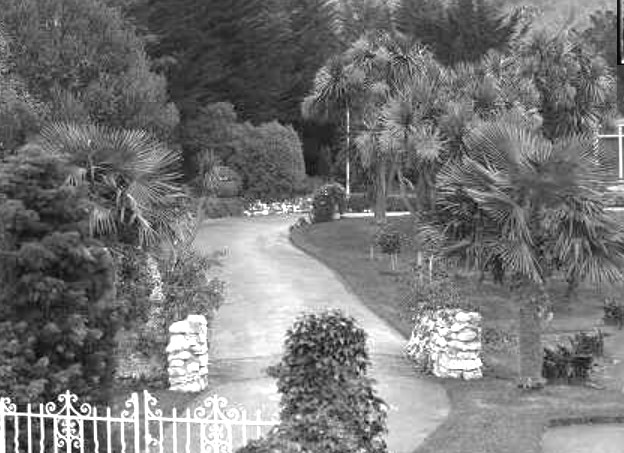
Being near the coast, frosts at Wharanui may have been quite mild, nevertheless the Chinese fan palm easily tolerates very cold temperatures, this possibly being part of the reason for its choice by the well-known landscape gardener.
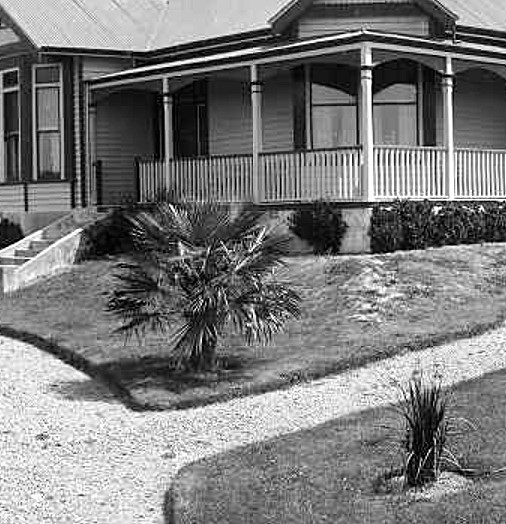
Further south, there are other good examples of how the Chinese fan palm was used to add an exotic element to homestead landscapes, sometimes being given pride of place in the garden. Here is a good example from Otaio, South Canterbury:

Source: House at Otaio, South Canterbury, ca 1925. Moore, R.P. Ref: Pan-0402-F. Alexander Turnbull Library, Wellington, New Zealand. /records/30629618
Again, if we enlarge the photo we can see the significant positioning of the palm:
Finally, a little further north in Rakaia, Canterbury, we revisit a homestead featuring a Monkey Puzzle tree which was discussed in an earlier post (the Monkey Puzzler):
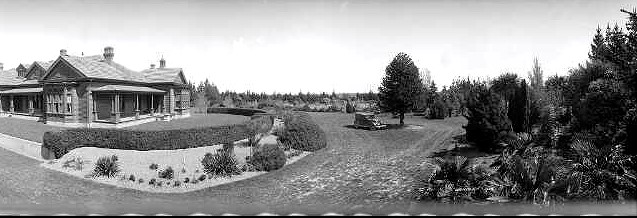
Source: Langley homestead, ca. 1925 Moore, R.P. Ref: Pan-0030-F. Alexander Turnbull Library, Wellington, New Zealand. /records/30629717
The already large Monkey Puzzle tree can be seen by the strategically placed automobile, but if we enlarge the right foreground we can see this time a number of Chinese fan palms have been included in the substantial homestead garden:

At least four can be seen, closely planted, and whereas this doesn’t come near the 29 palms used in Albert Park, it clearly shows that early homestead landscapers were keen to use multiple plantings of the palm to achieve an exotic garden effect. Again, the hardiness of the Chinese fan palm made it a perfect choice for the colder climate found in the South Island. Undoubtedly, there will be Chinese fan palms found growing right to the bottom of the South Island.
The Contemporary Situation
Unlike my efforts in tracking down the ‘rise and fall’ of the Phoenix palm in New Zealand, I cannot offer a rigorous overview of the current status of the Chinese fan palm in this country. It is likely that it is nowhere near as heavily planted as it was from about the 1880s to 1920s, when it constituted a very hardy exotic palm capable of being grown anywhere in New Zealand. That said, in palm-appearance terms, it is not exactly an extraordinary looking palm, and other alternatives did appear from the 1920s on (eg., Phoenix, Queen, Washingtonia, and nikau palms). But there is evidence that the palm has continued to be popular in contemporary times , albeit in specific locations. Two that I am aware of are Whanganui and Upper Hutt.
Whanganui is very much a ‘palm town’, at first glance dominated by Phoenix and Washingtonia palms, but more recently expanded by nikau palm planting. However, somewhat beneath the radar, there are significant numbers of Chinese fan palms used as street trees in the central city area:
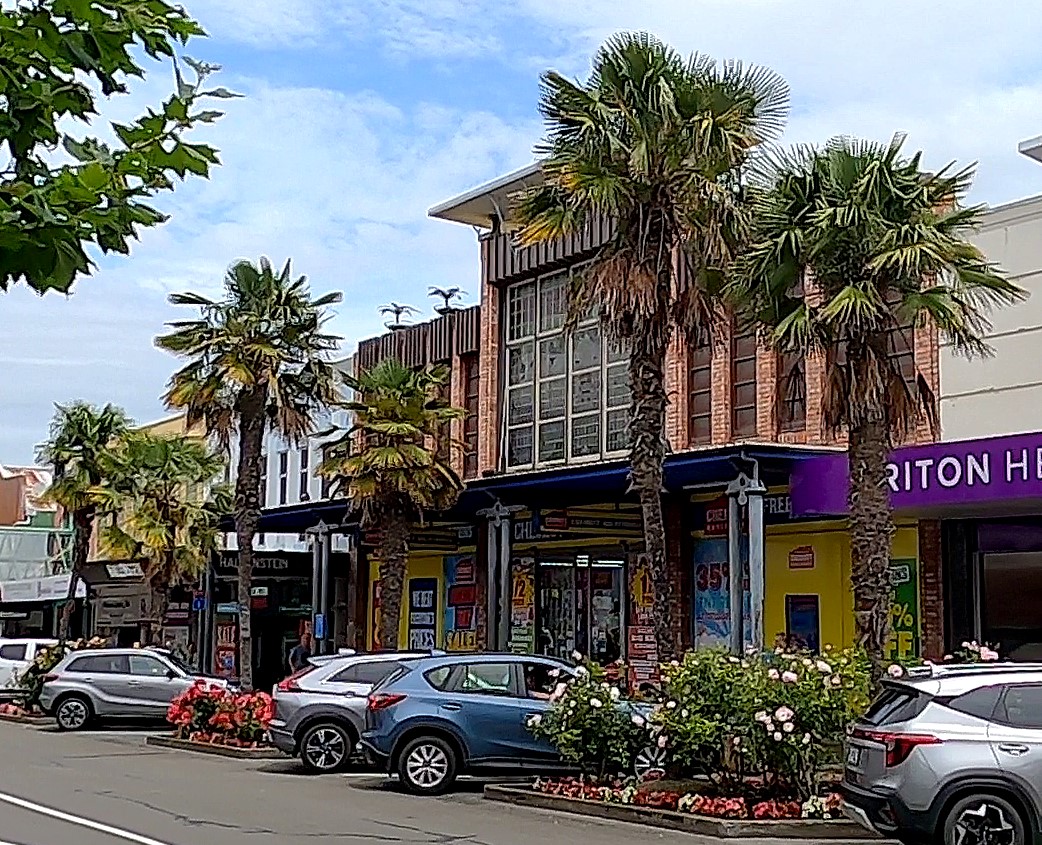
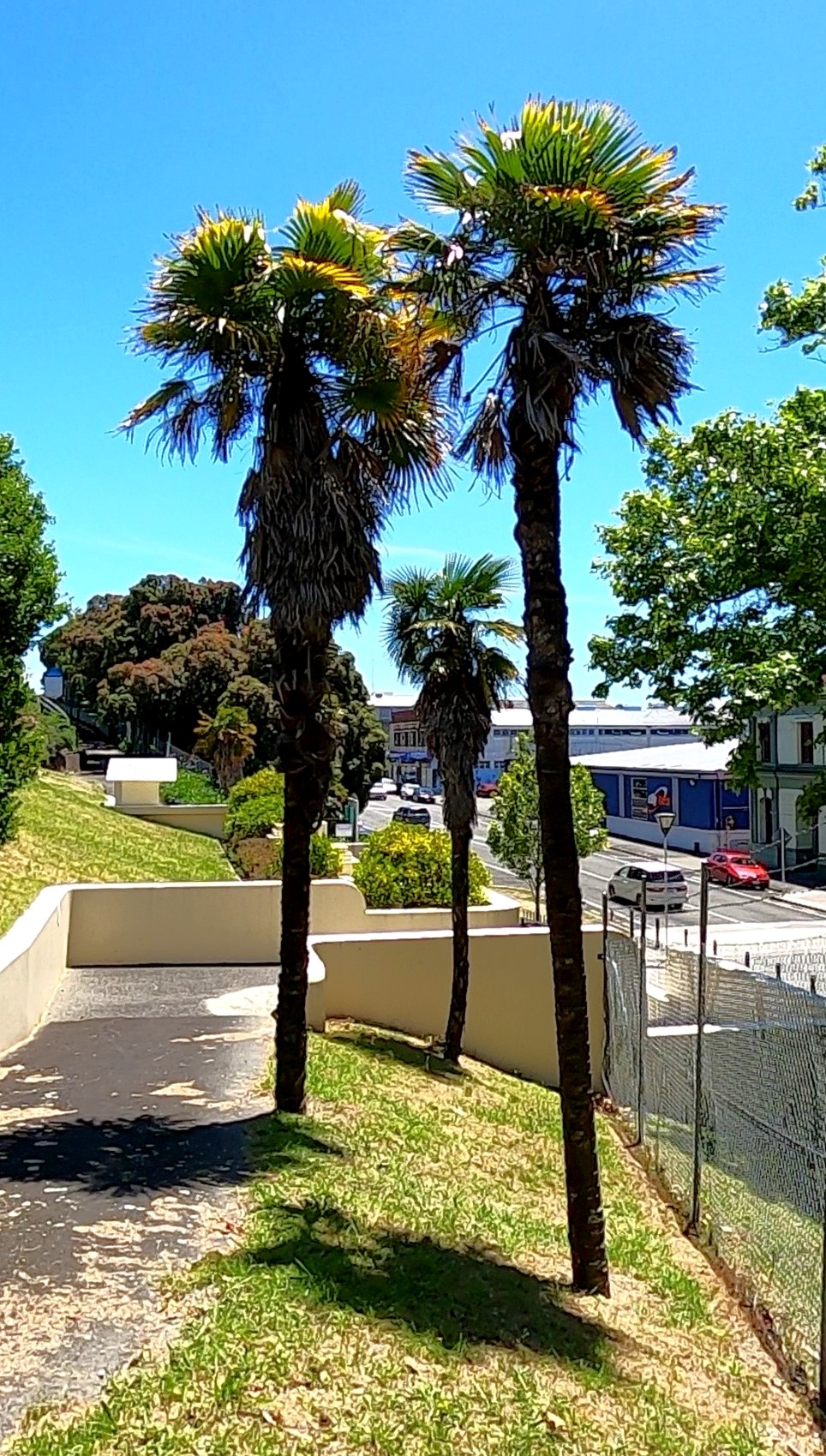

These are only some of the larger number that can be found. They look to have been planted from at least 40 years ago, and as indicated by the protective grills have been accorded some attention by the local parks and garden staff. There seems to be no reason why they shouldn’t grow for at least another 100 years.
Moving south to Upper Hutt, there is another example of street tree planting, but this time the palms were transplanted, as the following photo shows:
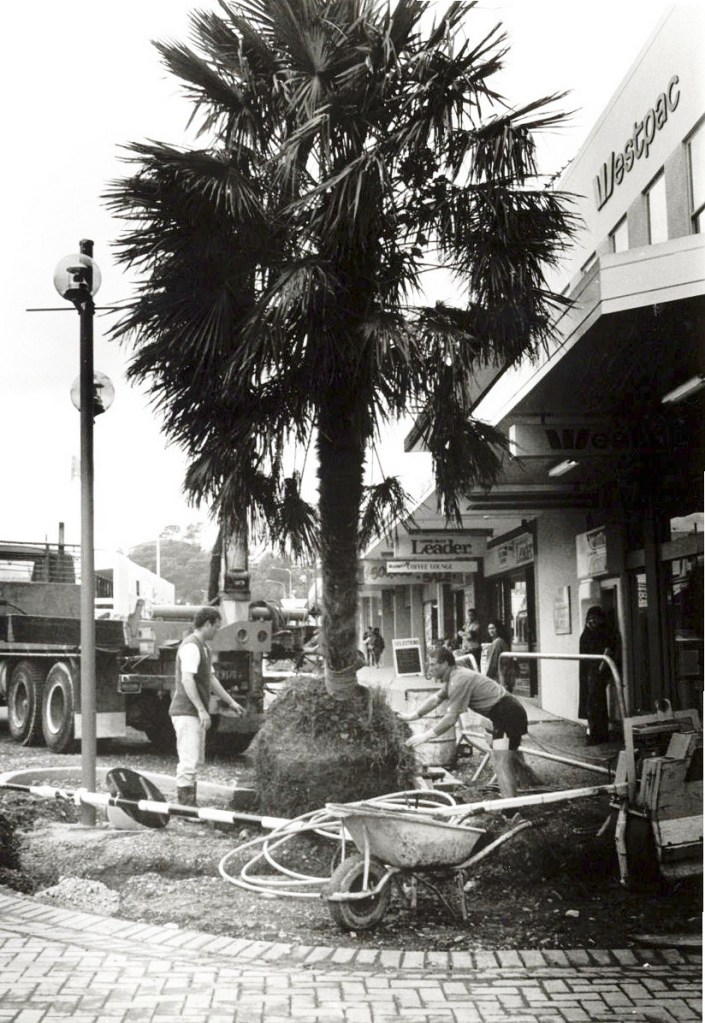
The article below the photo briefly details that 16 fan palms had so far been transplanted, these being donated by Upper Hutt residents (ie. moved from their gardens). The director of the transplant operation said they were chosen because they suited the CBD’s revamped look. A quick check of Google Maps Street View shows them still there and flourishing.
With some of the earliest planted Chinese fan palms now being over 140 years old natural attrition is occurring (like the recently deceased one in Albert Park), but as you travel about New Zealand it is not uncommon to see a solitary palm growing where there was once a homestead. The best example I know of I’ve already mentioned in a very early blogpost discussing gardens at Cheviot, but it is worth finishing with:
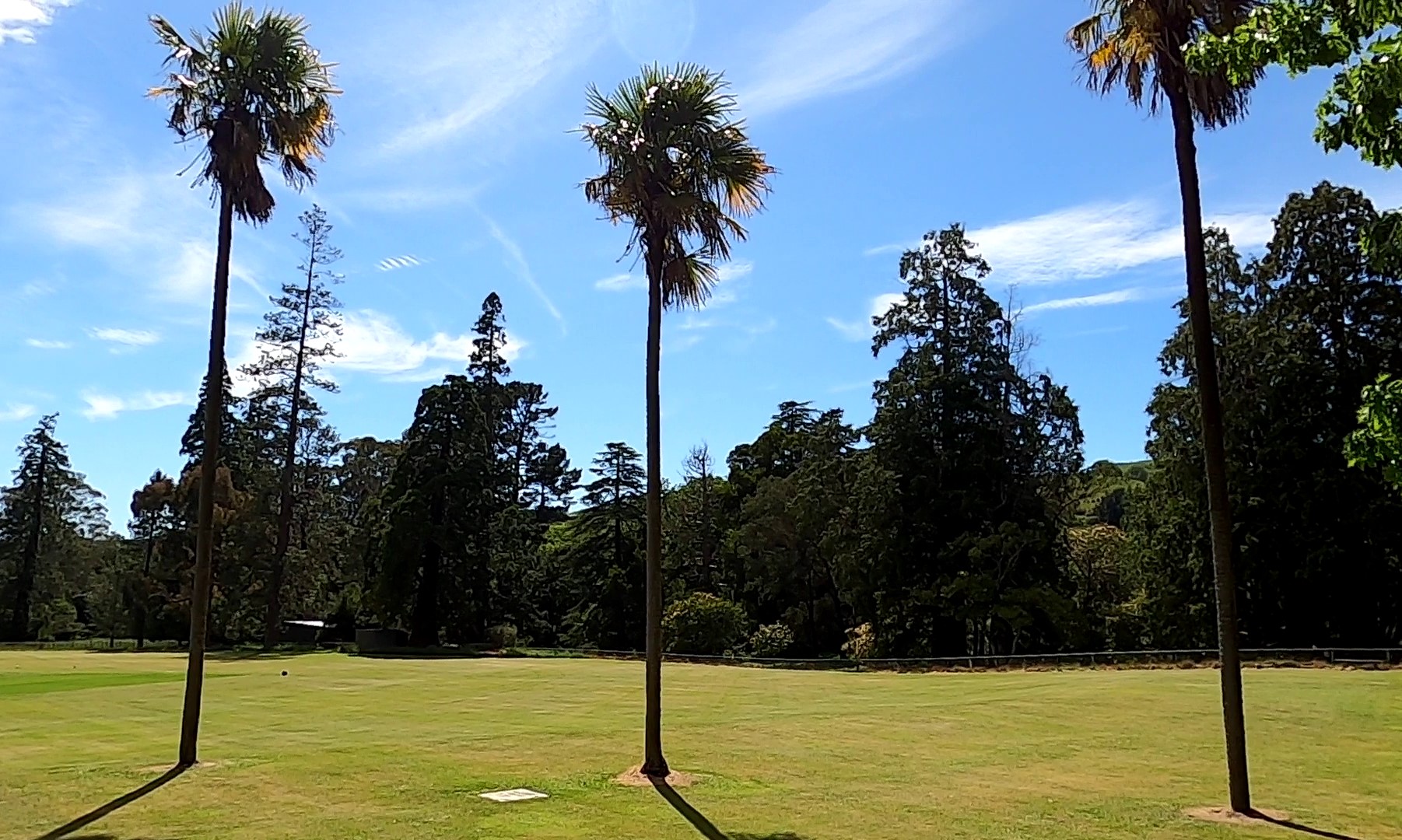
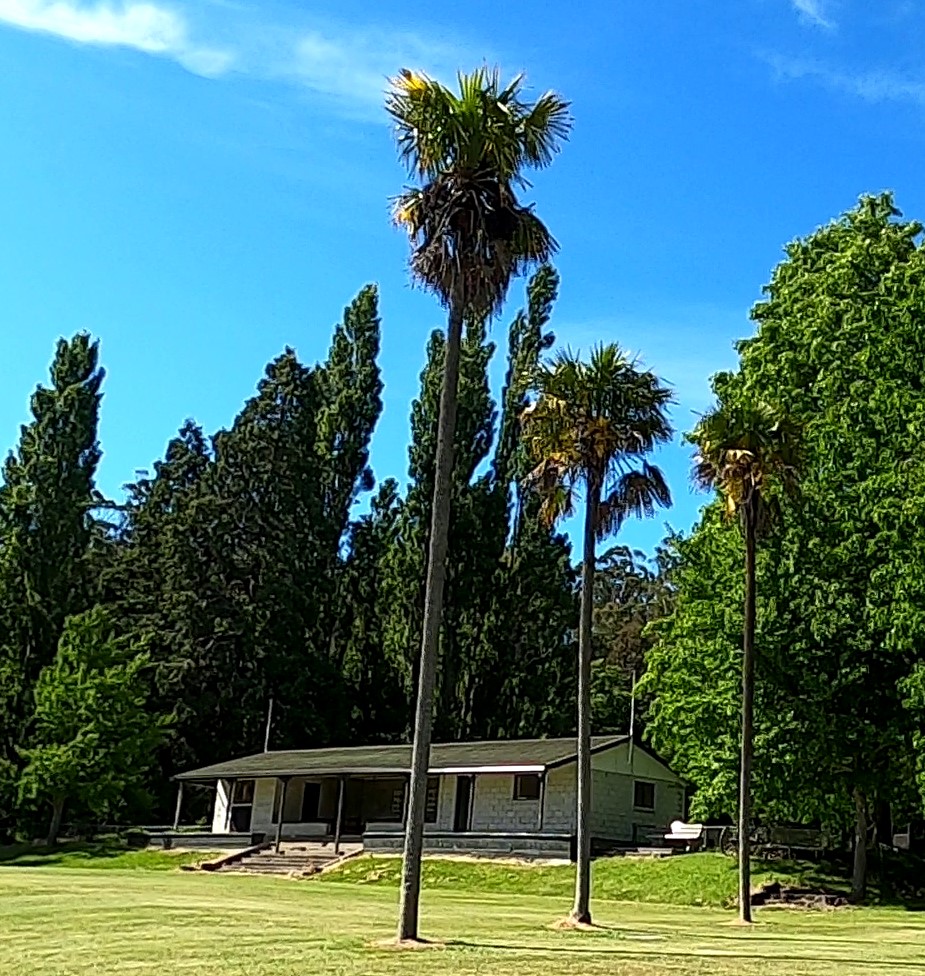
These palms were probably planted before the Albert Park group, possibly as early as 1875 (see NZTR entry). Originally they were in front of a large homestead, which burned down in 1936, and today three of the palms are found proudly standing outside the boundary of the well-tended cricket pitch, just before the cricket clubrooms, which is where the old mansion house was. The cricketers who play here are probably unaware of the age of the palms that grace the outfield, however the size of the other trees surrounding the area (see photos) clearly indicate how old the trees are here: it must be one of New Zealand’s most well-treed cricket grounds, and the Chinese fan palms have a deserved place amongst this arboreal history.
- See J. O’Leary ‘Zambesi seeds from Mr Moffat’: Sir George Grey as imperial botanist’, available at: International Review of Environmental History: Volume 5, Issue 1, 2019 ↩︎
- ‘Auckland sharemarket’ Auckland Star, 21 September 1882, p. 3. ↩︎
- Note that a large Phoenix palm can be seen in the background. Albert Park has some of the oldest Phoenix palms in New Zealand, but they are not as old as the T. fortunei gifted by Sir George Grey. ↩︎
- ‘Parks and reserves’ (letter from W. Sutton), New Zealand Herald, 11 April 1908, p. 4. ↩︎
- Buxton’s efforts at ‘Wharanui’ are discussed in Rupert Tipples’ 1989 book, Colonial Landscape Gardener: Alfred Buxton of Christchurch, New Zealand, 1872-1950. Lincoln: Lincoln College. ↩︎
Acknowledgement: Thanks to Lizzie Errington, Upper Hutt Libraries, for information on the Main Street transplanting.

 The Local Arboretum: Noticeable trees and their stories
Leave a comment