On 6 May 2023 when King Charles III was crowned, New Zealand was still not a republic, consequently it was understandable that much was done to mark the coronation. The then Prime Minister (Chris Hipkins) and Governor General (Cindy Kiro) travelled to London to attend the coronation ceremonies, but about two weeks prior Chris Hipkins was involved in a tree planting ceremony in Parliament Grounds. A totara was chosen, as seen in this photo:

As a brief record of the planting, the plaque, which gives the totara some space to grow, reads: ‘This tree was planted to mark the Coronation of His Majesty Charles III, King of New Zealand, on 6 May 2023’.
On the weekend of the coronation, councils across New Zealand also planted trees as part of He Rā Rākau Tītapu – King Charles III Coronation Plantings. The Office of the Governor General listed the towns and cities hosting such events, showing participation from 37 in the North Island and 18 in the South Island. I suspect most of these involved plantings of single trees, with the vast majority being natives. This is consistent with the other governmental action regarding coronation planting: a million dollar donation to ‘Trees That Count’ for the planting of 100,000 native trees throughout the country.
None of the latter will have plaques in front of them as the Parliament Grounds totara does, though the trees planted by district councils probably will. What we see here, especially in the Trees That Count donation, is a kind of co-option of the coronation’s noticeability as a public event. The desire to plant more trees pre-existed the coronation, so the donation to fund the planting of 100,000 natives built upon the significance of the coronation, in effect creating more public attention for the tree-planting (which was consistent with King Charles’ expressed interest in environmentalism).
This is all perfectly understandable and to the public good – who could decry the planting of 100,000 native trees? What is of interest though is that these plantings were part of a longstanding tradition connecting British Royalty and commemorative tree-planting, one that in its details has changed significantly over time. To begin to see this we can note that a mere 40 metres away from the young totara in Parliament Grounds is a 156 year-old Norfolk Island Pine. This also has a connection to royalty, but in a quite different way than the totara. Here is a photo I took from a nearby building looking across to Parliament:
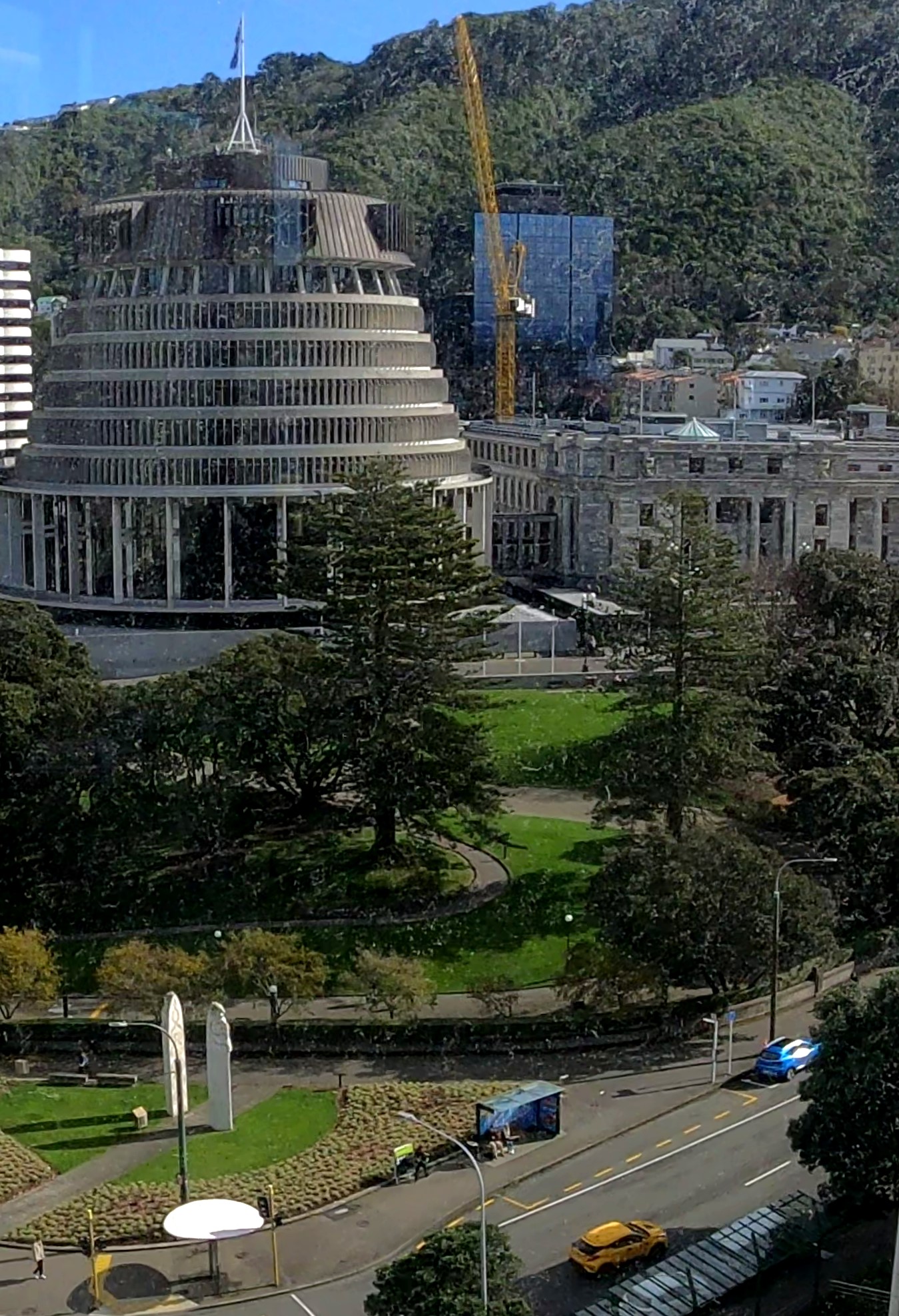
Two Norfolk Island Pines can be seen here, but the oldest is the one in the centre below the Beehive. Parliament Grounds is now well-treed, but this was not always the case. In his history of ‘Parliament’s Buildings and Grounds’ John Martin comments that ‘not a great deal of thought was given to landscaping until Premier Seddon took charge in the 1890s’1 By 1912 well-tended lawns and a few larger trees could be seen, including the Norfolk Island Pine:

Source: Grounds of Parliament Buildings, Wellington 1912. Ref: PAColl-4355. Alexander Turnbull Library. /records/22862463
The planting of the Norfolk in 1869 was well-recorded, as it was planted by Prince Alfred, the Duke of Edinburgh, who was the first member of British Royalty to visit New Zealand. During his visit he was invloved in planting four trees in Auckland’s Domain (more on this below), four in Parliament Grounds, and five in what is now the Christchurch Botanic Gardens. The Wellington planting was described as follows:
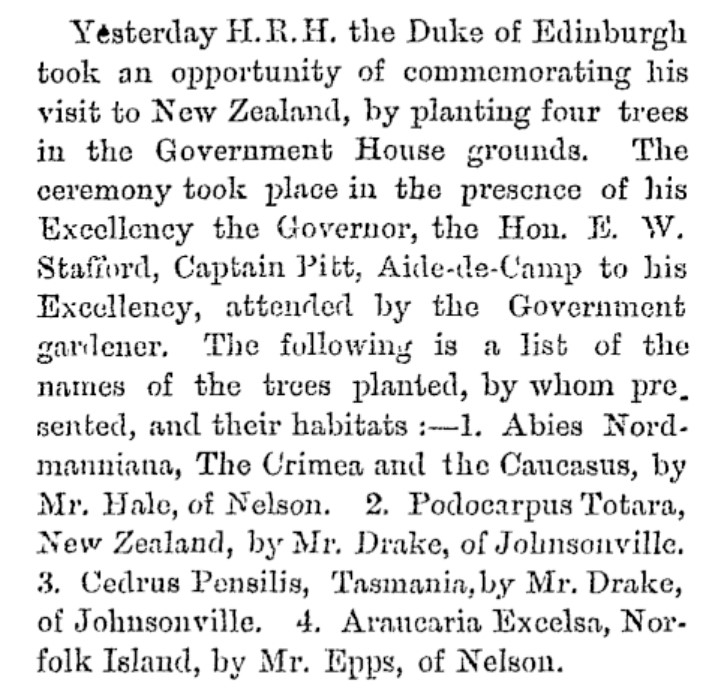
Source: Untitled, The Evening Post, Friday April 16, 1869, p. 2.
As described, the planting appears to have been a low-key event, attended by the Duke and listed others rather than a public-crowd. Three of the four trees are correctly identified, but ‘Cedrus Pensilis’ does not exist in botanical nomenclature. It may be Arthrotaxis cupressoides, the pencil pine from Tasmania, regardless, it no longer graces Parliament Grounds. In fact, of the four trees the Duke planted the Norfolk Island Pine is the sole tree remaining. By extrapolation, it appears that three of them were lost during the building of a new parliament house in 1912. A newspaper article describing the ‘building operations’ notes that ‘special attention will be given to some historical trees … [including] two planted by the Duke of Edinburgh’.2 The Norfolk Island Pine was distant from the building work, but the other three trees must have been closer and did not survive past the 1912 building work. In passing, it should be noted that the Norfolk, clearly an ‘historical tree’, is still not marked by a plaque recording the date of planting by the Duke of Edinburgh.
This latter point may attest to the fact that, by today’s standards, these royal plantings were relatively less publicised. There is even some evidence that they were sometimes exclusive events. The following article on the activities of the Auckland Acclimatisation Society has some interesting wording:
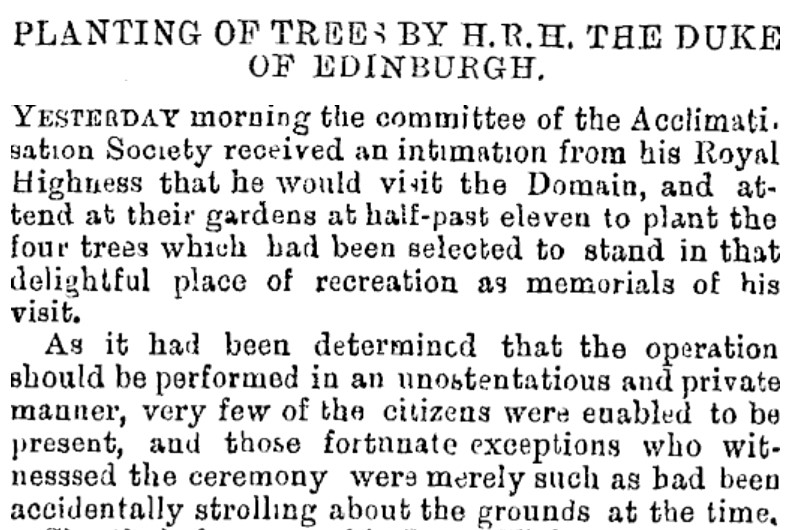
Source: ‘Acclimatisation Society’, Daily Southern Cross, 27 May 1869, p. 3
Two weeks later this description drew a letter to the editor, further highlighting how ‘unscripted’ the Duke of Edinburgh’s planting in the Domain had been. It is worth a lenghty extract:

Source: ‘Correspondence’, New Zealand Herald, 15 July 1869, p. 4
The anonymous correspondent seems to have been lucky enough to be present at the tree-planting by the Duke, but wishes to rebut notions that a ‘clique’ controlled the event. Either way, the comment that the Curator only knew of the planting ‘about an hour before the Prince arrived’ is a fascinating contrast with the subsequent history of connections between British royalty and commemorative tree planting in New Zealand. The involvement of British royalty in commemorative tree-planting was to become a highly organised and well-attended tradition.
In the next post I will briefly use scholarship by Joanne Morgan to detail this history, then proceed to focus on what Morgan calls a ‘trans-empire tree-planting project’. This was the worldwide tree planting to commemorate the coronation of King George VI in 1937. Connected with this, thousands of trees were planted in New Zealand, and in its details is an explanation of the phrase ‘acorns from Windsor Great Park’ in the blogpost titles.

 The Local Arboretum: Noticeable trees and their stories