In previous posts I’ve commented that Wellington (where I live) is not a well-treed city. But only 30 kilometres away in Upper Hutt, things look different, at least on the surface. We saw in the previous post (‘Hardly extraordinary …’) that in 1992 a lot of effort went into transplanting16 Chinese fan palms in Upper Hutt’s Main Street. That and other examples would leave a visitor with the impression that Upper Hutt likes its trees. I’d support that sentiment, however, if we move focus back from recent times, we find there has been a lot of coming and going in the trees of Upper Hutt. Here’s a photo from 1957 that shows an unlucky tree that is definitely going:
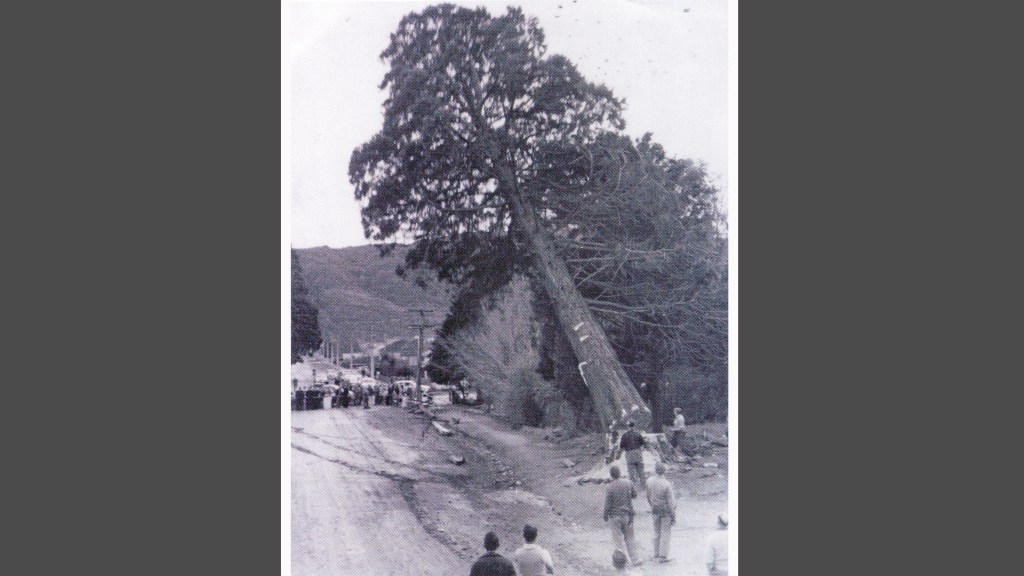
Source: from Upper Hutt Library collection, courtesy of Reid Perkins
This is (or was) a Sequoiadendron giganteum (giant redwood), one of three of substantial size within 100 metres of each other. On the left margin of this photo can be seen one of the other three. Magnifying and marking-up a photo from 1956 clearly shows the closeness of the trees, and an historic photo from an unknown date further shows the significant size of the trio of giant redwoods:

Source: Aerial photograph by The ‘Evening Post’ 1956 looking west from Henry Street, Upper Hutt Library
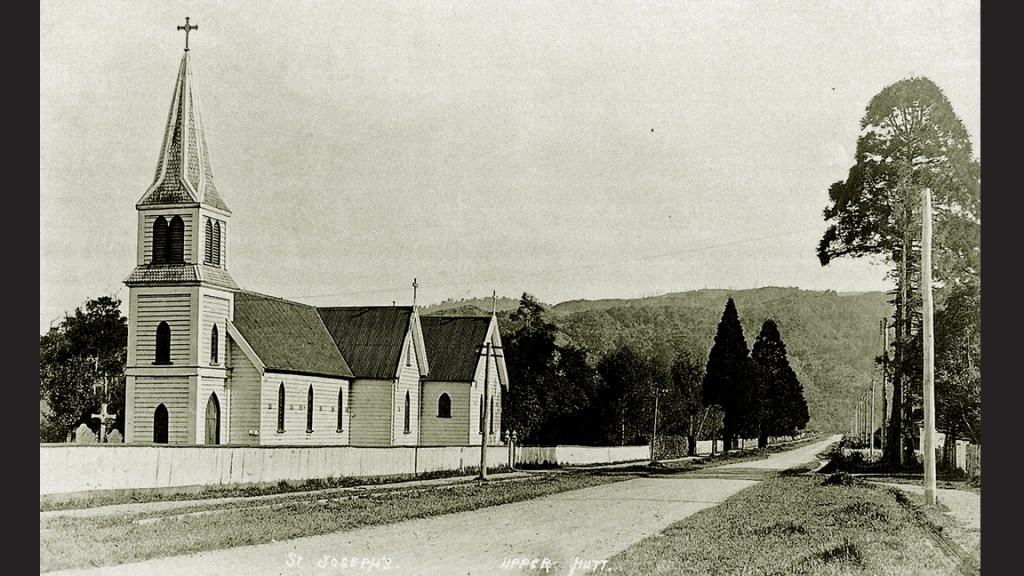
Source: ‘St Joseph’s Upper Hutt’, undated, Upper Hutt Library
Luckily, there is plenty of available information to fill in the story of the redwoods of Pine Avenue.1
A Standard Story? Councils and the maintenance of footpaths and roads
Pine Avenue was first called Slaughterhouse Road after an abattoir
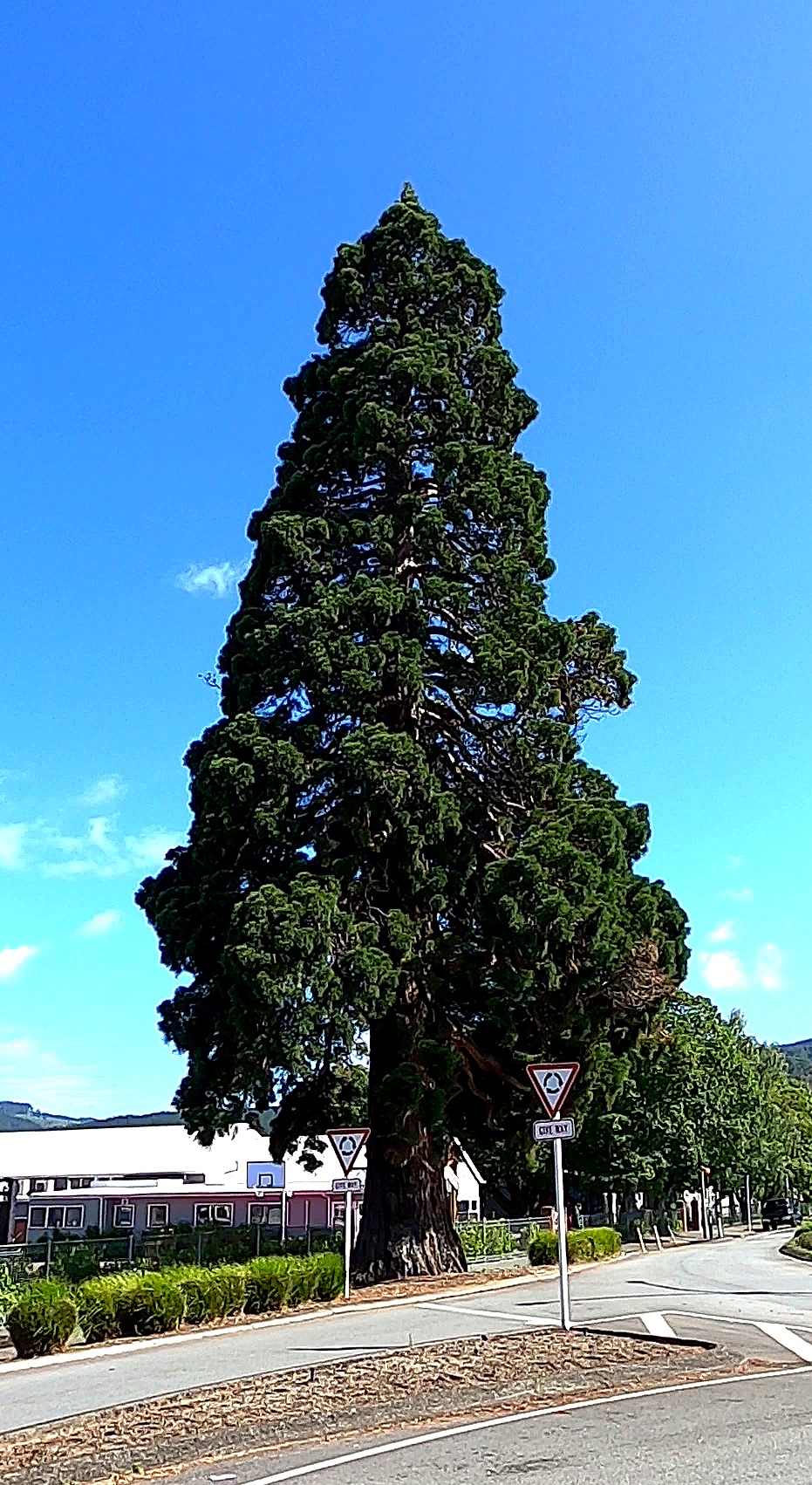
located there, originally being relatively narrow. It ran through the property of George Brown, son of early settler James Brown, who planted pine trees along its length, and the new name referred to this row of trees. Soon after the name was changed in the early 20th century, almost all the pines were chopped down by the newly established Upper Hutt Town Board in order to widen the street. The three giant redwoods were growing then and were spared. A New Zealand Tree Register entry for the surviving ‘lucky’ redwood dates the planting from 1844, however there is no information given verifying this date. Given that James Brown is recorded as having settled in Upper Hutt in 1847, the date for planting in J. Box’s NZTR entry must be incorrect. Giant redwoods were certainly a ‘must have’ tree for wealthy Victorian landholders with sufficient space,2 and many were planted in the latter half of the 19th century. The available information about the three redwoods in Pine Ave suggests a planting date of 1877.3
By the 1950s the local council wished Pine Avenue to be a major entry road into the central shopping area of Upper Hutt. At that time the road did not have an established footpath, and the need to develop such was the main justification for the removal of the first redwood (seen in the first photo above). Local residents banded together to resist this planned removal, with over a thousand signing a petition to save the tree. Nevertheless, the council was resolute in its plan: the tree was described as being 80 foot high and 6 feet thick, being only 3 feet from the road boundary, thus it had to go. Suggestions to put a deviating footpath around the tree were rejected and even an appeal by the then Governor General, Lord Norrie, and the Prime Minister, S. G. Holland, were not enough to force the council to change its mind. Holland rang Mr Slacke, the mayor, to plead for the tree’s retention, but ‘the mayor refused to give the matter any more consideration’.4 On 20 July 1957, in the presence of descendants of George Brown who had planted the redwoods, and with a large crowd gathered, Mr A. Clouston, manager of Akatarawa Sawmilling Company, directed the felling of the redwood. A few of the many photos taken of the event show just what a spectacle it was:
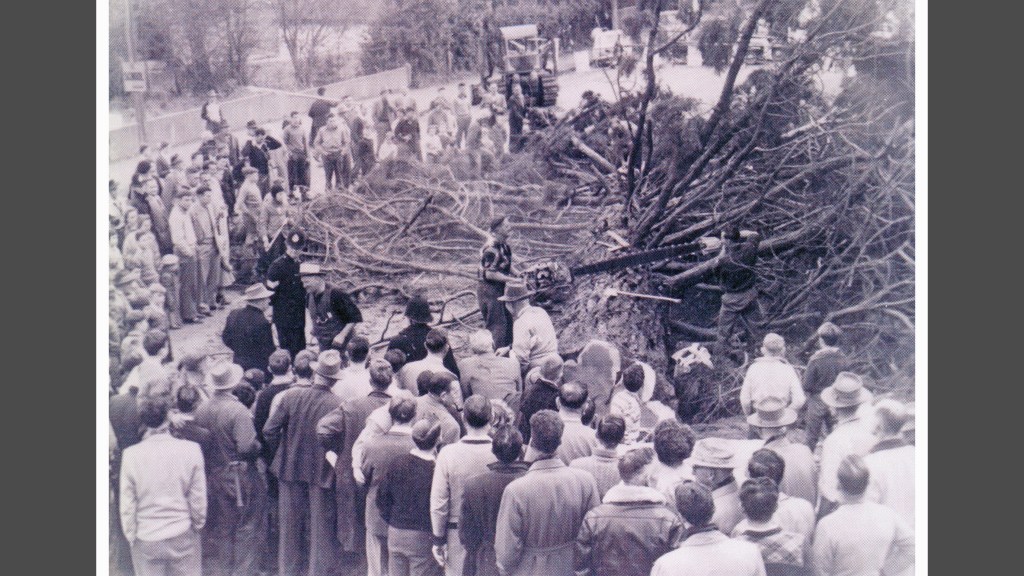
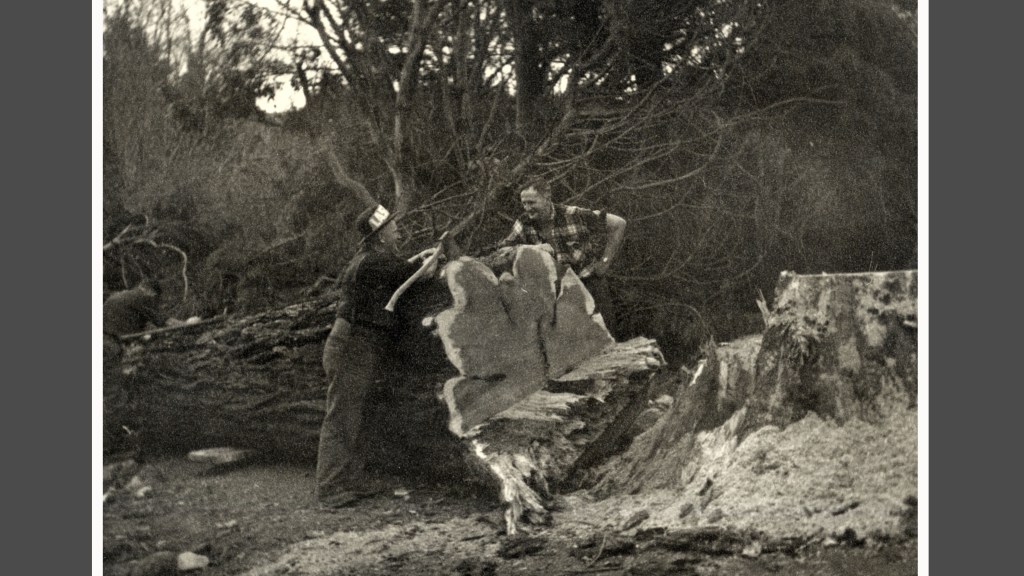

Source: courtesy of Upper Hutt Library
In many ways this is standard fare in the history of interaction between councils and groups of tree-favouring-residents (see the Norfolk Pines of Eastbourne), but there is quite an interesting further point. According to Reid Perkins from the Upper Hutt Library, there is no information on the removal of the second giant redwood, an equally impressive member of the trio. It has definitely gone though, possibly not long after the first removal. Whereas it is not known whether the surviving member was similarly at threat, it does seem fair to say that it should ‘count itself lucky’ given the removal of the other two members of the trio.
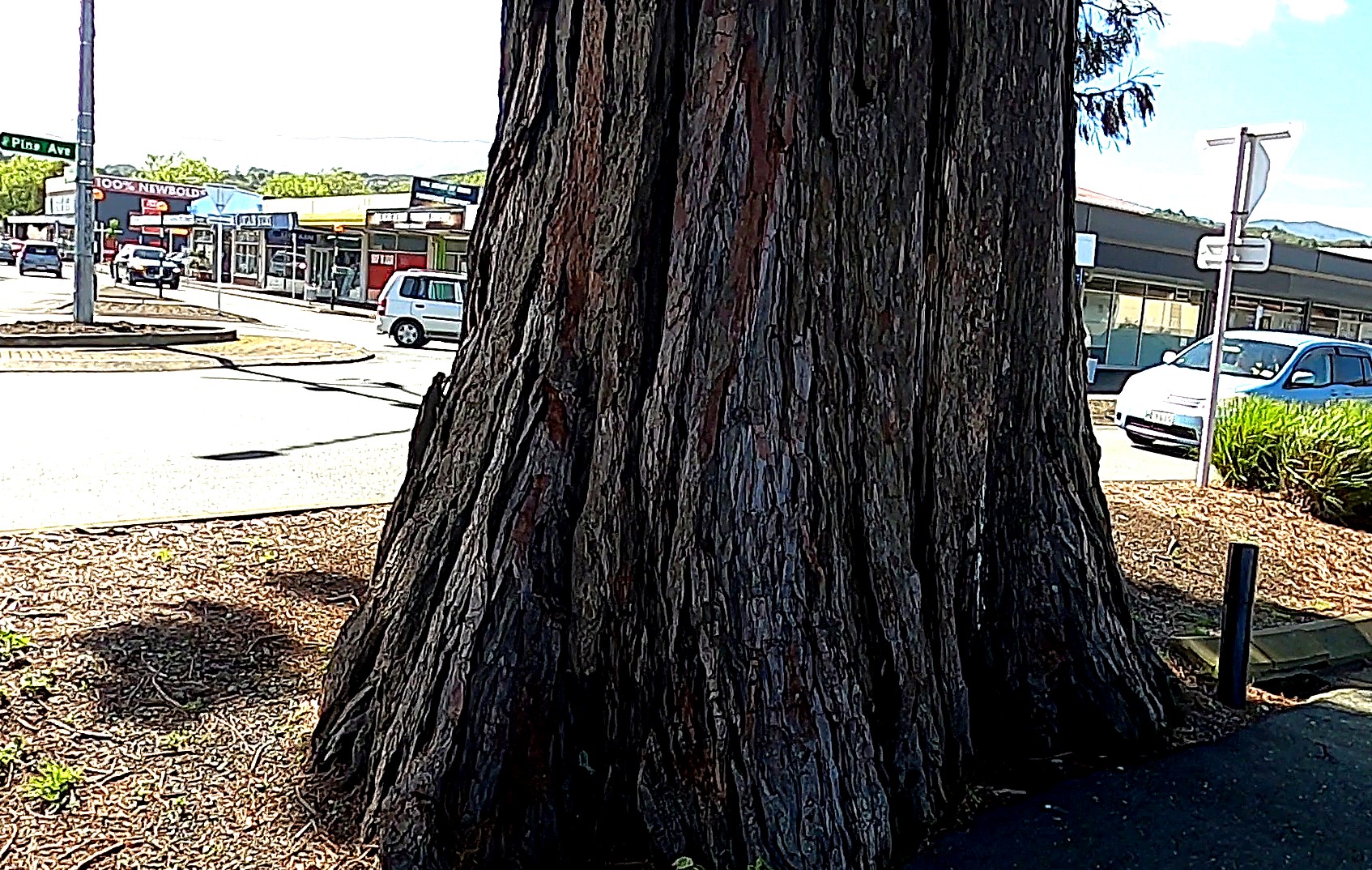
Today, the driver who diverts from the main highway and calls in to visit Upper Hutt can hardly escape seeing the giant redwood on the skyline. Clearly, though they should be interested to know about the battles that were fought over which trees survived and which were removed in the leafy precincts of Upper Hutt in the 1950s. It has to be said that at 148 years old the sole remaining redwood has remarkably good form and health, as the final photos show:

- Many thanks to Reid Perkins from Upper Hutt Library who provided me with ample resources. ↩︎
- For many years the common name given to the tree was Wellingtonia, after its first incorrect botanical naming as Wellingtonia gigantea (see Wikipedia entry). There are a number of other old giant redwoods in the Upper Hutt area (see a group of 15 in Trentham planted in 1909); certainly far more than can be found in Wellington. ↩︎
- ‘In memory of a tree, 1877 to 1957’ Upper Hutt Leader, 17 October, 1957. ↩︎
- ‘Battle of redwood now fought and won’, The Evening Post, 22 July 1957, ↩︎

 The Local Arboretum: Noticeable trees and their stories