Without much by way of intentional planning, we’ve been getting through the main palms that featured in early New Zealand gardens. Strangely though, I’ve left out the Mexican fan palm, even though it has at times been right before my eyes. For example, consider one of the ‘Arrowsmith photos’ first presented in The Arrowsmith Phoenix palms: An extraordinary resource:

In view in this 1962 photo of the picturesque fountain in Auckland’s Albert Park are two big Phoenix palms and two smaller Chinese fan palms, both of which have been discussed in posts within this blog. But clearly there is another palm on view here – the taller, leaner palm by the pathway out of the park onto Princes Street. This is a Washingtonia robusta, usually known by the common name Mexican fan palm, but given its form also fittingly known as the ‘skyduster’. For some reason it is more difficult to track down information on the history of this palm, nonetheless, what is available clearly suggests this is another significant palm in New Zealand’s garden history.
The Washingtonia genus has two species – filifera and robusta – the former is the California fan palm, which is smaller than its Mexican relative. Possibly one reason for the paucity of information on the skyduster is that it is difficult to distinguish between the two palms (at least when they have some height). When known by their initial botanical name, Brahia filamentosa, the palms were discussed in newspaper articles (of the 1890s1), so they appear to have been planted from about the same time as the Phoenix palm.
In contrast to the Chinese fan palms in Albert Park, the planting of which can be dated to 1882, there is no information on the planting of the Mexican fan palms. Nevertheless, a reasonable estimate can be made. The whole of Albert Park is a category A heritage site, meaning that there are plenty of photos covering its history. These can be very useful in uncovering aspects of the life of trees within Albert Park, as the following example shows:

Source: ‘Albert Park’, 1930-39, Burrell-Wilson Collection, Auckland Libraries Heritage Collections 7004-11-05
Firstly, this shows that the one skyduster palm we saw in the 1962 photo above is actually one of a row. Using Google Maps at least 12 of the palms can be seen in this vicinity.2 Secondly, even if the date of the photo covers 9 years, it does help with an estimation of planting date. In an early article on ‘Palms around Auckland’, Goodey notes that ‘palms like Washingtonia filifera in Auckland in the open will make up to a foot of growth in a year once established’.3 The Mexican species grows taller than the Californian fan palm, so there is no reason to believe this growth rate is not at least equalled. Consequently, from this 1930-39 photo, the row of skyduster palms can be estimated to be at least 30 years old, making circa 1900 a reasonable estimate of planting date. This certainly makes them a significant early cluster-planting.
Google Maps Street View can be checked to show the current size of the palms, but even as early as the 1970s the palms had a height justifying their common name of ‘skyduster’, as shown in this crop from an aerial photo:
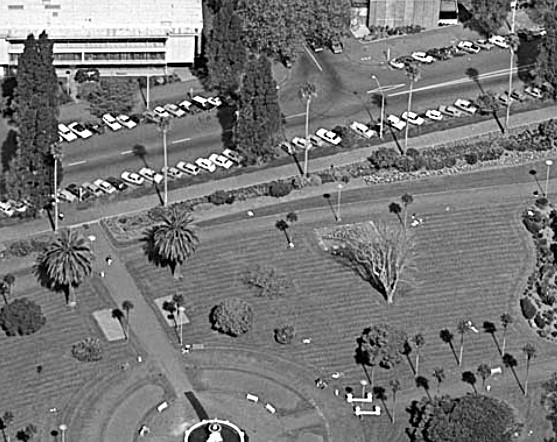
Source: ‘Aerial photographs of City campus, Albert Park and surrounding streets’, October 1977, University of Auckland Library
Albert Park was not the only place they were planted, whether singly or in clusters, consequently they very much deserve to be added to the Phoenix and Chinese fan palm as early significant palms in New Zealand gardens. Two further examples of early planting of the palms are considered below.
A Hastings homestead, and Napier’s premier central park
We can see in both these examples that just like Albert Park the skyduster was often planted along with Phoenix palms. Here is an early photo of Duart House, Havelock North:

Source: ‘St Georges School, 1917’, Hastings District Libraries
A crop from the photo of the area to the left of the house verandah shows the palms of interest:
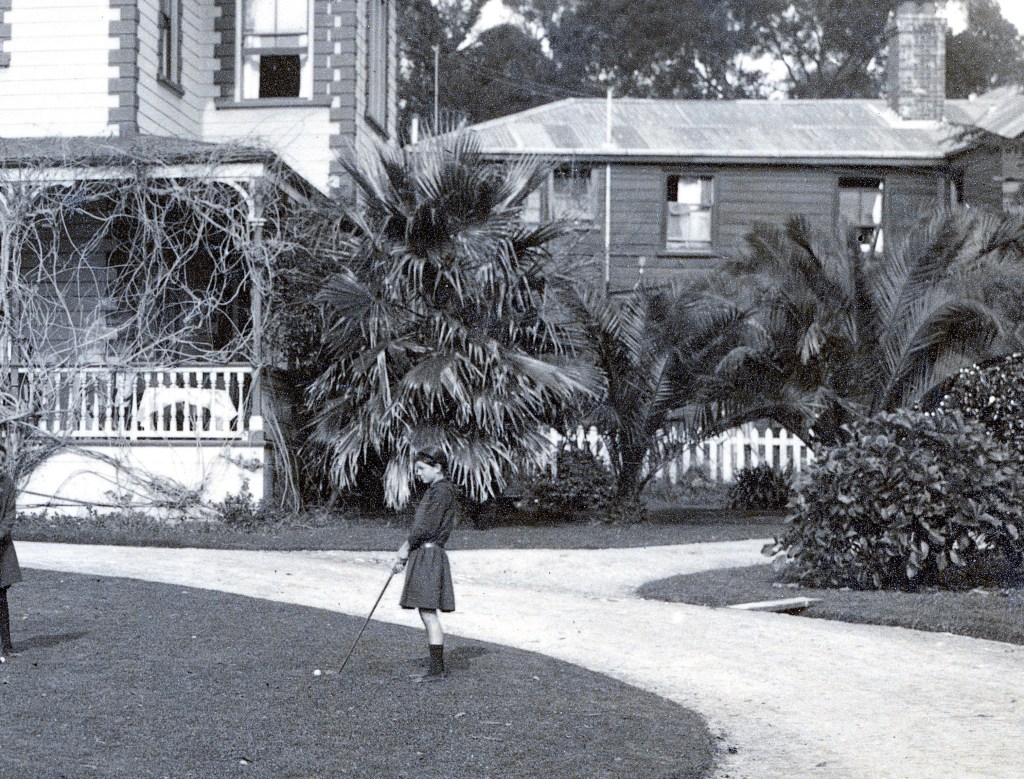
Behind the girl practicing golf is a 2.5 metre Mexican fan palm, with right next to it two Phoenix palms of slightly lesser height. Given that most palms are slow to grow in the establishment period, we could conservatively estimate a planting date of 1910. A visit to Duart House in October 2023 showed that the Phoenix palms had become monumental, but snaking above them was the also noticeable skyduster, all in very good health:


About 20 kilometres away in Napier, we can find more specimens of skydusters, this time planted in Napier’s premier central city park: Clive Square/Memorial Square. Luckily there is drone footage from a YouTube video that gives a good idea of the scale of the palms in the park:


Source: Napier (Clive Square/Memorial Square), New Zealand, Drone Footage. OziTraveler YouTube 2019
A photo of mine at ground-level also helps convey the impressive symmetricity of the park design:
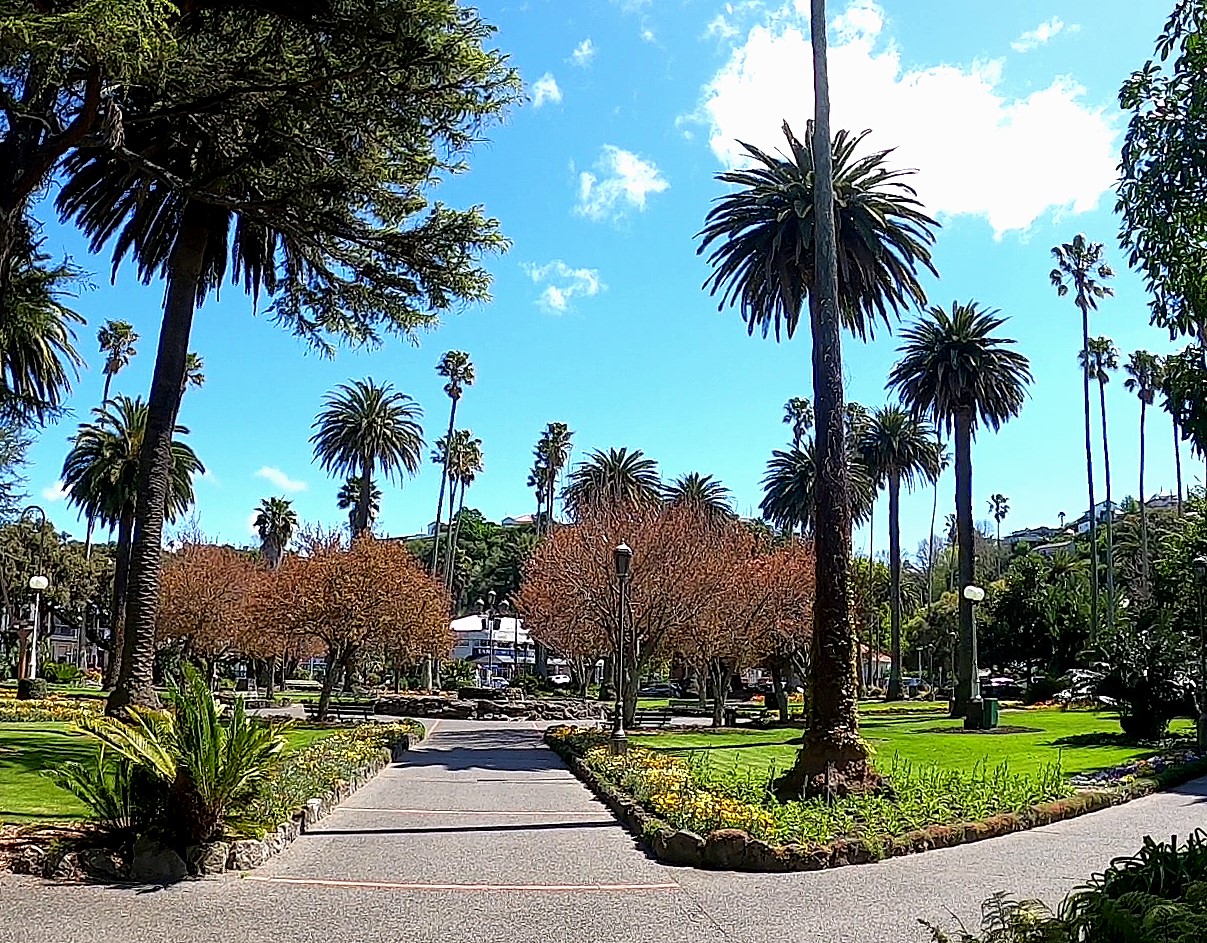
Just like the case for Albert Park, there is no clear record of when the skydusters were planted, but using the available resources I am confident that circa 1915 is a good estimate of their planting date (it may be that palms were planted at the two squares across several years). Firstly, there are newspaper reports from 1910 to 1913 where comments are made about the poor state of Clive Square with undertakings made to engage in beautifying work.4
Secondly, there are ample historical photos of both Clive and Memorial Square. The palms can be seen in many of these, however, unfortunately a lot of the photos are undated. There are two exceptions which help show that 1915 is a good estimate of planting date:

Source: Clive Square in Napier. Photographic negatives and prints of the Evening Post newspaper. Ref: EP-0693-1/2-G. Alexander Turnbull Library, /records/23146702
This photo is actually undated, but what it shows is part of a building known as Tintown. This was built after the February 1931 Napier earthquake as a temporary shopping area; it was dismantled in 1933, so the photo is probably taken in either 1932 or 1933. The two skyduster palms on view are in the order of 4 metres tall, which is the height we would expect of a palm planted circa 1915. A final photo confirms this, and also shows how early the effect of the palms contributed to the growing beauty of Clive Square:
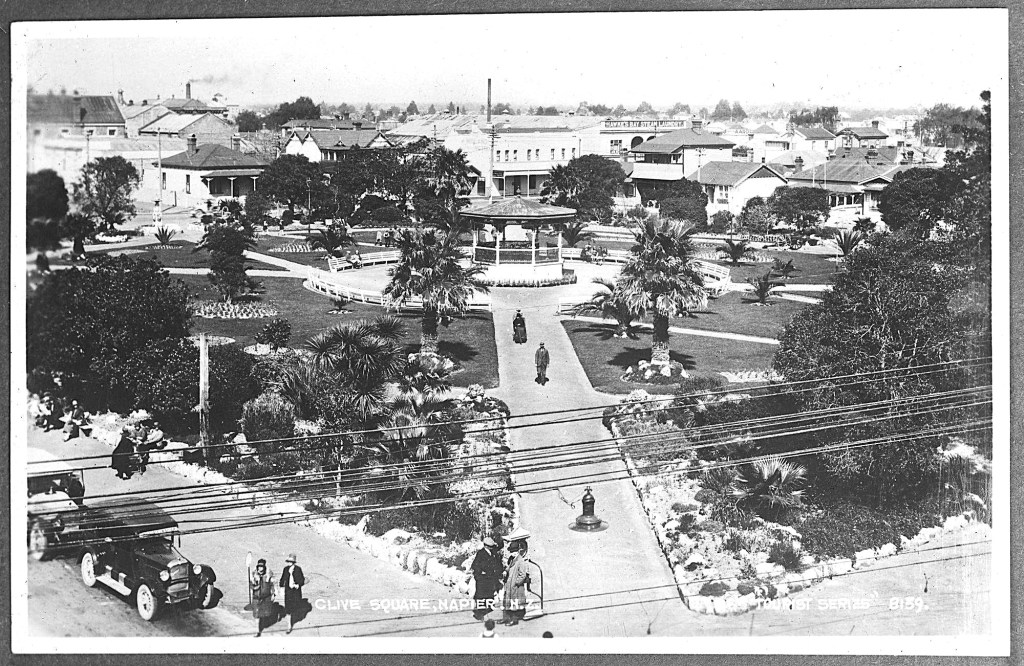
Source: ‘Clive Square, Napier’, circa 1930, Auckland Libraries Heritage Collections 35-R0768
The circa 1930 photo shows both the skydusters and the Phoenix palms, again at the height expected for a 15 year old palm (with the former having a faster growth rate). The bandstand in the middle of the square was probably removed to build Tintown, but it seems the majority of the palms survived and went on to flourish. It seems that a large part of the aesthetic effect is gained by planting them ‘in the dozens’. Also, the taller, narrower skyduster offers a good contrast to the bulkier Phoenix palm. Whereas the two squares are relatively small – certainly far smaller than Albert Park – they undoubtedly make an impressive garden contribution to Napier as an heralded art deco city.
In part two of this post we’ll consider some other plantings of skydusters in Whanganui, Gisborne and Lower Hutt.
Acknowledgment: Thanks to Joan Ruffett for information and a garden tour of Duart House.
- See ‘The garden’, New Zealand Herald, 24 March 1894, p. 4. Also note that the Washingtonia palms in Albert Park are listed in the Auckland Schedule of Notable Trees as filifera, however work by botanists clearly identifies them as robusta, eg. L. Goffart Hall,
Albert Park trees’, Auckland Botanical Society Journal, 1999, 54: 34-35. ↩︎ - I didn’t count them on a visit I made to Albert Park in 2024 as my interest then was in the Chinese fan palms. It is also worth noting that Washingtonia are of course the iconic palms of Los Angeles and many other cities in California. ↩︎
- M. Goodey, ‘Palms about Auckland’, RNZIH Annual Journal, No. 1, 1973, p. 7. ↩︎
- ‘Napier thirty-thousand club’, Hawke’s Bay Tribune, 25 November, 1913, p. 2. There are also reports from Napier’s head gardener detailing hours worked at Clive Square and other parks, including strong hints of a need for more gardeners. ↩︎

 The Local Arboretum: Noticeable trees and their stories
Leave a comment