In the first two posts of this set we saw two things. First, in New Zealand from 1859 on, a tradition was established of commemorative tree-planting that marked events associated with British royalty. These events could have been an actual visit to New Zealand by members of royalty, or something that happened back in Britain deemed significant enough to mark with tree-planting (eg. a royal wedding or coronation). Whereas a variety of trees were chosen for such planting, we saw secondly that the English oak was often a default choice, reflecting its significance in British culture.
The term ‘acorns from Great Windsor Park’ comes from a significant continuation of this tradition that is recorded in a hard-to-get book (details below). I would love to be able to track down more of the context and history of this, but I don’t have the resources to do so, however what we can do is look closely at the remarkable record of this significant event. Here is a first view:
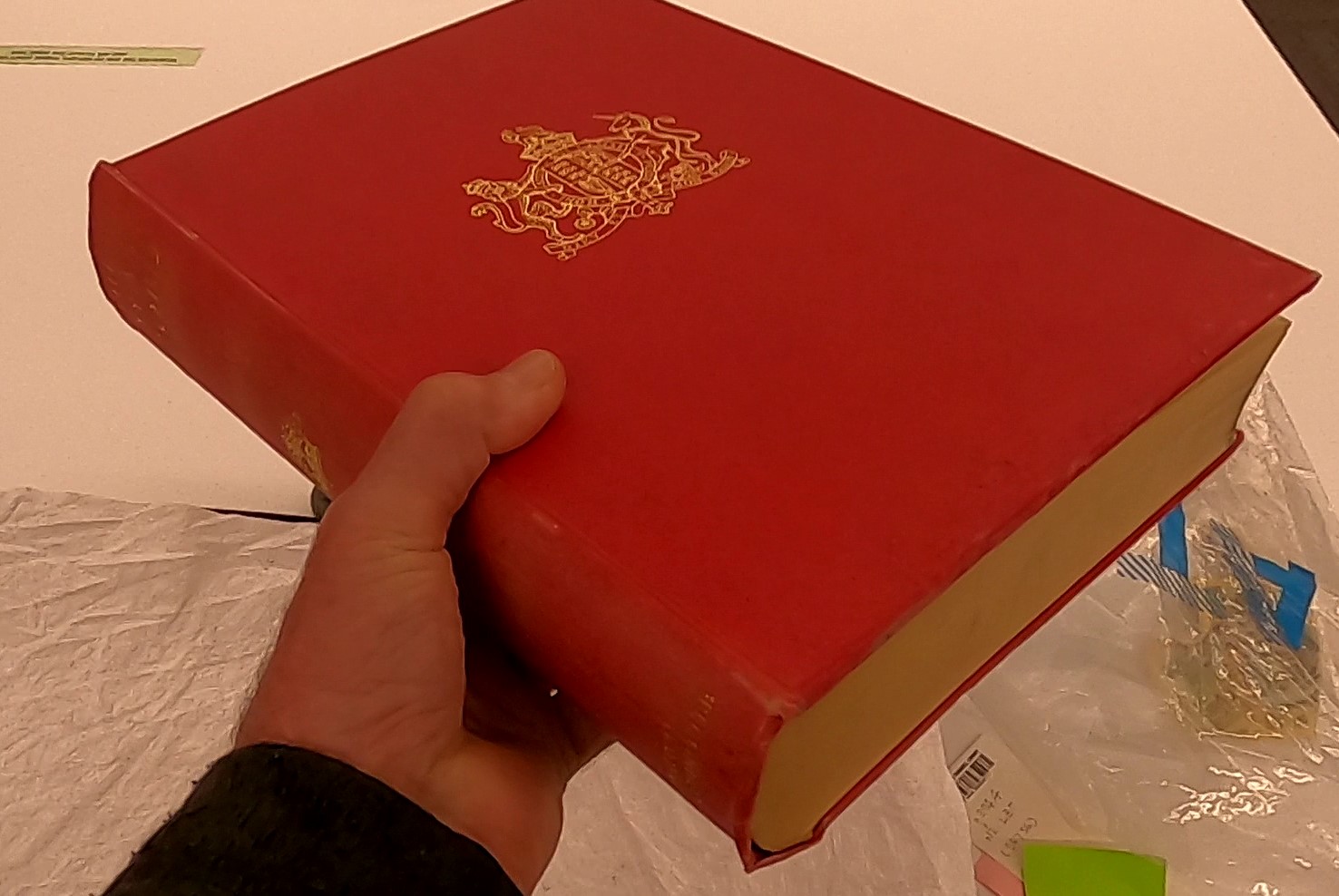
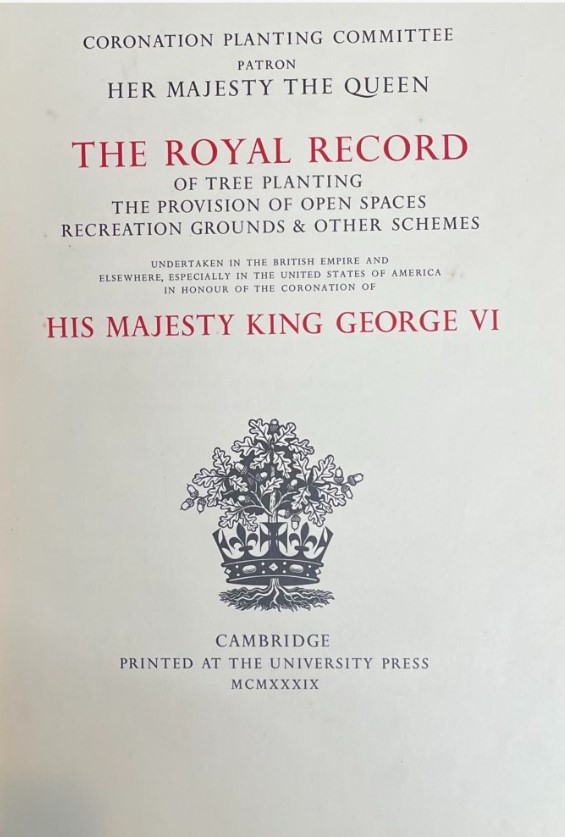
The top photo gives a good indication of the heft of the book, whereas the second gives the unabridged title from the frontpage (it is easier to refer to the book as the Royal Record). It is over 640 pages long and records over 15,000 trees planted throughout the British Empire and the US to mark the coronation of King George VI in 1937. The scale of this planting bears second thought – it is a remarkable moment of commemorative tree-planting. An introductory section in the Royal Record offers the relatively simple rationale of a desire to continue beautification of the British Empire. Those of a more sociological bent may be tempted to note that the coronation of King George VI occurred at a time when the British Empire was undoubtedly in decline, hence it could be argued that planting commemorative trees was a reminder that the empire and royalty were not entirely done for.
I am not tempted by such an argument myself. What interests me about the Royal Record is just how varied the planting was that went on in New Zealand. The record was compiled by the Department of Internal Affairs and spans pages 386 to 455, being organised in alphabetical order. Before getting to the list of plantings a note is provided on the distribution of the acorns from Windsor Great Park, including the interesting involvement of the Automobile Association of Great Britain:
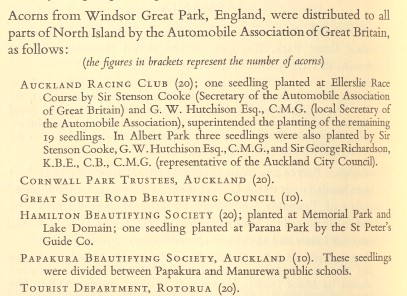
We can see that the provided information includes the number of acorns, and sometimes exact information about where they were planted and by whom.
Picking out an entry relatively randomly is useful. Here is an entry for Eltham:
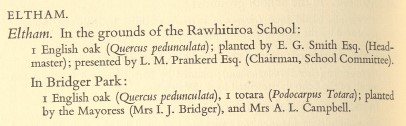
In this case 2 of the 3 plantings are recorded as English Oak (Quercus pedunculata), and these are likely to have been grown from the 80 acorns sent to South Taranaki by the Automobile Association of Great Britain.
Sometimes the source is explicitly recorded as Windsor Great Park as in these plantings for Auckland City:
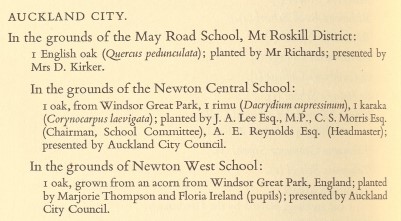
Also, the people who planted the trees is recorded and whereas these are often ‘people of importance’ (headmasters, mayors etc.), this is not always the case (eg. ‘pupils’ sometimes did the planting). What we also see in the above example is that along with the planting of the oaks, native trees also featured – a rimu and karaka in Newton Central School.
This planting of natives is a notable feature of the Royal Record. Sometimes they far outnumber the oaks, as in this example from small towns beginning with P:
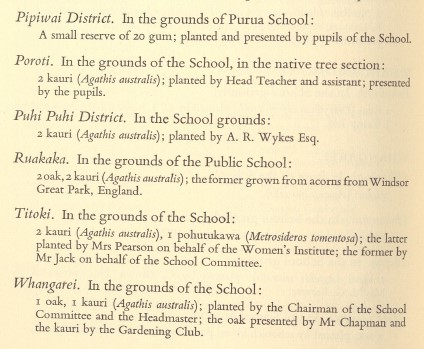
It seems that when oaks were available, presumably grown from the Windsor Great Park acorns, they were planted, but local residents were just as happy to plant natives and other trees. Also, it is evident that locality matters for what was planted: in the far north many kauri were planted, but in the south of the South Island they do not feature.
So what the Royal Record shows is that whereas many oaks were planted, and not all the common English oak, far more native trees were planted in this remarkable commemorative planting period. It is common to think that a preference for planting natives arose quite late in New Zealand gardening history, but the Royal Record shows that this was an extant development as early as the mid-1930s.
Records of speeches made on the day of commemorative plantings can be found1, and these do tend to note that oaks were planted as they were naturally symbolic of ‘home’. However, the remarkable variation in the trees that were planted, and the particular dominance of natives, suggests that the coronation of King George VI was more of a prompt or a convenient event to set off highly varied but coordinated tree-plantings. Planting a tree in this context was an intrinsic good in itself, rather than any simple reflection of the strength of support for royalty and empire.
- For example see ‘The coronation of King George VI. Lower Hutt Celebrations’, Hutt News, 19 May 1937, p. 5 ↩︎

 The Local Arboretum: Noticeable trees and their stories