In 1904 when monkey puzzle trees were still a considerable botanical curiosity,1 an article in the Ashburton Guardian on the local Beautifying Society records that ‘Mr James Porter, of Allenton, had presented the association with two monkey puzzle trees, which would be planted in Baring Square. It was decided to thank Mr Porter, and to ask each of the nurserymen in Ashburton to plant a bed in Baring Square of roses and other flowers.’2 That other nurserymen complied with the request of the Beautifying Society is suggested by an historic photograph of 1909:
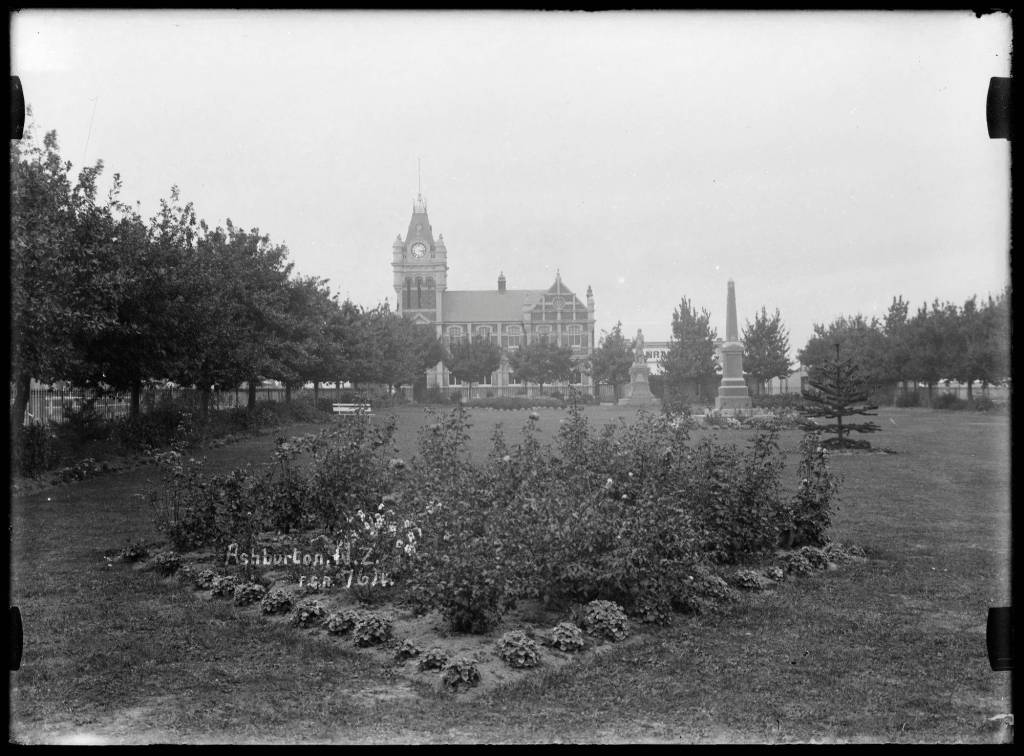
Source: ‘Ashburton’, F.G. Radcliffe, Auckland Libraries Heritage Collections 35-R2121
The foreground of the photo is taken up with a bed of roses and bedding plants, but there above the right apex of the bed is a young monkey puzzle tree, clearly showing the characteristic symmetrical form of the species. The brief ‘Ashburton’ title of the photo is filled out in the description as ‘Looking from Baring Square (foreground) showing the exterior of the Post Office, Ashburton in East Street’. As there are two Baring Squares in Ashburton, it is a little surprising ‘Baring Square East’ is not used as the descriptor.
At the time of the photo both West and East Baring Squares were relatively undeveloped, but their central location in Ashburton meant they were ripe for beautification, hence it is no surprise that James Porter’s donation of the two monkey puzzle trees was actioned by their planting in a key location. In respect to the second tree, which is not clearly visible in the 1909 photo, a magnification of a second photo clearly shows its location:
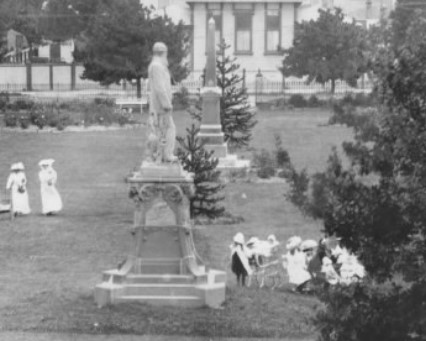
Source: Baring Square East, ca 1904, 02.1982.0402, Ashburton Museum & Historical Society
Viewing the square in the opposite direction to the first photo we can see the second monkey puzzle tree between the statue of John Grigg and the Boer War Memorial.3 Note though that the dating of the photo as circa 1904 seems wrong, as both trees in the above photo are taller than those seen in the photo probably accurately dated as 1909.
A nurseryman who liked monkey puzzles?
James Porter emigrated to Christchurch from Somerset, England, in 1877, and moved inland to Ashburton in 1878.4 Though without formal horticultural training he seemed gifted with plants, setting up his first nursery in Ashburton about 1882. HIs business grew and in 1901 he moved to a larger site in Middle Road, Allenton (now a suburb of Ashburton), where a lot of the stock grown were destined for shelter belt planting (he grew thousands of Monterey pines). But the wording of an early advertisement5 clearly shows that growing stock for shelter belts was not James’ sole focus:
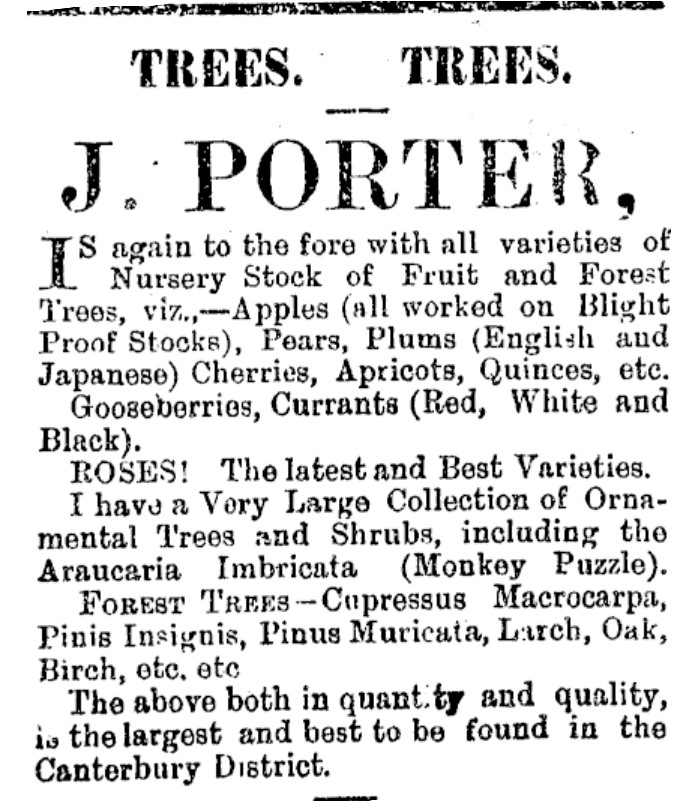
It is interesting that the monkey puzzle is the sole named tree amongst the ‘collection of ornamental trees and shrubs’ (at this time it was still known as Araucaria imbricata). Many of James’ nursery advertisements of this period similarly mentioned the monkey puzzle tree, however, it is clear that his range of offerings was very large. This probably reflected a business imperative, but there is also ample evidence that James’ personal plant interests were highly varied: in horticultural shows in Christchurch and Dunedin he entered apples, chrysanthemums, dahlias, sunflowers and a wide range of other plants. A report on a significant hailstorm in 1906 stated that, ‘Mr James Porter, who has been a resident in Allenton for twenty-eight years, states that he has not witnessed such a storm before or experienced such damage. Even such trees as monkey puzzles were considerably cut about’. 6 So, it may have been the robustness of the monkey puzzle that James valued rather than any particular fascination with its form or as a botanical curiosity.7
Not long after the report of the hailstorm a notice was carried in the local paper that ‘owing to ill-health’ James Porter’s 15-acre nursery with house and stock (called Clifton) was for sale.8 By 1907 Clifton Nursery was sold and James and his wife had moved to Wanganui. The ‘ill-health’ that precipitated this move was James’ susceptibility to asthma – he had only one lung – and the hope was that Wanganui’s climate would reduce this health problem. James Poter continued to actively garden in Wanganui, however he died there at the age of 68 in September 1917, survived by his wife Mary Ann. It is not known whether he kept up with the news from Ashburton, however, given his death in 1917 he certainly was unaware of subsequent developments regarding the monkey puzzle pair that he donated in 1904.
Vagaries of tree life
There is good photographic evidence that the pair grew at a good rate, and would have been quite a spectacle in Baring Square East. Consider this photo dated 1910-1920s:
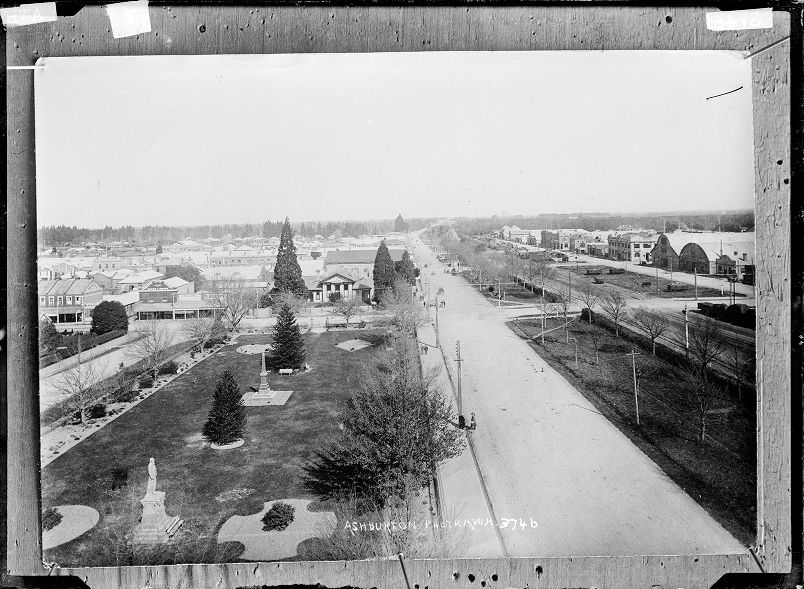
Source: ‘Ashburton, general view looking down East Street’, Photographer A.W. Hopkins, Price Collection, Alexander Turnbull Library.
Clearly, the monkey puzzle pair have become very noticeable, though they are not as tall as the impressive landmark giant redwoods seen at the top of the photo (the subject of Part 2 of this blogpost). The size of the monkey puzzle pair suggests the photo was taken in the 1920s, however, it could not have been after February 1929 as the following newspaper article9 shows:
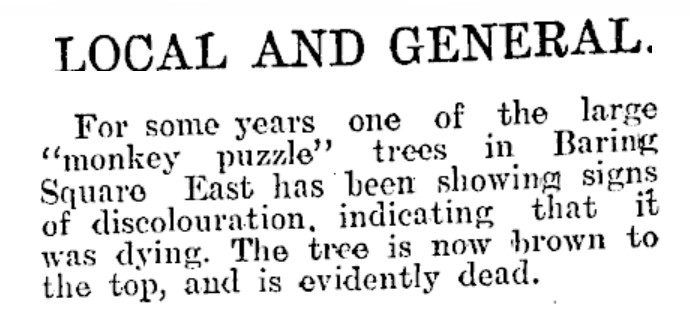
The brief note makes no mention of the history of the trees, including their donation by James Porter. Presumably the dead tree was promptly removed, but no thought seems to have been given to planting a replacement. Of course, as a vagary of tree life, succumbing to a disease and early death is something all trees can face. The next development regarding the remaining monkey puzzle tree is, however, quite puzzling (excuse the pun):
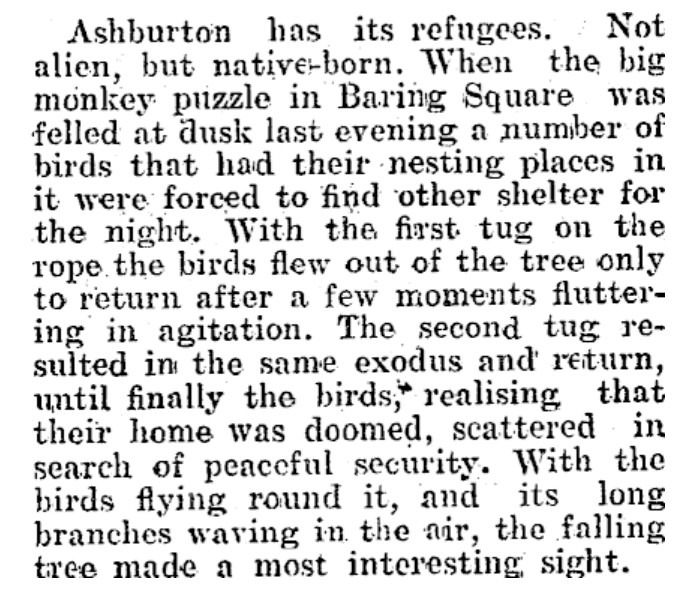
Carried with a range of other items of ‘Local & General’ Ashburton news,10 its tone is beyond simple description, almost as if the journalist took a literary flight of fancy. No reason is given for the removal, nor is there any mention of the history of the monkey puzzle tree, even though it is only 11 years since one of the pair died, and 36 years since the pair were planted. This may simply reflect the fact that at the time the whole of Baring Square East was being re-developed, making dominant a forward-looking orientation. Consequently, there may have been a significant reduction in the prior allure of a monkey puzzle tree as a botanical curiosity.
By the 1970s the square had again taken on a new aspect, with varied plantings, and the addition of a clock tower:
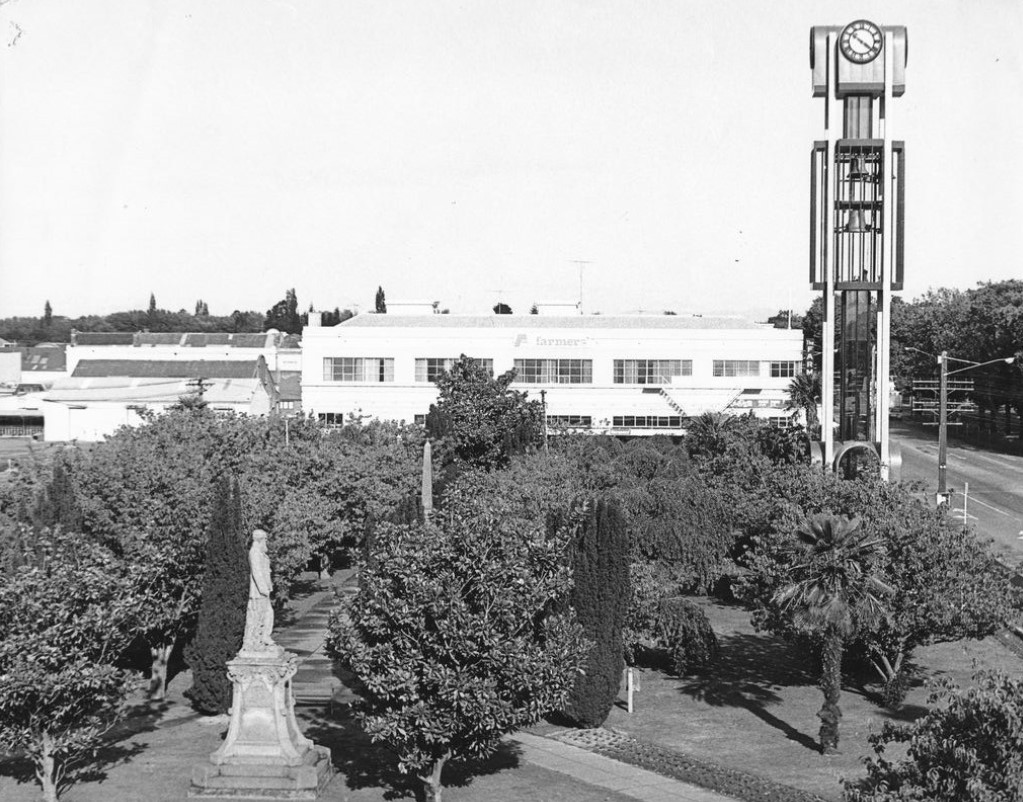
Source: View of Baring Square East, including the clock tower, John Grigg statue, Boer War memorial nestled in trees, and Farmers’ in the background. c. 1976. Photographer unknown. Rokowhiria Ashburton Museum, Whakatere Heritage photos of Baring Square East.
It is hard to escape such ‘progress’. The periodic re-development of New Zealand town and city squares very frequently involves the sacrifice of existing trees and the choice of new ones. Consequently, the story of Ashburton’s lost pair of monkey puzzles is not wholly surprising. Nevertheless, given James Porter’s contribution to the horticultural life of Ashburton, it does seem a pity that his donation of the monkey puzzle pair was so easily forgotten.11
- See the earlier post ‘The Monkey Puzzler‘ for some background. ↩︎
- ‘Ashburton Beautifying Society’, Ashburton Guardian, 31 May 1904, p. 2. ↩︎
- The Ashburton Museum has a wealth of information on both Baring Squares. Academic work focusing on statues and war memorials in the adjacent squares can be found in Michael Roche’s work, ‘Ashburton remembers: Celebration and commemoration in a New Zealand town 1903-1928’, 9th Australasian Urban History Conference, 5-7 February, 2008. ↩︎
- Details here come from Ashburton Guardian articles (via Papers Past) and from information provided by Lois Shipley, great-granddaughter of James Porter. Many thanks to Jill Porter for making the connection to Lois; also to Lesley McLachlan of the Ashburton NZ: History plus Facebook group. ↩︎
- ‘Trees trees’, Ashburton Guardian, 2 June, 1903, p.4. ↩︎
- ‘Yesterday’s storm’, Ashburton Guardian, 24 January, 1906, p. 2. ↩︎
- Additional evidence shows that James also donated other types of trees (oaks for example) for planting in Ashburton. An early recorded plant donation by James was in 1893, being an Arbor Day planting in Ashburton School: ‘Arbor Day: Ashburton’, Ashburton Guardian, 5 August, 1893, p. 3. Note that James was a member of the Ashburton Horticultural Society from when it was first formed in 1891: ‘Horticultural Society’, Ashburton Guardian, 12 December, 1891, p. 2. ↩︎
- ‘Nurserymen!’ Ashburton Guardian, 17 May, 1906, p. 2. ↩︎
- ‘Local & General’, Ashburton Guardian, 28 February, 1929, p. 4. ↩︎
- Ashburton Guardian, 31 May, 1940, p. 4. ↩︎
- I know of no New Zealand town or city that has a pair of old monkey puzzle trees located in a significant square or park, so Ashburton missed out on something unique. To see what they could have looked like there is a record on the New Zealand Tree Register of a monkey puzzle pair in Ravensbourne, Dunedin. Good photos are available at the online entry: CR/1409 ↩︎


