The first blogpost on the monkey puzzle tree in New Zealand finished with a view of a good specimen in Queen Mary Hospital, Hanmer. It was planted about 1930, very likely as part of Alfred Buxton’s commissioned work at this site. Given that Buxton & Company planted quite a few monkey puzzles in their highly regarded garden designs, it is reasonable to infer that this helped maintain their popularity in New Zealand. However, by 1930 signs of resistance to the tree had also developed. Here is one example from the Hawke’s Bay Tribune, January 8, 1930:1
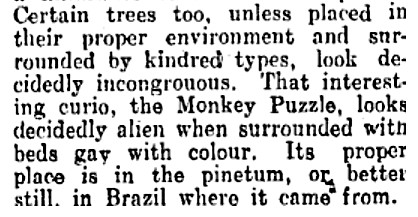
The article is sub-titled ‘An Expert’s Views.’ Of course, the expert is entitled to characterise the monkey puzzle as an ‘interesting curio’, but in saying its proper place is in ‘Brazil where it came from’, some doubts can be cast on his or her ‘expert’ opinions. Whereas Brazil is close to Chile and Argentina, the monkey puzzle is not endemic to Brazil.
Not long after the expert’s views were expressed, this time in the Southland Times, a writer expresses a nonchalant indifference towards the monkey puzzle. In a column on ‘The Garden’, the view is expressed that ‘An elegant green foliage shrub to take the place of an old araucaria is Cupressus bermudiana.’2 By ‘old araucaria’ the writer probably does mean the monkey puzzle tree, rather than other Araucaria species like the Norfolk Island pine, or bunya bunya, as the latter two species were not commonly planted in the far south. However, the monkey puzzle seems to have been very popular in Otago and Southland, and by 1935 there were indeed old specimens to be found in the far south. Southland is as good a place as any to begin the discussion here which helps to show that the monkey puzzle tree was more than an interesting curio in New Zealand. After considering examples in Southland we move to one particularly well-known example in central Canterbury, then move to Hawera in the North Island.
Some Southland Monkey Puzzles
Invercargill is the main city in Southland and as early as 1856 land was set aside for a central park, however, it was not until 1873 that planting began in Otepuni Gardens (sometimes simply known as ‘Town Gardens’).3 Monkey puzzle trees were planted early in the Gardens’ history, and in prime locations as this early photograph shows:
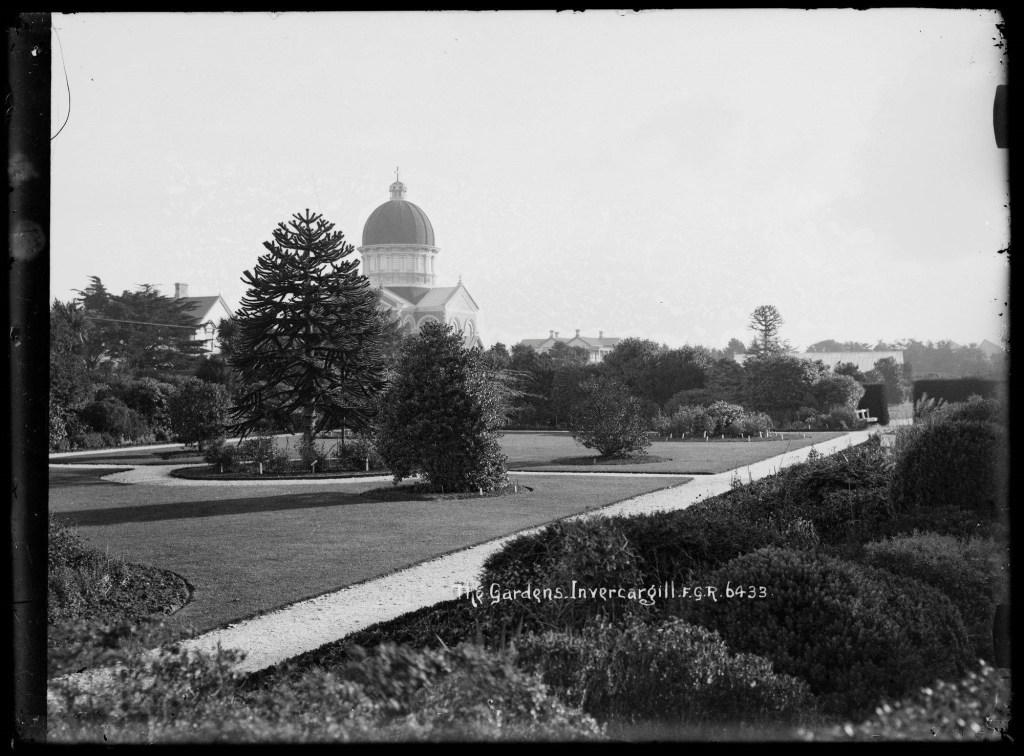
Source: F.G. Radcliffe, 1900-09, Auckland Libraries Heritage Collections 35-R0623
Just as the St Mary’s Roman Catholic Basilica stands out on the skyline, so too does the sturdy specimen growing in a feature circle. Further in the distance a second monkey puzzle can be seen rising above other plantings. Both look to be about 15 years old, thus having been planted circa 1890.4
Otepuni Gardens were the premier gardens of Invercargill at the time, and on a visit many people would have viewed the monkey puzzle trees. If they wished they could also send their friends and relatives a postcard featuring a colourised view not that different from the photo above:
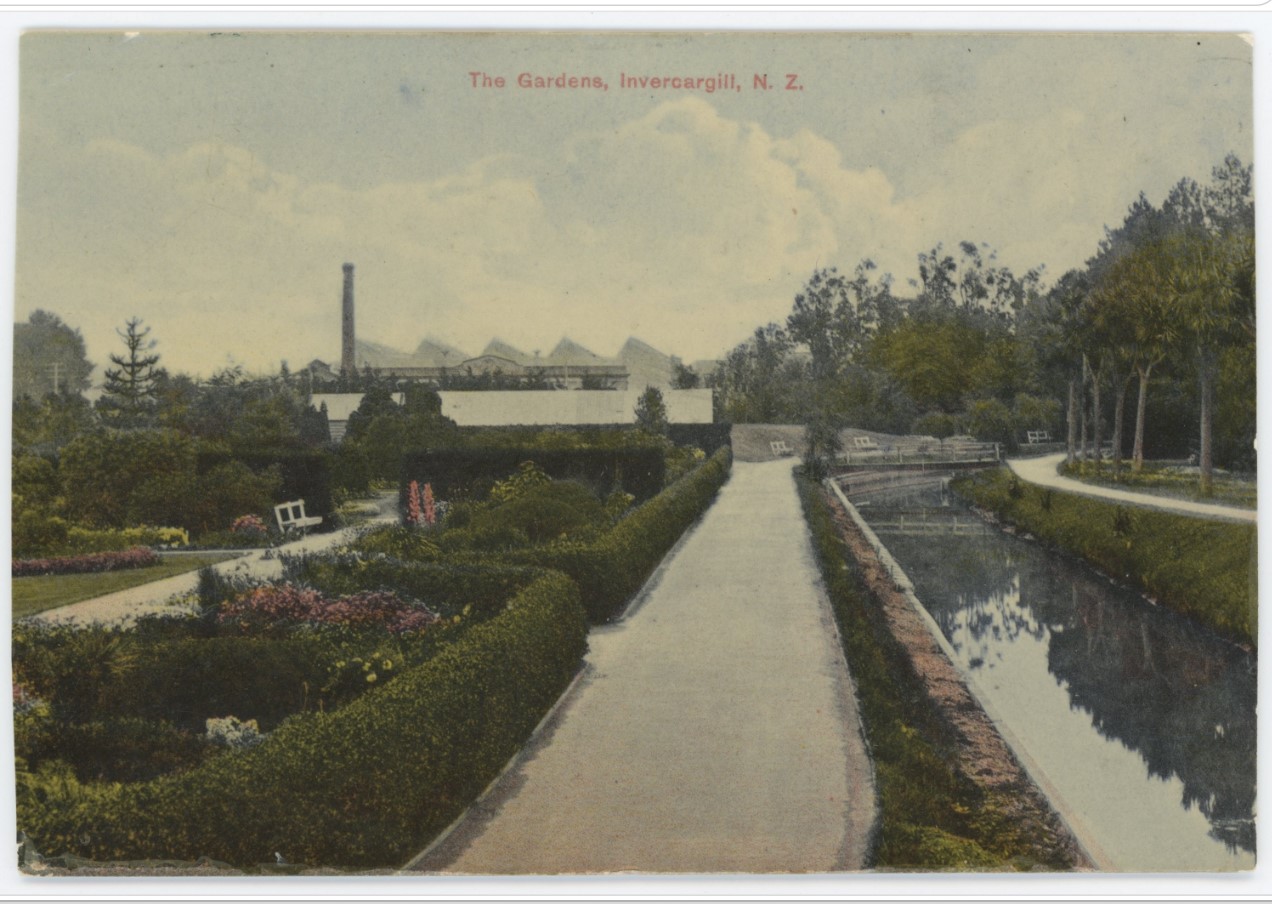
Source: ‘The Gardens, Invercargill, N.Z.’ ca 1909, Fergusson Ltd Postcard, Invercargill City Council Archives A0637_S27880015
There is no way of knowing whether the impressive pair at Otepuni Gardens stimulated other plantings, but nurseries did have stock for sale, and there certainly were many other plantings in Southland about this time. We can consider four examples not far from Invercargill, all in a northwards direction (distance given in brackets): at Edendale (34 kms), Brydone (37kms), Otamita (60kms), and Waikaka Valley (75kms):
Granny Brown’s Cottage at Edendale 1890-95
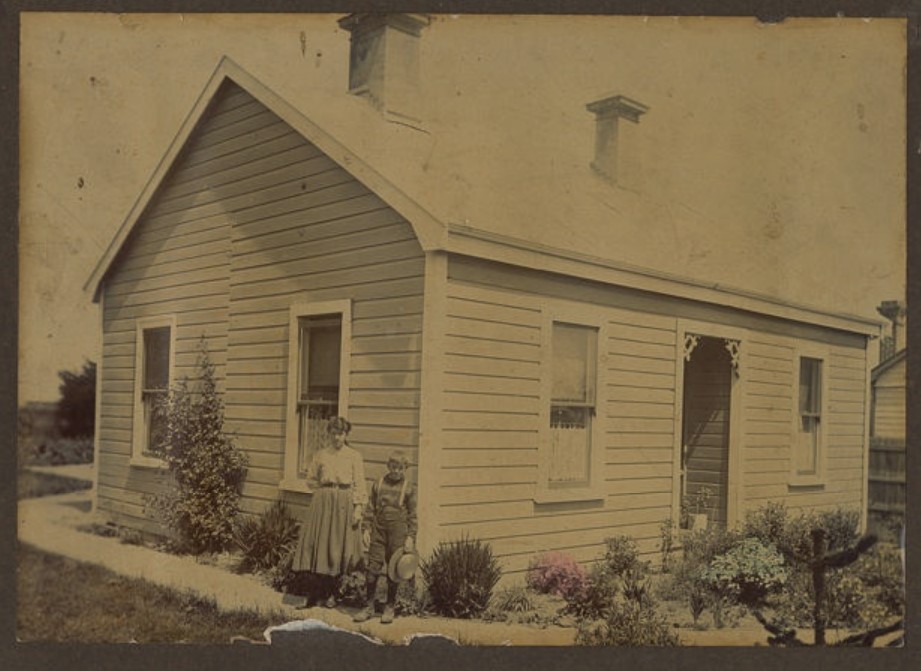
Source: Granny Brown’s House, Wyndham & District Historical Museum, WY-0000-.577
The notes for this photo give the location as 18 Brydone Street, giving the names of the woman and boy, also stating, ‘Note the monkey puzzle tree in the foreground’. It would appear to have been planted within a year or two of the photo, at what is clearly a modest cottage, where nonetheless ‘Granny Brown’ took care over her garden.
Brydone 1890-1900
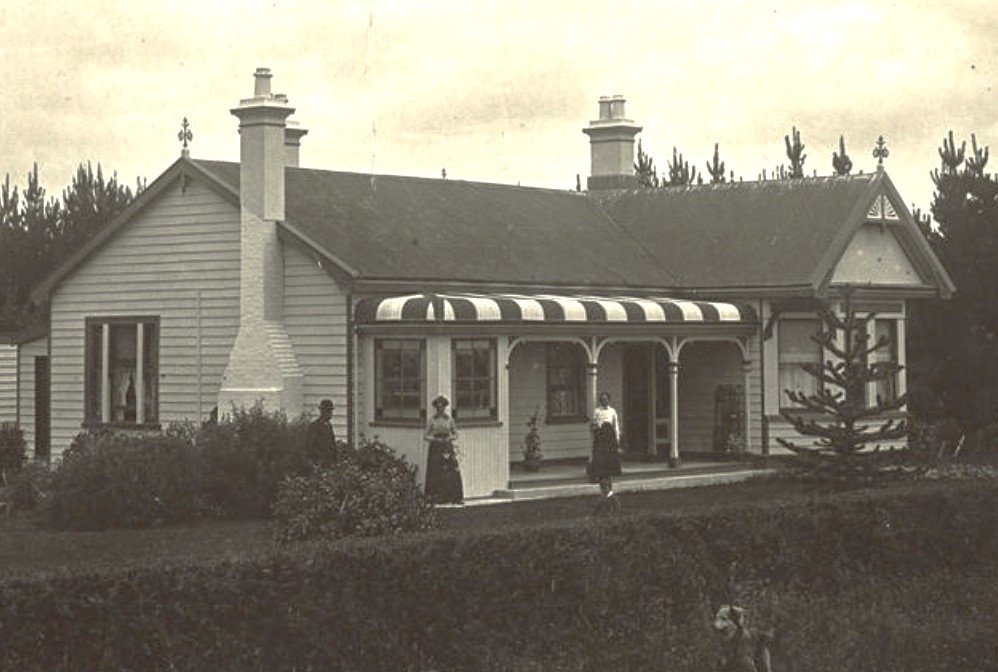
Source: Photograph, house with three adults …, Wyndham & District Historical Museum, WY.2009.09.10
This time the house is much larger, probably fitting the classification ‘middle class’, but similar to the Edendale cottage the monkey puzzle tree is planted close to the house. Clearly, both the Edendale and Brydone examples show that in the 1890s small-town Southland properties featured monkey puzzles in conspicuous sites. The same applies to rural farmhouses, as we can see in the next two examples.
Farmhouse at Otamita, 1923-28
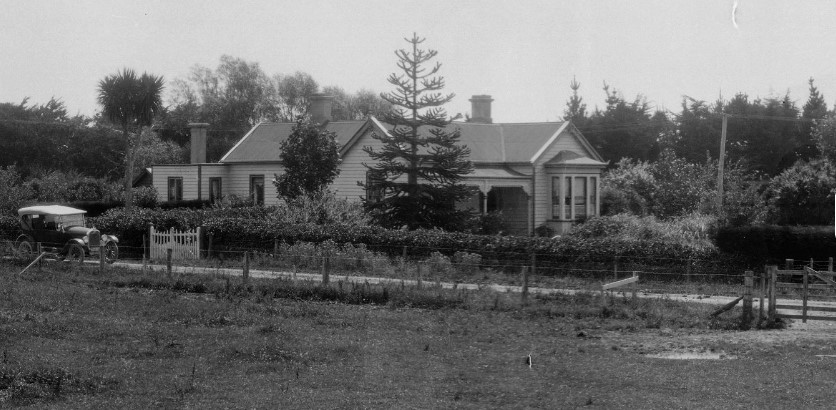
Source: R P Moore Collection, Alexander Turnbull Library, 1923-28, Pan-0408-F
The full panoramic photo shows a very isolated farmhouse, but there again in pride of place in front of the house is a significant monkey puzzle tree. This looks to have been planted about 1900 to 1910.
Farmhouse on hill, Waikaka Valley, 1923
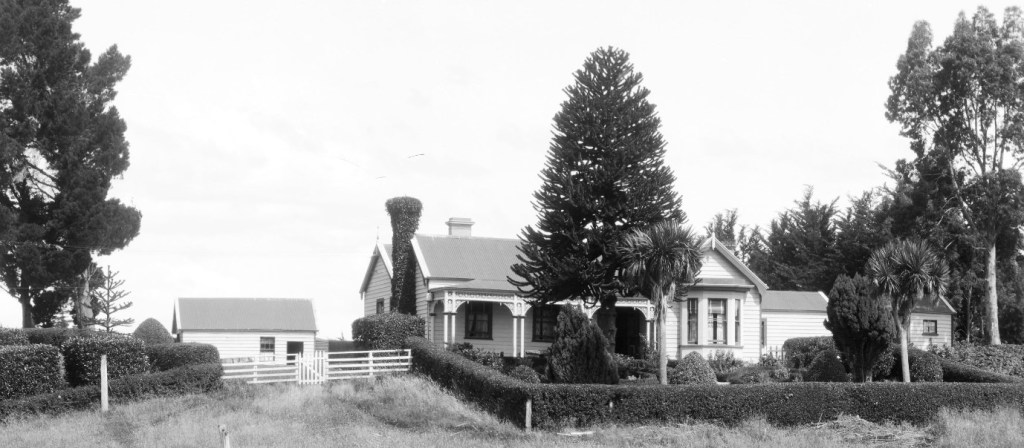
Source: R P Moore Collection, Alexander Turnbull Library, 1923, Pan-0108-F
Just as with the last example, the farmhouse is isolated, this time sitting atop a small hillock. It has well-trimmed hedges and right in front of the house a perhaps 25 to 30-year-old monkey puzzle, nicely framed by two cabbage trees. Careful attention to the left of the photo, next to the small shed, shows a second monkey puzzle, in the order of 4-years-old. The planting of two specimens clearly suggests the farmer was very taken with the tree.
Awaiting fhe fall?
Undoubtedly many more monkey puzzle trees were planted in Southland from the late 1800s into the early 1900s. The examples above are sufficient though to show a liking for the tree across situations: from small town cottage-gardens, to middle-class town houses, to isolated farmhouses. An obvious question is, ‘what happened to these trees?’ In some cases further information can be found, but in general it is impossible to accurately track down their fate. This makes difficult a simple repetition of a ‘rise-and-fall’ narrative, however, there is also another factor that bears examination. Hints of this are seen in an extract from the Southland Times, 1921:5
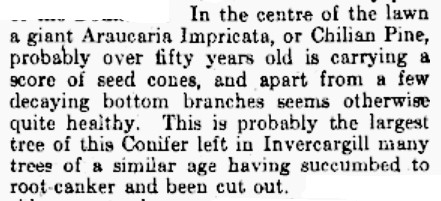
This is an extract from a lengthy report on a ‘garden club’ visit to ‘Lennel’, a well-known residence in the Invercargill suburb of Gladstone. The writer suggests the currently healthy tree was planted in the 1870s, it being one of few that age surviving in Invercargill due to ‘root-canker’. ‘Canker’ can be a fairly general term for tree ailments, but regardless of how good a descriptor it is of what ailed monkey puzzle trees the identification of this loss of trees is significant.6 Again it suggests that social things like fads and fashions may not be the best explanation of the fall in popularity of the monkey puzzle tree. Instead, they may have fallen out of the public eye due to disease, and not mainly any change in opinion about the merits of a healthy tree in the garden. We will return to this factor in considering the Hawera example, but first we can move to the case of the monkey puzzle at Lincoln College, Canterbury.
Lincoln College loses an old friend (but forgets its history)
On August 1, 1975, there was a severe wind-storm in Canterbury. One result is shown in this photo taken by a horticultural lecturer at the College:
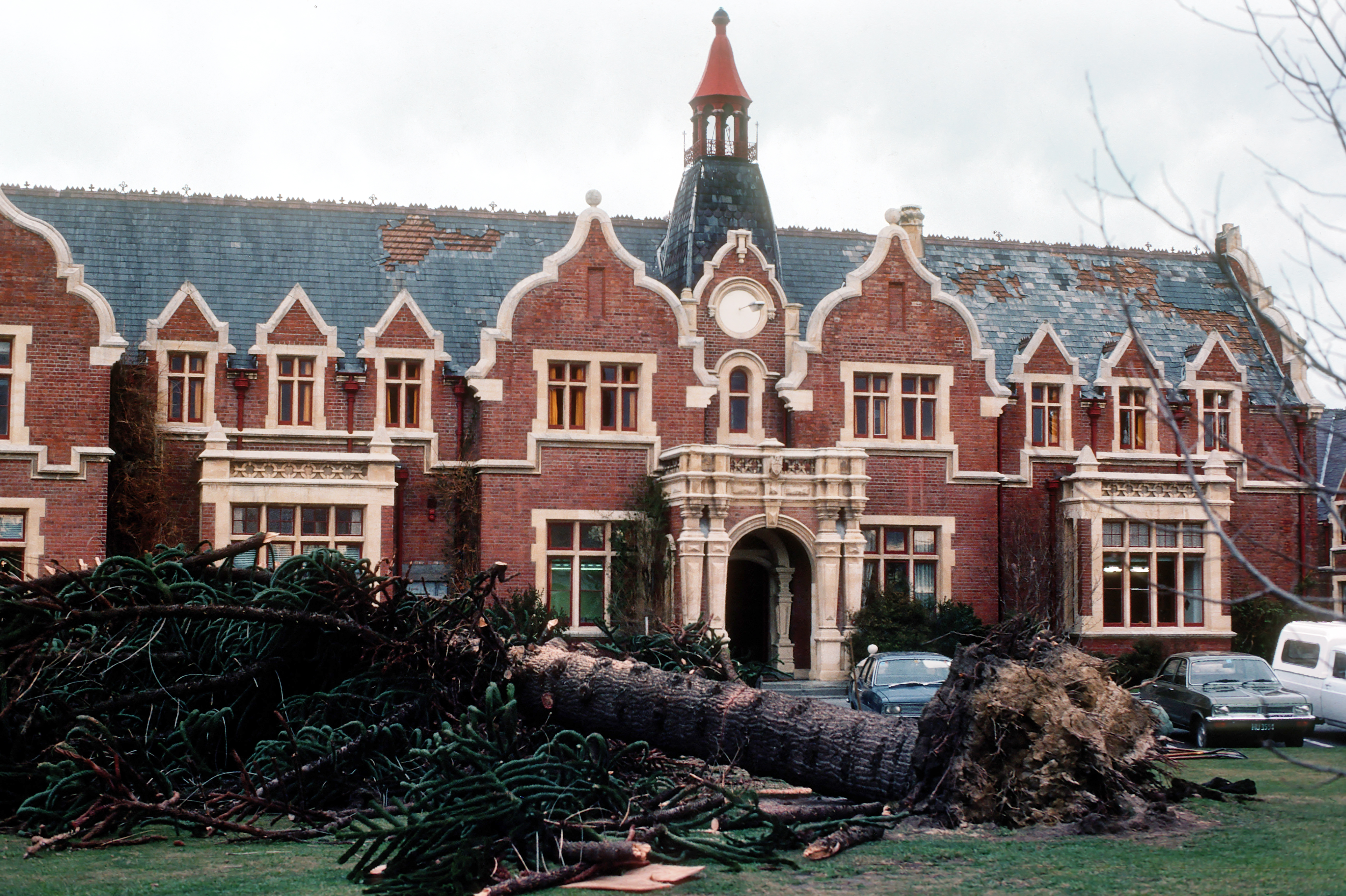
Source: Wind damage to tree outside Ivey Hall, 1975. 11-S C Challenger Slides
The photo shows a toppled monkey puzzle tree in front of Lincoln College’s iconic Ivey Hall. What the tree looked like when upright, commanding a significant site, is shown by another photo:
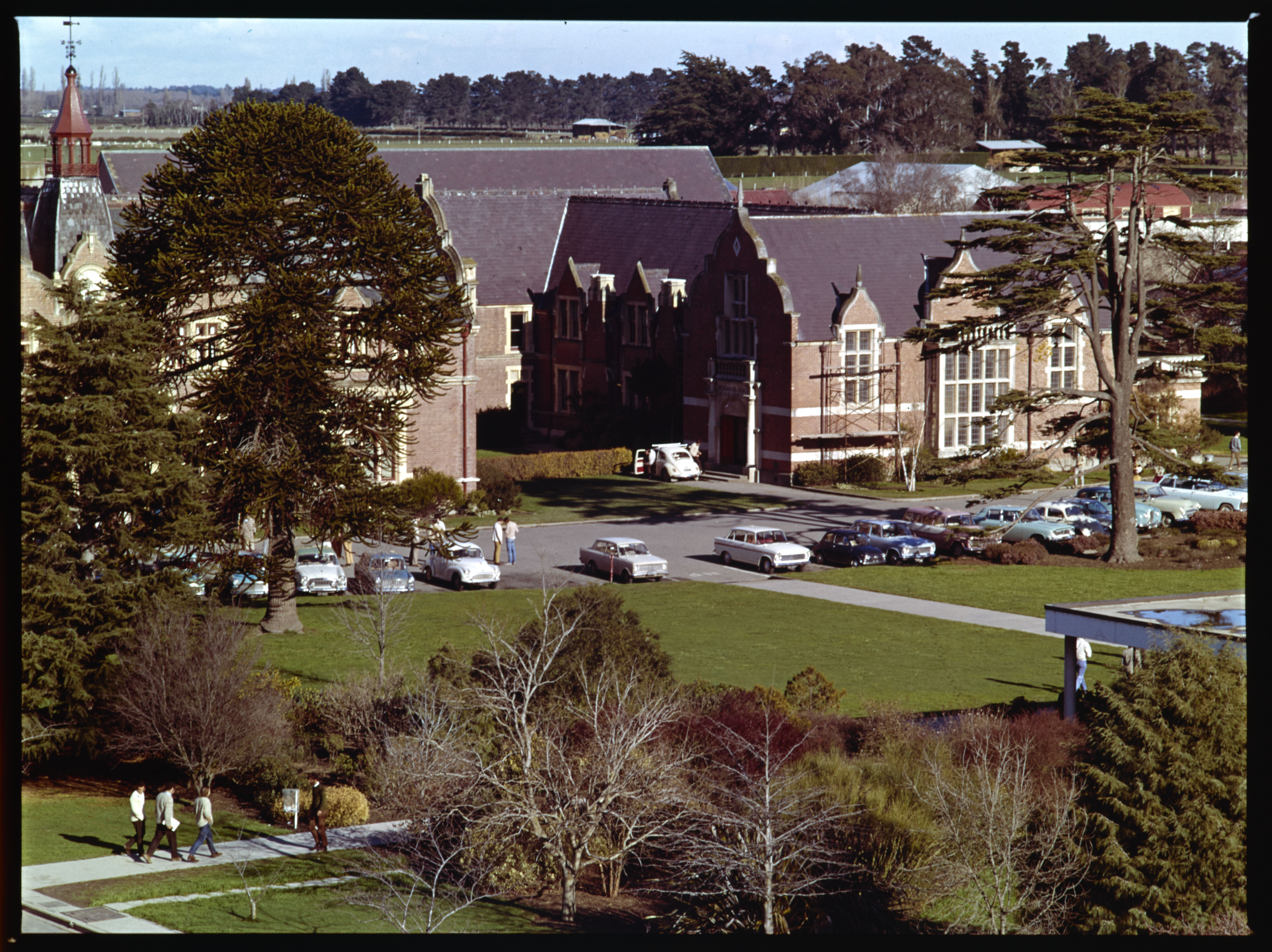
Source: Early to mid 1960s Ivey Hall, Lincoln University Living Heritage
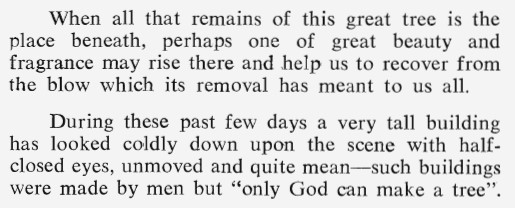
The tree was clearly of significant size and in very good health. Not long after its toppling, reports mourning the loss of the tree appeared. On August 13 The Press carried an article titled ‘In memory of a monkey puzzle’ (p. 5). Starting with the byline ‘Lincoln College lost an old friend in the great gale of August’, the article notes that the tree had developed a majestic presence as it grew over about 80 years, then quotes G B McLeod from a college newsletter. If we go to that source, we first learn that a count of the tree rings dated the tree as 91 years old, thus it was planted in 1884. McLeod’s tribute is worth quoting at some length. He says the tree
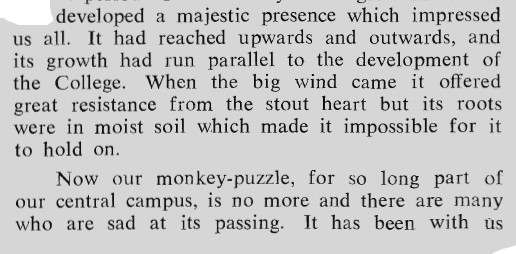
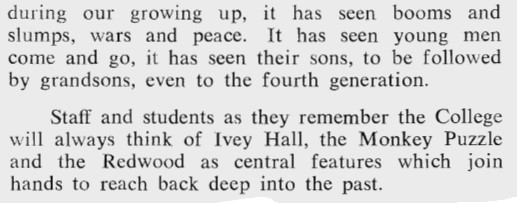
…
Source: ‘An Ill Wind’, Lincoln College Magazine, 1975 pp 28-29
There is little reason to doubt that the monkey puzzle tree was centrally placed within the culture and history of Lincoln College. The sentiment is heartwarming, and even a non-believer can connect with the powerful finish: ‘only God can make a tree’. However, while McLeod alludes to the ‘very tall building’ looking ‘coldly down upon the scene’ he does not look beyond his own lyricism. The fact is, up until 1958, there were three monkey puzzle trees planted in front of Ivey Hall, as this photo shows:
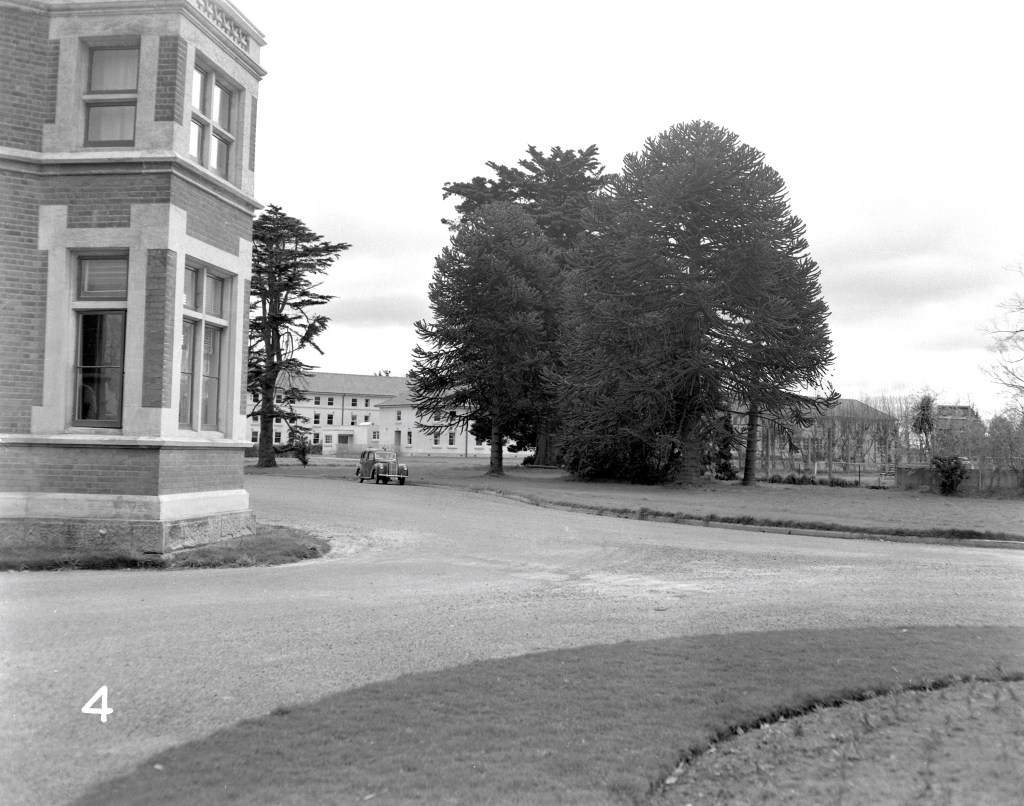
Of course, writing in 1975 McLeod could not do a quick google search, as we can, to find these historic photos. Such a search also turns up two key documents by Ruth Burns: Some Trees at Lincoln College (1964), and Ivey Hall Lincoln College, A Pictorial Comment (1977).
Ruth, an American, was the wife of Malcolm Burns, whom she had met and married while he was on a fellowship at Cornell University. Beginning as a lecturer in soil science at the then Canterbury Agricultural College, Malcom went on to become director of the college in 1952, and then principal in 1962 when it became Lincoln College7. Ruth notes in ‘Some Trees’ that they lived on the college grounds for 33 years, and in the first part of that document lists a number of trees that she planted, sometimes growing these from seed. It is clear that Ruth is knowledgeable about trees and gardening, being impressed by the monkey puzzle trees. It is in the ‘Pictorial Comment’ that this is made most clear. The tree that was toppled in the storm is described as Lincoln’s ‘most distinctive tree’, though at the time of writing she admitted that ‘fashions have changed and young monkey puzzles are seldom seen now’. Most interesting is the comment that she ‘grew eight seedlings 20 years ago’, detailing why and what happened to them:
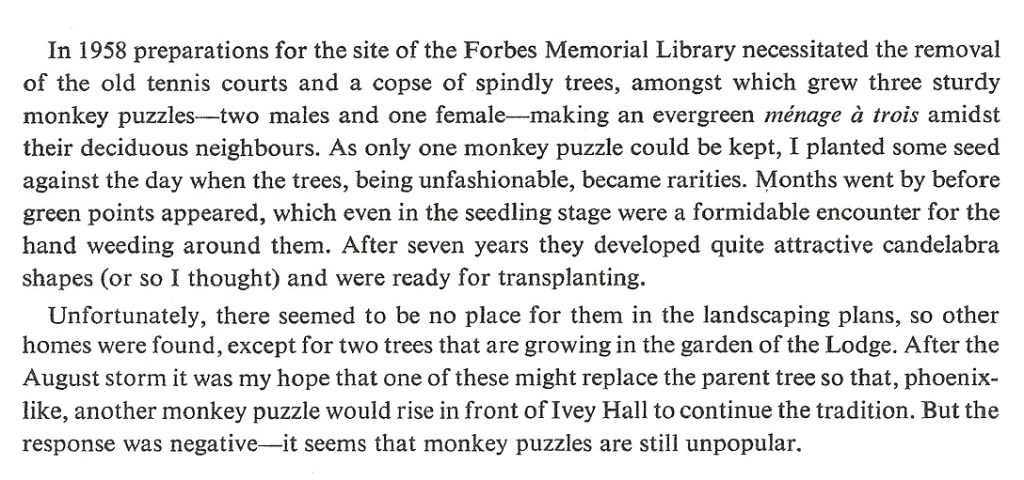
Though the document from which this is quoted is dated 1977, it needs to be realised that Malcolm Burns retired as principal of Lincoln College in 1974. Thus in 1975 when the tree was toppled, Ruth had moved to Christchurch with Malcolm to retire, meaning that she no longer had the ability to have trees she had grown from seed planted in the Lincoln College grounds. This probably helps explain why the offer of a replacement monkey puzzle for the toppled 91-year-old was turned down.8
The ‘Some Trees’ document, dated 1964, explains that one of the monkey puzzle trees planted by the Lodge died, and the second was moved to the horticultural research area. Inquiries indicate no trace there of a monkey puzzle tree. So, in the space of 90 years Lincoln College went from having five monkey puzzle trees to none.
A new group of buildings at Lincoln College named the Burns Wing, in recognition of the contribution of Malcolm and Ruth to the College, was opened in 1976. Extrapolating from her clear love of trees and gardening, Ruth may have been happier if one of her seedling monkey puzzles had been replanted in front of Ivey Hall, rather than having a building named after her husband and her. If ‘only God can make a tree’, it is clear that once made humans do highly variable things to them.
The Hawera Triangle
Finally, we move north to Hawera, in South Taranaki, with an example that also involves three monkey puzzle trees. They are in Hawera’s King Edward Park, but to set the scene for their planting it is useful to view a full Robert Percy Moore panorama, taken in Hawera sometime between 1923-28:

Though it looks like a small park, this is a homestead named ‘Ti-Maru’ (R P Moore Collection, pan-2471-F, Alexander Turnbull Library). If we magnify the area close to the house we can see the owner, Charles Goodson, as well as a significant tree:
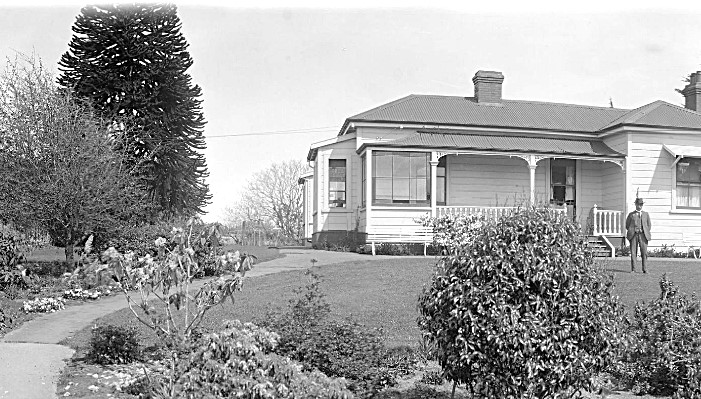
The impressively healthy monkey puzzle is well over six metres tall and must have been planted pre-1900. Available information on Charles Goodson describes his gardening interests and helps to contextualise what we will see at King Edward Park.
Goodson was born in Wanganui in 1866, and when a young man he farmed with his father at ‘Waihi Downs’ near Hawera. When his father died in 1888 Charles extended his farm to 700 acres, becoming an active stockbreeder. He was elected to the Hawera Borough Council in 1904 and was appointed chairman of the parks and reserves committee, a role he retained until 1918. Under his direction King Edward Park was planned and laid out, with an emphasis on trees, shrubs and plants suitable to Hawera’s climate. At his Ti-maru residence in Cameron Street, Hawera, Charles’ garden included rhododendrons and daffodils which he hybridised and bred. He was a self-taught horticulturalist, but nonetheless had great success in plant-breeding, and was also recognised as the person who introduced Luculia species to New Zealand.9
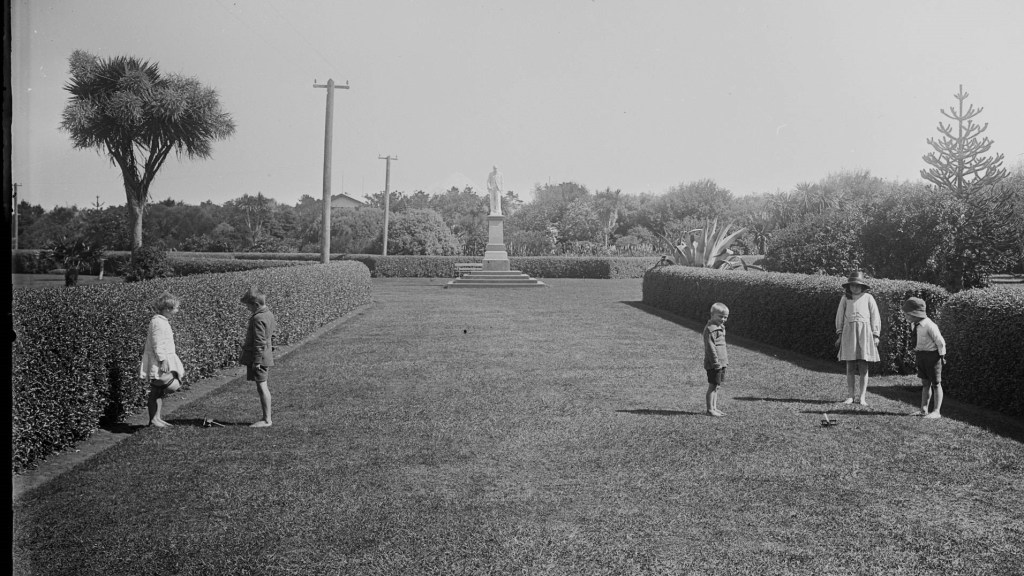
It is not likely that Charles planted the monkey puzzle at Ti-maru, but given its robustness and his admitted desire to plant trees and shrubs which grew well in the local environment, it is no surprise to find monkey puzzles as an early planting at King Edward Park, as this 1920 photo shows:
Source: ‘King Edward Park, 1920’, E Bradbury, Auckland Libraries Heritage Collections 1784-132
A good-sized specimen can be seen above the children on the right of the photo, but if we magnify the left side we can see a second specimen between the cabbage tree and young palm:
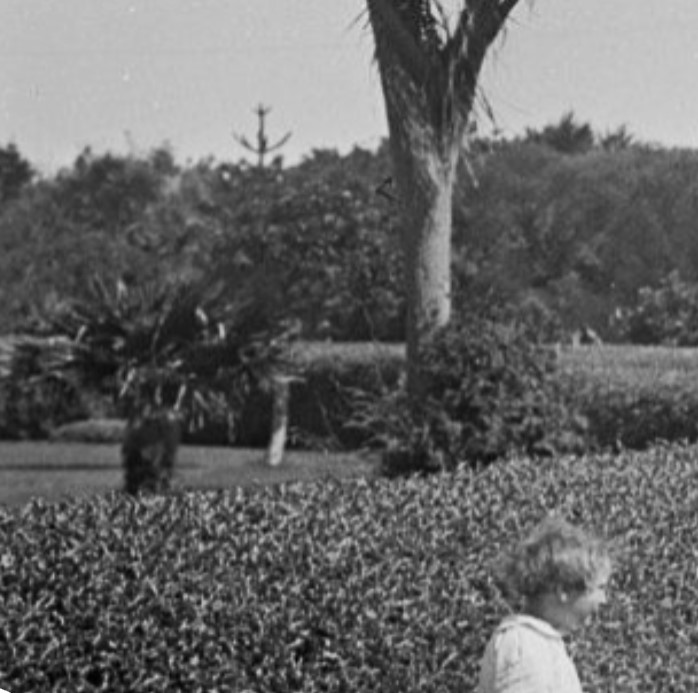
In his history of King Edward Park David Bruce10 dates the planting of the monkey puzzle to the right as Arbor Day, 1907. However, the newspaper article11 that he refers to in suggesting this date does not specify particular plant names. Bruce does not mention there being two monkey puzzles in the site seen above, nor does he seem aware of a third planting, just visible in this 1914 photo:
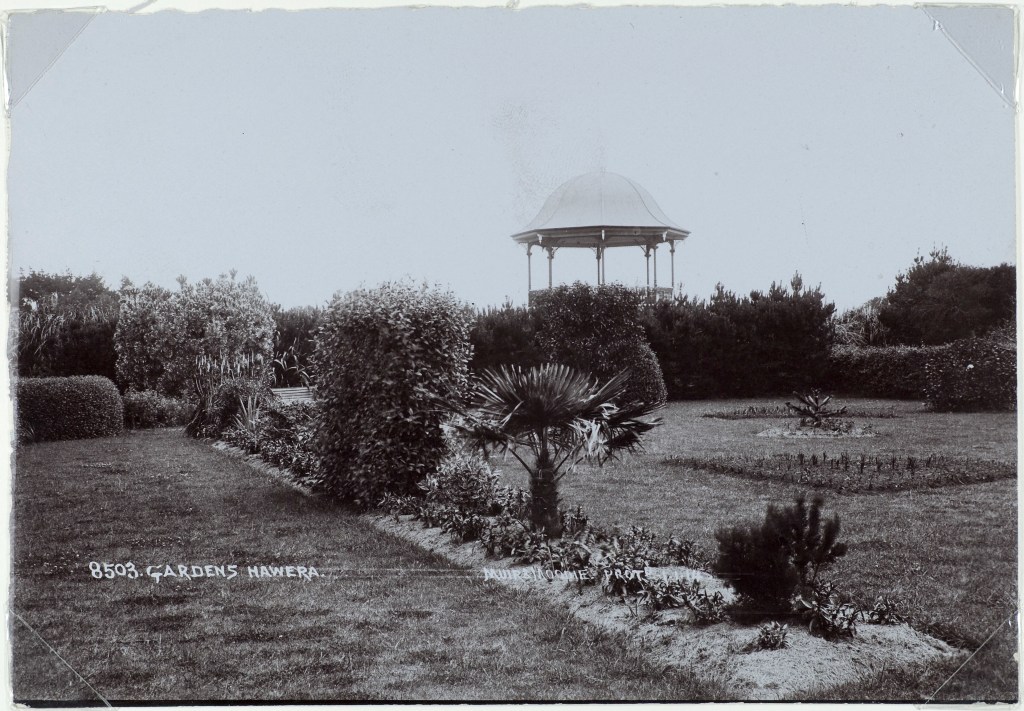
Source: Gardens, Hawera, January 1914, Muir & Moodie. Te Papa (O.001879)
A magnification suggests the monkey puzzle is freshly planted:
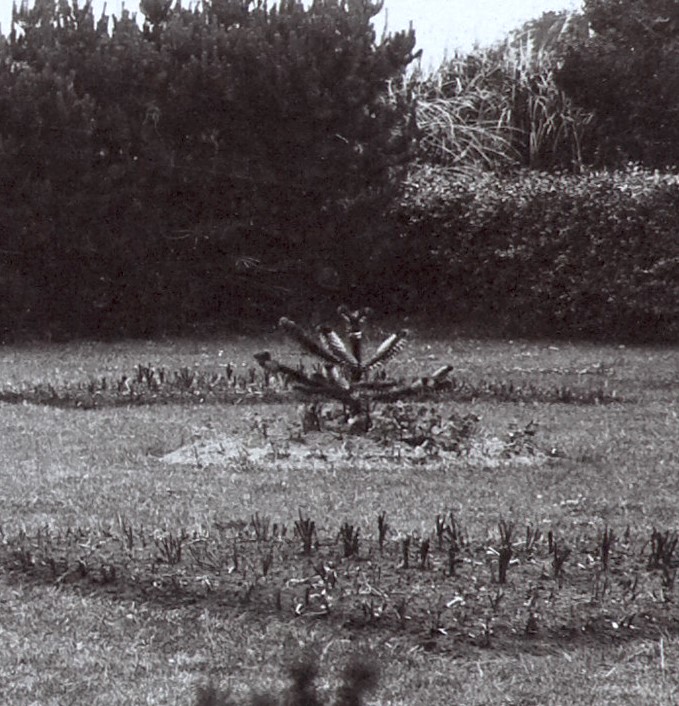
The band rotunda is some distance away from the area seen in the first photo, so it does very much look like there were three monkey puzzles planted in King Edward Park. Given the size of the two seen in the 1920 photo, it seems likely that 1913-14 was the planting date for all three.
The point of going into so much detail here is to emphasise how little of this historic planting has been remembered, despite three being a significant number of monkey puzzle trees to plant. David Bruce’s history of the park does feature a 1958 Whites aerial12 photo of King Edward Park, which does show the specimen to the right of the three children, at 44 years old. But there is no mention of the fate of the other two trees, and no mention of the trees is found In Papers Past searches. What we are left with is this:
Some specimens have also succumbed to natural causes. Planted in that long ago Arbor Day in 1907, the Chilean “monkey puzzle” pine, which for more than a century stood alongside the Fantham statue, succumbed to the fungal disease armillaria blight in early 2011. (Bruce, p. 46)
Whether it was 104 years old from a 1907 planting, or 98 years old from a 1913 planting, the tree would have had a massive presence. The site did not have the constant public traffic that the Lincoln College tree did, nonetheless, it grew in the premier park in Hawera. Four years after Charles Goodson’s death, in recognition of his contribution to horticulture in Hawera, a Charles Goodson Memorial Garden was established in King Edward Park (see Bruce, p.30). There are no monkey puzzle trees in the Memorial Garden.
The same goes for Ti-maru, the garden that Goodson stood proudly surveying in the 1920 photo above. In 1933, at the age of 67, Charles put his large property up for sale13, moving to a smaller section within it. Searches of aerial photos of the site show no sign of a very large monkey puzzle tree, just a lot more houses added. There is a little good news however: the area around the pond, which had fallen into ‘wrack and ruin’, has been restored and preserved as a small public garden called the ‘Goodson Dell‘.
Coda
There is no doubt that the monkey puzzle tree was very popular in New Zealand at least into the 1930s. But owing to factors like root canker, ill winds, fungal blight, and property development, the trees are now hard to find. There is a more recent part of the story of the monkey puzzle tree in New Zealand to be told. Likewise, it is not good news, but here rather than burden the reader with yet more talk of demise, interested readers can check The Local Arboretum blogposts where this extra information will be included along with a gallery of images of monkey puzzle trees. The latter will provide further evidence of how striking they appeared in New Zealand gardens, an effect that as we have seen brings no guarantee of a long-life.
- On page 3, titled ‘The flower garden . Advice on designing’ ↩︎
- ‘The Garden’, Southland Times, 31 July 1935, p. 16. ↩︎
- Otepuni Gardens, Invercargill City Council webpage. ↩︎
- A 1892 article ‘By the Corporation Gardener’ (ie.Thomas Waugh) on ‘Trees in the Invercargill Reserves’ includes ‘Arancaria imbricata’ (sic) in the list, and notes that ‘most of the plants in Invercargill have been brought from London in Wardian cases’. Thus, 1890 looks to be a good estimate for planting date. Southland Times, 9 July 1892, p 1 (supplement). ↩︎
- The Garden Club, Southland Times, 9 November 1921, p. 2; note that impricata, actually imbricata, was the first (now replaced) botanical species name for the monkey puzzle tree. ↩︎
- Note too that whereas there is no mention in the Southland Times newspaper, photographic evidence shows that by the mid-1920s the two monkey puzzles in Otepuni Gardens were no longer there. Roger Percy Moore has a good photo of the formal garden area, sans monkey puzzles: ‘Invercargill Gardens, New Zealand’, 1923-28, Pan-1234-F. ↩︎
- See Biography: Burns, Malcolm McRae in Te Ara, ↩︎
- Just how long the two seedling trees planted in front of the Lodge had been in the ground in 1975 is unknown. They may have still been relatively young, thus Ruth’s ‘replacement’ suggestion may have assumed that the tree can be easily transplanted, which may not be the case. ↩︎
- Details from ‘Life-long service to horticulture record of late Mr C. Goodson’, Hawera Star, 7 December 1949, p. 4. ↩︎
- A 56 page report available from the South Taranaki District Council ↩︎
- ‘Arbor Day 1907’, Hawera & Normanby Star, 11 July 1907, p.5. ↩︎
- Go to Hawera and magnify the photo to see the size of the only viewable monkey puzzle in 1958. ↩︎
- ‘Advertisement – land for sale’, Hawera Star, 7 October 1933, p. 10. ↩︎


