While searching Papers Past for information on monkey puzzle trees in Hawera (see last blogpost), I came across two results to do with the Manaia golf course (Manaia is about 12 kilometres north-east of Hawera). A report on the 1937 final of the Manaia Golf Club’s women’s championship includes the following:
At the seventh played bad seconds, Miss Lloyd to be stymied by the Monkey Puzzle tree, Mrs Instone winning the hole in six.1
For Miss Lloyd (no relation) to be stymied by the monkey puzzle, the tree must have been reasonably big. Confirming this was another article from 1925 about the building of a new clubhouse ‘alongside the monkey puzzle’,2 suggesting it may have been planted about or just before 1920. After a little searching I discovered that the tree was still there, and the president of the golf club was kind enough to send me a photo of what it currently looked like:
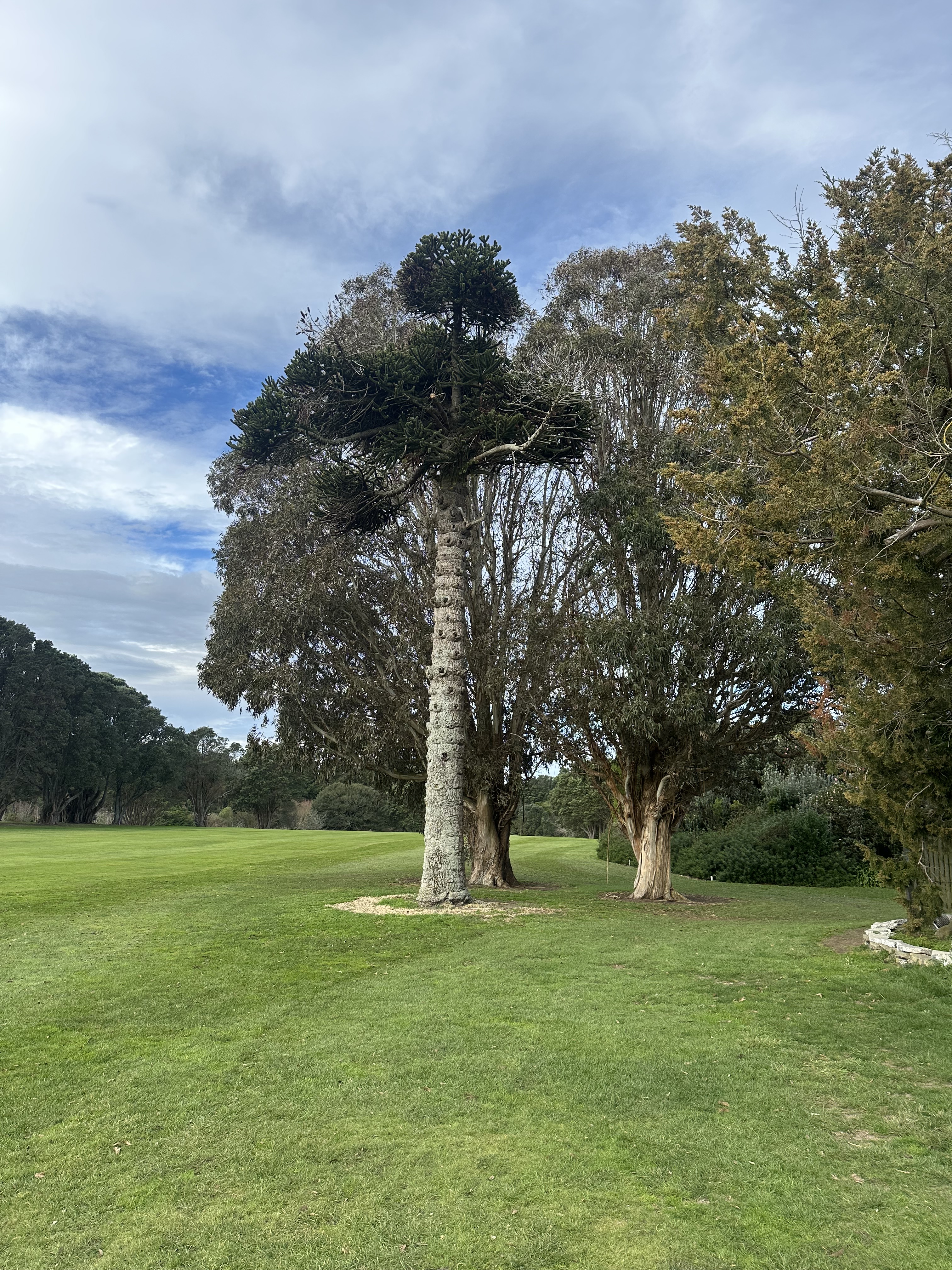
Additionally, he mentioned that there was another tree at the Manaia Golf Club, at the 9th hole, also providing a photo:
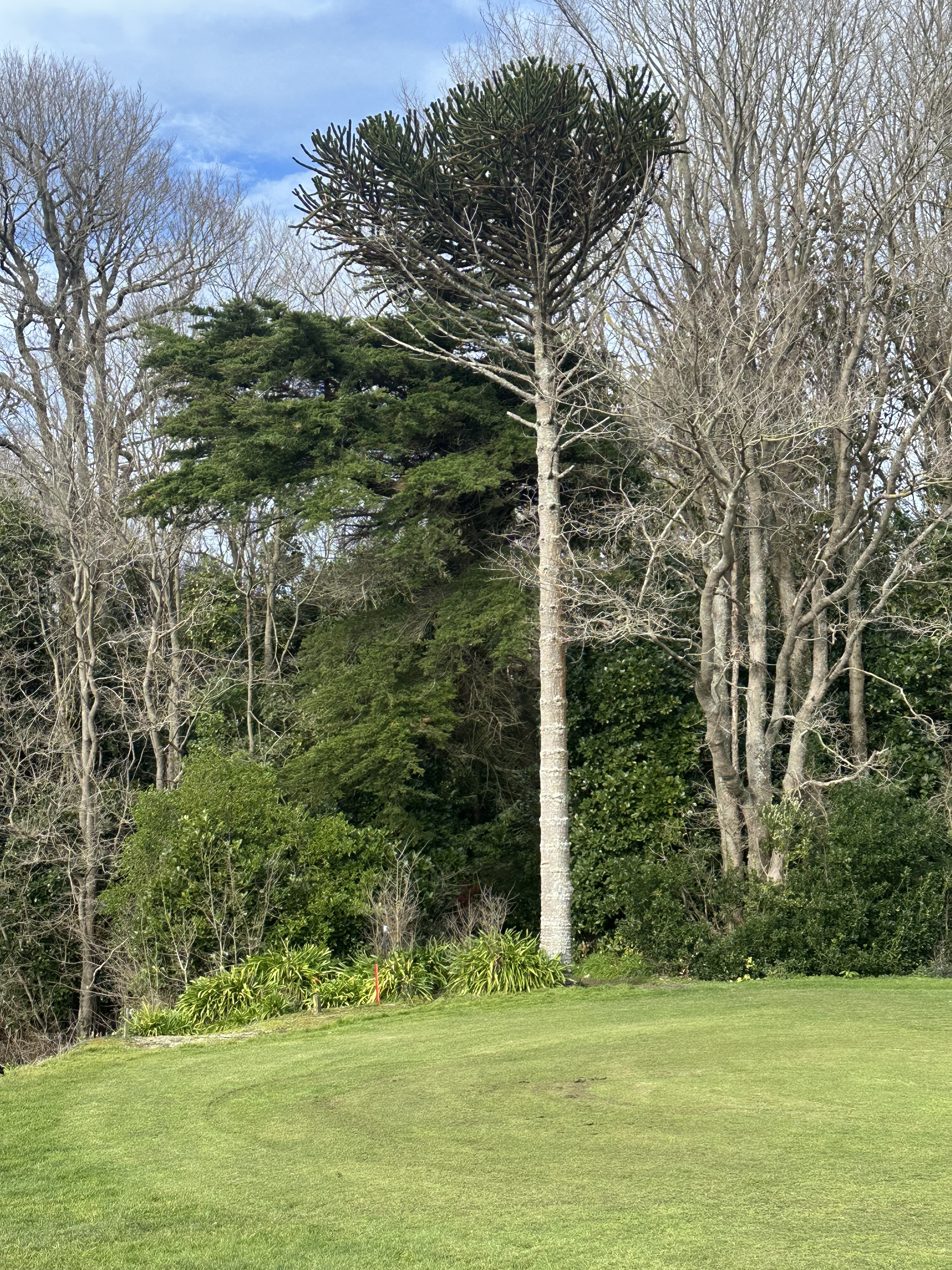
It was pleasing to learn that the two trees still grew, but I was surprised by what I saw in the photos: I’d never seen monkey puzzles looking so sparse. It was easy to presume the trees had simply had their lower branches pruned off, but in order to find out more I contacted Brad Cadwallader, a Nelson-based tree consultant. His opinion was unequivocal:
[the] two trees have been hammered over the years by repeated use of broadleaf herbicides (use of these at Golf clubs is very high). All Araucaria species are extremely sensitive to broadleaf herbicides. Most instances I’ve investigated where Monkey Puzzles have suddenly died or are very sick have involved the use of broadleaf herbicides.
Brad referred me to several cases where Google Maps could be used to track the decline of a tree, including this sorry sight in Derwent St. Naseby:
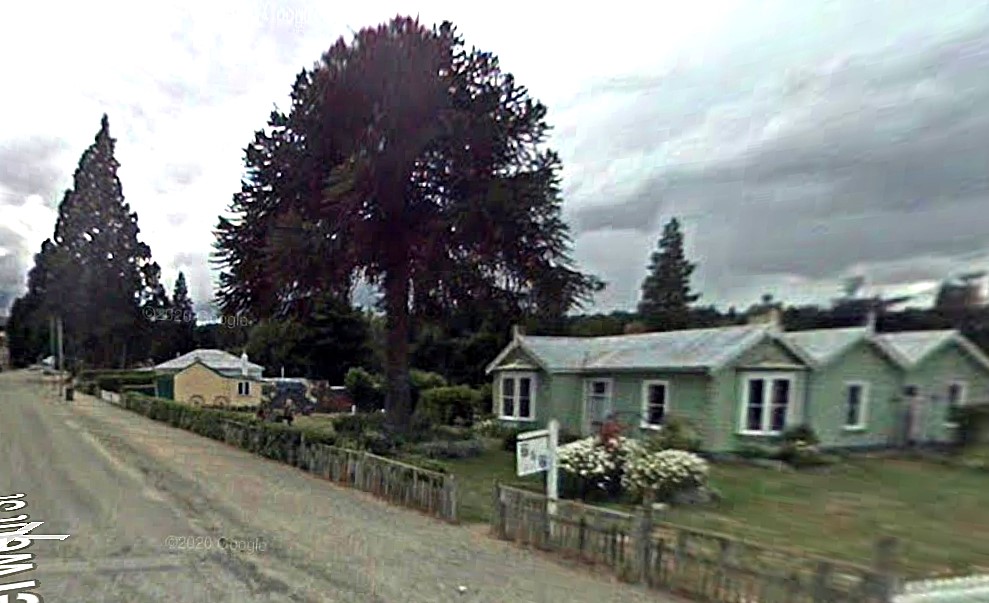
Google Maps, Street View, Feb 2008
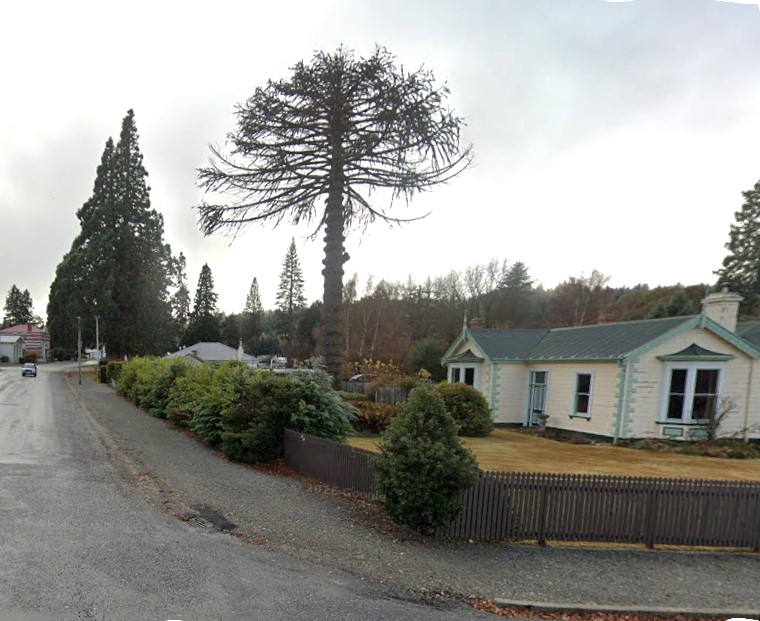
Google Maps, Street View, Jun 2026
In his 2013 New Zealand Tree Register entry for this tree, Brad noted, ‘In very poor condition. Suspected to have been affected by herbicide used to control flat weeds in turf.’ Thirteen years later the tree is obviously dead. As Brad also communicated to me, it may be the ill-effects of such exposure should be more closely investigated rather than invoking ‘mystery diseases’, as has been claimed about trees in Otago.3
This extra point in my series of blogposts is obviously not good news for those, like me, who have become fond of monkey puzzle trees. But rather than dwell on the ill-fortune that has befallen the tree in New Zealand, let’s move on to an image gallery. With minimal comment, this is designed simply to celebrate the tree; to use Alfred Buxton’s apt phrase (see part 1 of the Monkey Puzzle posts), to show the tree’s ‘uninjured form clear against the sky’. All of the images below, except for the first, are magnifications from Robert Percy Moore panoramic photographs – readers can follow the provided link for each photo to see the full panorama.
A Most Recognisable Tree
Ruth A. Burns, The Monkey Puzzle, 1972
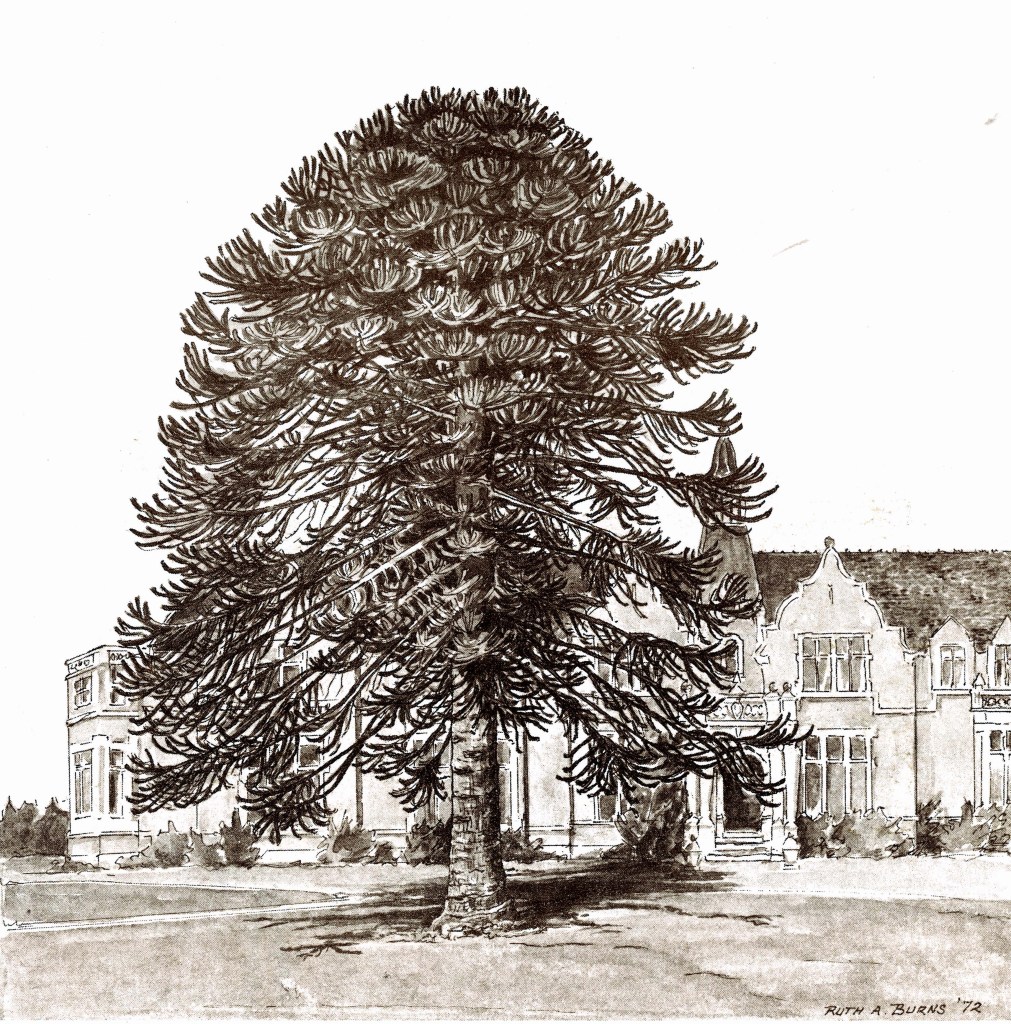
Drawn just 3 years before it was blown over in a massive storm, Ruth Burns’ artwork shows Lincoln College’s well-known tree in front of the iconic Ivey Hall.
House of A C McGeorge, Rosyln, Dunedin, 1923-28 Pan-1345-F
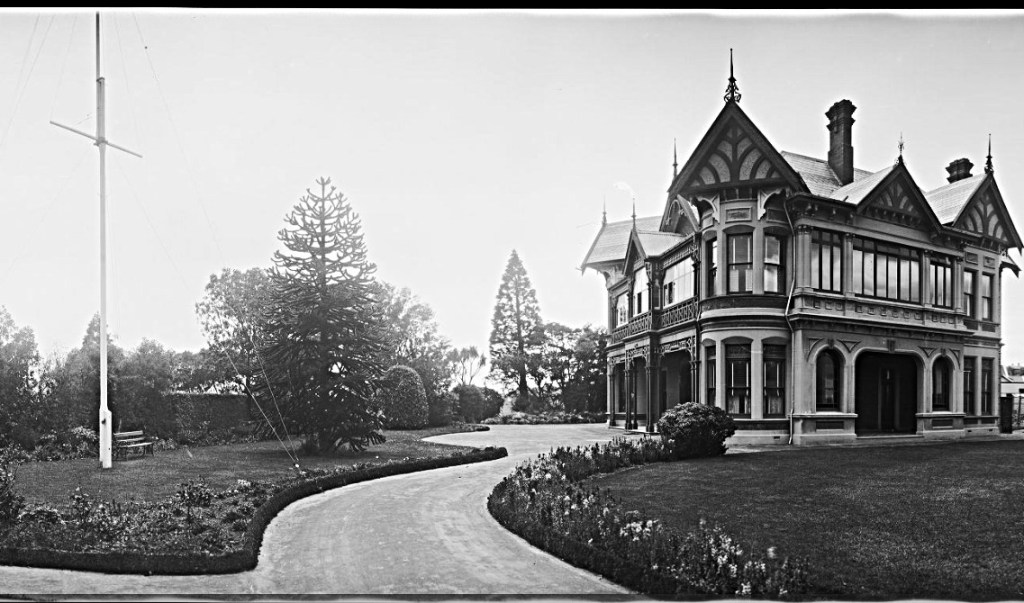
Monkey puzzles were commonly planted in the gardens of the upper classes, exemplified here. There is a very healthy and symmetrical specimen beside the flagpole, with a giant redwood in the background behind the impressive house.
House and grounds, including tennis court, Christchurch, 1923-28 Pan-0045-F
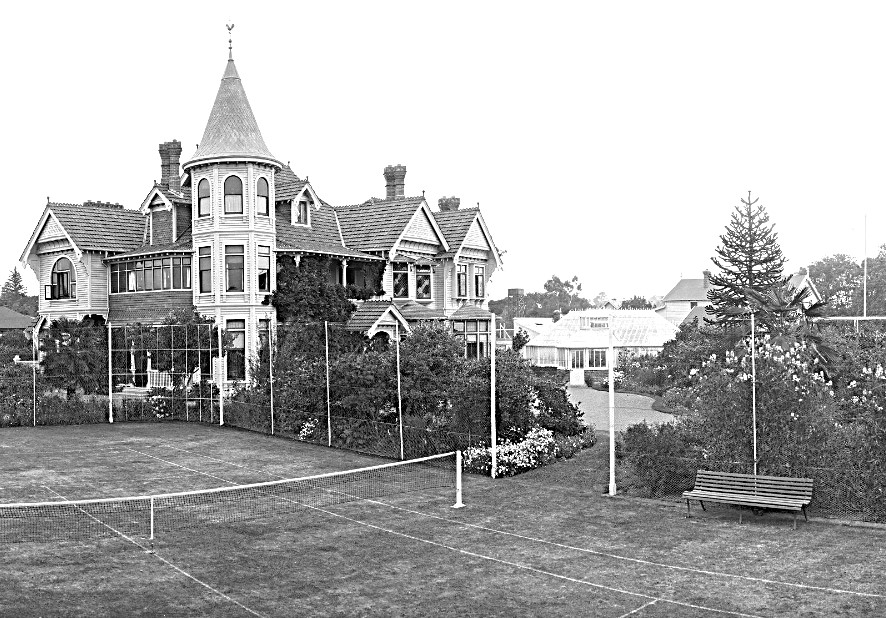
This is an even larger house, with tennis court and self-contained conservatory, with another very healthy monkey puzzle tree.
House and grounds of R H Edie, Edievale, Otago, 1923-28 Pan-1899-F
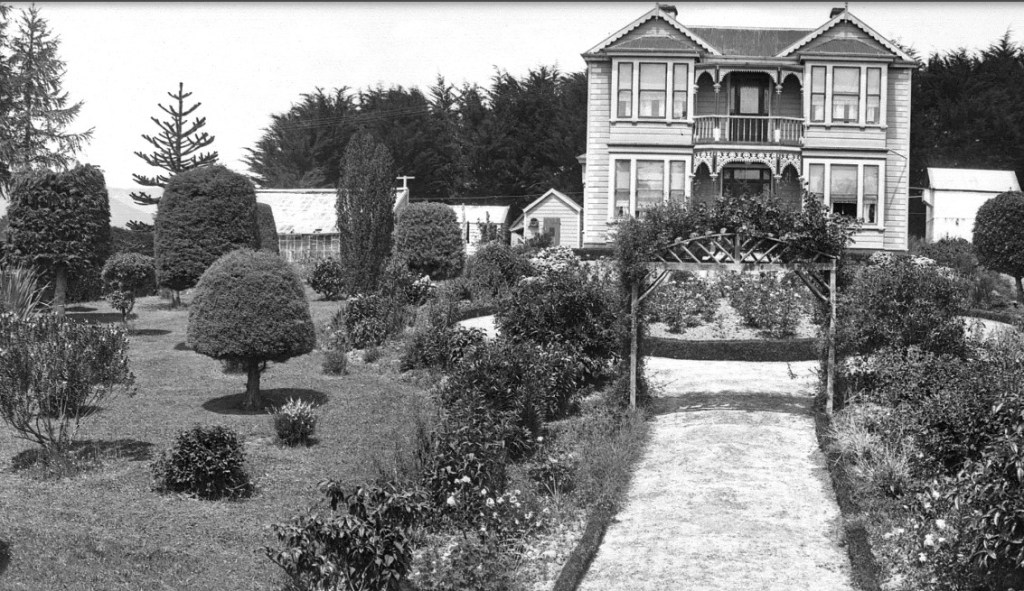
The macrocarpa hedge at the back of the house shows a typical feature of rural farmhouses, this time also affording shelter to the large topiary garden in front of the house. This includes a monkey puzzle that needs no pruning to fit with R H Edie’s obvious liking of topiary.
Residence of Mr J McKelvie, front panoramic view, Pukemarama, 1923-28 Pan-0532-F
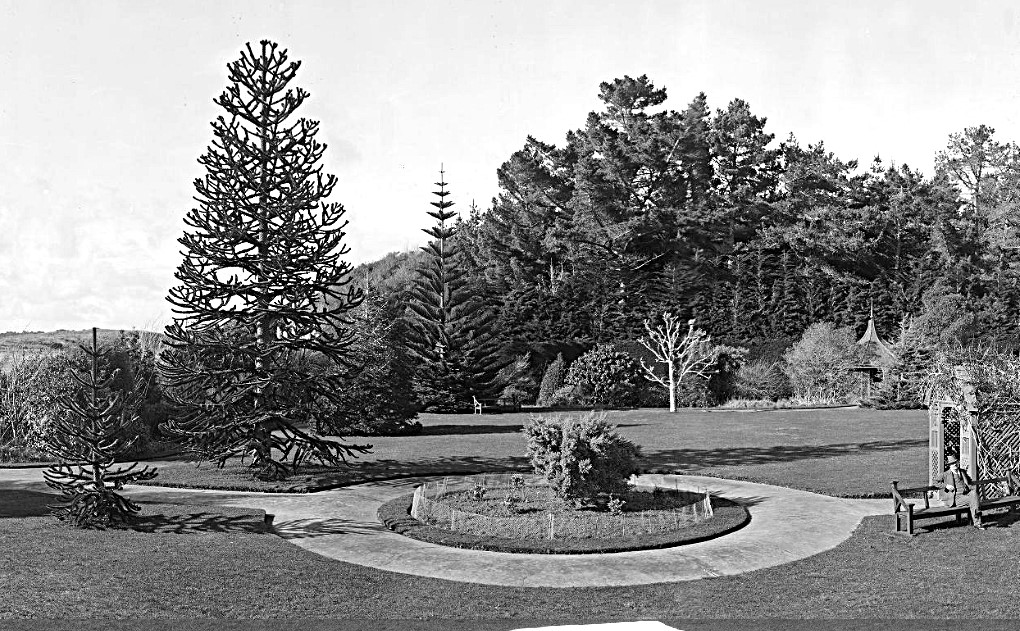
This example shows a rural farmhouse garden in the North Island, near Bulls, where instead of topiary Mr McKelvie (seated) formed a liking for pairs of trees,4 though one of the two monkey puzzles is obviously younger than the other.
“Taunui – 1924”, Pan-0478-F
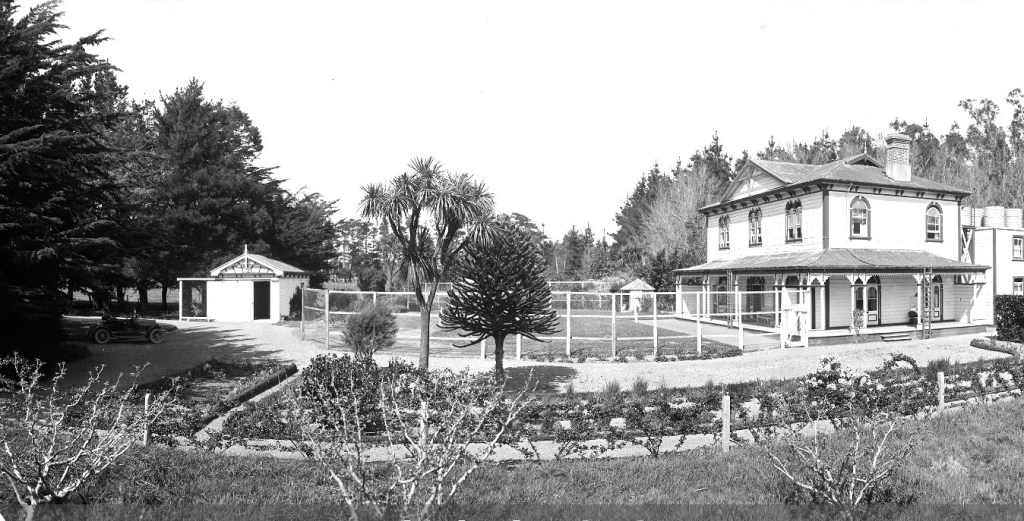
This time a farmhouse, again with typical shelter-belt trees, has a much younger monkey puzzle in a central place. But this garden in Pirinoa, Wairarapa, has fewer clearly designed elements than the Pukemarama garden.
“Mahoe”, Fielding, N.Z. 1923-28, Pan-0530-F
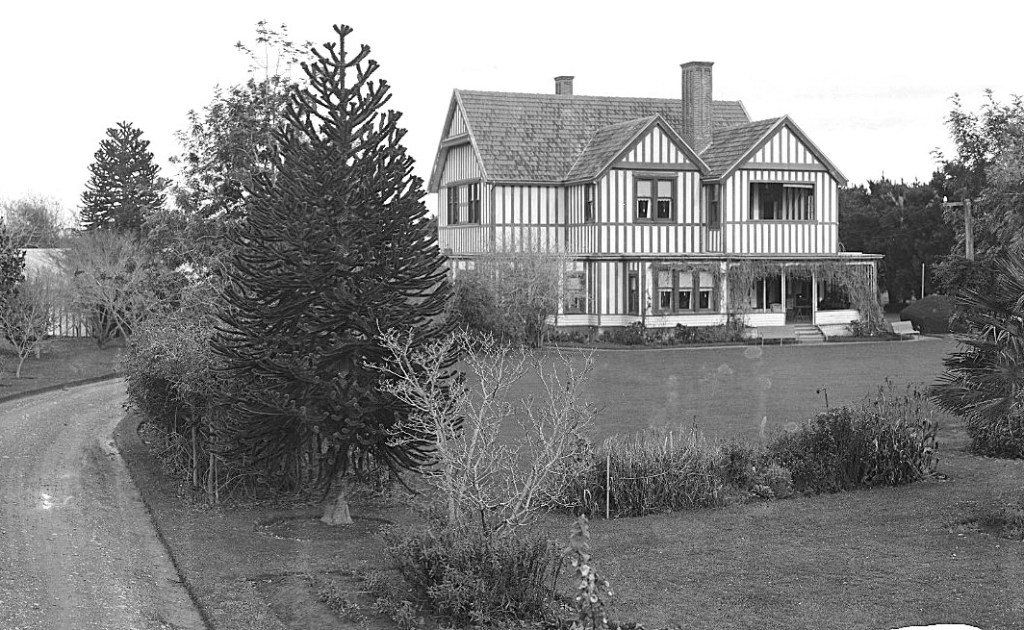
This house designed by the well-known architect Charles Natusch, is on the outskirts of Fielding. It was built in 1904, suggesting that the two monkey puzzles on display are approximately 15 years old.
Large colonial style villa in wooded grounds, Amberley, Canterbury, 1923-28, Pan-0217-F
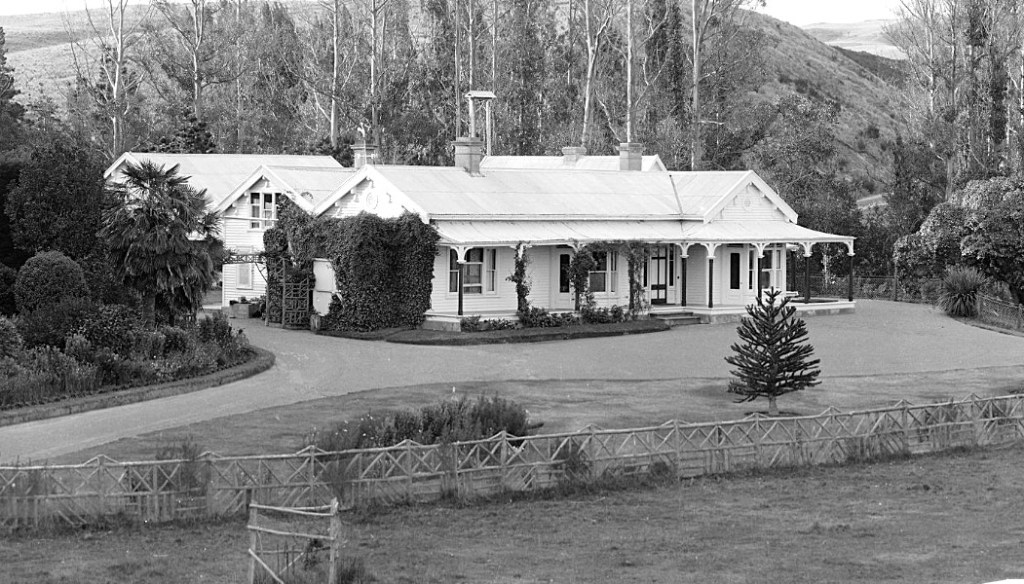
Looking more functional, this farmhouse villa nonetheless has space preserved for a feature monkey puzzle tree.
Wooden farm cottage, South Canterbury, 1923-28, Pan-0287-F
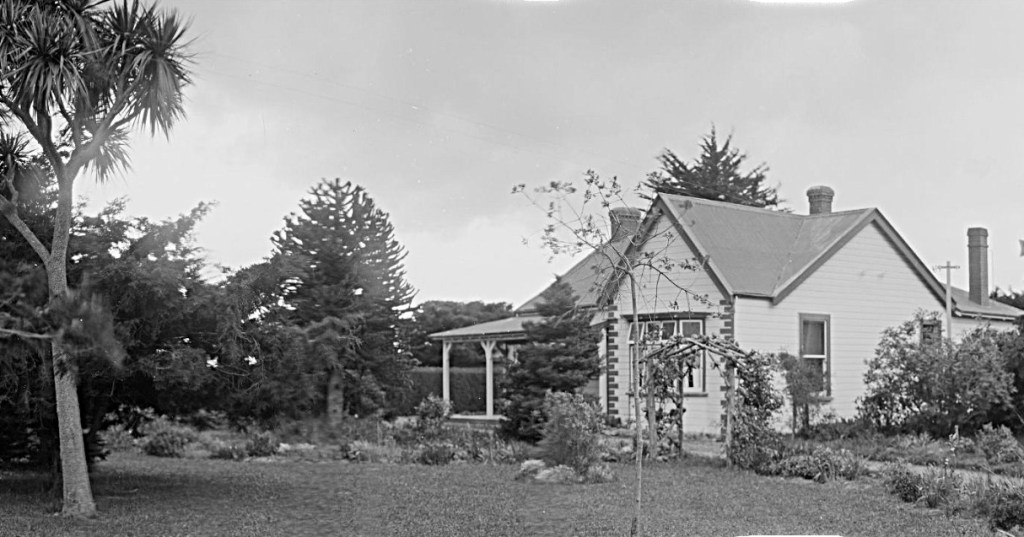
In Seadown, this farm cottage is far less fancy than many of the farmhouses above, nonetheless there again is the monkey puzzle tree planted close to the cottage.
‘Coronation Square’ Wairoa H B 1928, Pan-0640-F
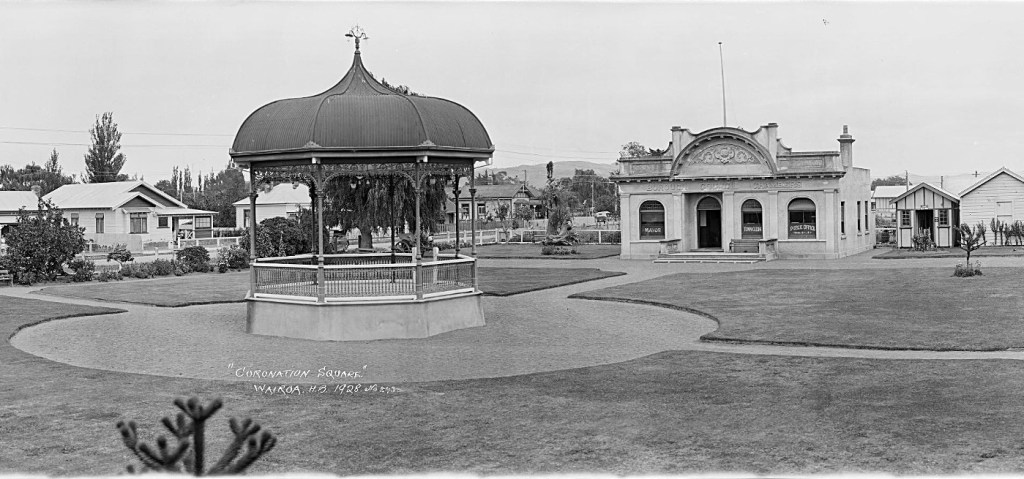
A nice example of a monkey puzzle sneaking its way into a photo, but if you look carefully there is a second tree in the upper-right of the frame. Also a good example of a well-designed band rotunda.
House of H M Field in Nelson, ca. 1924, R P Moore Pan-0487-F
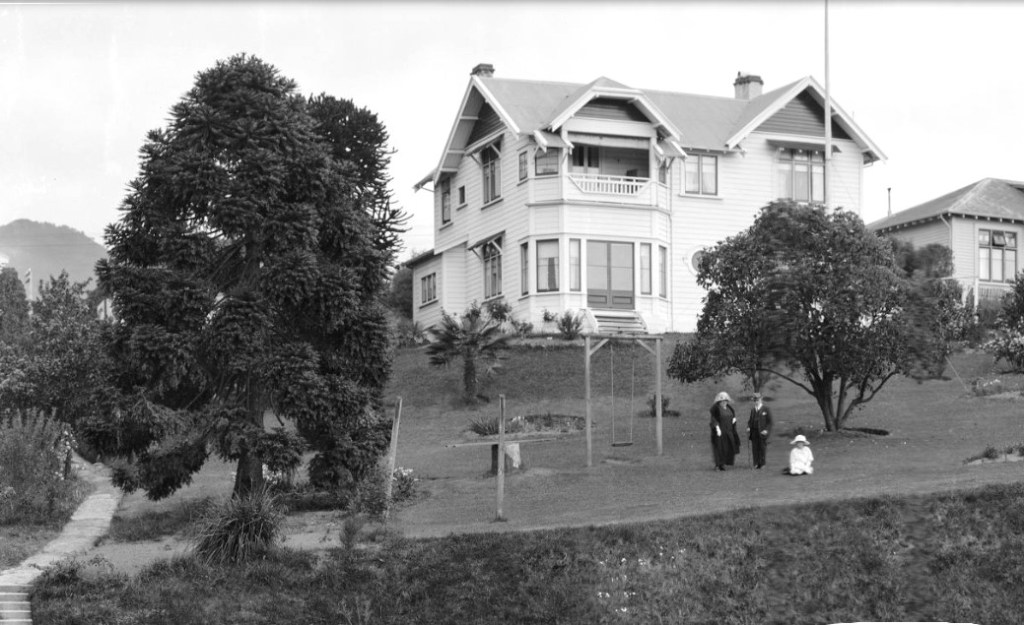
Many more images could be shown, but the house (and garden) of H. M. Field is a good place to stop. It also provides a stepping off point for further blogposts. Careful inspection of the photo shows two araucarias: to the right of the family is an Araucaria bidwillii, and behind it can be seen a glimpse of an equally tall monkey puzzle. While the more visible tree is usually known by the common name bunya bunya, it is sometimes known as the ‘false monkey puzzle tree’5. As both mature they develop a rounded head and do indeed look similar, but in this photo where they look to be about 30-years-old they are easily distinguishable.
Further information can be found on H M Field and his family, which unfortunately leads to the conclusion that both trees disappeared, perhaps as early as 1940. Being in central Nelson the Field house was prime real estate, and as time went by the large property seen here was subdivided and built on. Removal of trees due to development has been a common discovery across all three of the blogposts on monkey puzzle trees, however, given how many were planted from the late 1800s to the mid-1930s some old and tall trees will still be growing. More positively, it could be that bunya bunya have fared better. There are a good number on the New Zealand Tree Register, including a naturalised grove in the Auckland Domain.6 That positive note invites further inquiry.
Acknowledgements:
Thanks to Rod le Fleming, president of the Manaia Golf Club, for sending me two photographs, and to Brad Cadwallader for sharing his professional opinion about susceptibility of araucarias to herbicides.
- ‘Miss Lloyd beats Mrs Instone’, Hawera Star, 4 November, 1937, p. 6. ↩︎
- ‘Golf’, Hawera Star, 30 May, 1925, p. 11. ↩︎
- See Gillian Vine’s article in the Otago Daily Times for a discussion of the ‘mysterious’ decline from 2012 in some Dunedin monkey puzzle trees. ↩︎
- Pukemarama has become an historic New Zealand garden. See Jill Friar’s article in the New Zealand Gardener, Feb. 1993, 49(2): 30-32. Sadly, Google Maps street view shows the monkey puzzle trees have gone from the garden. ↩︎
- See wikipedia entry on Araucaria bidwillii. ↩︎
- M. Wilcox, C. Bradshaw, & E. Cameron, 2004, ‘Woody plants of the Auckland Domain’, Auckland Botanical Society Journal, 59(1): 44-56. ↩︎


